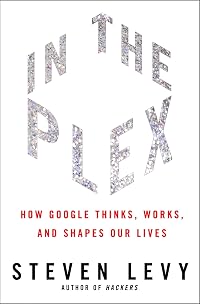
In The Plex: How Google Thinks, Works, and Shapes Our Lives
by Steven Levy
On This Page
Description
Written with full cooperation from top management at Google, this is the story behind the most successful and admired technology company of our time. Few companies in history have ever been as successful and as admired as Google, the company that has transformed the Internet and become an indispensable part of our lives. How has Google done it? The author, a technology reporter was granted access to the company, and in this book he takes readers inside Google headquarters, the Googleplex show more to show how Google works. While they were still students at Stanford, Google cofounders Larry Page and Sergey Brin revolutionized Internet search. They followed this brilliant innovation with another, as two of Google's earliest employees found a way to do what no one else had: make billions of dollars from Internet advertising. With this cash cow (until Google's IPO nobody other than Google management had any idea how lucrative the company's ad business was), Google was able to expand dramatically and take on other transformative projects: more efficient data centers, open source cell phones, free Internet video (YouTube), cloud computing, digitizing books, and much more. The key to Google's success in all these businesses, the author reveals, is its engineering mind set and adoption of such Internet values as speed, openness, experimentation, and risk taking. After its unapologetically elitist approach to hiring, Google pampers its engineers, free food and dry cleaning, on site doctors and masseuses, and gives them all the resources they need to succeed. Even today, with a workforce of more than 23,000, Larry Page signs off on every hire. But has Google lost its innovative edge? It stumbled badly in China, and the author discloses what went wrong and how Brin disagreed with his peers on the China strategy. And now with its newest initiative, social networking, Google is chasing a successful competitor for the first time. Some employees are leaving the company for smaller, nimbler start ups. Can the company that famously decided not to be evil still compete? show lessTags
Recommendations



















Member Recommendations
Member Reviews
I've read several books on Google, so I was reluctant at first to read another one, and one a decade old. I am glad I did. Based on many interviews and covering a wide swatch of history and line of business, this is an engaging and perceptive bit of journalism. It covers from earliest days when as students at Stanford, Google co-founders Larry Page and Sergey Brin revolutionized Internet search proving out their ideas taxing university computing resources. Fascinating to me was how Google bought up fiber optic infrastructure left over from telco fever dreams and this was key to their success and managing costs so that until Google's IPO, nobody other than Google management had any idea how lucrative the company's ad business show more was.
Generally boldly gambling and challenging conventions, Google has failed from time to time in areas explored here in detail. It stumbled badly in China, social networking, and crowd-sourced video.
This audiobook edition concludes with a candid interview by the author with Marissa Mayer, a long-time executive, usability leader, and key spokeswoman for Google (employee #20). show less
Generally boldly gambling and challenging conventions, Google has failed from time to time in areas explored here in detail. It stumbled badly in China, social networking, and crowd-sourced video.
This audiobook edition concludes with a candid interview by the author with Marissa Mayer, a long-time executive, usability leader, and key spokeswoman for Google (employee #20). show less
Levy's inside look at Google is clear, insightful, pointed at the right things, but ultimately reads a bit like a hagiography. I should correct this, Google's founders may well DESERVE a hagiography, but I was left with the feeling that this is Google's approved biography with conflicts and ethical dilemmas framed from Google's point of view. Again, this may not be a bad thing, as Levy is perfectly correct in noting that many of Google's critics simply don't understand the thing that they are criticizing, but readers should be aware that this is a mash note to Google.
The great strength of this look at the amazing company is how it solidly identifies the engineering breakthroughs that make Google great and focuses on them, rather than on show more Google's social impact. Google's search algorithm, their adwords and adsense businesses, and their server cluster architecture are three feats of engineering that are Google's steam engine, Tennessee Valley Authority, and transcontinental railroad. It makes sense to write about the company pointing out these features, even if most general users won't really notice the advertising (a great coup in itself) and certainly no one who isn't a geek will notice their server clusters.
Anyway, Levy establishes his credibility when he describes Google as a machine learning company. This is the important and often over-looked detail that is often lost when authors try to capture Google's impact on society. Levy focuses on the real innovations that make Google different.
Where Levy and Google get criticism is in their handling of Google's ethical (privacy and China) problems. Here, I think Levy does a great job of explaining the crisises from Goog's point of view. Readers may want to also read E. Morozov's Internet Delusion and Siva V.'s The Googlization of Everything to put these into a fuller perspective.
This book is worth five stars, but I subtracted one for drinking the Mt. View Kool-aide. show less
The great strength of this look at the amazing company is how it solidly identifies the engineering breakthroughs that make Google great and focuses on them, rather than on show more Google's social impact. Google's search algorithm, their adwords and adsense businesses, and their server cluster architecture are three feats of engineering that are Google's steam engine, Tennessee Valley Authority, and transcontinental railroad. It makes sense to write about the company pointing out these features, even if most general users won't really notice the advertising (a great coup in itself) and certainly no one who isn't a geek will notice their server clusters.
Anyway, Levy establishes his credibility when he describes Google as a machine learning company. This is the important and often over-looked detail that is often lost when authors try to capture Google's impact on society. Levy focuses on the real innovations that make Google different.
Where Levy and Google get criticism is in their handling of Google's ethical (privacy and China) problems. Here, I think Levy does a great job of explaining the crisises from Goog's point of view. Readers may want to also read E. Morozov's Internet Delusion and Siva V.'s The Googlization of Everything to put these into a fuller perspective.
This book is worth five stars, but I subtracted one for drinking the Mt. View Kool-aide. show less
An expansive and well written book but I cannot get over how sycophantic it is. Made me cringe and sick in my stomach from all the obsequious reverence. On every issue it follows the Google narrative to the letter. Absolutely zero attempt is taken to show any dissenting opinion or even a pretence of objectivity.
Fascinating read about Google's history: from a project by two doctoral students to the global behemoth that knows everything about us - often more than we know ourselves or would like to reveal. As the author follows Google's rise and rise, an ethical story develops alongside it: can one truly not be evil when one is omniscient? How to stay true to lofty ethical principles that were formulated in adolescence? The author does not spell it out, but I came away from this book with a pessimistic view on Google's future - or rather: the future of my own privacy in a Google-dominated world.
I like Google because of their un-corporate approach. I love how the founders' iconoclastic urges led them to give the finger to Wall St during the IPO and to most things labelled “establishment”. But there's a paradox: the founders want to do good for society; yet it is also a corporation that has become the 'Net’s dominant behemoth, with investors and shareholders who demand returns. Page and Brin are brilliant engineers and visionaries. They never knew a world of work outside school and university before Google. So they created their own vision of what work and a corporation should be like: something that resembles a grad school. But do they have a rounded worldview that we can trust with that power? We are at the mercy of show more their sense of morality. (Then again, does any CEO who has only known corporate life and a business school education hold a worldview that is worth a damn, not pathological, or any better? Hell I prefer them to the Steves: Jobs and Ballmer)
"That power" lies in the fact that they have created a gargantuan, data-driven learning machine with the computing power that dwarfs that of any other entity, masses of data and the talent and capability to crunch and mine it. Google has transformed the way that we consume and find information, yet it is simultaneously a money machine that would profit from knowing our behaviour, understanding our wants and anticipating them.
This book - the best about Google that I have read - gives an unparallelled insight into the culture and the minds of the Googlers - and raises more questions about a corporation that has become a phenomenon. show less
"That power" lies in the fact that they have created a gargantuan, data-driven learning machine with the computing power that dwarfs that of any other entity, masses of data and the talent and capability to crunch and mine it. Google has transformed the way that we consume and find information, yet it is simultaneously a money machine that would profit from knowing our behaviour, understanding our wants and anticipating them.
This book - the best about Google that I have read - gives an unparallelled insight into the culture and the minds of the Googlers - and raises more questions about a corporation that has become a phenomenon. show less
Google is everywhere! Steven Levy has provided us with a fascinating look inside Google, from its early days to the present. He maintains a balanced perspective, which I appreciated, telling us what Google has done, provided some insight into their thought process, but has let the reader decide. For example, was Google right to comply with censorship in China? To use algorithms to analyse our e-mail and target ads?
I liked Google unconventional approaches to things like office design, hierarchy, et al. But, there is a darker side. Google has so much information and an almost unbelievable capacity to use it that it's downright scary.
The book made me contemplate: privacy issues, whether a large corporation can hold on to its ideals show more ("don't be evil") or whether idealism is the purview of the young and small; as we turn to Google ever more often for quick answers, will we lose our ability to problem solve.
I think of Cyberspace as a frontier. Just like Pioneers opening up the old West, or prospectors flocking North for gold, society's laws and norms follow behind the path breakers. We have yet to see where Google, and technology, will take us. show less
I liked Google unconventional approaches to things like office design, hierarchy, et al. But, there is a darker side. Google has so much information and an almost unbelievable capacity to use it that it's downright scary.
The book made me contemplate: privacy issues, whether a large corporation can hold on to its ideals show more ("don't be evil") or whether idealism is the purview of the young and small; as we turn to Google ever more often for quick answers, will we lose our ability to problem solve.
I think of Cyberspace as a frontier. Just like Pioneers opening up the old West, or prospectors flocking North for gold, society's laws and norms follow behind the path breakers. We have yet to see where Google, and technology, will take us. show less
This was a fascinating read on the history and culture of the now giant Google. It's beginning as just another Internet start up to its now nearly global domination of search ..and a few other things too!
The most revealing chapter to me was the explanation of its ad business..or how it solved the problem of making money on the Internet.
Levy is relatively uncritical but he does bring out the inherent tensions between the founders original idealism and the politics and problems of being a giant global company.
Page and Brin wanted to disrupt the world and they've certainly done that. Whether they can continue to do so remains to be seen but I wouldn't bet against them.
I'll certainly be clearing my cookies more regularly though!
The most revealing chapter to me was the explanation of its ad business..or how it solved the problem of making money on the Internet.
Levy is relatively uncritical but he does bring out the inherent tensions between the founders original idealism and the politics and problems of being a giant global company.
Page and Brin wanted to disrupt the world and they've certainly done that. Whether they can continue to do so remains to be seen but I wouldn't bet against them.
I'll certainly be clearing my cookies more regularly though!
Members
- Recently Added By
Author Information

13 Works 5,480 Members
Steven Levy is a senior editor for "Newsweek." For ten years he wrote the "Iconoclast" column for "MacWorld" magazine. His previous books include "Hackers" & "Artificial Life." (Bowker Author Biography)
Some Editions
Awards and Honors
Distinctions
Notable Lists
Common Knowledge
- Canonical title*
- Rivoluzione Google: i segreti dell'azienda che ha cambiato il mondo
- Original title
- In The Plex: How Google Thinks, Works, and Shapes Our Lives
- People/Characters
- Sergey Brin; Larry Page; Eric Schmidt; Al Gore
- Important places
- Mountain View, California, USA
- Dedication
- In memory of Philip Klass (1920-2010)
- First words
- "Have you heard of Google?"
- Last words
- (Click to show. Warning: May contain spoilers.)And maybe the impossible.
*Some information comes from Common Knowledge in other languages. Click "Edit" for more information.
Classifications
Statistics
- Members
- 1,062
- Popularity
- 24,304
- Reviews
- 46
- Rating
- (3.94)
- Languages
- English, German, Italian, Portuguese
- Media
- Paper, Audiobook, Ebook
- ISBNs
- 12
- ASINs
- 12