
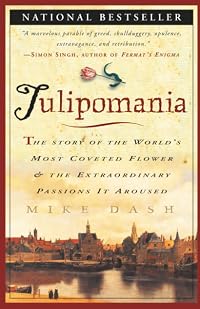
Tulipomania : The Story of the World's Most Coveted Flower & the Extraordinary Passions It Aroused
by Mike Dash
On This Page
Description
A vivid narration of the history of the tulip, from its origins on the barren, windswept steppes of central Asia to its place of honor in the lush imperial gardens of Constantinople, to its starring moment as the most coveted-and beautiful-commodity in Europe. In the 1630s, visitors to the prosperous trading cities of the Netherlands couldn't help but notice that thousands of normally sober, hardworking Dutch citizens were caught up in an extraordinary frenzy of buying and selling. The show more object of this unprecedented speculation was the tulip, a delicate and exotic Eastern import that had bewitched horticulturists, noblemen, and tavern owners alike. For almost a year rare bulbs changed hands for incredible and ever-increasing sums, until single flowers were being sold for more than the cost of a house. Historians would come to call it tulipomania. It was the first futures market in history, and like so many of the ones that would follow, it crashed spectacularly, plunging speculators and investors into economic ruin and despair. This colorful cast of characters includes Turkish sultans, Yugoslav soldiers, French botanists, and Dutch tavern keepers-all centuries apart historically and worlds apart culturally, but with one thing in common: tulipomania. show lessTags
Recommendations















































Member Reviews
An excellent read... better than I was expecting. While the book is focused on the tulip mania that overtook the United Provinces - which now comprise modern day Netherlands - from 1635 to the first half of 1636, it is the amazing similarities of that mania to other more recent sharp boom/bust market scenarios, like the amazing climb and spectacular crash of the price of bitcoins, that caught my attention. The trading of tulips was outside of the regulated stock and futures markets of the time period, and its frenzy was in part fueled by the fact that any one from the wealthy to the common artisans and workers could get involved, even in a small way, in the hopes of cashing in a profit. The lure of making cash in such a simple way must show more have been too good for many to pass up. With that information in mind, I was only somewhat surprised to learn that the Dutch artist Jan van Guyen had invested, and lost almost everything but the shirt off his back, in the tulip crash. He had given up painting during the tulip mania and it was only because of the financial straights he found himself and his family in that he returned to painting, leaving behind a legacy of brilliant landscapes that, in the words of the author, "many of which would have probably never have been painted had he made his fortune in the tulip trade".
I was saddened to learn that some of the rarer tulips that helped fuel the tulip mania, are lost to us forever, except in preserved paintings, like the Semper Augusta. Interestingly, the vivid colorful markings of the highly sought after tulips like the Semper Augustus, were not a product of cultivated hybrid breeding. They were a product of a broken tulip infected with the mosaic virus. While the bulb industry has managed to wipe out the mosaic virus, as the author notes, " The infinite variety that each broken tulip could display is gone, and with it much of the flower's capacity to fascinate and astound."
Overall, a wonderful blending of "horticulture meets financial markets" kind of read. show less
I was saddened to learn that some of the rarer tulips that helped fuel the tulip mania, are lost to us forever, except in preserved paintings, like the Semper Augusta. Interestingly, the vivid colorful markings of the highly sought after tulips like the Semper Augustus, were not a product of cultivated hybrid breeding. They were a product of a broken tulip infected with the mosaic virus. While the bulb industry has managed to wipe out the mosaic virus, as the author notes, " The infinite variety that each broken tulip could display is gone, and with it much of the flower's capacity to fascinate and astound."
Overall, a wonderful blending of "horticulture meets financial markets" kind of read. show less
This book was a slow start for me, but worth the read. It's all about the tulip craze that occurred in the Netherlands in the early 1600's. The book establishes a solid groundwork by introducing the flower- where it came from, why it was so unique and sought-after, all the little particulars about the Dutch economy, customs, and the flower itself that made it possible for so many people to suddenly bid crazily on the bulbs. Staggering fortunes were spent, rapidly changing hands, all for flower bulbs that couldn't be examined because they were in the ground until a certain period of time usually months in the future! The nature of how tulips grow made them relatively scarce to begin with, the treasured vivid streaking of colors called show more "breaking" was unpredictable (actually caused by a virus), and so valued even more. Prices continued to rise steeply until they suddenly crashed, and the last few chapters cover the aftermath- how people recovered or didn't, how the tulip steadily remained a gardener's flower, even after its heightened popularity had abated. Interestingly, the author also mentions a few other tulip crazes that occurred in different countries- a hundred years later- and with other flowers as well for brief periods- hyacinths, dahlias, red spider lilies- although none of those quite as astounding as the tulip mania, they show the same phenomenon. It was a very interesting read and I learned a lot, not only about one particular flower, but also about the rudimentary workings of a stock market (that's basically how the bidding and exchanges of bulbs were carried out- as far as I understand- because they were mostly intangible objects, some people selling didn't even own any bulbs!) The only thing I wished for was a few illustrations showing the gorgeous colors and patterns that once had people trading an entire estate for a single flower.
from the Dogear Diary show less
from the Dogear Diary show less
This was an unexpectedly interesting read. Tulipomania is a well written account of what we would today call an economic bubble. It's a good primer on just how irrational people can get when greed runs amok. It should be a recommended reading in any basic economics class. Dash's writing is compelling and he packs numerous historic anecdotes and facts into a very readable narrative bringing to life 17th and 16th century Holland and Turkey consumed by unusual passion for a flower.
A thorough history of the tulip, covering its origins, history, evolution, and the various men and women who have collected them, speculated on them, loved them, and lost their fortunes (and in a few occasions, even their lives) in the process. Well researched, with good end notes for further reading for those interested. Author Dash must be complimented for the many hours he obviously spent pouring over old documents to record the names and dates of all the cases cited…some of which should have been in footnotes…but are easily skated over once you've gotten the gist of the situation. (One quirky observation: I hadn't realized that the big Dutch tulip craze was occurring exactly during those years the Pilgrims were wending their way show more overseas to settle in America--the 1630s; I find pegging the date of a historical event to a date carved in my memory from childhood is a wonderful way to build my global reference database.)
I longed for a map of the Netherlands (and adjoining territories) while reading the 'Dutch' chapters, and wish the book had included reproductions of some of the famous Dutch still life paintings that included tulips--were these examples of the rarest of the tulips that sold for thousands of guilders? Such a painting would have made a far more interesting cover than the river scene chosen (and now that the Rikjsmuseum has given free open access to its collection for any and all purposes--commercial or education, we can hope to see many more of such paintings.) Perhaps the next book I plan to read ([b:The Embarrassment of Riches: An Interpretation of Dutch Culture in the Golden Age|21073|The Embarrassment of Riches An Interpretation of Dutch Culture in the Golden Age|Simon Schama|https://d.gr-assets.com/books/1388187458s/21073.jpg|965311] will include a chapter on the portrayal of these tulips in Dutch art. show less
I longed for a map of the Netherlands (and adjoining territories) while reading the 'Dutch' chapters, and wish the book had included reproductions of some of the famous Dutch still life paintings that included tulips--were these examples of the rarest of the tulips that sold for thousands of guilders? Such a painting would have made a far more interesting cover than the river scene chosen (and now that the Rikjsmuseum has given free open access to its collection for any and all purposes--commercial or education, we can hope to see many more of such paintings.) Perhaps the next book I plan to read ([b:The Embarrassment of Riches: An Interpretation of Dutch Culture in the Golden Age|21073|The Embarrassment of Riches An Interpretation of Dutch Culture in the Golden Age|Simon Schama|https://d.gr-assets.com/books/1388187458s/21073.jpg|965311] will include a chapter on the portrayal of these tulips in Dutch art. show less
My uncle recommended this book to me and although I found myself skimming some of the highly detailed, textbook-like segments, I found this case study in speculative economic booms fascinating, especially since I really enjoyed growing flowers from bulbs when I used to live in the northeastern USA.
In many ways, this is a "Tale of Two Cities" (Countries?)...the Netherlands and Istanbul...and how Tulipomania swept through both cities at different times. Although both tales are intriguing & historically-packed, I personally found the accounts of the Turkish sultans and their obsession with the lovely tulip extremely engrossing.
Amazing how the rejuvenating powers of such a short-lived bloom can inspire & impact all levels of society, from show more tavern keepers, florists, artists & social critics to gardeners and Sultans! show less
In many ways, this is a "Tale of Two Cities" (Countries?)...the Netherlands and Istanbul...and how Tulipomania swept through both cities at different times. Although both tales are intriguing & historically-packed, I personally found the accounts of the Turkish sultans and their obsession with the lovely tulip extremely engrossing.
Amazing how the rejuvenating powers of such a short-lived bloom can inspire & impact all levels of society, from show more tavern keepers, florists, artists & social critics to gardeners and Sultans! show less
When my book club picked this as our next read, I thought ‘What a great way to kick-off spring!’ Then I started reading and it was not what I was expecting. Don’t let the title mislead you. It is not a book about Tulips per se. It is more so the history of the Tulip, the mining of the Tulip, the behind the scenes deals and extremes the wealthy would succumb to in their obsession to obtain the greatest bulb. It is also a story of extremes, those who nurture & breed the bulb vs those who buy. Our world is more advanced now than in the 1630’s due to innovation and technology. But after reading and reflecting on the main message, when it comes to behavior, our species hasn’t changed very much. The subtitle: The story of the show more world’s most coveted flower and the extraordinary passions it aroused’ is very fitting. Would I recommend this book? It would depend on the occasion. Did I learn anything about tulips? No. Was I reminded of the age old teaching that pride goes before a fall and that in any society where there is greed; destruction is right around the corner? Oh yes! and that is a very powerful message in these economic times. My favorite sections were those of the Tulip house, in het ootje, and the chapter of the orphans of Wouter Winkel. show less
When economists need to summon an age of unchecked speculation and financial fecklessness, the Dutch tulip mania is at the top of the list. If you’re not familiar with the story, it’s an early example of the vagaries of the stock market. In the mid-1630s, the Dutch fell in love with tulips. The flower became a status symbol, and the Dutch were all but tripping over each other in a race to conspicuously consume. To satisfy burgeoning demand, speculators began to trade in what were essentially tulip futures; these grew outlandishly complicated and expensive, and on the third of February, 1637, the tulip market collapsed.
The book begins with a history of the origins and cultivation of the tulip in the Ottoman Empire and how it came to show more be introduced in the Netherlands by botanist Carolus Clusius, who established an extensive garden at the University of Leiden.
The demand for tulips of a rare species increased so much in the year 1636, that regular markets for their sale were established on the Stock Exchange of Amsterdam, in Rotterdam, Harlaem, Leyden, Alkmar, Hoorn, and other towns. The tulip-jobbers speculated in the rise and fall of the tulip stocks. People of all grades converted their property into cash, and invested it in flowers. Houses and lands were offered for sale at ruinously low prices, or assigned in payment of bargains made at the tulip-mart.
This book was an interesting story of botany and greed and what can happen when the latter triumphs. show less
The book begins with a history of the origins and cultivation of the tulip in the Ottoman Empire and how it came to show more be introduced in the Netherlands by botanist Carolus Clusius, who established an extensive garden at the University of Leiden.
The demand for tulips of a rare species increased so much in the year 1636, that regular markets for their sale were established on the Stock Exchange of Amsterdam, in Rotterdam, Harlaem, Leyden, Alkmar, Hoorn, and other towns. The tulip-jobbers speculated in the rise and fall of the tulip stocks. People of all grades converted their property into cash, and invested it in flowers. Houses and lands were offered for sale at ruinously low prices, or assigned in payment of bargains made at the tulip-mart.
This book was an interesting story of botany and greed and what can happen when the latter triumphs. show less
Members
- Recently Added By
Author Information

9+ Works 2,839 Members
He is the author of the critically acclaimed TULIPOMANIA and two other books. He is the former editorial director of the Fortean Times. A Cambridge educated historian before he became a writer, his articles have been published in the Guardian and the Observer, and he appears frequently on television in the UK. (Bowker Author Biography)
Some Editions
Common Knowledge
- Canonical title*
- La febbre dei tulipani: storia di un fiore e degli uomini a cui fece perdere la ragione
- Original title
- Tulipomania: The Story of the World's Most Coveted Flower & the Extraordinary Passions It Aroused
- Alternate titles*
- La febbre dei tulipani. La prima grande crisi economica della storia
- Original publication date
- 1999
- People/Characters
- Osman of Sogut; Prince Lazar; Murad I; Bayezid I; Tamerlane; Sultan Mehmed II (show all 13); Suleyman the Magnificent; Selim II; Johann Heinrich Herwart; Charles de L'Escluse aka Carolus Clusius; Joris Rye; Charles V, Holy Roman Emperor; Maximilian II, Holy Roman Emperor
- Important places
- Alkmaar, North Holland, Netherlands; Tian Shan; Istanbul, Turkey; Topkapi Palace, Istanbul, Turkey; Augsburg, Bavaria, Germany; Antwerp, Antwerp, Belgium (show all 9); Mechelen, Antwerp, Belgium; Vienna, Austria; Leiden, South Holland, Netherlands
- Important events
- Battle of Kosovo (1389-6-15); Fall of Constantinople (1453-5-29); Dutch Revolt (1566 | 1648)
- Epigraph
- They were possessed with such a Rage or,
to give it its proper Name, such as Itching for their Flowers,
as to give often three thousand Crowns for a
Tulip that pleased their Fancies;
a Disease t... (show all)hat ruined several rich Families.
MONSIEUR DE BLAINVILLE, TRAVELS THROUGH HOLLAND
(LONDON, 1743), vol. 1, p. 28 - Dedication
- For Ffion
- First words
- One day in the early spring of 1637, a Dutch merchant named François Koster paid the enormous sum of 6650 guilders for a few dozen tulip bulbs.
- Last words
- (Click to show. Warning: May contain spoilers.)The mania virus had come home at last.
- Blurbers
- Singh, Simon
*Some information comes from Common Knowledge in other languages. Click "Edit" for more information.
Classifications
- Genres
- History, Nonfiction, General Nonfiction, Home & Garden
- DDC/MDS
- 635.93432 — Applied science & technology Agriculture Garden crops (Horticulture) Flowers and ornamental plants Groupings by life duration; taxonomic groupings Monocots, basal angiosperms, Chloranthales, magnoliids {formerly Liliopsida/Monocotyledons} Formerly Lilidae. Lilies (formerly: Liliales, Xyridales, Commelinales) Formerly: lily family {including aloes, bluebells, hostas, hyacinths, tulips}
- LCC
- SB425 .D37 — Agriculture Horticulture. Plant propagation. Plant breeding Plant culture Flowers and flower culture. Ornamental plants Classes of plants
- BISAC
Statistics
- Members
- 1,005
- Popularity
- 25,910
- Reviews
- 21
- Rating
- (3.64)
- Languages
- 7 — Dutch, English, French, German, Italian, Romanian, Swedish
- Media
- Paper, Audiobook, Ebook
- ISBNs
- 20
- ASINs
- 11