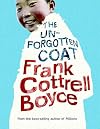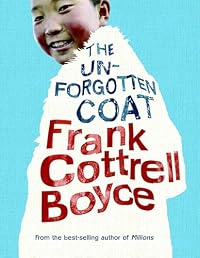
The Unforgotten Coat
by Frank Cottrell Boyce
On This Page
Description
When two Mongolian brothers inexplicably appear one morning in her sixth grade class, Julie, who lives in a town near Liverpool named Bootle, becomes their new friend and "Good Guide," navigating them through soccer, school uniforms, and British slang.Tags
Recommendations




Member Reviews
Sixth-grader Julie is mostly interested in getting her crush's attention and finding a way to get her popular friend to invite Julie over to her house after school, until the day she meets Chingis and Nergui. Charismatic Chingis, who is able to talk Julie's teacher into allowing his younger brother to stay in their classroom instead of being sent to a lower grade, appoints Julie as the brothers' 'good guide.' Julie takes her new role seriously, spending free time with Chingis and Nergui and doing a report on Mongolia which she shares with the class. She tries to extend their friendship beyond the classroom, hoping to see where the boys live, but when she finally achieves this goal, she gets an unexpected glimpse into the fear that show more Chingis and his family live with from day to day. When the family is abruptly deported, Julie is left with questions that haunt her well into adulthood.
This is an interesting book, almost surreal in places (this effect is amplified by the Polaroid-style illustrations sprinkled throughout), but also grimly realistic in its portrayal of a family caught in a difficult situation. In the Author's Note at the end, Boyce mentions that the story was inspired by real-life events. Though this is a quick read, I think it will appeal more to adults than to children. show less
This is an interesting book, almost surreal in places (this effect is amplified by the Polaroid-style illustrations sprinkled throughout), but also grimly realistic in its portrayal of a family caught in a difficult situation. In the Author's Note at the end, Boyce mentions that the story was inspired by real-life events. Though this is a quick read, I think it will appeal more to adults than to children. show less
This was going to be a quick read so that I could squeeze in one more review for the library children's department before the month ended. I chose Boyce's new book despite its awkward title because I was rather taken with the only other book of his I'd read, Millions. Then I wasn't even able to review it for the library because the reviews are supposed to be recommendations, which means I must find the book to have earned at least three stars.
Unlike Millions, this book seems like it was hastily written and published. The narrative is not cohesive. It seems like Boyce wrote the story to raise awareness among kids about the difficulties and issues surrounding immigration (Julie, the main character, gets to know two brothers in her class show more who have immigrated to the UK from Mongolia with their parents).
The story contains sweet moments and a bit of adventure, but Boyce can do much better. show less
Unlike Millions, this book seems like it was hastily written and published. The narrative is not cohesive. It seems like Boyce wrote the story to raise awareness among kids about the difficulties and issues surrounding immigration (Julie, the main character, gets to know two brothers in her class show more who have immigrated to the UK from Mongolia with their parents).
The story contains sweet moments and a bit of adventure, but Boyce can do much better. show less
Two refugee brothers from Mongolia are determined to fit in with their Liverpool schoolmates, but bring so much of Mongolia to Bootle that their new friend and guide, Julie, is hard-pressed to know truth from fantasy as she recollects a wonderful friendship that was abruptly ended when Chingis and his family were forced to return to Mongolia. Told with the humour, warmth and brilliance of detail which characterizes Frank Cottrell Boyce's writing, this magical and compelling story is enriched by stunning and atmospheric Polaroid photos.
As posted on Outside of a Dog:
Is there any bigger trope in the fictional canon than 'the year/summer/semester that changed my life'? It covers a variety of story possibilities and pops up everywhere you look. Adults are certainly not immune, but I do think it occurs more often in children’s and young adult literature, probably because these times that change our lives tend to happen when we’re young. It may be a cliché, but when handled correctly, it can be the perfect beginning for a lovely story.
“…doesn’t everyone remember everything about their last summer in elementary school?” our narrator Julie asks at the beginning of Frank Cottrell Boyce’s The Unforgotten Coat. The summer in question is changed for Julie by the show more arrival of two brothers to her school, Chingis and Nergui, from Mongolia. Chingis is in her class and quickly adopts Julie to be his “Good Guide”, a role that Julie takes seriously. The brothers, you see, are being chased by a demon, one that wants to make Nergui disappear. As good guide, Julie teaches the brothers about the playground and about football, learns all she can about Mongolia, and tries desperately to get herself invited over, to no avail. The boys in turn give Julie a new kind of meaning and purpose. This slim novel culminates in a skipping-school-off –the-road-trip where Julie learns a little more about the brothers and ends up learning the truth behind the demon and from what they were really running. Thanks to time, technology and a little growing up, our story has a happy ending, but one that is gained through a great price.
If I were to pair this novel with another 2011 release, I’d put it with National Book Award winner, Inside Out and Back Again by Thanhha Lai. Together they give two different experiences of immigration, but both have a sense of longing for place and time. For Boyce, the longing comes from Julie, who wants to know about the brothers’ home in Mongolia, and secretly dreams of becoming a Mongolian princess. There is also a feeling of nostalgia produced as the adult Julie tells her story of the end of her primary school days. Boyce captures that feeling perfectly, and doesn’t beat you over the head with it. The characters are all drawn with fine strokes, giving nuance even to the teacher, Mrs. Spendlove. Polaroid photographs are scattered throughout the text, and give poignancy to the story. The image of the title coat is especially memorable.
This is the first of Boyce’s novels for young people I’ve read, but I’m a big fan of screenwriting career. Tristram Shandy: A Cock and Bull Story and Millions are among my favorites (why I’ve never picked up Millions the novel is beyond me. Chalk it up to ‘too little time’). I know now I’ll have to pay more attention to his prose. What he accomplishes in only 93 pages with The Unforgotten Coat is remarkable. It’s a quick read, but one more than worth your time.
Note: The afterword is nearly as interesting as the story itself, detailing how Boyce got the idea for The Unforgotten Coat on a school visit. Be sure not to miss it. show less
Is there any bigger trope in the fictional canon than 'the year/summer/semester that changed my life'? It covers a variety of story possibilities and pops up everywhere you look. Adults are certainly not immune, but I do think it occurs more often in children’s and young adult literature, probably because these times that change our lives tend to happen when we’re young. It may be a cliché, but when handled correctly, it can be the perfect beginning for a lovely story.
“…doesn’t everyone remember everything about their last summer in elementary school?” our narrator Julie asks at the beginning of Frank Cottrell Boyce’s The Unforgotten Coat. The summer in question is changed for Julie by the show more arrival of two brothers to her school, Chingis and Nergui, from Mongolia. Chingis is in her class and quickly adopts Julie to be his “Good Guide”, a role that Julie takes seriously. The brothers, you see, are being chased by a demon, one that wants to make Nergui disappear. As good guide, Julie teaches the brothers about the playground and about football, learns all she can about Mongolia, and tries desperately to get herself invited over, to no avail. The boys in turn give Julie a new kind of meaning and purpose. This slim novel culminates in a skipping-school-off –the-road-trip where Julie learns a little more about the brothers and ends up learning the truth behind the demon and from what they were really running. Thanks to time, technology and a little growing up, our story has a happy ending, but one that is gained through a great price.
If I were to pair this novel with another 2011 release, I’d put it with National Book Award winner, Inside Out and Back Again by Thanhha Lai. Together they give two different experiences of immigration, but both have a sense of longing for place and time. For Boyce, the longing comes from Julie, who wants to know about the brothers’ home in Mongolia, and secretly dreams of becoming a Mongolian princess. There is also a feeling of nostalgia produced as the adult Julie tells her story of the end of her primary school days. Boyce captures that feeling perfectly, and doesn’t beat you over the head with it. The characters are all drawn with fine strokes, giving nuance even to the teacher, Mrs. Spendlove. Polaroid photographs are scattered throughout the text, and give poignancy to the story. The image of the title coat is especially memorable.
This is the first of Boyce’s novels for young people I’ve read, but I’m a big fan of screenwriting career. Tristram Shandy: A Cock and Bull Story and Millions are among my favorites (why I’ve never picked up Millions the novel is beyond me. Chalk it up to ‘too little time’). I know now I’ll have to pay more attention to his prose. What he accomplishes in only 93 pages with The Unforgotten Coat is remarkable. It’s a quick read, but one more than worth your time.
Note: The afterword is nearly as interesting as the story itself, detailing how Boyce got the idea for The Unforgotten Coat on a school visit. Be sure not to miss it. show less
For some reason this book didn't really grab me like I was hoping it would. At the beginning I didn't care for the author's voice, and I wasn't feeling the choice to have the author narrate as her adult self. In the end I understood why that choice was made, but the narrative voice sounded like a child's voice and not an adult's. I think that's also why I didn't really get the story from the beginning, because I was assuming the narrator was reliable, since she was telling it from her adult perspective. She knew, as an adult, that these kids were just messing with everyone, that their coats and photos weren't really from Mongolia and that everyone treating them like they didn't know American culture were probably just being strung show more along. But the narration really sounded like a child's voice, who believed all of the things that Chingis was telling her and not an adult who had an adult skepticism about the whole thing. So it all kind of felt really forced, and not as magical as I feel they were probably going for. The afterword was cute, though, because it was a real story. I wish this book had been a non-fiction account of that truth instead of the fictional version of it. show less
This book really is amazing! Imagine: a strange boy comes into a middle school classroom, with his little brother, who refuses to speak and will not take off his large, fuzzy hat, and proceeds rule the roost. Told in a series of flashbacks, centered around beautiful, quasi-poloroid illustrations, this is an absolutely unique collaboration of artist and author, and a great story!
Note: I read a review which said that this was an inaccurate depiction of Mongolian culture. I am sure that it is, but that is part of the point of the book. The main character is very young, and displaced. His culture is what he invents -- and he has amazing verve and imagination.
I also loved that the book is based on a true story, and that the author tells you show more exactly how much of the story is real. That makes the book: 1. very poignant, and 2. an amazing paean to the power of the imagination.
In sum: This book is awesome! Read it, you won't regret it! show less
Note: I read a review which said that this was an inaccurate depiction of Mongolian culture. I am sure that it is, but that is part of the point of the book. The main character is very young, and displaced. His culture is what he invents -- and he has amazing verve and imagination.
I also loved that the book is based on a true story, and that the author tells you show more exactly how much of the story is real. That makes the book: 1. very poignant, and 2. an amazing paean to the power of the imagination.
In sum: This book is awesome! Read it, you won't regret it! show less
I did like this story for a few reasons. The first reason I liked this story was because I thought that the writing flowed at a steady pace. The story was constantly leading to a major event that I personally did not see coming. The climax of the story was completely unexpected, and added a lot of surprise to the story. Another thing that I liked about the story was that the language was very clear. The language was easy for the readers to understand, and this helped the story to flow well. Another aspect that helped the story to flow well was the suspenseful plot. Throughout the story the two boys were talking about a demon, and this was odd. I constantly wondered what they meant by a demon, because I did not know if the boys thought a show more spiritual demon was following them or something else. This was able to add a lot of suspense to the story. I was always wondering what would happen next with the boys, and if their “demon” was ever going to catch up with them. Then when readers found out what the actual demon was it was a very big surprise. This really helped engage me into the story, because I really didn’t know what was going to happen to the boys after they were deported. Another reason that I liked the story was because I thought that the reader pushed the readers to think about a different perspective. Readers had to think about what it would be like to start over in a new country, and how difficult that might be. Readers will also have to think about how scared the boys must have been, and what it would have been like to always wonder if today was they day they were going to be deported. Readers are then forced to think about what it would be like to just be deported one day from your home, and forced to go to a place you did not want to go. I know I have never been in this situation, so I found this a difficult thing to think about. The story is able to broaden readers’ perspectives about immigration, and the difficulties that go along with immigrating. A last thing I liked about the story was the illustrations that were placed throughout the story. Often in the story Polaroid pictures are described, and often in the story the pictures are also shown. I found this to be extremely helpful when understanding the story. The visuals helped the reader to understand what was being described, and this was able to really enhance the story. The illustrations were also able to break up the text, and engage the reader in the story by being able to visualize the story. I believe the overall big message of the story is that you cannot always run away from your problems. The boys were constantly trying to run away, but eventually their demon did catch up with them. It was a bitter end to the story, but it teaches readers that sometimes problems have to be overcome in difficult ways. show less
Members
- Recently Added By
Author Information

42+ Works 4,323 Members
Awards and Honors
Awards
Distinctions
Common Knowledge
- Original publication date
- 2011
- Important places
- Mongolia; Liverpool, England, UK
- Important events
- Soccer
Classifications
Statistics
- Members
- 258
- Popularity
- 125,170
- Reviews
- 24
- Rating
- (3.78)
- Languages
- English, German, Turkish
- Media
- Paper, Audiobook, Ebook
- ISBNs
- 22
- ASINs
- 5