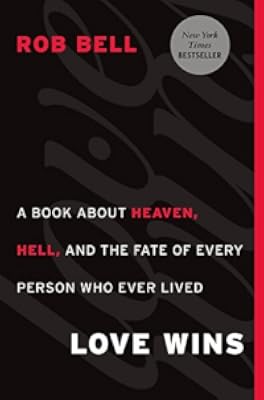
Love Wins: A Book About Heaven, Hell, and the Fate of Every Person Who Ever Lived
by Rob Bell
On This Page
Description
"Bestselling author of VELVET ELVIS and the 2 million-plus selling Nooma videos, Rob Bell, reveals a secret deep in the heart of millions of Christians-they don't believe what they have been taught are the essential truths of their faith. Out of respect for their tradition, they keep quiet, confiding to a few close friends their doubts and questions about salvation, Jesus, and, of course, God. Is Jesus really the only way into heaven? Is God "good" if he is planning on sending billions of show more people to eternal torment in hell? Are Christians the only ones who have it "right," and everyone else is just deceived? Bell brings out to the open and faces squarely the questions on everyone's mind: Does it really make sense that God is a loving, kind, compassionate God who wants to know people in a personal way, but if they reject this relationship with Jesus, they will be sent to hell where God will eternally punish them forever? In LOVE WINS, Bell goes to the heart of these issues and argues that the church's traditional understanding of heaven and hell is actually not taught by the Bible. Bell is emphatically not offering a new view of heaven and hell-instead, he closely examines every verse in the Bible on heaven and hell and shows what they really teach. And he discovers that Jesus's most fundamental teaching about heaven and hell is, "Love wins.""-- show lessTags
Recommendations












Member Recommendations
The Last Word and the Word after That: A Tale of Faith, Doubt, and a New Kind of Christianity by Brian D. McLaren
StephenBarkley Both books both explore views of Heaven and Hell from an emerging church perspective.
Member Reviews
Continuing my uncharacteristic journey into Christian theology, I read this book. This is a hugely controversial book for American Evangelicals, although having read it, I think that most of the controversy was generated by people who had not actually read this very short book. Basically, the author looks at what Jesus has to say about hell and takes the merciful interpretation. It's a you may be surprised at the people you see in heaven emphasis rather than the more usual idea that heaven's inhabitants will consist only of the very few people whose theology exactly agrees with one's own. Bell also separates what's actually in the Bible on the topic from the cultural constructs that form a huge part of the traditional fundamentalist show more view of heaven and hell. It's very thought provoking, but not really that shocking, unless you're really, really committed to wanting everyone you ever disliked punished for eternity. The sans-serif typeface drove me nuts, but that's nit-picking. show less
Essentially, this book asks a lot of questions - ones which some Christians may see as over-challenging or controversial. The writing style is in short sentences, inviting readers to start thinking about God, about the Bible, and about their beliefs. We all have preconceived ideas - those we have been taught, those we have assumed, and Rob Bell does an excellent job of getting back to first principles, of asking who this God is whom we worship, and what the Bible means by love, by redemption, and by Heaven and Hell.
I found it very readable and thought-provoking. It doesn't give a lot of answers, and those it gives are left open to the reader to consider, and perhaps answer differently. The main focus which I thought very positive was of show more the importance of how we live, and how we grow in relationship with God and each other, and how we continually need to question our assumptions - the 'stories', as he puts it, which we tell ourselves, or perhaps which other people have told us.
While this book is surprisingly controversial, and has many critics, I thought it a helpful overview of what many Christians believe, and would recommend it to anyone, particularly those who have been hurt or damaged by images of a slave-driving or vengeful God, or indeed by well-meaning Christians who don't really answer genuine questions. show less
I found it very readable and thought-provoking. It doesn't give a lot of answers, and those it gives are left open to the reader to consider, and perhaps answer differently. The main focus which I thought very positive was of show more the importance of how we live, and how we grow in relationship with God and each other, and how we continually need to question our assumptions - the 'stories', as he puts it, which we tell ourselves, or perhaps which other people have told us.
While this book is surprisingly controversial, and has many critics, I thought it a helpful overview of what many Christians believe, and would recommend it to anyone, particularly those who have been hurt or damaged by images of a slave-driving or vengeful God, or indeed by well-meaning Christians who don't really answer genuine questions. show less
I feel weird writing a book review for Love Wins when so many great leaders and famous pastors have done the same thing.
Some hate it, some love it, some tolerate it… certainly this book will not be labeled so quickly.
If you have not read it, but are reading the reviews to decide if you should, I fear that the only way to know if you’ll find it useful is… if you read it. The only reason I would steer you as a reader from a book would be that I thought it contained dangerous or heretical teaching; and I don’t. Nothing in this book will alter your salvation or change your faith or standing with God. In the end, Rob’s book is about love and I believe so is God.
I have read this book from cover to cover, and I read each word show more carefully and took it in, I didn’t skim it and jump to conclusions, I acted as though the author was there in the room with me and we were having a conversation. I read the book slowly over time and allowed the words to sit with me and last, I talked with others about what I read to have a sounding board.
I doubt those who have given this book such a low review have done the same.
Deservedly, they probably know scripture better than I do, or at least the “ammunition verses” to use in situations like this – but as a pastor myself – and having been in conversations and ministry like Rob has, I know that a conversation like this – is important.
When I read some of these reviews I find myself saying, “Rob never said that.” Many have jumped to their own conclusions and because words carry such weight and can be loaded with bias and history, we sling them like rocks or stamp them like labels without so much as a care.
And even though I do not think I have ever typed a negative word about Rob in the past, there were two aspects of the book I disagreed with (notice I did not say Rob was “wrong”).
The first is, Rob suggested that perhaps after death, people will get a second chance to go to Heaven. Yes, they will go to Hell, yes they will have chosen it, but perhaps God will bring them before judgment once more (Matt 20:1-16). Some have called this “univeralism” however; Rob does not believe that God will “pull” all into Heaven as universalists do.
Rob squarely indicated that he believes there are those that will choose hell forever. Do I think there are second chances after death? No, I don’t… but the bigger question should be… does God? I can’t dictate in my personal theology what God should or should not do in judgment. He is the judge and I am not.
Maybe Rob is a “post-modern Universalist” and perhaps it is time for words to carry new meanings.
What does the bible say? “One day every knee will bow and every tongue confess Jesus is Lord” (Philippians 2:10-11). The scriptures say “every” person will bend the knee in worship and that “every” mouth will make a confession of faith. What does that mean? It certainly does not sound like “Hell wins” does it? Because right now, most Christians believe Hell wins. We believe two-thirds of the earth will go to a place of torment, fire and punishment. We believe that a loving forgiving God will send millions and millions of people to eternal torment simply because they never said the sinner’s prayer (a prayer not found in the bible). But if “wide is the path that leads to destruction” (Matthew 7:13) how can we in the next breath say, “I know the end of the story (meaning the bible) and Jesus wins.”
He does?
Jesus wins if the majority of the world goes to Hell?
How is that winning?
I guess it’s a back handed win by having the “last word” with a giant “I told you so” as you slam dunk the naysayers and doubters of the world into the universe’s largest barbeque pit.
Second Rob indicated that Jesus is the “mechanism” that each of us goes to heaven; however it is uncertain how that mechanism works. As Christians we have claimed that “confession” is the “key” that unlocks the “Jesus code” and allows sinners to enter paradise, but do we always believe that?
If a two month old baby dies, we say that the little one is now “resting in the arms of Jesus.” Why? Did the baby make a confession of faith? No, but we sometimes bend the rules don’t we? So the question then becomes… does God? Does God bend the rules for the lost tribe in the deep dark Amazon forest who have never heard the name of Jesus? Will Jews who faithfully read the torah and pray to YHWH go to Heaven? Will nominal Jehovah’s Witnesses go to heaven? A staunch Christian would love to say “no” but in the end… aren’t they God’s rules?
Personally I believe a knowledge of Jesus and a willingness to follow him are required for salvation – so here is another area my beliefs don’t align with Rob’s … but… as far as we know there is no “video evidence” of Heaven, Hell or eternity. It is not up to us to steak a flag in the sand and demand that eternity has to be exactly the way we dictate. If Ghandi is standing next to me in Heaven, I am not going to storm into God’s office and demand that he be deported.
Rob believes that in the end Love Wins and that yes… God wins.
But is that heretical?
Is it so bad to believe that God’s grace and love and forgiveness will extend to my enemy? Is it so wrong to believe that Heaven will be filled with people from every race, language and nation (Rev 5:9)?
Rob’s intent was so that this book would start a discussion, not an argument. Rob wanted people to talk with openness about God’s love and to perhaps find new ways to talk to those that have so many questions about a loving God who allows “good people” to burn forever. Certainly Heaven and Hell are not as “simple” as we make them out to be, and most definitely we can not just “dismiss” these questions with a three word tweet. show less
Some hate it, some love it, some tolerate it… certainly this book will not be labeled so quickly.
If you have not read it, but are reading the reviews to decide if you should, I fear that the only way to know if you’ll find it useful is… if you read it. The only reason I would steer you as a reader from a book would be that I thought it contained dangerous or heretical teaching; and I don’t. Nothing in this book will alter your salvation or change your faith or standing with God. In the end, Rob’s book is about love and I believe so is God.
I have read this book from cover to cover, and I read each word show more carefully and took it in, I didn’t skim it and jump to conclusions, I acted as though the author was there in the room with me and we were having a conversation. I read the book slowly over time and allowed the words to sit with me and last, I talked with others about what I read to have a sounding board.
I doubt those who have given this book such a low review have done the same.
Deservedly, they probably know scripture better than I do, or at least the “ammunition verses” to use in situations like this – but as a pastor myself – and having been in conversations and ministry like Rob has, I know that a conversation like this – is important.
When I read some of these reviews I find myself saying, “Rob never said that.” Many have jumped to their own conclusions and because words carry such weight and can be loaded with bias and history, we sling them like rocks or stamp them like labels without so much as a care.
And even though I do not think I have ever typed a negative word about Rob in the past, there were two aspects of the book I disagreed with (notice I did not say Rob was “wrong”).
The first is, Rob suggested that perhaps after death, people will get a second chance to go to Heaven. Yes, they will go to Hell, yes they will have chosen it, but perhaps God will bring them before judgment once more (Matt 20:1-16). Some have called this “univeralism” however; Rob does not believe that God will “pull” all into Heaven as universalists do.
Rob squarely indicated that he believes there are those that will choose hell forever. Do I think there are second chances after death? No, I don’t… but the bigger question should be… does God? I can’t dictate in my personal theology what God should or should not do in judgment. He is the judge and I am not.
Maybe Rob is a “post-modern Universalist” and perhaps it is time for words to carry new meanings.
What does the bible say? “One day every knee will bow and every tongue confess Jesus is Lord” (Philippians 2:10-11). The scriptures say “every” person will bend the knee in worship and that “every” mouth will make a confession of faith. What does that mean? It certainly does not sound like “Hell wins” does it? Because right now, most Christians believe Hell wins. We believe two-thirds of the earth will go to a place of torment, fire and punishment. We believe that a loving forgiving God will send millions and millions of people to eternal torment simply because they never said the sinner’s prayer (a prayer not found in the bible). But if “wide is the path that leads to destruction” (Matthew 7:13) how can we in the next breath say, “I know the end of the story (meaning the bible) and Jesus wins.”
He does?
Jesus wins if the majority of the world goes to Hell?
How is that winning?
I guess it’s a back handed win by having the “last word” with a giant “I told you so” as you slam dunk the naysayers and doubters of the world into the universe’s largest barbeque pit.
Second Rob indicated that Jesus is the “mechanism” that each of us goes to heaven; however it is uncertain how that mechanism works. As Christians we have claimed that “confession” is the “key” that unlocks the “Jesus code” and allows sinners to enter paradise, but do we always believe that?
If a two month old baby dies, we say that the little one is now “resting in the arms of Jesus.” Why? Did the baby make a confession of faith? No, but we sometimes bend the rules don’t we? So the question then becomes… does God? Does God bend the rules for the lost tribe in the deep dark Amazon forest who have never heard the name of Jesus? Will Jews who faithfully read the torah and pray to YHWH go to Heaven? Will nominal Jehovah’s Witnesses go to heaven? A staunch Christian would love to say “no” but in the end… aren’t they God’s rules?
Personally I believe a knowledge of Jesus and a willingness to follow him are required for salvation – so here is another area my beliefs don’t align with Rob’s … but… as far as we know there is no “video evidence” of Heaven, Hell or eternity. It is not up to us to steak a flag in the sand and demand that eternity has to be exactly the way we dictate. If Ghandi is standing next to me in Heaven, I am not going to storm into God’s office and demand that he be deported.
Rob believes that in the end Love Wins and that yes… God wins.
But is that heretical?
Is it so bad to believe that God’s grace and love and forgiveness will extend to my enemy? Is it so wrong to believe that Heaven will be filled with people from every race, language and nation (Rev 5:9)?
Rob’s intent was so that this book would start a discussion, not an argument. Rob wanted people to talk with openness about God’s love and to perhaps find new ways to talk to those that have so many questions about a loving God who allows “good people” to burn forever. Certainly Heaven and Hell are not as “simple” as we make them out to be, and most definitely we can not just “dismiss” these questions with a three word tweet. show less
There are obviously two versions of Rob Bell's Love Wins book that are available. The one in which he is a universalist and the one in which he isn't.
The furorer started with Justin Taylor's post about Bell's promotional video. Piper responded with a tweet: "Farewell Rob Bell". What he meant by that is anybody's guess -- farewell from Christianity, from evangelicalism, from new calvinism, from Zondervan (the book was Bell's first from Harper Collins)? I don't know about love winning but the publicity certainly meant that the publishers won!
Why the fear? What is wrong with posing questions? I don't agree with all Bell's answers, but the questions he raises are important and need to be addressed.
How biblical is the so-called 'traditional' show more view of hell? Many evangelicals have taken different views on this topic - does that stop them being evangelicals or even Christian? Why the concern over boundaries - who is and who isn't an evangelical? Since when has a correct view of hell been an indicator of whether one is 'in' or 'out'? Since when has a literal reading of the Bible been an indicator of whether one is an evangelical or not?
There are many types of universalism - some may have some biblical warrant others clearly do not. Likewise, there are many views of hell - some may have biblical warrant others don't.
Here's my rough draft of a range of views:
1. Hell as a place of eternal torment/ punishment (either mental or physical or both)
2. Hell as a place of separation from God
3. Annihilation
3.1 Conditional immortality
3.1.1 Those in Christ are resurrected the rest are annihilated
3.1.2 All are resurrected – then face judgment those not in Christ are then annihilated
3.2 All are created immortal after the resurrection the unbelievers are punished and then annihilated.
4. Purgatorial view
4.1 Hell as a place of discipline
4.2 Hell as the opportunity for post-mortem decision
5. Inclusivism – some may be saved - even if they have not heard of Jesus - based on the revelation they have received
6. Universalism
6.1 Christian universalism: all will be saved through what Christ has done
6.2 Pluralistic universalism: all will be saved – no matter what
Bell seems to hold to a version of 6.1; for example:
What Jesus does is declare that he,
and he alone
is saving everybody (p. 155)
but and it’s a big but with a form of 4.2. But it seems that human free will trumps all that God has done:
God gives us what we want, and if that's hell, we can have it.
We have that kind of freedom, that kind of choice. We are that free. (p. 72)
and
And that's what we find in Jesus's teaching about hell - a volatile mixture of images, pictures, and metaphors that describe the very real experiences and consequences of rejecting out God-given goodness and humanity. Something we are free to do, anytime, anywhere, with anyone. (p. 73)
Bell is then no universalist - we have the freedom to reject what God has done.
On the other hand he seems to be arguing as follows:
1. God is sovereign and in control of all things
2. God wants all to be saved
3. Therefore, all will be saved.
If 1 and 2 are true then 3 must follow. However, Bell seems to want to add
4. Unless we want to reject the offer of salvation
Bell is obviously questioning evangelical shibboleths- he is an iconoclast, and doesn't mind whose toes he steps on - more power to him!
The focus of the criticism has been on Bell's view of hell. This misses some of the excellent points he makes, particularly in chapter 2. This is a brilliant chapter: for example this extract:
Honest business
redemptive art
honorable law
sustainable living,
medicine,
education,making a home,
tending a garden --
they're all sacred tasks to be done in partnership with God now, because they will all go on in the age to come.
(p. 47)
Ultimately, Bell's message is that free will is sovereign: we get what we want. show less
The furorer started with Justin Taylor's post about Bell's promotional video. Piper responded with a tweet: "Farewell Rob Bell". What he meant by that is anybody's guess -- farewell from Christianity, from evangelicalism, from new calvinism, from Zondervan (the book was Bell's first from Harper Collins)? I don't know about love winning but the publicity certainly meant that the publishers won!
Why the fear? What is wrong with posing questions? I don't agree with all Bell's answers, but the questions he raises are important and need to be addressed.
How biblical is the so-called 'traditional' show more view of hell? Many evangelicals have taken different views on this topic - does that stop them being evangelicals or even Christian? Why the concern over boundaries - who is and who isn't an evangelical? Since when has a correct view of hell been an indicator of whether one is 'in' or 'out'? Since when has a literal reading of the Bible been an indicator of whether one is an evangelical or not?
There are many types of universalism - some may have some biblical warrant others clearly do not. Likewise, there are many views of hell - some may have biblical warrant others don't.
Here's my rough draft of a range of views:
1. Hell as a place of eternal torment/ punishment (either mental or physical or both)
2. Hell as a place of separation from God
3. Annihilation
3.1 Conditional immortality
3.1.1 Those in Christ are resurrected the rest are annihilated
3.1.2 All are resurrected – then face judgment those not in Christ are then annihilated
3.2 All are created immortal after the resurrection the unbelievers are punished and then annihilated.
4. Purgatorial view
4.1 Hell as a place of discipline
4.2 Hell as the opportunity for post-mortem decision
5. Inclusivism – some may be saved - even if they have not heard of Jesus - based on the revelation they have received
6. Universalism
6.1 Christian universalism: all will be saved through what Christ has done
6.2 Pluralistic universalism: all will be saved – no matter what
Bell seems to hold to a version of 6.1; for example:
What Jesus does is declare that he,
and he alone
is saving everybody (p. 155)
but and it’s a big but with a form of 4.2. But it seems that human free will trumps all that God has done:
God gives us what we want, and if that's hell, we can have it.
We have that kind of freedom, that kind of choice. We are that free. (p. 72)
and
And that's what we find in Jesus's teaching about hell - a volatile mixture of images, pictures, and metaphors that describe the very real experiences and consequences of rejecting out God-given goodness and humanity. Something we are free to do, anytime, anywhere, with anyone. (p. 73)
Bell is then no universalist - we have the freedom to reject what God has done.
On the other hand he seems to be arguing as follows:
1. God is sovereign and in control of all things
2. God wants all to be saved
3. Therefore, all will be saved.
If 1 and 2 are true then 3 must follow. However, Bell seems to want to add
4. Unless we want to reject the offer of salvation
Bell is obviously questioning evangelical shibboleths- he is an iconoclast, and doesn't mind whose toes he steps on - more power to him!
The focus of the criticism has been on Bell's view of hell. This misses some of the excellent points he makes, particularly in chapter 2. This is a brilliant chapter: for example this extract:
Honest business
redemptive art
honorable law
sustainable living,
medicine,
education,making a home,
tending a garden --
they're all sacred tasks to be done in partnership with God now, because they will all go on in the age to come.
(p. 47)
Ultimately, Bell's message is that free will is sovereign: we get what we want. show less
Count on Rob Bell to push evangelicals to the edge of their comfort zone...and then push them right off it.
Employing a method that relies heavily on accessible vocabulary and style (it's more like reading a casual e-mail than a theoretical theology paper), a bit of snark and guilt-tripping, and plenty of references to the writing of early Christian thinkers, Bell posits that everybody ends up going to heaven. He supports the thesis largely by offering a reinterpretation of what heaven and hell actually are.
He's got some good ideas in here that I want to be on board with; but Bell also draws some conclusions that seem like not-quite-supported logical leaps, and he fails to address important passages in the Bible that could easily be show more interpreted as being in opposition to his ideas.
I already lean toward agreeing with his conclusions, but I want to see him (or someone) get there with a little less proof-texting and emotional manipulation and a little more of a convincing argument. show less
Employing a method that relies heavily on accessible vocabulary and style (it's more like reading a casual e-mail than a theoretical theology paper), a bit of snark and guilt-tripping, and plenty of references to the writing of early Christian thinkers, Bell posits that everybody ends up going to heaven. He supports the thesis largely by offering a reinterpretation of what heaven and hell actually are.
He's got some good ideas in here that I want to be on board with; but Bell also draws some conclusions that seem like not-quite-supported logical leaps, and he fails to address important passages in the Bible that could easily be show more interpreted as being in opposition to his ideas.
I already lean toward agreeing with his conclusions, but I want to see him (or someone) get there with a little less proof-texting and emotional manipulation and a little more of a convincing argument. show less
Love Wins really resonated with me. Overall, it was a good read that challenged my views and stretched my thinking. Ultimately causing me to delve deeper into God's word. In a sense it liberated me from the constraints of my own ill-conceived views about God. I have for many years viewed God much like my earthly father: fear-monger, rule-maker, always careful not to incur his wrath. But, then Jesus comes along and my view of God changes everything. I have long held to the belief that Jesus has reconciled ALL things to God. Ultimately, as long as we place our trust in Christ... everything will be alright; complete with our imperfections and screw ups. My view of grace has become broader in scope. It's no longer bound by individual belief show more or doctrine, but is a free gift for the entire world. And, I do believe all people will have a chance to grab hold of that gift, now, and just maybe even after death.
Bell's retelling of the story of the Prodigal Son really hit home with me too. How often are we the older son, at home with the Father, but never really enjoying life? We think life is unfair, full of rules, strict doctrine, theology, legalism, and requiring strict obedience, but fail to really enjoy life and engage our Father.
In regards to theology, the chapter concerning hell really made me pause and think. Is hell a literal place that God simply throws people away to be burned and consumed by fire because they didn't accept Jesus in this life? Is God all loving, but then shows no love to those who never heard the Gospel and consigns them to eternal torment? Or, was hell simply a place called Gehenna where the city trash dump existed near Jerusalem at the time of Jesus, where trash was thrown to the fire and the animals can be found gnashing at the teeth? Or, is hell what we make from rejecting the love of God, both in the life now and the life thereafter?
And what about salvation? Is salvation limited and confined to the natural world in which we live? Or, can salvation be received even after we die in the spiritual world? Bell presupposes that God may save people even after their earthly death. If you would have told me this two years ago I would have scoffed at the idea. But, the more I thought about it, why couldn't He? If God is totally sovereign, then why should He be confined and limited to saving people only in the natural world, and not in the spiritual world? Bell references the story of Abraham's bosom in Luke 16 as possible evidence that God can indeed save people in the afterlife. And, I believe this passage is key because it shows interaction between God and what is presumed to be hell or separation (great chasm). The fact that God can still interact with those in this "place" shows that God doesn't give up and is not absent in the afterlife no matter the destination.
Although I agreed with a majority of Bell's material, there were a few things I disagreed with. I disagreed that people will be able to be saved from hell and move on over into heaven after they die. This would imply that God wavers in His judgment. I believe once God pronounces His judgment, what is done is done. But, I do believe that people may still be saved after their death prior to judgment. Does this mean I believe in a sort of purgatory? Perhaps. I don't know. I believe there is a biblical case for it. This is something I'm still wrestling through. Gregory Boyd talks a lot about this from a Protestant perspective. I also disagree that hell is temporary, only a refining fire. Hell is permanent. It is literal and not figurative. But, what hell looks like we can only speculate.
I also disagreed with the minimal use of Scripture. Bell really needed to use more Scripture to back his claims. A lot of what he proposed was speculative, but certainly a possibility. I believe Bell would have built a stronger case would he have utilized more Scripture, along with the early church's views on these matters.
However, what I disagreed with the most was that Bell left almost all of the subject matter open-ended. I know this was intentional. But, I think he left more people scratching their heads. I hope he will someday write a follow-up book to answer these open-ended questions. For instance, I want to know more details about why he believes people will be saved after they die. I want to know more details about why he believes hell will be more of an imaginative reality rather than the traditional views held by most evangelicals.
All throughout the book I thought Rob Bell gives compelling alternative views to heaven, hell, and eternal salvation from a biblical perspective. Even though I might not have agreed with everything, it most certainly has made me rethink my own position on these issues. I didn't see any glaring red flags or heresy from my own observation. I hope those who ranted and raved against him will relax a bit in the spirit of Christ and unity. Bell simply provides another view complete with Scripture and hermeneutical research to solidify his thoughts. And, many of his arguments are not new, but simply resurrected from the past. Do we default to centuries old traditions/interpretations on these matters and dismiss all other views? Or, do we open ourselves to probing deeper into these issues, engaging in dialog, and possibly begin to understand them from a much different perspective?
If anything, Rob Bell has taught me two things: that it's okay to question fundamental issues and love indeed wins. show less
Bell's retelling of the story of the Prodigal Son really hit home with me too. How often are we the older son, at home with the Father, but never really enjoying life? We think life is unfair, full of rules, strict doctrine, theology, legalism, and requiring strict obedience, but fail to really enjoy life and engage our Father.
In regards to theology, the chapter concerning hell really made me pause and think. Is hell a literal place that God simply throws people away to be burned and consumed by fire because they didn't accept Jesus in this life? Is God all loving, but then shows no love to those who never heard the Gospel and consigns them to eternal torment? Or, was hell simply a place called Gehenna where the city trash dump existed near Jerusalem at the time of Jesus, where trash was thrown to the fire and the animals can be found gnashing at the teeth? Or, is hell what we make from rejecting the love of God, both in the life now and the life thereafter?
And what about salvation? Is salvation limited and confined to the natural world in which we live? Or, can salvation be received even after we die in the spiritual world? Bell presupposes that God may save people even after their earthly death. If you would have told me this two years ago I would have scoffed at the idea. But, the more I thought about it, why couldn't He? If God is totally sovereign, then why should He be confined and limited to saving people only in the natural world, and not in the spiritual world? Bell references the story of Abraham's bosom in Luke 16 as possible evidence that God can indeed save people in the afterlife. And, I believe this passage is key because it shows interaction between God and what is presumed to be hell or separation (great chasm). The fact that God can still interact with those in this "place" shows that God doesn't give up and is not absent in the afterlife no matter the destination.
Although I agreed with a majority of Bell's material, there were a few things I disagreed with. I disagreed that people will be able to be saved from hell and move on over into heaven after they die. This would imply that God wavers in His judgment. I believe once God pronounces His judgment, what is done is done. But, I do believe that people may still be saved after their death prior to judgment. Does this mean I believe in a sort of purgatory? Perhaps. I don't know. I believe there is a biblical case for it. This is something I'm still wrestling through. Gregory Boyd talks a lot about this from a Protestant perspective. I also disagree that hell is temporary, only a refining fire. Hell is permanent. It is literal and not figurative. But, what hell looks like we can only speculate.
I also disagreed with the minimal use of Scripture. Bell really needed to use more Scripture to back his claims. A lot of what he proposed was speculative, but certainly a possibility. I believe Bell would have built a stronger case would he have utilized more Scripture, along with the early church's views on these matters.
However, what I disagreed with the most was that Bell left almost all of the subject matter open-ended. I know this was intentional. But, I think he left more people scratching their heads. I hope he will someday write a follow-up book to answer these open-ended questions. For instance, I want to know more details about why he believes people will be saved after they die. I want to know more details about why he believes hell will be more of an imaginative reality rather than the traditional views held by most evangelicals.
All throughout the book I thought Rob Bell gives compelling alternative views to heaven, hell, and eternal salvation from a biblical perspective. Even though I might not have agreed with everything, it most certainly has made me rethink my own position on these issues. I didn't see any glaring red flags or heresy from my own observation. I hope those who ranted and raved against him will relax a bit in the spirit of Christ and unity. Bell simply provides another view complete with Scripture and hermeneutical research to solidify his thoughts. And, many of his arguments are not new, but simply resurrected from the past. Do we default to centuries old traditions/interpretations on these matters and dismiss all other views? Or, do we open ourselves to probing deeper into these issues, engaging in dialog, and possibly begin to understand them from a much different perspective?
If anything, Rob Bell has taught me two things: that it's okay to question fundamental issues and love indeed wins. show less
This is Bell's controversial masterpiece about "heaven, hell, and the fate of every person who ever lived." Love, says this internationally influential pastor, wins in the end ... and nobody has to go to hell.
God wants all people to be saved. Will God get what He wants?
Of Bell's works, I've read only this and Velvet Elvis, though I have three more in my review stack. I'll be spreading them out over the next few months. I confess that too much Bell, with his colloquial rah-rah style, might push me off the deep end, but in Love Wins, the message overcomes the style and earns five stars. I also feel the book is very well organized, leading inexorably to a logical conclusion.
That said, this book does not probe any deep theological show more arguments. It's far too short for that. It's a common-sense approach to a troubling question: Can God be both loving and vengeful?
Actually, Bell's book is chock full of questions! It makes you think about your perception of Jesus, of God, and of His eternal plan. Bell says, "Often times when I meet atheists and we talk about the god they don't believe in, we quickly discover that I don't believe in that god either." When we hear that a certain person has rejected Christ, we should probably first ask, "Which Christ?" The antiscience, antigay one standing out on the sidewalk with his bullhorn, telling people that they're going to burn forever? Or the one who invites everyone to share in his heaven?
Which invites another question. Which heaven? The one far away, a dream of eternal bliss, or the one Jesus constantly spoke of, here, now, on this earth? Bell's "heaven" is very "earthy," rightly recognizing that Jesus spoke not of a place but of an age ... an age where God dwells with his people, on this earth. Bell is not denying an afterlife, he simply is putting the focus where Jesus did: the now.
But what about hell? Well, there's plenty of hell on earth now, too. Surprisingly, not everyone prefers heaven. Love wins, and we get whatever we want. But over and over and over, God speaks of restoration ... helping those who have slipped into hell back on their feet and back into heaven.
That's God's agenda. So here we are at a final question: Does this magnificent, mighty, marvelous God fail in the end? show less
God wants all people to be saved. Will God get what He wants?
Of Bell's works, I've read only this and Velvet Elvis, though I have three more in my review stack. I'll be spreading them out over the next few months. I confess that too much Bell, with his colloquial rah-rah style, might push me off the deep end, but in Love Wins, the message overcomes the style and earns five stars. I also feel the book is very well organized, leading inexorably to a logical conclusion.
That said, this book does not probe any deep theological show more arguments. It's far too short for that. It's a common-sense approach to a troubling question: Can God be both loving and vengeful?
Actually, Bell's book is chock full of questions! It makes you think about your perception of Jesus, of God, and of His eternal plan. Bell says, "Often times when I meet atheists and we talk about the god they don't believe in, we quickly discover that I don't believe in that god either." When we hear that a certain person has rejected Christ, we should probably first ask, "Which Christ?" The antiscience, antigay one standing out on the sidewalk with his bullhorn, telling people that they're going to burn forever? Or the one who invites everyone to share in his heaven?
Which invites another question. Which heaven? The one far away, a dream of eternal bliss, or the one Jesus constantly spoke of, here, now, on this earth? Bell's "heaven" is very "earthy," rightly recognizing that Jesus spoke not of a place but of an age ... an age where God dwells with his people, on this earth. Bell is not denying an afterlife, he simply is putting the focus where Jesus did: the now.
But what about hell? Well, there's plenty of hell on earth now, too. Surprisingly, not everyone prefers heaven. Love wins, and we get whatever we want. But over and over and over, God speaks of restoration ... helping those who have slipped into hell back on their feet and back into heaven.
That's God's agenda. So here we are at a final question: Does this magnificent, mighty, marvelous God fail in the end? show less
Members
- Recently Added By
Published Reviews
Rob Bell is a heretic.
And so are you.
But that's the good news...The book, which will be released by Harper One on Tuesday, drew the ire of critics (many of whom had not yet read it) last week, lighting up the Twitterverse and the blogosphere with condemnations of Bell and his theology.
They called him a Universalist. A wolf in sheep's clothing. A false prophet. A radical. Dangerous.
And more show more than a few have labeled Bell, one of the most influential voices in evangelical Christianity today, a heretic. show less
And so are you.
But that's the good news...The book, which will be released by Harper One on Tuesday, drew the ire of critics (many of whom had not yet read it) last week, lighting up the Twitterverse and the blogosphere with condemnations of Bell and his theology.
They called him a Universalist. A wolf in sheep's clothing. A false prophet. A radical. Dangerous.
And more show more than a few have labeled Bell, one of the most influential voices in evangelical Christianity today, a heretic. show less
added by vancouverdeb
Rob Bell's Bridge Too Far
The controversial pastor raises crucial questions, but offers answers that may sabotage his goals.....After reading the book, it's hard for me to believe that Bell doesn't espouse universalism, but to be fair, he never formally affirms such belief. And in later passages, he does allude to hellish consequences for unbelief. In the end, he says he is raising the issue show more only to show that we "must leave plenty of room" for that possibility.
Perhaps, but in raising such momentous issues, he has raised crucial questions that also must be asked. If universal salvation is true, why does Jesus not showcase it? Why is Jesus' teaching characterized instead by a relentless focus on the last judgment? show less
The controversial pastor raises crucial questions, but offers answers that may sabotage his goals.....After reading the book, it's hard for me to believe that Bell doesn't espouse universalism, but to be fair, he never formally affirms such belief. And in later passages, he does allude to hellish consequences for unbelief. In the end, he says he is raising the issue show more only to show that we "must leave plenty of room" for that possibility.
Perhaps, but in raising such momentous issues, he has raised crucial questions that also must be asked. If universal salvation is true, why does Jesus not showcase it? Why is Jesus' teaching characterized instead by a relentless focus on the last judgment? show less
added by vancouverdeb
Lists

Mike's Theology Books
74 works; 2 members
Author Information

78 Works 11,422 Members
Robert Holmes "Rob" Bell Jr. was born on August 23, 1970. Bell grew up in a traditional Christian environment. He attended Wheaton College. While at Wheaton, he roomed with Ian Eskelin of All Star United. With friends Dave Houk, Brian Erickson, Steve Huber and Chris Fall, he formed the indie rock band, "ton bundle". Bell received his bachelor's show more degree in 1992 from Wheaton and taught water skiing in the summers at Wheaton College's Honey Rock Camp. During this time, Bell offered to teach a Christian message to the camp counselors after no pastor could be found. He taught a message about "rest". He said that God led him to teaching at this moment. Bell moved to Pasadena, California to pursue this calling for teaching and received a M.Div. from Fuller Theological Seminary. According to Bell, he never received good grades in preaching class because he always tried innovative ways to communicate his ideas. During his time at Fuller he was a youth intern at Lake Avenue Church. He did, however, occasionally attend Christian Assembly in Eagle Rock, California, which led to him and his wife asking questions in the direction of how a new style of church would appear. Bell and his wife moved from California to Grand Rapids to be close to family and on invitation to study under pastor Ed Dobson. He handled many of the preaching duties for the Saturday Night service at Calvary Church. Bell announced that he would be branching out on his own to start a new kind of community and he would call it "Mars Hill" after the Greek site where the apostle Paul told a group, "For as I walked around and looked carefully at your objects of worship, I even found an altar with this inscription: TO AN UNKNOWN GOD. Now what you worship as something unknown I am going to proclaim to you." In February 1999, Bell founded Mars Hill Bible Church, with the church originally meeting in a school gym in Wyoming, Michigan. As of 2005, an estimated 11,000 people attend the two "gatherings" on Sundays at 9 and 11 AM.[7] As of March 2011, Sunday attendance numbers between 8,000 and 10,000.[8] His teachings at Mars Hill inspired the popular "Love Wins" bumper sticker, and the congregation freely distributes these stickers after services. (Bowker Author Biography) show less
Awards and Honors
Distinctions
Work Relationships
Has the adaptation
Is replied to in
Has as a reference guide/companion
Common Knowledge
- Original publication date
- 2011
- First words
- from Preface
To begin with,
a bit about this book
First, I believe that Jesus' story is first and foremost about the love of God for every single one of us. It is a stunning, beautiful, expa... (show all)nsive love, and it is for everybody, everywhere. - Blurbers
- Peterson, Eugene H.; Boyd, Greg; McLaren, Brian D.
Classifications
Statistics
- Members
- 2,034
- Popularity
- 10,277
- Reviews
- 57
- Rating
- (3.50)
- Languages
- 8 — Czech, Danish, Dutch, English, French, German, Portuguese, Swedish
- Media
- Paper, Audiobook, Ebook
- ISBNs
- 25
- UPCs
- 1
- ASINs
- 12