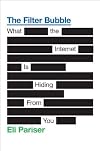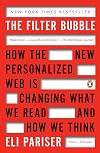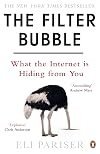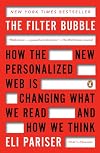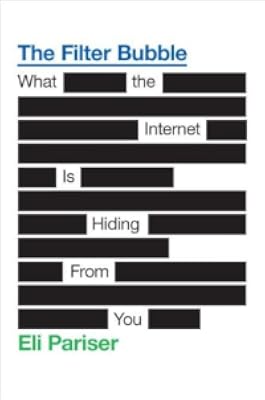
The Filter Bubble: What the Internet Is Hiding from You
by Eli Pariser
On This Page
Description
The hidden rise of personalization on the Internet is controlling--and limiting--the information we consume. In 2009, Google began customizing its search results. Instead of giving you the most broadly popular result, Google now tries to predict what you are most likely to click on. According to MoveOn.org board president Eli Pariser, this change is symptomatic of the most significant shift to take place on the Web in recent years--the rise of personalization. Though the phenomenon has gone show more largely undetected until now, personalized filters are sweeping the Web, creating individual universes of information for each of us. Data companies track your personal information to sell to advertisers, from your political leanings to the hiking boots you just browsed on Zappos. In a personalized world, we will increasingly be typed and fed only news that is pleasant, familiar, and confirms our beliefs--and because these filters are invisible, we won't know what is being hidden from us. Our past interests will determine what we are exposed to in the future, leaving less room for the unexpected encounters that spark creativity, innovation, and the democratic exchange of ideas.--From publisher description. show lessTags
Recommendations















Member Reviews
If you’re not paying for something, you’re not the customer; you’re the product being sold.
Attributed to a commenter on the Internet and oft-quoted by LT’s Tim Spaulding, that line lays the foundation of half of this book (thematic half, not structural): that virtually every website you visit collects, compiles and integrates your personal data and then uses or sells it for commercial purpose. Google and Facebook are particularly vilified: Google captures your searches and result-link clicks; Facebook doesn’t have to capture data, users provide it voluminously.
The other half of the book is the stuff of the title -- that the Internet increasingly uses that collected data to tailor itself to you, creating an online space that is show more your own little filtered bubble. Used to be, you could Google something and tell someone to click the third link on the first page -- those “Page rankings” (named after Google’s Larry Page) having been based on what was most relevant to the whole of Internet users. But since 2009, Google searches are individualized and ranked according to what’s most relevant to you, i.e. what you’re most likely to click on. Google yourself and you won’t get the results I get for you. Google a controversial topic and you’ll get results in line with what you already know; same with the prioritization of your Facebook feeds. Online (and increasingly offline), you are what you click on the web; you are what you share there or link to … did you know that your “real life” credit-worthiness may be affected by the credit-worthiness of your Facebook friends?
Pariser acknowledges that media has always been filtered (network news and newspapers) and that at least with the Internet, you can go find what you don’t know … as long as you know you don’t know it; stumbling on “unknown unknowns” is harder. But he riles against the lack of transparency in data collection and cautions that Internet filtering puts techies in charge of the dialogue and discourse that create society. That reminds me of Edward Tufte’s caution in The Visual Display of Quantitative Information: “Allowing artist-illustrators to control the design and content of statistical graphics is almost like allowing typographers to control the content, style, and editing of prose.”
If I recall correctly (I listened via audiobook), Pariser suggests there is little solution other than regulation; he offers a couple suggestions to mitigate, for example setting your web browser to delete cookies/history each time it closes.
The book is revelatory. It or another book on the topic is required reading for every person who goes online. show less
Attributed to a commenter on the Internet and oft-quoted by LT’s Tim Spaulding, that line lays the foundation of half of this book (thematic half, not structural): that virtually every website you visit collects, compiles and integrates your personal data and then uses or sells it for commercial purpose. Google and Facebook are particularly vilified: Google captures your searches and result-link clicks; Facebook doesn’t have to capture data, users provide it voluminously.
The other half of the book is the stuff of the title -- that the Internet increasingly uses that collected data to tailor itself to you, creating an online space that is show more your own little filtered bubble. Used to be, you could Google something and tell someone to click the third link on the first page -- those “Page rankings” (named after Google’s Larry Page) having been based on what was most relevant to the whole of Internet users. But since 2009, Google searches are individualized and ranked according to what’s most relevant to you, i.e. what you’re most likely to click on. Google yourself and you won’t get the results I get for you. Google a controversial topic and you’ll get results in line with what you already know; same with the prioritization of your Facebook feeds. Online (and increasingly offline), you are what you click on the web; you are what you share there or link to … did you know that your “real life” credit-worthiness may be affected by the credit-worthiness of your Facebook friends?
Pariser acknowledges that media has always been filtered (network news and newspapers) and that at least with the Internet, you can go find what you don’t know … as long as you know you don’t know it; stumbling on “unknown unknowns” is harder. But he riles against the lack of transparency in data collection and cautions that Internet filtering puts techies in charge of the dialogue and discourse that create society. That reminds me of Edward Tufte’s caution in The Visual Display of Quantitative Information: “Allowing artist-illustrators to control the design and content of statistical graphics is almost like allowing typographers to control the content, style, and editing of prose.”
If I recall correctly (I listened via audiobook), Pariser suggests there is little solution other than regulation; he offers a couple suggestions to mitigate, for example setting your web browser to delete cookies/history each time it closes.
The book is revelatory. It or another book on the topic is required reading for every person who goes online. show less
The central message in The Filter Bubble is that the search algorithms used by websites like Amazon, Netflix, Facebook, and (most perniciously, Pariser argues) Google are incredibly good at showing us content that similar to content we’ve already looked at. The cumulative effect of all this, Pariser argues, is that if we do nothing we wind up living in a tightly circumscribed online world filled with information, ideas, and outlooks already familiar to us: the “filter bubble” of the title. Pariser also has reservations about the ways in which companies like Google and Facebook gather, store, and use information about us: the raw material their algorithms use to decide what we want to see. Such privacy concerns, though, rest on show more ground already mapped by other writers, going back to Vance Packard and The Naked Society in 1964. Pariser’s central – and far more novel – theme is the perniciousness of the filter bubble itself. The internet shows us what we want to see, not what we need to see, and that deeply frustrates him.
What frustrated me, for virtually the entire length of the book, is that Pariser seems far more concerned with warning readers that they’re on the road that leads to filter-bubble Hell than with asking why that particular route might have seemed – or might still seem – more attractive than the other routes available. He never stops, for example, to consider why filters feel like essential tools when exploring even a narrow, bounded world like Facebook (much less the web as a whole): A hyper-abundance of information, a horrific signal-to-noise ratio, and users with limited time and shaky information- literacy skills. Filtered search results and tailored news feeds have flourished, in part, because people find them useful and efficient.
Pariser, who wants them to return a higher proportion of results that aren’t just what the user would expect (and thus want) is thus in the odd position of arguing that search engines would be improved if they were – in the eyes of most users – made less efficient. Arguing that efficiency isn’t an absolute virtue is far from absurd (it works for hand-dipped milkshakes, artisan bread, and craft-brewed beer) but it’s hard to see it being used to sell lifeboat bilge pumps or body armor. Or search engines. Some things, you just want to be boringly efficient.
The premise underlying Pariser’s case for less-tightly-filtered, (and thus seemingly less-efficient) search engines and news feeds isn’t absurd, either. It’s that “efficiency” in search isn’t giving the user the information they want, it’s giving them the information they need – the information that will make them better informed, better able to think, and thus better able to deal with the world. It’s far from clear, however, that an internet search engine programmed (by others) to give them that is any more desirable than one programmed (by others) to give them just what they want. It’s also far from clear that most people, if presented with that broader range of information, would not – using their own homegrown filters – immediately weed out (as “irrelevant,” “biased,” “uninteresting” or simply “wrong”) precisely the information that Pariser is so determined to provide them with. show less
What frustrated me, for virtually the entire length of the book, is that Pariser seems far more concerned with warning readers that they’re on the road that leads to filter-bubble Hell than with asking why that particular route might have seemed – or might still seem – more attractive than the other routes available. He never stops, for example, to consider why filters feel like essential tools when exploring even a narrow, bounded world like Facebook (much less the web as a whole): A hyper-abundance of information, a horrific signal-to-noise ratio, and users with limited time and shaky information- literacy skills. Filtered search results and tailored news feeds have flourished, in part, because people find them useful and efficient.
Pariser, who wants them to return a higher proportion of results that aren’t just what the user would expect (and thus want) is thus in the odd position of arguing that search engines would be improved if they were – in the eyes of most users – made less efficient. Arguing that efficiency isn’t an absolute virtue is far from absurd (it works for hand-dipped milkshakes, artisan bread, and craft-brewed beer) but it’s hard to see it being used to sell lifeboat bilge pumps or body armor. Or search engines. Some things, you just want to be boringly efficient.
The premise underlying Pariser’s case for less-tightly-filtered, (and thus seemingly less-efficient) search engines and news feeds isn’t absurd, either. It’s that “efficiency” in search isn’t giving the user the information they want, it’s giving them the information they need – the information that will make them better informed, better able to think, and thus better able to deal with the world. It’s far from clear, however, that an internet search engine programmed (by others) to give them that is any more desirable than one programmed (by others) to give them just what they want. It’s also far from clear that most people, if presented with that broader range of information, would not – using their own homegrown filters – immediately weed out (as “irrelevant,” “biased,” “uninteresting” or simply “wrong”) precisely the information that Pariser is so determined to provide them with. show less
A thought-provoking, if somewhat repetitive, examination of the notion of the intenet 'filter bubble', whereby increasing (automated) personalisation traps you in self-referencing feedback loops. Pariser's thesis is that this dulls you to broader social concerns, and that you're less likely to be exposed to something genuinely new (and possibly even contrary) to your way of thinking. I find this argument fairly compelling, although I also have to recognise that this is hardly unique to the internet, as all media and information sources are curated to some extent (yes, even libraries, says the librarian). However, the degree to which we’re being presented with information supposedly honed to our personal interests is unprecedented, and show more that thought makes me itchy. I find the book's real importance lies in its reminders that so much of our personal information is held in the hands of a few powerful companies, and more often than not, we simply don't know what that information is and what they're doing with it. show less
In a world of warm and fuzzy internet giants such as Google, Facebook, Netflix, Amazon, etc., all may not be well according to the author of the new book, The Filter Bubble. While we theoretically have access to more than ever, what we access, algorithmically derived from our own previous click history, is actually limited in scope. Due to “embedded filtering” our own “personalized internet” purportedly limits one’s ability to encounter new ideas, serendipitous discoveries, and opportunities to learn. Where the internet initially was rooted in anonymity, the filter bubble creates a homogenous online environment where privacy is but an illusion. In an apparent twist on selling our souls to the devil, these free internet-based show more services use personal histories, preferences, and data without our explicit knowledge or approval to extend their power, control, and profit-margin. Certainly alarmist, this book is food for thought for creatures of habit though technological determinists are likely to see it as a false alarm. show less
An interesting look at how the web is changing with the push for 'personalization' leading the way; a push that is reducing the 'World' in 'World Wide Web' to 'access'. We can all access the web but we don't all see the same content even if we are all on the same page!
The author argues for the need to pressure Google, Facebook and the other big internet players on transparency; we need to know exactly how what we see is being 'personalized'; just what personal data they're holding on us and who else has access to all or part of that data. Whether we'll get transparency or not is another matter.
All corporations 'tend to their own good', any public good they generate is a collateral benefit, and, like collateral damage, is 'just show more business' although in this case (and maybe in all cases) IT'S PERSONAL. The information collected by the various sites is our personal data and is being selected and stored based on the personal decisions of a small handful of people. Decisions that impact literally billions of us everyday, yet most of us are completely unaware that the same Google search will return different results for different people. Or that Facebook news feeds ignore many a 'friends' updates.
One thing the book does make abundantly clear: everything we do on the Web and, increasingly, off the web, is being tracked, stored and used by someone to their gain and, potentially, our loss not just of personal privacy but of a collective civil society. If all we see on the web is our own reflection what a small, dull world it will be. show less
The author argues for the need to pressure Google, Facebook and the other big internet players on transparency; we need to know exactly how what we see is being 'personalized'; just what personal data they're holding on us and who else has access to all or part of that data. Whether we'll get transparency or not is another matter.
All corporations 'tend to their own good', any public good they generate is a collateral benefit, and, like collateral damage, is 'just show more business' although in this case (and maybe in all cases) IT'S PERSONAL. The information collected by the various sites is our personal data and is being selected and stored based on the personal decisions of a small handful of people. Decisions that impact literally billions of us everyday, yet most of us are completely unaware that the same Google search will return different results for different people. Or that Facebook news feeds ignore many a 'friends' updates.
One thing the book does make abundantly clear: everything we do on the Web and, increasingly, off the web, is being tracked, stored and used by someone to their gain and, potentially, our loss not just of personal privacy but of a collective civil society. If all we see on the web is our own reflection what a small, dull world it will be. show less
Great research, even if sometimes the apocalyptic "the filter bubble will end the world as we know it" every three paragraphs got a little tiring.
The topic here is crucial, and I thank Eli Pariser for entering into the conversation with a well-researched book instead of just a post on social media. I love the flow of the book's topics, but the sections in some chapters get a little bit loaded with definitions of expert lingo or snippets of examples which are inserted every few sentences. But when he is commenting on where this all might be taking us and how we can act within it, I think this is where Pariser really hits his stride in this book. The lingo and research are interesting, but this is a crucial situation and he writes with non-alarmist urgency about our need to be aware and active in how this all shakes out.
Members
- Recently Added By
Lists

Non-Fiction Worth Reading
1,015 works; 254 members
Books That Changed Our Perspective
423 works; 168 members
Author Information

2 Works 936 Members
Some Editions
Series
Belongs to Publisher Series
Common Knowledge
- Alternate titles
- The Filter Bubble: How the New Personalized Web Is Changing What We Read and How We Think
- Original publication date
- 2011
- Dedication
- To my grandfather, Ray Pariser, who taught me that scientific knowledge is best used in the pursuit of a better world. And to my community of family and friends, who fill my bubble with intelligence, humor, and love.
- First words
- Few people noticed the post that appeared on Google's corporate blog on December 4, 2009. (Introduction)
- Last words
- (Click to show. Warning: May contain spoilers.)Protecting the early vision of radical connectedness and user control should be an urgent priority for all of us.
- Blurbers
- McKibben, Bill; Lanier, Jaron; Lessig, Lawrence; Rushkoff, Douglas; Lakoff, George; Kirkpatrick, David
- Canonical DDC/MDS
- 004.678
- Canonical LCC
- ZA4237.P37
Classifications
- Genres
- Technology, Sociology, General Nonfiction, Nonfiction
- DDC/MDS
- 004.678 — Computer science, information & general works Computer science, knowledge & systems Computer science Interfacing and communications (including networking) Wide-Area Networks Internet
- LCC
- ZA4237 .P37 — Bibliography, Library Science and Information Resources Information resources/materials Information resources (General) Information in specific formats or media Electronic information resources Computer network resources
- BISAC
Statistics
- Members
- 936
- Popularity
- 28,458
- Reviews
- 34
- Rating
- (3.87)
- Languages
- 6 — English, German, Italian, Portuguese, Russian, Spanish
- Media
- Paper, Audiobook, Ebook
- ISBNs
- 23
- ASINs
- 15