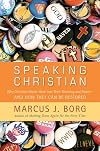
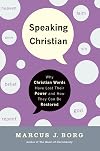
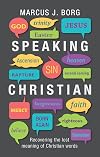
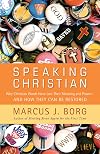
Speaking Christian: Why Christian Words Have Lost Their Meaning and Power - And How They Can Be Restored
by Marcus J. Borg, Marcus J. Borg (Author)
求索系列
On This Page
Description
Asserts that a failure to understand Christian words and phrases has lead to the religion losing much of its meaning, and offers a path back to a true understanding of Christianity.Tags
Recommendations














Member Reviews
This book has languished on my bookshelf for a long time and finally found its day in the sun. It should be required reading for anyone even remotely interested in Christianity.
Borg is not afraid to look at tradition as a humanly determined set of practices, doctrines, interpretations, understandings and hence beliefs. His "liberal" view of Christian practices gives a practical and logical reason for those who cannot accept literal accounts of biblical historical writings to continue to be Christians in word, thought and deed. By putting biblical text into historical and linguistic context, he frees us from the need to accept ancient description at face value and allows us to follow the "will of God" as endorsed and practiced by His show more son, Jesus. Borg contrasts liberal and conservative interpretations and views of scripture and offers to both camps the inclusivity taught by Jesus himself. While this may make some conservative Christians uncomfortable, it should be required reading in a spirit of compassion and understanding. show less
Borg is not afraid to look at tradition as a humanly determined set of practices, doctrines, interpretations, understandings and hence beliefs. His "liberal" view of Christian practices gives a practical and logical reason for those who cannot accept literal accounts of biblical historical writings to continue to be Christians in word, thought and deed. By putting biblical text into historical and linguistic context, he frees us from the need to accept ancient description at face value and allows us to follow the "will of God" as endorsed and practiced by His show more son, Jesus. Borg contrasts liberal and conservative interpretations and views of scripture and offers to both camps the inclusivity taught by Jesus himself. While this may make some conservative Christians uncomfortable, it should be required reading in a spirit of compassion and understanding. show less
In this book, Borg goes through a number of key Christian concepts and explains what they mean from a perspective that is not the heaven-and-hell Christianity that is so common today (especially in the US). The approach he takes to reading is to create a historical-metaphorical understanding of these key concepts. It's important to understand what this does and does not entail. This approach does not entail applying modern ideas or morals on top of Christian ideas. It does not entail watering down the Bible or reading it selectively.
Rather, what it entails is two-fold: first, Borg takes a historical perspective on these concepts. He asks the question, "What did these words mean in and for the ancient communities that used them? What show more did they mean for their 'then'?" and from this, he asks "Given what their words meant for their then, what might their meaning be for our now?" Key in this method of understanding the Bible is that what something means for "their then" need not be the same thing it means to "our now". However, we should not project the understanding of "our now" onto "their then".
Second, it is a metaphorical understanding. This is the fairly straightforward idea that much -- probably most -- of the language of the Bible was meant to be read metaphorically, not literally. Biblical literalism -- and the idea that most texts should be taken as bare factual "newspaper" writing -- is a modern invention which can interfere with our ability to read older texts such as the Bible.
From this foundation, Borg discusses many different concepts. He uses an almost formulaic 1 chapter per 1-2 concept organization. My one criticism of the book is that there are some obvious thematic elements throughout which Borg pulls together occasionally (including at the end) but which could be woven more strongly into a biblically sound progressive Christianity.
Instead of going through the many concepts discussed, I'll focus on that theme. The common theme throughout is that the language of the Bible, both Old Testament and New points toward societal transformation, not individual salvation. However one conceives of God, the message of the Christian language is that God's vision is for a world where there are distributional justice and peace.
If you're used to a heaven-and-hell Christianity, this may sound like a stretch. For example, didn't Jesus die for our sins? How is that not about individual salvation and the afterlife? One of the things that pleasantly surprised me about this book is that Borg was able to make the argument that the broad message of biblical Christianity and many of the specifics that seem to point toward individual salvation are all focused on societal concerns. While it's true that his job was made easier because he sees the Bible as the record of the one tradition's understanding of God rather than as a literal divine revelation, he still takes the Bible as the foundation of his definitions.
This book is an engaging read for anyone, Christian or not, who cares about the monopoly that literalistic Christianity has over moral discourse in the US. show less
Rather, what it entails is two-fold: first, Borg takes a historical perspective on these concepts. He asks the question, "What did these words mean in and for the ancient communities that used them? What show more did they mean for their 'then'?" and from this, he asks "Given what their words meant for their then, what might their meaning be for our now?" Key in this method of understanding the Bible is that what something means for "their then" need not be the same thing it means to "our now". However, we should not project the understanding of "our now" onto "their then".
Second, it is a metaphorical understanding. This is the fairly straightforward idea that much -- probably most -- of the language of the Bible was meant to be read metaphorically, not literally. Biblical literalism -- and the idea that most texts should be taken as bare factual "newspaper" writing -- is a modern invention which can interfere with our ability to read older texts such as the Bible.
From this foundation, Borg discusses many different concepts. He uses an almost formulaic 1 chapter per 1-2 concept organization. My one criticism of the book is that there are some obvious thematic elements throughout which Borg pulls together occasionally (including at the end) but which could be woven more strongly into a biblically sound progressive Christianity.
Instead of going through the many concepts discussed, I'll focus on that theme. The common theme throughout is that the language of the Bible, both Old Testament and New points toward societal transformation, not individual salvation. However one conceives of God, the message of the Christian language is that God's vision is for a world where there are distributional justice and peace.
If you're used to a heaven-and-hell Christianity, this may sound like a stretch. For example, didn't Jesus die for our sins? How is that not about individual salvation and the afterlife? One of the things that pleasantly surprised me about this book is that Borg was able to make the argument that the broad message of biblical Christianity and many of the specifics that seem to point toward individual salvation are all focused on societal concerns. While it's true that his job was made easier because he sees the Bible as the record of the one tradition's understanding of God rather than as a literal divine revelation, he still takes the Bible as the foundation of his definitions.
This book is an engaging read for anyone, Christian or not, who cares about the monopoly that literalistic Christianity has over moral discourse in the US. show less
Reading this book confirms for me that Marcus Borg is possibly my favorite heretic. Don't get me wrong, I don't think he says anything particularly new; his theology is a blend of Schleiermacher subjectivity and Bultmann's de-mythologizing. He denies that Jesus was God pre-Easter (though there is a certain vagueness which makes me unsure if he is an Adoptionist), any substitutionary understanding of Christ's death, the Resurrection, the Ascension, the Second Coming, the Trinity. And yet, he feels that his theological home is Christianity. You may be wondering, if he doesn't believe any of these things can he be called a Christian? Well to answer that question, he wrote a book where he redefines and appropriates Christian show more language.
Actually he makes some good points. Borg has two axes to grind here. One is the way in which he tries to redeem Christian language from two errors. First, there is the Heaven-and-Hell framework which construes Christianity to be about what happens to you when you die. The other is an overly literal interpretation of the Bible.
I think he is right that Christians have, quite often made the faith about believing the right stuff so that you go to heaven when you die, without enough emphasis on how you live now, so I appreciate the critique.
I disagree with his critique on the literal interpretation, precisely because what he means is that the supernatural elements of Jesus life (i.e. miracles, resurrection ,ascension) didn't happen, but that we must probe these events for what they mean. I agree with some of his evocative readings, but do not share his historical literal suspicion.
Where I think Borg is golden is in his description of lived faith. He appropriately probes the meaning of belief in the Christian sense as not merely assent to doctrine, but something more akin to 'I give my heart to.' He explores a full orbed meaning of salvation which includes wholeness, health and liberation and rescue. He examines the human condition and has some good words to say on the Lord's prayer.
So while I can't really endorse this book or offer my hearty recommendation, I enjoyed it and found it edifying (in pieces). show less
Actually he makes some good points. Borg has two axes to grind here. One is the way in which he tries to redeem Christian language from two errors. First, there is the Heaven-and-Hell framework which construes Christianity to be about what happens to you when you die. The other is an overly literal interpretation of the Bible.
I think he is right that Christians have, quite often made the faith about believing the right stuff so that you go to heaven when you die, without enough emphasis on how you live now, so I appreciate the critique.
I disagree with his critique on the literal interpretation, precisely because what he means is that the supernatural elements of Jesus life (i.e. miracles, resurrection ,ascension) didn't happen, but that we must probe these events for what they mean. I agree with some of his evocative readings, but do not share his historical literal suspicion.
Where I think Borg is golden is in his description of lived faith. He appropriately probes the meaning of belief in the Christian sense as not merely assent to doctrine, but something more akin to 'I give my heart to.' He explores a full orbed meaning of salvation which includes wholeness, health and liberation and rescue. He examines the human condition and has some good words to say on the Lord's prayer.
So while I can't really endorse this book or offer my hearty recommendation, I enjoyed it and found it edifying (in pieces). show less
Excellent summary of the choice between literalistic reading of Christian scriptures and the original meanings of basic terms. Borg rejects the assumption that the more conservative (at the extreme: fundamentalistic) interpretations, which arose in the last 200 years, must be accepted as the orthodox theological viewpoint. He defends and describes beautifully the original meanings of basic terms like heaven, salvation, sin and belief and contrasts the differences between a heaven/hell perspective and an earth-centered approach to Christian faith. A great book for those who are turned off by the judgmental, right or wrong, in or out approach of many Christian churches. There is a more faithful form of Christianity that is rooted in the show more scriptures and stresses compassion, inclusion, acceptance and the power of Jesus' teachings about love and forgiveness that has greater moral integrity. RevG show less
What is meant by our Christian language? How do we understand words like “redemption”? Borg reflects on the difference in meaning between liberal and conservative Christian thinking, even though the language is identical. Borg is quite liberal, and he refuses to turn the meaning of words that are special and meaningful to him over to a Christianity that he feels has strayed from the original, radical, this-worldly message of the first Christians.
Early Christianity was not focused on heaven or hell. An emphasis on the afterlife has turned Christianity away from its roots, and consequently, many of the concepts of the Bible have been modernized. A lot of the meanings of words we use as Christians differ so severely from person to show more person that it renders some of us speechless. We simply don’t know how to say what we mean. At least in America, when liberal Christians speak of faith, resurrection, even God, the conservative interpretation is so popular that we often can’t be understood.
The problem words are numerous. Saved. Born again. Mercy. Sin. Belief. (Borg suggests that a proper synonym for "believing" is “beloving.”) I've struggled mightily with this problem on various online forums, to the point where it's tempting to simply give up on "speaking Christian." This makes Borg’s book especially timely for me. So serious is the problem that some have concluded that Christian language is beyond redemption and needs to be replaced by language that actually communicates what we want to communicate. But Borg encourages us to hang in there. If we avoid the language of our faith because of uncertainty about what it means, we grant a monopoly on it to those who are most certain about its meaning. That would be unfortunate, for the language is extraordinarily rich, wise, and transformative. Moreover, if we neglect or reject biblical and Christian language because of its common current-day meanings, a serious question arises: Can we be Christian without using the language of Christianity?
Borg says no. To abandon the language of Christianity would mean leaving behind something that has been profoundly nourishing. Religions are like language. Ceasing to speak French would mean no longer being French. Being Christian means "speaking Christian." show less
Early Christianity was not focused on heaven or hell. An emphasis on the afterlife has turned Christianity away from its roots, and consequently, many of the concepts of the Bible have been modernized. A lot of the meanings of words we use as Christians differ so severely from person to show more person that it renders some of us speechless. We simply don’t know how to say what we mean. At least in America, when liberal Christians speak of faith, resurrection, even God, the conservative interpretation is so popular that we often can’t be understood.
The problem words are numerous. Saved. Born again. Mercy. Sin. Belief. (Borg suggests that a proper synonym for "believing" is “beloving.”) I've struggled mightily with this problem on various online forums, to the point where it's tempting to simply give up on "speaking Christian." This makes Borg’s book especially timely for me. So serious is the problem that some have concluded that Christian language is beyond redemption and needs to be replaced by language that actually communicates what we want to communicate. But Borg encourages us to hang in there. If we avoid the language of our faith because of uncertainty about what it means, we grant a monopoly on it to those who are most certain about its meaning. That would be unfortunate, for the language is extraordinarily rich, wise, and transformative. Moreover, if we neglect or reject biblical and Christian language because of its common current-day meanings, a serious question arises: Can we be Christian without using the language of Christianity?
Borg says no. To abandon the language of Christianity would mean leaving behind something that has been profoundly nourishing. Religions are like language. Ceasing to speak French would mean no longer being French. Being Christian means "speaking Christian." show less
Feels patronizing at first-- but ends up being a good initial examination of how the meanings Christians give to some of their key concepts have changed over the centuries. Essential for anyone who takes the religion seriously.
In Speaking Christian, acclaimed Bible scholar Marcus Borg, author of Meeting Jesus Again for the First Time, argues that the very language Christians use has become dangerously distilled, distorted, and disconnected from the beliefs which once underpinned it. Borg calls for a radical change to the language we use to invoke our beliefs—the only remedy that will allow the Church's words to once again ring with truth, power, and hope.
Members
- Recently Added By
Lists

Nonfiction
41 works; 1 member
Author Information

65+ Works 14,223 Members
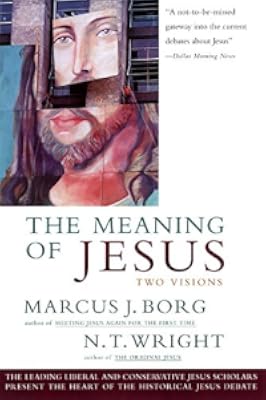
Marcus J. Borg was born on March 11, 1942 in Minnesota. He majored in philosophy and political science at Concordia College. He did graduate work at Union Theological Seminary in New York City and at Oxford University. He taught at various Midwest universities before joining the faculty at Oregon State University in 1979. He taught religion there show more until his retirement in 2007. During his lifetime, he wrote or co-wrote 21 books including Jesus: A New Vision, The Meaning of Jesus: Two Visions with N. T. Wright, and Convictions: How I Learned What Matters Most. He died after a prolonged illness on January 21, 2015 at the age of 72. (Bowker Author Biography) show less
Series

Common Knowledge
- Original title
- Speaking Christian : why Christian words have lost their meaning and power-- and how they can be restored
- Alternate titles*
- 恢復基督教字詞的意義與威力
- Original publication date
- 2011
*Some information comes from Common Knowledge in other languages. Click "Edit" for more information.
Classifications
Statistics
- Members
- 479
- Popularity
- 63,801
- Reviews
- 14
- Rating
- (3.90)
- Languages
- Chinese, English
- Media
- Paper, Audiobook, Ebook
- ISBNs
- 8
- ASINs
- 5