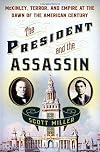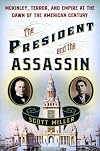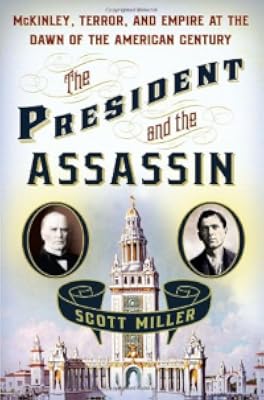
The President and the Assassin: McKinley, Terror, and Empire at the Dawn of the American Century
by Scott Miller
On This Page
Description
In 1901, as America tallied its gains from a period of unprecedented imperial expansion, an assassin's bullet shattered the nation's confidence. This book is the story of the momentous years leading up to that event, and of the very different paths that brought together two figures of the era: President William McKinley and anarchist Leon Czolgosz. The two men seemed to live in eerily parallel Americas. The United States was undergoing an uneasy transition from a simple agrarian society to show more an industrial powerhouse, spreading its influence overseas by force of arms. Czolgosz was on the losing end of the economic changes taking place--a first-generation Polish immigrant and factory worker, sickened by a government that seemed focused solely on making the rich richer. Journalist Scott Miller chronicles how these two men, each pursuing what he considered the right and honorable path, collided in violence at the 1901 Pan-American Exposition in Buffalo, New York.--From publisher description. show lessTags
Recommendations



Member Reviews
Review of: The President and the Assassin: McKinley, Terror, and Empire
at the Dawn of the American Century, by Scott Miller
by Stan Prager (9-2-24)
Noted biographer David Herbert Donald, confident in his conviction that Abraham Lincoln’s character was defined by what he styled as “his essential passivity,” was to take him at his word in an 1864 letter in which the then-president alleged that "I claim not to have controlled events, but confess plainly that events have controlled me." That someone of Donald’s stature could be so utterly deceived by Lincoln’s celebrated acumen for spinning different yarns for assorted audiences simply astonished me. While I bristled quietly, acclaimed Lincoln scholars objected both audibly and show more vehemently, and do so to this day. But if ever there truly was a passive occupant of the White House driven almost entirely by outside events, it was the William McKinley that emerges in The President and the Assassin: McKinley, Terror, and Empire at the Dawn of the American Century [2011], by international correspondent Scott Miller, a fast-paced, well-written portrait of America in the final years of the nineteenth century burdened by one of the most ill-conceived and awkward titles in recent memory.
McKinley, the mild-mannered pro-business twenty-fifth president, is largely remembered—when he is remembered at all—for his assassination at the turn of the century, which catapulted his far more colorful and politically progressive Vice President Theodore Roosevelt into executive office. Yet, it was McKinley who presided over a newly-expansionist America’s initial violent baby steps towards a global presence in its first significant act of overseas aggression, the Spanish-American War of 1898. But here too McKinley was upstaged by Roosevelt, who in his then-role as Assistant Secretary of the Navy helped instigate the war, and then famously led his “Rough Riders” on charges up Kettle and San Juan Hills in Cuba. Meanwhile, McKinley spent much of his time quietly vacillating over policy, when not tending to his sickly, likely hypochondriac, wife Ida. McKinley, who was quite popular and even beloved, won reelection in a landslide, but his second term was abruptly cut short by bullets fired by anarchist Leon Czolgosz during his attendance at the Pan-American Exposition in Buffalo, New York on September 6, 1901. He died of his wounds one week later.
Those who turn to The President and the Assassin for a focus upon McKinley’s untimely end may be disappointed, because despite the title this incident represents only a small slice of the narrative. But that turns out to be just as well, because Miller instead serves up a much wider menu that ranges from the explosive expansion of the American economy fueled by industrialism and innovation, the roots and endurance of labor unrest, the related growth of political radicalism and its sometime close cousin anarchism, and Washington’s lust to join the other Western powers in an orgy of imperialism that included the peaceful annexation of Hawaii, along with the ill-begotten gains from the war with Spain that added Guam, Puerto Rico, and the Philippines as overseas territories, while asserting an “Open Door” right to access Chinese markets. Each of these topics merits a book-length treatment, but Miller succeeds in blending these themes and much more into a fascinating and immensely readable account of disparate forces that coalesced to shape the nation as the nineteenth century drew to a close.
The post-Reconstruction Republican Party largely abandoned African Americans and their struggle for civil rights while embracing big business and pro-growth policies that in an era lacking any real regulation created enormous wealth for some while tethering the welfare of masses of wage workers, many of them immigrants, to the whims of the few who controlled factories, mills, mining, and other industries. The vast economic inequality that characterized the Gilded Age bred deep resentment and anger among the working class, who found themselves paid a pittance of near-starvation wages while compelled to labor long hours in often unsafe conditions and liable to be fired at a moment’s notice if they advanced even the slightest objection. The protectionism in vogue at the time—McKinley made his political career championing tariffs—kept prices high even when wages arbitrarily fell. The law favored business and their captains of industry, such that the attempts of organized labor to improve their lot were frequently crushed with the support and active participation of the police and the military, leaving workers dead, imprisoned, or unemployed, even blackballed from being rehired ever again.
McKinley, who many years earlier served pro bono as counsel for striking miners, as president demonstrated little concern for the plight of workers, but he was, as the author emphasizes, consumed with the growing problem of overproduction that was threatening the nation’s long-term economic health. In short, the buying power of the population of the United States could not support purchasing the amount of goods that factories were churning out. Rather than producing less, as the typical capitalist supply and demand economic imperative would dictate, manufacturers kept up a frenetic pace of increased supply, cutting wages by caprice to increase profitability. It was this dilemma that got the president to shift his gaze overseas. If cutting production was unthinkable, perhaps expanding the market for American goods to foreign shores would do the trick. And it was that notion that saw McKinley, a Civil War veteran who had witnessed enough bloodletting in his time to enter office firmly resistant to any kind of jingoist adventurism, begin to temper that opposition even as larger events presented a convenient opportunity to do so.
Those events centered around the ongoing guerrilla war in Cuba by insurgents seeking the island’s independence from Spain. Americans were generally sympathetic to the rebels and eager to see the Spanish driven from the hemisphere. In 1897, McKinley even offered to purchase Cuba, but was rebuffed by Spain. When the US battleship Maine exploded for unknown reasons and sank while docked at Havana Harbor in February1898, forces were set in motion that would lead to war. At first, McKinley sought a diplomatic solution, but he also dithered, while others—especially Roosevelt—lobbied for aggressive action. Finally, McKinley’s longing for foreign markets for American goods aligned with the pleadings of those who urged him to act in the national interest, and a shooting war was on. The once-mighty Spain fell rapidly to American firepower on land and at sea. The United States acquired Guam, Puerto Rico, and the Philippines. Cuba was granted its independence, as such, even as it fell under the thumb of US domination for six decades to come. The real war, with Filipino guerrillas seeking their own sovereignty, had just begun, and was put down brutally by the United States. Later termed the Philippine–American War, it resulted in the deaths of over 200,000 civilians. While Miller’s coverage here generally deserves high marks, he tends to be far too sympathetic to American objectives and little dwells upon the terrible atrocities committed by US forces in the process of pacifying the Philippines. For that, the reader must turn elsewhere.
Meanwhile, as attempts at organized labor fizzled and union-busting went unpunished, more radical politics began to inform the disenfranchised seeking some form of satisfaction. At the fringes were anarchists like Emma Goldman who preached against any form of authority, a message that resonated among some sectors of the oppressed. Still, the powers that be feared anarchism far out of proportion to its actual influence. I have often compared George W. Bush’s vague, ill-judged “War on Terror” with comparable efforts against anarchism back in the day. Since neither jihadists nor anarchists can commonly be identified with any formal organization, attacking each with all forces at your disposal amounts to little more than punching at paper bags in a darkened room, with similar results. Chicago’s Haymarket Affair, now recalled as the origin of International Workers' Day, began as a peaceful assembly in support of a workers’ strike that turned violent when police interceded, and a bomb was thrown by an individual who was never identified. Eight anarchists were arrested, and four were hanged, including the well-known activist Albert Parsons, even though there remains no evidence any were involved with the bombing, while the responsibility for the deaths of nearly a dozen at Haymarket were likely the result of police gunfire.
But there was indeed also an authentic violent streak in anarchism. In the two decades leading up to McKinley’s assassination, anarchists murdered the Russian tsar, the president of France, the Spanish prime minister, the Austro-Hungarian empress, and the king of Italy. It was Czolgosz’s turn next, but in Miller’s characterization, he comes across as the unlikeliest of assassins. A lazy, aimless, disaffected, and socially-awkward loner, his passion for ideology seemed to come in a far distant second to his desperation for finding a place to fit in. Instead, it cost him his life. Still asserting that he acted in support of the working man, he was swiftly tried and executed in the electric chair only forty-five days after McKinley succumbed to his wounds.
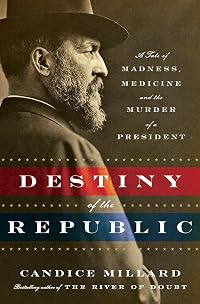
Presidential biographies are a favored genre. I found The President and the Assassin on the shelves of my personal library shortly after reading two books on James A. Garfield back-to-back, including Candice Millard’s Destiny of the Republic, which is devoted to Garfield’s long, excruciating death from gunshot wounds. McKinley and Garfield had much in common. Both were Civil War generals. Both mourned the loss of young children. Both were Republican politicians, highly regarded by their peers, who advanced to the presidency. Also, tragically, both fell to an assassin’s bullets, almost exactly twenty years apart to the very month. Unlike Lincoln and JFK, who were shot in the head, both Garfield and McKinley suffered injuries to the torso that need not have been fatal. Garfield, whose wounds were probed with unwashed fingers, lived an agonizing seventy-nine days before dying of the resulting infection. Medical care had improved dramatically since Garfield’s day, but it did not save McKinley, who mercifully only lingered for a week, but yet died of gangrene.
While it was perhaps a morbid fascination with McKinley’s end that first brought me to The President and the Assassin, the book turned out to have far more to offer. I want to believe that the ungainly title was forced upon Miller by an editor eager for book sales who either disregarded or disdained the author’s intended audience, but it certainly shortchanged the value of this book, which deserves not only a better title but an expanded readership. I highly recommend it.
Sidney Blumenthal objects to Donald’s characterization of Lincoln in the prologue: Review of: A Self-Made Man: The Political Life of Abraham Lincoln Vol. I, 1809–1849, by Sidney Blumenthal
For more extensive coverage of the Spanish-American War and especially the Filipino insurgency: Review of: The True Flag: Theodore Roosevelt, Mark Twain, and the Birth of American Empire, by Stephen Kinzer
For an account of Garfield’s long death: Review of: Destiny of the Republic: A Tale of Madness, Medicine and the Murder of a President, by Candice Millard
More on Garfield and Republican politics: Review of: President Garfield: From Radical to Unifier, by C.W. Goodyear
Review of: The President and the Assassin: McKinley, Terror, and Empire at the Dawn of the American Century, by Scott Miller – Regarp Book Blog https://regarp.com/2024/09/02/review-of-the-president-and-the-assassin-mckinley-... show less
at the Dawn of the American Century, by Scott Miller
by Stan Prager (9-2-24)
Noted biographer David Herbert Donald, confident in his conviction that Abraham Lincoln’s character was defined by what he styled as “his essential passivity,” was to take him at his word in an 1864 letter in which the then-president alleged that "I claim not to have controlled events, but confess plainly that events have controlled me." That someone of Donald’s stature could be so utterly deceived by Lincoln’s celebrated acumen for spinning different yarns for assorted audiences simply astonished me. While I bristled quietly, acclaimed Lincoln scholars objected both audibly and show more vehemently, and do so to this day. But if ever there truly was a passive occupant of the White House driven almost entirely by outside events, it was the William McKinley that emerges in The President and the Assassin: McKinley, Terror, and Empire at the Dawn of the American Century [2011], by international correspondent Scott Miller, a fast-paced, well-written portrait of America in the final years of the nineteenth century burdened by one of the most ill-conceived and awkward titles in recent memory.
McKinley, the mild-mannered pro-business twenty-fifth president, is largely remembered—when he is remembered at all—for his assassination at the turn of the century, which catapulted his far more colorful and politically progressive Vice President Theodore Roosevelt into executive office. Yet, it was McKinley who presided over a newly-expansionist America’s initial violent baby steps towards a global presence in its first significant act of overseas aggression, the Spanish-American War of 1898. But here too McKinley was upstaged by Roosevelt, who in his then-role as Assistant Secretary of the Navy helped instigate the war, and then famously led his “Rough Riders” on charges up Kettle and San Juan Hills in Cuba. Meanwhile, McKinley spent much of his time quietly vacillating over policy, when not tending to his sickly, likely hypochondriac, wife Ida. McKinley, who was quite popular and even beloved, won reelection in a landslide, but his second term was abruptly cut short by bullets fired by anarchist Leon Czolgosz during his attendance at the Pan-American Exposition in Buffalo, New York on September 6, 1901. He died of his wounds one week later.
Those who turn to The President and the Assassin for a focus upon McKinley’s untimely end may be disappointed, because despite the title this incident represents only a small slice of the narrative. But that turns out to be just as well, because Miller instead serves up a much wider menu that ranges from the explosive expansion of the American economy fueled by industrialism and innovation, the roots and endurance of labor unrest, the related growth of political radicalism and its sometime close cousin anarchism, and Washington’s lust to join the other Western powers in an orgy of imperialism that included the peaceful annexation of Hawaii, along with the ill-begotten gains from the war with Spain that added Guam, Puerto Rico, and the Philippines as overseas territories, while asserting an “Open Door” right to access Chinese markets. Each of these topics merits a book-length treatment, but Miller succeeds in blending these themes and much more into a fascinating and immensely readable account of disparate forces that coalesced to shape the nation as the nineteenth century drew to a close.
The post-Reconstruction Republican Party largely abandoned African Americans and their struggle for civil rights while embracing big business and pro-growth policies that in an era lacking any real regulation created enormous wealth for some while tethering the welfare of masses of wage workers, many of them immigrants, to the whims of the few who controlled factories, mills, mining, and other industries. The vast economic inequality that characterized the Gilded Age bred deep resentment and anger among the working class, who found themselves paid a pittance of near-starvation wages while compelled to labor long hours in often unsafe conditions and liable to be fired at a moment’s notice if they advanced even the slightest objection. The protectionism in vogue at the time—McKinley made his political career championing tariffs—kept prices high even when wages arbitrarily fell. The law favored business and their captains of industry, such that the attempts of organized labor to improve their lot were frequently crushed with the support and active participation of the police and the military, leaving workers dead, imprisoned, or unemployed, even blackballed from being rehired ever again.
McKinley, who many years earlier served pro bono as counsel for striking miners, as president demonstrated little concern for the plight of workers, but he was, as the author emphasizes, consumed with the growing problem of overproduction that was threatening the nation’s long-term economic health. In short, the buying power of the population of the United States could not support purchasing the amount of goods that factories were churning out. Rather than producing less, as the typical capitalist supply and demand economic imperative would dictate, manufacturers kept up a frenetic pace of increased supply, cutting wages by caprice to increase profitability. It was this dilemma that got the president to shift his gaze overseas. If cutting production was unthinkable, perhaps expanding the market for American goods to foreign shores would do the trick. And it was that notion that saw McKinley, a Civil War veteran who had witnessed enough bloodletting in his time to enter office firmly resistant to any kind of jingoist adventurism, begin to temper that opposition even as larger events presented a convenient opportunity to do so.
Those events centered around the ongoing guerrilla war in Cuba by insurgents seeking the island’s independence from Spain. Americans were generally sympathetic to the rebels and eager to see the Spanish driven from the hemisphere. In 1897, McKinley even offered to purchase Cuba, but was rebuffed by Spain. When the US battleship Maine exploded for unknown reasons and sank while docked at Havana Harbor in February1898, forces were set in motion that would lead to war. At first, McKinley sought a diplomatic solution, but he also dithered, while others—especially Roosevelt—lobbied for aggressive action. Finally, McKinley’s longing for foreign markets for American goods aligned with the pleadings of those who urged him to act in the national interest, and a shooting war was on. The once-mighty Spain fell rapidly to American firepower on land and at sea. The United States acquired Guam, Puerto Rico, and the Philippines. Cuba was granted its independence, as such, even as it fell under the thumb of US domination for six decades to come. The real war, with Filipino guerrillas seeking their own sovereignty, had just begun, and was put down brutally by the United States. Later termed the Philippine–American War, it resulted in the deaths of over 200,000 civilians. While Miller’s coverage here generally deserves high marks, he tends to be far too sympathetic to American objectives and little dwells upon the terrible atrocities committed by US forces in the process of pacifying the Philippines. For that, the reader must turn elsewhere.
Meanwhile, as attempts at organized labor fizzled and union-busting went unpunished, more radical politics began to inform the disenfranchised seeking some form of satisfaction. At the fringes were anarchists like Emma Goldman who preached against any form of authority, a message that resonated among some sectors of the oppressed. Still, the powers that be feared anarchism far out of proportion to its actual influence. I have often compared George W. Bush’s vague, ill-judged “War on Terror” with comparable efforts against anarchism back in the day. Since neither jihadists nor anarchists can commonly be identified with any formal organization, attacking each with all forces at your disposal amounts to little more than punching at paper bags in a darkened room, with similar results. Chicago’s Haymarket Affair, now recalled as the origin of International Workers' Day, began as a peaceful assembly in support of a workers’ strike that turned violent when police interceded, and a bomb was thrown by an individual who was never identified. Eight anarchists were arrested, and four were hanged, including the well-known activist Albert Parsons, even though there remains no evidence any were involved with the bombing, while the responsibility for the deaths of nearly a dozen at Haymarket were likely the result of police gunfire.
But there was indeed also an authentic violent streak in anarchism. In the two decades leading up to McKinley’s assassination, anarchists murdered the Russian tsar, the president of France, the Spanish prime minister, the Austro-Hungarian empress, and the king of Italy. It was Czolgosz’s turn next, but in Miller’s characterization, he comes across as the unlikeliest of assassins. A lazy, aimless, disaffected, and socially-awkward loner, his passion for ideology seemed to come in a far distant second to his desperation for finding a place to fit in. Instead, it cost him his life. Still asserting that he acted in support of the working man, he was swiftly tried and executed in the electric chair only forty-five days after McKinley succumbed to his wounds.
Presidential biographies are a favored genre. I found The President and the Assassin on the shelves of my personal library shortly after reading two books on James A. Garfield back-to-back, including Candice Millard’s Destiny of the Republic, which is devoted to Garfield’s long, excruciating death from gunshot wounds. McKinley and Garfield had much in common. Both were Civil War generals. Both mourned the loss of young children. Both were Republican politicians, highly regarded by their peers, who advanced to the presidency. Also, tragically, both fell to an assassin’s bullets, almost exactly twenty years apart to the very month. Unlike Lincoln and JFK, who were shot in the head, both Garfield and McKinley suffered injuries to the torso that need not have been fatal. Garfield, whose wounds were probed with unwashed fingers, lived an agonizing seventy-nine days before dying of the resulting infection. Medical care had improved dramatically since Garfield’s day, but it did not save McKinley, who mercifully only lingered for a week, but yet died of gangrene.
While it was perhaps a morbid fascination with McKinley’s end that first brought me to The President and the Assassin, the book turned out to have far more to offer. I want to believe that the ungainly title was forced upon Miller by an editor eager for book sales who either disregarded or disdained the author’s intended audience, but it certainly shortchanged the value of this book, which deserves not only a better title but an expanded readership. I highly recommend it.
Sidney Blumenthal objects to Donald’s characterization of Lincoln in the prologue: Review of: A Self-Made Man: The Political Life of Abraham Lincoln Vol. I, 1809–1849, by Sidney Blumenthal
For more extensive coverage of the Spanish-American War and especially the Filipino insurgency: Review of: The True Flag: Theodore Roosevelt, Mark Twain, and the Birth of American Empire, by Stephen Kinzer
For an account of Garfield’s long death: Review of: Destiny of the Republic: A Tale of Madness, Medicine and the Murder of a President, by Candice Millard
More on Garfield and Republican politics: Review of: President Garfield: From Radical to Unifier, by C.W. Goodyear
Review of: The President and the Assassin: McKinley, Terror, and Empire at the Dawn of the American Century, by Scott Miller – Regarp Book Blog https://regarp.com/2024/09/02/review-of-the-president-and-the-assassin-mckinley-... show less
Well-written book about the assassination of McKinley. What is particularly good about the book is that way that it tells the story of McKinley in parallel to the story of his assassin.
A “Review” of The President and the Assassin
With a title like The President and the Assassin, you'd think this book was about a president and an assassin. And it is. Sort of. This book is less about the individuals and more about the period and the prevailing attitudes at the turn of the century. Granted, William McKinley is not one of the most well-known presidents. And surely there isn't much information regarding Leon Czolgosz. Still, I hoped for a little more sustenance regarding the two figures.
But there's plenty here about industry, military, anarchy, politics, and society in the late nineteenth century. The author does wonderfully to portray the facts and withhold personal feelings. The late 1800s was a time that mirrors our show more own, and the United States was on the brink of huge change. The United States, having recovered from the Civil War, was considering a bold rejection of its anti-imperialist past in exchange for a bridge of U.S. islands that led straight into China. First, however, the U.S. needed to convince its people, so Teddy Roosevelt went scuba diving under a U.S. battleship, blew it up, and insisted revenge be taken on Spain. Problem was, the President himself wasn't completely convinced because he was actually one of the more decent presidents and wasn't about to go rushing into war when he suspected something fishy was going on (speaking of which, McKinley's relationship with his wife was out-and-out adorable, wasn't it? They should've had their own reality show. I mean, really, how many men out there can say they can show up William McKinley?) So the people are hungry for war with Spain and McKinley's backed into a corner and after so much time he relents (because for some reason he's now a little blood-thirsty himself) and wages war on... the Philippines? Oh yeah, bridge to China. Throw in a dash of desperate workers and all-too-knowing anarchists and you've got a good story.*
So, interesting times indeed. A good book. Unlike the author, however, I've let my personal feelings jade this review. At least I can hide my rant under a misleading title and claim I was merely inspired by the author.
*(Some readers may wish to take the above summary and insert the following words where appropriate: Dick Cheney, Afghanistan, and Iraq. Also, for proper parallels to be drawn, the sentence that begins “Problem was, the President...” must be removed. Some readers, on the other hand, may wish to beat me with a wooden spoon.) show less
With a title like The President and the Assassin, you'd think this book was about a president and an assassin. And it is. Sort of. This book is less about the individuals and more about the period and the prevailing attitudes at the turn of the century. Granted, William McKinley is not one of the most well-known presidents. And surely there isn't much information regarding Leon Czolgosz. Still, I hoped for a little more sustenance regarding the two figures.
But there's plenty here about industry, military, anarchy, politics, and society in the late nineteenth century. The author does wonderfully to portray the facts and withhold personal feelings. The late 1800s was a time that mirrors our show more own, and the United States was on the brink of huge change. The United States, having recovered from the Civil War, was considering a bold rejection of its anti-imperialist past in exchange for a bridge of U.S. islands that led straight into China. First, however, the U.S. needed to convince its people, so Teddy Roosevelt went scuba diving under a U.S. battleship, blew it up, and insisted revenge be taken on Spain. Problem was, the President himself wasn't completely convinced because he was actually one of the more decent presidents and wasn't about to go rushing into war when he suspected something fishy was going on (speaking of which, McKinley's relationship with his wife was out-and-out adorable, wasn't it? They should've had their own reality show. I mean, really, how many men out there can say they can show up William McKinley?) So the people are hungry for war with Spain and McKinley's backed into a corner and after so much time he relents (because for some reason he's now a little blood-thirsty himself) and wages war on... the Philippines? Oh yeah, bridge to China. Throw in a dash of desperate workers and all-too-knowing anarchists and you've got a good story.*
So, interesting times indeed. A good book. Unlike the author, however, I've let my personal feelings jade this review. At least I can hide my rant under a misleading title and claim I was merely inspired by the author.
*(Some readers may wish to take the above summary and insert the following words where appropriate: Dick Cheney, Afghanistan, and Iraq. Also, for proper parallels to be drawn, the sentence that begins “Problem was, the President...” must be removed. Some readers, on the other hand, may wish to beat me with a wooden spoon.) show less
I had thought this would contain more of a biography of William McKinley, as the book about Garfield's assassination had a good biography of that president. Unfortunately, this book did not have much of a McKinley biography, although it has a very detailed biography of his assassin. I'm always a little uncomfortable when we spend so much time with assassins, giving them as much weight as their targets. However, its clear that the author wants to discuss the society in America at the turn of the 20th century, and so that explains why we are reading more about the assassin than the target. However, I feel like the narrative loses focus at times, going on tangents about the anarchist movement in the US at this time, although since that's show more how the assassin identified himself it makes sense. There's just something mildly unfulfilling about this book and I can't quite identify what it is. show less
A fascinating book that offers a compelling and insightful look at the heights of America's industrial age and its imperialistic ambitions born out of the Manifest Destiny mentality, the anarchist movement, and political developments in Europe and east Asia, all within the conext of the assassination of President McKinley.
Very good read. Dry in spots but not as dry as other non-fiction. I enjoyed reading abt the Polish immigrant experience and the personal life of McKinley as well as the Pan Am experience.One thing for sure is that 112 years later,politics has NOT changed.Substiute terrorists for anarchists,the immigrant experience is the same also.Recommended.
I've been to the Roosevelt Inaugural site many times and always learned alot about McKinley assassination.But this book filled in alot of missing info for me.
I've been to the Roosevelt Inaugural site many times and always learned alot about McKinley assassination.But this book filled in alot of missing info for me.
This book is the story of the momentous years leading up to the assassination of President McKinley, and of the very different paths that brought together two figures of the era: President William McKinley and anarchist Leon Czolgosz. Journalist Scott Miller chronicles how these two men, each pursuing what he considered the right and honorable path, collided in violence at the 1901 Pan-American Exposition in Buffalo, New York.
This is a non-fiction book that tells the story of both men. It touches on various issues of the time that McKinley was dealing with including the effect of the industrial revolution. Czolgosz was effected in a different way. He was drawn to anarchist groups that were rather prevalent at the time and claimed to be show more on the side of the working man. The book didn’t go into depth on any issue but I liked that. I got enough of an understanding and learned a few things while moving along at a good pace. show less
This is a non-fiction book that tells the story of both men. It touches on various issues of the time that McKinley was dealing with including the effect of the industrial revolution. Czolgosz was effected in a different way. He was drawn to anarchist groups that were rather prevalent at the time and claimed to be show more on the side of the working man. The book didn’t go into depth on any issue but I liked that. I got enough of an understanding and learned a few things while moving along at a good pace. show less
Members
- Recently Added By
Lists

Top Five Books of 2013
1,562 works; 721 members

The Presidents
42 works; 2 members
Author Information

3 Works 575 Members
Awards and Honors
Notable Lists
Common Knowledge
- Original publication date
- 2011
- People/Characters
- William McKinley; Leon Czolgosz; Emilio Aguinaldo; William Jennings Bryan; George Dewey; Emma Goldman (show all 11); Mark Hanna; John Hay; Ida McKinley; Albert Parsons; Theodore Roosevelt
- Important places
- Buffalo, New York, USA; Canton, Ohio, USA; Chicago, Illinois, USA; Cuba; Manila, The Philippines; Philippines
- Important events
- Election of 1896; Election of 1900; Assassination of William McKinley; Haymarket Riot; Spanish-American War; Pan-American Exposition
- Dedication
- To Mom
- First words
- They streamed among the manicured flower beds and dewy lawns of Delaware Park that early September morning in Buffalo, New York, a portrait of America in the Gilded Age.
- Last words
- (Click to show. Warning: May contain spoilers.)Silently, the witnesses filed out of the observation room and into the morning.
(Click to show. Warning: May contain spoilers.)The whole trigger for the Spanish-American War, and all that had happened in the years that followed, had been an accident. - Blurbers
- Thomas, Evan; Zakaria, Fareed
Classifications
- Genres
- History, Nonfiction, General Nonfiction, Biography & Memoir
- DDC/MDS
- 973.8 — History & geography History of North America United States The Gilded Age, Reconstruction, Spanish American War (1865-1901)
- LCC
- E711 .M45 — History of the United States United States Late nineteenth century, 1865-1900 McKinley's first administration, 1897-1901
- BISAC
Statistics
- Members
- 525
- Popularity
- 57,023
- Reviews
- 15
- Rating
- (3.96)
- Languages
- English
- Media
- Paper, Audiobook, Ebook
- ISBNs
- 8
- ASINs
- 7