On This Page
Description
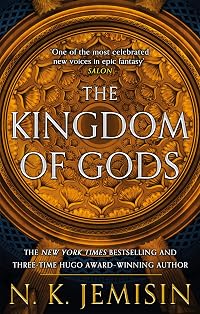
Shahar and the godling Sieh must face off against the terrible magic threatening to consume their world in the incredible conclusion to the Inheritance Trilogy, from Hugo award-winning and NYT bestselling author N. K. Jemisin.For two thousand years the Arameri family has ruled the world by enslaving the very gods that created mortalkind. Now the gods are free, and the Arameri's ruthless grip is slipping. Yet they are all that stands between peace and world-spanning, unending war.
Shahar, show more last scion of the family, must choose her loyalties. She yearns to trust Sieh, the godling she loves. Yet her duty as Arameri heir is to uphold the family's interests, even if that means using and destroying everyone she cares for.
As long-suppressed rage and terrible new magics consume the world, the Maelstrom — which even gods fear — is summoned forth. Shahar and Sieh: mortal and god, lovers and enemies. Can they stand together against the chaos that threatens?
Includes a never before seen story set in the world of the Inheritance Trilogy.
The Inheritance Trilogy
The Hundred Thousand Kingdoms
The Broken Kingdoms
The Kingdom of Gods
The Inheritance Trilogy (omnibus edition)
Shades in Shadow: An Inheritance Triptych (e-only short fiction)
The Awakened Kingdom (e-only novella)
For more from N. K. Jemisin, check out:
Dreamblood Duology
The Killing Moon
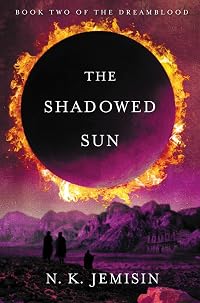
The Shadowed Sun
The Broken Earth series
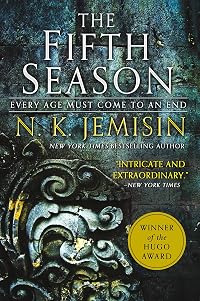
The Fifth Season
The Obelisk Gate
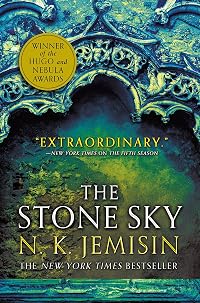
The Stone Sky
. show less
Tags
Recommendations







Member Reviews
First off, it's amazing how much progress one can make on a fantasy novel while one is cooling one's heels before a solar eclipse reaches totality.
Having commented a number of times on how the second book of this trilogy didn't do much for me, and I only finally got it read by dealing with it as a chore to get done, I approached the final book with a little trepidation. However, taking the godling Sieh as its prime character focus, this concluding book is far from a chore to read, and I enjoyed it quite a lot. But, did I enjoy it better than "The Hundred Thousand Kingdoms?" Perhaps not, but it's been a long time since I read that book and I'm still inclined to call it my second favorite work of Jemisin's, only esteeming "The Fifth show more Season" more.
Still, things blow up real good in the climax of this trilogy, in which the process of collapse started in the first book comes to its culmination point, leading to a rebirth of sorts. Also, Jemisin ends on a grace note calling out to that second book I'm not so fond of, which I personally thought turned out to be a great point to end on. show less
Having commented a number of times on how the second book of this trilogy didn't do much for me, and I only finally got it read by dealing with it as a chore to get done, I approached the final book with a little trepidation. However, taking the godling Sieh as its prime character focus, this concluding book is far from a chore to read, and I enjoyed it quite a lot. But, did I enjoy it better than "The Hundred Thousand Kingdoms?" Perhaps not, but it's been a long time since I read that book and I'm still inclined to call it my second favorite work of Jemisin's, only esteeming "The Fifth show more Season" more.
Still, things blow up real good in the climax of this trilogy, in which the process of collapse started in the first book comes to its culmination point, leading to a rebirth of sorts. Also, Jemisin ends on a grace note calling out to that second book I'm not so fond of, which I personally thought turned out to be a great point to end on. show less
This is the final volume in N.K. Jemisin's Inheritance trilogy, and... wow. The first two books were good, but this one is fantastic. This time the story is told from the point of view of one of the gods (although one who's suffering from a slight mortality problem), and the perspective this gives us on the nature and experiences and history of these entities is fascinating. I really am in awe of what Jemisin does with her mythology, the way it feels at once familiar in its archetypes and yet also utterly inventive and original. She makes her god characters compellingly complex and subtle, too, in ways that make one really think about what it even means to be a god of something.
Oh, yes, and the plot is also great, with a climax that is show more exciting and unexpected, epic and moving and perhaps even a little bit profound.
And, as a bonus, it's also got possibly the most hilarious glossary of terms I've ever seen in a novel, too. show less
Oh, yes, and the plot is also great, with a climax that is show more exciting and unexpected, epic and moving and perhaps even a little bit profound.
And, as a bonus, it's also got possibly the most hilarious glossary of terms I've ever seen in a novel, too. show less
I must say that this is the best of all three.
Sieh.
He touched me just as much as he touched Shahar or Deka. And before you start going on about how that's nasty, I mean it entirely metaphorically! Gosh, you people. I was damn close to tears an unknowable number of times while reading this. It was special in a way that all deeply mythological tales can be special, even when they tear a hole in reality to let in the Maelstrom, borrow from so many sources, and yet manage to be fully creative and original all on their own.
Was I genuinely surprised by some of their choices, or by the events that happened, or the way it finally got resolved? Yes, to all three.
I cried. It was just that good.
As for some of the things that some of you might be show more looking for in a progressive tale: There is offhand and natural relations between the sexes that I've come to expect from gods and godlings, only it is is a bit more down to earth with more of the mortal flavor in this novel. Traditional love story, this isn't.
What it really manages to be, spectacularly, is a novel about growing up.
That in itself is the biggest source of all conflict, of course, and made so much worse because it is the god of childhood and mischief that has to undergo such a nightmare of losing everything that he is.
What an emotional ride.
Plots and other storylines were very interesting and held the rest of the tale together as tightly as anyone could desire, and there were some rather huge events that happened, satisfying my ever-increasing desire for "More, More, More" mind-blowing greatness. I truly couldn't put the novel down for the life of me. It was intelligent, so well-crafted, wise, mischievous, and eventful. And best of all, it had one hell of a great story underneath everything else that was popping.
I already knew that Jemisin was one hell of an artist, from the first novel that I read, [b:The Fifth Season|19161852|The Fifth Season (The Broken Earth, #1)|N.K. Jemisin|https://d.gr-assets.com/books/1386803701s/19161852.jpg|26115977], to this third book in the wonderful [b:The Broken Kingdoms|7904453|The Broken Kingdoms (Inheritance, #2)|N.K. Jemisin|https://d.gr-assets.com/books/1282522268s/7904453.jpg|11165787]. She's now become my go-to mastermind for brilliant storytelling, huge worldbuilding, and mythopunk craving.
So damn wonderful! show less
Sieh.
He touched me just as much as he touched Shahar or Deka. And before you start going on about how that's nasty, I mean it entirely metaphorically! Gosh, you people. I was damn close to tears an unknowable number of times while reading this. It was special in a way that all deeply mythological tales can be special, even when they tear a hole in reality to let in the Maelstrom, borrow from so many sources, and yet manage to be fully creative and original all on their own.
Was I genuinely surprised by some of their choices, or by the events that happened, or the way it finally got resolved? Yes, to all three.
I cried. It was just that good.
As for some of the things that some of you might be show more looking for in a progressive tale: There is offhand and natural relations between the sexes that I've come to expect from gods and godlings, only it is is a bit more down to earth with more of the mortal flavor in this novel. Traditional love story, this isn't.
What it really manages to be, spectacularly, is a novel about growing up.
That in itself is the biggest source of all conflict, of course, and made so much worse because it is the god of childhood and mischief that has to undergo such a nightmare of losing everything that he is.
What an emotional ride.
Plots and other storylines were very interesting and held the rest of the tale together as tightly as anyone could desire, and there were some rather huge events that happened, satisfying my ever-increasing desire for "More, More, More" mind-blowing greatness. I truly couldn't put the novel down for the life of me. It was intelligent, so well-crafted, wise, mischievous, and eventful. And best of all, it had one hell of a great story underneath everything else that was popping.
I already knew that Jemisin was one hell of an artist, from the first novel that I read, [b:The Fifth Season|19161852|The Fifth Season (The Broken Earth, #1)|N.K. Jemisin|https://d.gr-assets.com/books/1386803701s/19161852.jpg|26115977], to this third book in the wonderful [b:The Broken Kingdoms|7904453|The Broken Kingdoms (Inheritance, #2)|N.K. Jemisin|https://d.gr-assets.com/books/1282522268s/7904453.jpg|11165787]. She's now become my go-to mastermind for brilliant storytelling, huge worldbuilding, and mythopunk craving.
So damn wonderful! show less
I’m ngl, I had a really tough time getting into this book. I think it’s because I’m just really not a fan of the trope where a main character loses their powers. So it took me weeks to actually finish this. In the end, Sieh is still one of my favourite characters from the inheritance trilogy, and this book’s rating got increased by 1 star because of the ending, which I loved. It really wraps this series up well and solved practically all of the questions that I had previously. I will definitely be reading this trilogy again though, definitely a favourite of mine from now on.
The Kingdom of Gods is the third book in N. K. Jemisin’s Inheritance trilogy. Like the first two books it tells a complete story, although I think the background from the earlier books adds more depth that one wouldn’t get if they jumped straight to this book for some ungodly reason. If I were a godling, I’d be the godling of Reading Series Books in Consecutive Order. :)
The story is set several decades after the last book and the main character is a godling that we’ve met before, but he’s new as a POV character. I’m going to put his name in spoiler tags for those who want to be surprised:Sieh, the godling of childhood, sometimes called the Trickster . Although he did some things that I didn’t like and could not respect, he show more was often a fun voice to narrate the story and I did like him quite well by the end. I thought there were a few slow spots, but it mostly held my interest. In fact, until I finished and started updating my notes, I completely forgot that it was 200 pages longer than each of the previous two books. It didn’t feel longer to me.
For most of the book I was planning to give this a solid 4 stars, or possibly 4.5 and round down to 4 on Goodreads, but the ending made me very happy. And then, in my edition anyway, it was followed up with a short story called Not the End which takes place after this third book but provides some closure to the second book. It was a bit sappy, but it made me happy too. And then that was followed up with a glossary that totally cracked me up. Clearly the author made the mistake of letting her main character get a hold of it! So after all of those smiles at the end, I decided to rate it at 4.5 stars and round up to 5 on Goodreads.
I have a few more spoiler-filled comments, mostly about the ending.
At the beginning of the book, Sieh said something about how he wasn’t going to play any tricks about who he was writing to, and then made snide references to how we found out who the narrators of the previous two books were writing to. Near the end of the book after Sieh died and Shahar took over the narration, I thought Sieh had actually played the cruelest trick of them all and I wasn’t very happy at all. But I was all smiles by the end of the Coda.
I think with every book in this trilogy I’ve reached the almost-end feeling unhappy about how things were clearly going to end, only to find that the author still had one more trick up her sleeve that at least partially turned things around for me. I still had mixed feelings about the final endings of the first two books, but I really liked the end of this one. The short story at the end made me feel happier about the second book also, especially given the misinformation that Glee had intentionally given to Sieh during book three. show less
The story is set several decades after the last book and the main character is a godling that we’ve met before, but he’s new as a POV character. I’m going to put his name in spoiler tags for those who want to be surprised:
For most of the book I was planning to give this a solid 4 stars, or possibly 4.5 and round down to 4 on Goodreads, but the ending made me very happy. And then, in my edition anyway, it was followed up with a short story called Not the End which takes place after this third book but provides some closure to the second book. It was a bit sappy, but it made me happy too. And then that was followed up with a glossary that totally cracked me up. Clearly the author made the mistake of letting her main character get a hold of it! So after all of those smiles at the end, I decided to rate it at 4.5 stars and round up to 5 on Goodreads.
I have a few more spoiler-filled comments, mostly about the ending.
I think with every book in this trilogy I’ve reached the almost-end feeling unhappy about how things were clearly going to end, only to find that the author still had one more trick up her sleeve that at least partially turned things around for me. I still had mixed feelings about the final endings of the first two books, but I really liked the end of this one. The short story at the end made me feel happier about the second book also, especially given the misinformation that Glee had intentionally given to Sieh during book three.
Another enjoyable page-turner from Jemisin.
Jemisin writes novels in which her characters and settings are radically transformed during the course of the narrative. The Kingdom of Gods did this particularly well, making for a story with strong forward momentum. Sieh, our trickster narrator, goes on a journey that we don't expect, and political and cosmological shifts literally change the world.
The plotting didn't always work for me - it reminded me of the previous book in the trilogy, with the characters tumbling from one messy situation to another, sometimes via obvious plot hook. The worldbuilding was mostly strong, but sometimes the language threw me off; Sieh's childlike slanginess included stock phrases from in our world, and I show more think invented phrases would have worked better.
This is certainly the most ambitious novel in the trilogy, which is why I'm inclined to give it a high rating despite plot wobbliness. At its best moments, it's profound about the human condition, going places that are more often explored in science fiction than in fantasy. (I say that as someone who normally prefers fantasy!) show less
Jemisin writes novels in which her characters and settings are radically transformed during the course of the narrative. The Kingdom of Gods did this particularly well, making for a story with strong forward momentum. Sieh, our trickster narrator, goes on a journey that we don't expect, and political and cosmological shifts literally change the world.
The plotting didn't always work for me - it reminded me of the previous book in the trilogy, with the characters tumbling from one messy situation to another, sometimes via obvious plot hook. The worldbuilding was mostly strong, but sometimes the language threw me off; Sieh's childlike slanginess included stock phrases from in our world, and I show more think invented phrases would have worked better.
This is certainly the most ambitious novel in the trilogy, which is why I'm inclined to give it a high rating despite plot wobbliness. At its best moments, it's profound about the human condition, going places that are more often explored in science fiction than in fantasy. (I say that as someone who normally prefers fantasy!) show less
It's perhaps too on-the-nose to critique a novel largely about the relationships between deities to say that the ending felt a little too deus ex machina, but there it is. While I enjoyed The Kingdom of Gods, I didn't think it was as strong as the previous two novels in the series, and felt as if it lacked internal discipline. Jemisin's prose is still as strong as ever, and I love her ability to create a diverse cast of characters whose motivations are derived more from psychological or emotional conflict than they are by the tropes of conventional high fantasy. Yet I didn't particularly buy the triad relationship established here between Sieh, Deka and Shahar—perhaps it was because we had such little insight into either of the show more latter, but I didn't get the sense of the passionate connection, or the strong relationship foundations, needed to make me buy the ending. show less
Members
- Recently Added By
Lists

Female Author
1,234 works; 67 members

LGBTQ+ Speculative Fiction
821 works; 51 members

Books Featuring Teens
25 works; 4 members

Best African and African diaspora books
111 works; 4 members

Books Read in 2015
3,299 works; 129 members

Books Read in 2025
4,091 works; 97 members
Author Information

68+ Works 45,543 Members
N. K. Jemisin is an American author and blogger, born in 1972, and based in Brooklyn, New York. She earned a B.S. in Psychology from Tulane University and her Masters of Education from the University of Maryland College Park. Her work includes numerous short stories, a novella, a triptych, The Inheritance trilogy, Dreamblood series, and The Broken show more Earth trilogy. The Fifth Season is a book in The Inheritance trilogy for which she won the 2016 Hugo Award for Best Novel. Her other awards include Romantic Times Reviewers' Choice, Fantasy (for The Shadowed Sun); Sense of Gender Award, 2011 (for The Hundred Thousand Kingdoms, Japanese version); Romantic Times Reviewers' Choice, Fantasy (for The Broken Kingdoms); and the Locus Award, 2010 (First Novel, for The Hundred Thousand Kingdoms). She won the 2017 Nebula Award and the 2018 Hugo Award, Best Novel category for The Stone Sky. (Bowker Author Biography) show less

N. K. Jemisin is a LibraryThing Author, an author who lists their personal library on LibraryThing.
Some Editions
Awards and Honors
Awards
Distinctions
Series

Work Relationships
Is contained in
Common Knowledge
- Canonical title
- The Kingdom of Gods
- Original title
- The Earth and the Sky03. Kingdom of Gods
- Original publication date
- 2011-10
- People/Characters
- Sieh; Shahar Arameri; Dekarta Arameri; Remath Arameri; Ahad; Nahadoth (show all 12); Itempas; Yeine Darr; Glee Shoth; Kahl; Nemmer; Usein Darr
- First words
- She looks so much like Enefa, I think, the first time I see her.
- Last words
- (Click to show. Warning: May contain spoilers.)And we will all create such wonderful new things, you and we, out here beyond the many skies.
- Blurbers
- Novik, Naomi
- Original language*
- Englisch
*Some information comes from Common Knowledge in other languages. Click "Edit" for more information.
Classifications
Statistics
- Members
- 1,599
- Popularity
- 14,205
- Reviews
- 87
- Rating
- (3.96)
- Languages
- English, French, German
- Media
- Paper, Audiobook, Ebook
- ISBNs
- 15
- ASINs
- 13