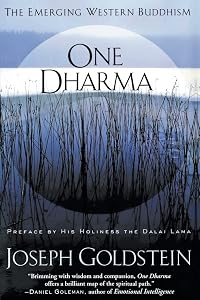
One Dharma: The Emerging Western Buddhism
by Joseph Goldstein
On This Page
Description
One of America's most respected Buddhist teachers distills a lifetime of practice and teaching in this groundbreaking exploration of the new Buddhist tradition taking root on American soil.Tags
Recommendations







Member Reviews
Starts off strong and maintains that strength the majority of the way through. Gets into a compare and contrast exercise mostly Buddhist scholars would appreciate for the last couple chapters which I found tedious. My main takeaway was that I'm not as interested anymore in associating with a particular school (one Dharma included) as much as pursuing what works.
This is definitely a comprehensive look at the core concepts of Buddhism from the perspective of many different traditions. Goldstein postulates that while history has seen the division of Buddhism into many different traditions, it’s arrival in the West has heralded a reunification of the teachings of the Buddha. This is seen as a positive outcome, one that offers those on the path with many vantage points with which to guide them along their own path towards awakening. Definitely a must read for anyone interested in Buddhism.
This is an excellent synthesis of the various streams of Buddhism: Zen, Theravadan, Tibetan Dzogchen, etc. He writes very clearly and simply, explaining the differences and the convergences among the practices in a way that sheds light on each of them. Not a dry academic exercise, but a useful manual that will assist the reader in whatever their chosen practice happens to be.
Surely it was the right time for me to read this book, as it seemed to answer all my questions even as they arose in my mind, as if anticipating them. Buddhist doctrine can be a bewildering rabbit-hole but Joseph Goldstein manages to harmonize the various traditions and teachings.
This is a good introduction to the various schools of Buddhism and how they differ, but more importantly how they are similar.
Joseph Goldstein has a smooth writing style and good knowledge of the schools and their practices. One thing I found weak was the connection between his sources and his bibliography. It took a bit of slow looking to figure out which quotation went with which source and a few times I was unable to figure it out at all. My theory is he wanted the book to be reader friendly and not too academic, but this frustrates those of us who may be interested in following the trail he followed to get to this book. This is not to say that the bibliography is limited or lacking, it just isn't linked with the specifics notes and show more quotations, etc., that are in the actual text.
I was interested in the Thai forest tradition and wished more would have been included, but I assume (and hope my assumption isn't too ignorant) it was for sake for clarity and overall coverage that Goldstein included the amount he did and no more. This is where his bibliography shows its strength.
After some time, I plan to read this again and to look into the sources Goldstein includes and hope I will have more to write about it.
If you are interested in Buddhism in general, and particular how it is changing in the West, this is a good book to begin your investigation into this fascinating subject. There is not a lot of practice in this book, but there is some. Mostly, it is information on the history of Buddhism as it it being practiced in the West. show less
Joseph Goldstein has a smooth writing style and good knowledge of the schools and their practices. One thing I found weak was the connection between his sources and his bibliography. It took a bit of slow looking to figure out which quotation went with which source and a few times I was unable to figure it out at all. My theory is he wanted the book to be reader friendly and not too academic, but this frustrates those of us who may be interested in following the trail he followed to get to this book. This is not to say that the bibliography is limited or lacking, it just isn't linked with the specifics notes and show more quotations, etc., that are in the actual text.
I was interested in the Thai forest tradition and wished more would have been included, but I assume (and hope my assumption isn't too ignorant) it was for sake for clarity and overall coverage that Goldstein included the amount he did and no more. This is where his bibliography shows its strength.
After some time, I plan to read this again and to look into the sources Goldstein includes and hope I will have more to write about it.
If you are interested in Buddhism in general, and particular how it is changing in the West, this is a good book to begin your investigation into this fascinating subject. There is not a lot of practice in this book, but there is some. Mostly, it is information on the history of Buddhism as it it being practiced in the West. show less
Following the Buddha's death, Buddhism experienced a schism which nurtured its development through three main vehicles -- the Theravada, Mahayana, and Vajrayana faiths. Since then, the different schools of thought have retained predominantly separate lines of ontogeny, with only sporadic cross-pollination. However, exportation of Buddhism to the West has provided a unique opportunity for the different familial lines of Buddhism to cross and fuse again. With this book Joseph Goldstein provides "insight" into the current state of Western Buddhism.
One of America's most respected Buddhist teachers distills a lifetime of practice and teaching in his groundbreaking exploration of the new Buddhist tradition taking root on American soil.
Members
- Recently Added By
Author Information

29+ Works 2,787 Members
Joseph Goldstein has studied and practiced meditation since 1967 and is a cofounder of the Insight Meditation Society and the Barre Center for Buddhist Studies in Barre, Massachusetts. He is the author of many books, including Mindfulness: A Practical Guide to Awakening and One Dharma: The Emerging Western Buddhism, and he has coauthored books show more with Sharon Salzberg and lack Kornfield. He continues to lead Insight Meditation retreats around the world. show less
Some Editions
Common Knowledge
- Canonical title*
- De opkomst van een Westers Boeddhisme
- Original title
- One Dharma: the Emerging Western Buddhism
- Original publication date
- 2002
- Original language*
- Engels
*Some information comes from Common Knowledge in other languages. Click "Edit" for more information.
Classifications
Statistics
- Members
- 326
- Popularity
- 97,469
- Reviews
- 9
- Rating
- (3.91)
- Languages
- 7 — Dutch, English, German, Italian, Polish, Portuguese, Spanish
- Media
- Paper, Ebook
- ISBNs
- 10
- ASINs
- 3