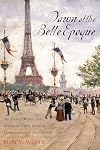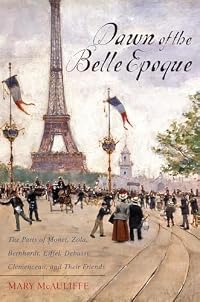
Dawn of the Belle Epoque: The Paris of Monet, Zola, Bernhardt, Eiffel, Debussy, Clemenceau, and Their Friends
by Mary McAuliffe
On This Page
Description
"A humiliating military defeat by Bismarck's Germany, a brutal siege, and a bloody uprising--Paris in 1871 was a shambles, and the question loomed, 'Could this extraordinary city even survive?' Mary McAuliffe takes the reader back to these perilous years following the abrupt collapse of the Second Empire and France's uncertain venture into the Third Republic. By 1900, Paris had recovered and the Belle Epoque was in full flower, but the decades between were difficult, marked by struggles show more between republicans and monarchists, the Republic and the Church, and an ongoing economic malaise, darkened by a rising tide of virulent anti-Semitism. Yet these same years also witnessed an extraordinary blossoming in art, literature, poetry, and music, with the Parisian cultural scene dramatically upended by revolutionaries such as Monet, Zola, Rodin, and Debussy, even while Gustave Eiffel was challenging architectural tradition with his iconic tower. Through the eyes of these pioneers and others, including Sarah Bernhardt, Georges Clemenceau, Marie Curie, and César Ritz, we witness their struggles with the forces of tradition during the final years of a century hurtling towards its close. Through rich illustrations and evocative narrative, McAuliffe brings this vibrant and seminal era to life."--Jacket. show lessTags
Recommendations


































Member Reviews
I can't stress enough how ignorant I was about this time in history. Certainly, I knew the names (except Morisot's) and I knew Impressionism, but otherwise: zip.
So as someone who had virtually no knowledge of the subject material going in, I found this book to be easy to read and well-written in a narrative style that had me putting aside my current fiction because I wanted to find out what happened next?.
Covering a year or two per chapter, Ms. McAuliffe follows the lives of the artists and politicians of Paris immediately following the Commune up to 1900 (30 years or so). Each chapter is further broken down to sections focussing on one of the characters of this time, making this an exceptionally easy book to read.
Mostly, I thought show more the read was excellent; I occasionally got a little bit lost when she jumped forward or backward in time to foreshadow or set the backstory, but this was rare. I learned a lot - heaps! - from this book. I've always loved the Impressionist's art and of course academically, I knew they all painted during the same time period, but I never knew just how interconnected they all were and how interconnected they were to the writers, actors, and politicians too. But most startling was learning about the Dreyfus Affair; not the anti-semitism: while that sickened me, it sadly didn't shock me. But the lengths those involved went to in order to protect themselves and their complete willingness to throw away another life for their own preservation in such a flatly premeditated way was confronting. People suck; I mean, they really suck. Fortunately Zola was a (surprising) bright light and I admired his dedication to seeing it through.
Also, massive kudos go to Eugene Manet for being the only man in the entire book who kept it in his pants.
Without hesitation, I'd recommend this book to anyone who wants to learn more about history but wants to avoid the academic analysis and statistics that often go with it. This one reads like a great novel.
[PopSugar 2015 Challenge: A non-fiction book] show less
So as someone who had virtually no knowledge of the subject material going in, I found this book to be easy to read and well-written in a narrative style that had me putting aside my current fiction because I wanted to find out what happened next?.
Covering a year or two per chapter, Ms. McAuliffe follows the lives of the artists and politicians of Paris immediately following the Commune up to 1900 (30 years or so). Each chapter is further broken down to sections focussing on one of the characters of this time, making this an exceptionally easy book to read.
Mostly, I thought show more the read was excellent; I occasionally got a little bit lost when she jumped forward or backward in time to foreshadow or set the backstory, but this was rare. I learned a lot - heaps! - from this book. I've always loved the Impressionist's art and of course academically, I knew they all painted during the same time period, but I never knew just how interconnected they all were and how interconnected they were to the writers, actors, and politicians too. But most startling was learning about the Dreyfus Affair; not the anti-semitism: while that sickened me, it sadly didn't shock me. But the lengths those involved went to in order to protect themselves and their complete willingness to throw away another life for their own preservation in such a flatly premeditated way was confronting. People suck; I mean, they really suck. Fortunately Zola was a (surprising) bright light and I admired his dedication to seeing it through.
Also, massive kudos go to Eugene Manet for being the only man in the entire book who kept it in his pants.
Without hesitation, I'd recommend this book to anyone who wants to learn more about history but wants to avoid the academic analysis and statistics that often go with it. This one reads like a great novel.
[PopSugar 2015 Challenge: A non-fiction book] show less
McAuliffe intertwines the political, military, social, engineering, literary, and art history of France from the period of the Commune, 1870, to the Paris exposition of 1900. You don't find many books that discuss all those topics together, so if you've read about the political history of France and have read about the Impressionist artists, and you know that the Statue of Liberty was a gift of the French to the Americans, you may well enjoy seeing how they, as well as the Eiffel Tower all fit together. Sometimes it feels a bit disjointed because no one person or project or event was delved into deeply at any one time. This is because McAuliffe explains it all year by year. There will be a short discussion of, say Eiffel, and then it show more jumps to Clemenceau or Le Chat Noir or Berthe Morisot. But in doing that, McAuliffe follows the people and events in their own time frame and for me it was great to see what things were happening at the same time and how they interacted and influenced each other.
Possibly, because no one person or project or event is delved into deeply at any one time, you don't get as emotionally attached to the protagonists as you might if a whole chapter or a whole book were dedicated to any one of them. The exception to this distancing, for me, was the explanation of the Dreyfus case. Even broken up into bits, it landed a big punch. show less
Possibly, because no one person or project or event is delved into deeply at any one time, you don't get as emotionally attached to the protagonists as you might if a whole chapter or a whole book were dedicated to any one of them. The exception to this distancing, for me, was the explanation of the Dreyfus case. Even broken up into bits, it landed a big punch. show less
Ms. McAuliffe's history of the late 1800s presents a panorama of France between the end of the Franco-Prussian War to 1900. She takes us across the span of 30 years while Paris recovered from the War. Her attempt to cover a wide range of individuals who lived & breathed beyond the political aspects of the Third Republic is breathtaking. The Impressionists, for example, challenged the artistic world while they, at times, were nearly at each other's throats. This is not the only brush she paints as she covers Debussy, Ritz, & Eiffel, all contributing to the life of Paris. The creation of the Statue of Liberty, the Eiffel Tower are mentioned here along with the Panama Canal Scandal. The famed Sarah Bernhardt with all of her success on the show more stage as well as her scandalous living are covered. The Alfred Dreyfus affair is also given considerable length in the work which exposed the corruption in high levels of the military & government. The author excelled in bringing out the ongoing tensions in French society still working out unresolved issues that both the Franco-Prussian War & the collapse of the Communards had exposed. show less
Interesting material but the author hasn't chosen the most exciting way of presenting it, keeping to a strict chronological order. The poets of the period do not get much attention, Verlaine only mentioned at his death, Rimbaud not at all. The emphasis is on politics, painting, sculpture and, somewhat less, music.
hardcover
340 pg + addendum
"The Belle Époque ("Beautiful Era") was a period in European social history that began during the late 19th century and lasted until World War I.
Occurring during the era of the Third French Republic and the German Empire, it was a period characterized by optimism and new technological and medical discoveries.
The Belle Époque was named in retrospect, when it began to be considered a "golden age" when compared to the horrors of World War I."
4.5 very informative....highly recommended
340 pg + addendum
"The Belle Époque ("Beautiful Era") was a period in European social history that began during the late 19th century and lasted until World War I.
Occurring during the era of the Third French Republic and the German Empire, it was a period characterized by optimism and new technological and medical discoveries.
The Belle Époque was named in retrospect, when it began to be considered a "golden age" when compared to the horrors of World War I."
4.5 very informative....highly recommended
Ratings
Members
- Recently Added By
Author Information

9 Works 584 Members
Mary McAuliffe holds a PhD in history from the University of Maryland, has taught at several universities, and has lectured at the Smithsonian Institution. She has traveled extensively in France, and for many years she was a regular contributor to Paris Notes. Her books include Paris Discovered, Dawn of the Belle Epoque, Clash of Crowns, and When show more Paris Sizzled. She lives in New York City with her husband. show less
Common Knowledge
- People/Characters
- Alfred Dreyfus; Claude Monet; Émile Zola; Sarah Bernhardt; Claude Debussy; Georges Clemenceau
- Important places
- Paris, France
Classifications
- Genres
- History, Nonfiction, General Nonfiction, Art & Design
- DDC/MDS
- 944.361081 — History & geography History of Europe France and Monaco Champagne; Ile de France; Lorraine Île-de-France Paris
- LCC
- DC735 .M43 — History of Europe, Asia, Africa and Oceania France – Andorra – Monaco History of France Local history and description Paris
- BISAC
Statistics
- Members
- 154
- Popularity
- 212,010
- Reviews
- 5
- Rating
- (4.19)
- Languages
- English
- Media
- Paper, Audiobook, Ebook
- ISBNs
- 5
- ASINs
- 3