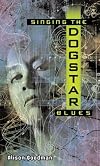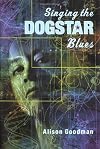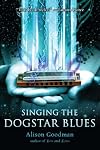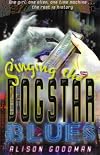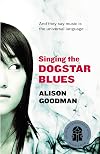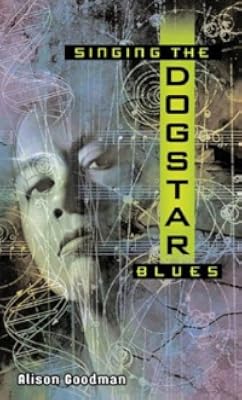
Singing the Dogstar Blues
by Alison Goodman
On This Page
Description
In a future Australia, the saucy eighteen-year-old daughter of a famous newscaster and a sperm donor teams up with a hermaphrodite from the planet Choria in a time travel adventure that may significantly change both of their lives.Tags
Recommendations






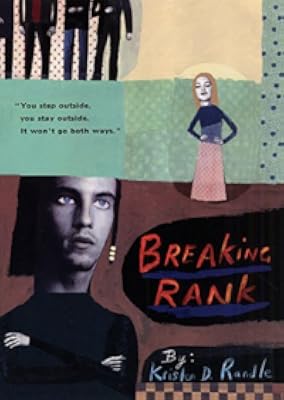


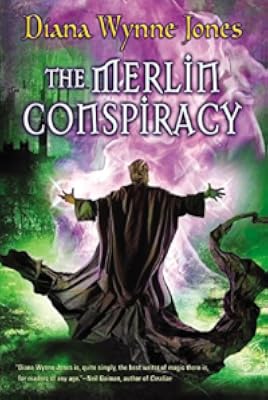

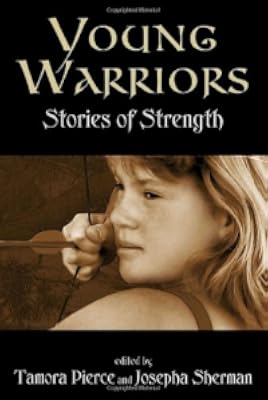
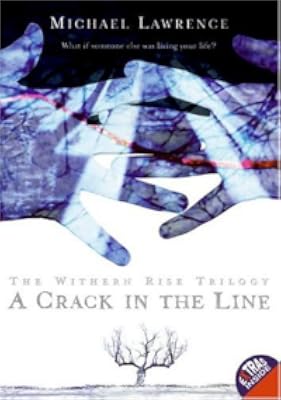





Member Recommendations
Member Reviews
Joss Aaronson is first-year student, studying to be a time-travelling historian at the only time-travel training centre in the world (the University of Australia's Centre for Neo-Historical Studies). Which would be enough to be going on with... but Joss is then chosen to be the time-travelling partner of a Chorian, Mavkel, the first alien to study at the university. The harmonising, telepathic Chorians are little understood, attracting a lot of media attraction and death threats; Mavkel's position in the time-travel class is controversial. Although Joss has long been fascinated with Chorians, living with Mavkel is a drastic change - they're housed in state-of-the-art top-security, accompanied to classes by body guards, and Joss is still show more learning how to relate to Mavkel. Meanwhile, the centre's director, who seems to have appointed himself as Joss' enemy, is looking for any reason to expel her.
Joss is also struggling with her deteriorating relationship with her mother, and her heritage as a genetically engineered "comp-kid".
When Mavkel becomes homesick, Joss discovers that knowledge of her parentage may save him. She embarks on quest to discover her father's identity, a mission which involves taking risks - including potentially giving the director a solid reason to expel her. But Joss has never been a girl to let rules stop her.
I love the delightfully quirky near-future world of aliens and time-travel. Joss' commentary on her world and her life is humorous and witty. Joss herself is a fun character - determined, resourceful and with a strong personality which causes some others perceive her as a delinquent. Goodman's vision of what technology and attitudes could become is convincing - and interesting. There are a lot of thought-provoking ideas raised, especially surrounding discrimination, and some unexpected wisdom.
However, Singing the Dogstar Blues's heart concerns relationships. Joss has an estranged mother, an unknown father, and an absent "ex-step-parent", and she is working out what these relationships mean to her. Mavkel is mourning the loss of his twin, and discovering what it is to live in a non-telepathic society where you are truly alone. This is a story about finding common ground, about family and friendship.
I can't recall exactly what I thought of this when I first read it, but I do remember being about 15 and thinking this the most hilarious novel ever. These days, I find it less amusing, but I don't know whether that's because I am older or because such moments are now too-familiar, courtesy of reading this book too many times in the intervening years. But it's still entertaining, moving, quotable... and wins points in my eyes for being about music, and for being set in a familiar city. And so Singing the Dogstar Blues remains my favourite YA science-fiction novel.
"[My mother]'s positive I also inherited by attitude problem from him. She says being chucked out of twelve schools must be genetic." show less
Joss is also struggling with her deteriorating relationship with her mother, and her heritage as a genetically engineered "comp-kid".
When Mavkel becomes homesick, Joss discovers that knowledge of her parentage may save him. She embarks on quest to discover her father's identity, a mission which involves taking risks - including potentially giving the director a solid reason to expel her. But Joss has never been a girl to let rules stop her.
I love the delightfully quirky near-future world of aliens and time-travel. Joss' commentary on her world and her life is humorous and witty. Joss herself is a fun character - determined, resourceful and with a strong personality which causes some others perceive her as a delinquent. Goodman's vision of what technology and attitudes could become is convincing - and interesting. There are a lot of thought-provoking ideas raised, especially surrounding discrimination, and some unexpected wisdom.
However, Singing the Dogstar Blues's heart concerns relationships. Joss has an estranged mother, an unknown father, and an absent "ex-step-parent", and she is working out what these relationships mean to her. Mavkel is mourning the loss of his twin, and discovering what it is to live in a non-telepathic society where you are truly alone. This is a story about finding common ground, about family and friendship.
I can't recall exactly what I thought of this when I first read it, but I do remember being about 15 and thinking this the most hilarious novel ever. These days, I find it less amusing, but I don't know whether that's because I am older or because such moments are now too-familiar, courtesy of reading this book too many times in the intervening years. But it's still entertaining, moving, quotable... and wins points in my eyes for being about music, and for being set in a familiar city. And so Singing the Dogstar Blues remains my favourite YA science-fiction novel.
"[My mother]'s positive I also inherited by attitude problem from him. She says being chucked out of twelve schools must be genetic." show less
For me, this book balances science fiction, humour and interesting characters in a way that grabbed me far more than any [a:Douglas Adams|4|Douglas Adams|http://photo.goodreads.com/authors/1189120061p2/4.jpg] book ever did. To be honest, the author had me at "flappy-eared alien".
Science fiction when it is told well is easily one of my favourite genres, but too much of it turns into some crappy dystopian romance or is written for a male readership... the only sci-fi I can honestly say I've enjoyed in recent years is [a:Margaret Atwood|3472|Margaret Atwood|http://photo.goodreads.com/authors/1282859073p2/3472.jpg] and [a:Ursula K. Le Guin|874602|Ursula K. Le Guin|http://photo.goodreads.com/authors/1244291425p2/874602.jpg]. But I loved the show more world building in this novel and the characters were different and intriguing - especially Mavkel. I somehow managed to find it totally believable that these Chorians - a bunch of genderless, flappy-eared aliens with four noses, two mouths and two brains - had made contact with Earth in the future and both humans and aliens were now trying to share their technological knowledge.
There's mystery and time travel too and a heroine who doesn't annoy me. What more could I possibly want?
I don't know why this isn't a series, there's so much here that could be explored. The world created is exciting and has the potential to hold many more stories, and the novel closes with very little of it discovered by the reader. I find it strange and rather funny that in an age where every author who comes up with the slightest hint of originality will most definitely write at least a trilogy, this is only a standalone. More please, Ms. Goodman. show less
If prizes were awarded for the best speculative fiction titles, Singing the Dogstar Blues would surely garner its share of accolades. It's witty and clever, projecting a degree of dignity while at the same time not taking itself too seriously. On top of that, it's relevant to the story at hand. Fortunately for readers, this young adult novel by Australia's Alison Goodman is more than just a pretty title. Goodman's story is an engaging character-centered time travel adventure that--while uneven at times--manages to overcome its shortcomings and deliver the goods.
Part of the novel's problems stem from the fact that Goodson is a wee bit too ready to rely on cliche when it suits her. The main character, a 17-year-old girl named Joss, is show more your typical disaffected anti-establishment type who is smarter than anyone gives her credit for. Despite getting thrown out of pretty much every school she's ever attended, she's managed to get accepted into the prestigious Centre for Neo-Historical Studies. The ultra-competitive Centre is the world's first, last and only institute for the education and training of time travelers. And before long, it become apparent that it's also got the only time machine in the known universe, as aliens from the planet Choria are keen to get a handle on the technology for their own uses. Chorians know the secret of interstellar travel, humans know the secret of time travel. Both worlds want what the other has, and neither is quite willing to give up its own secrets in an even trade.
Joss, being the anti-establishment type that she is, runs afoul of the Centre's acting director, Professor Camden-Stone, by page 4. Camden-Stone--cut from a long line of sour college deans whose sole mission in life seems to involve extinguishing any small flicker of joy from students' lives--is scant minutes away from booting Joss from the Center when the unexpected happens. Despite all of Camden-Stone's machination and planning, Mavkel, the first Chorian ever accepted into the Centre, chooses Joss to be his time travel training partner. And things, as they say, get interesting from there.
Goodson never really adds anything new to the genre with Dogstar Blues, but rather takes existing tropes, ideas and themes and weaves them together in fresh and interesting ways. That fresh approach only carries Dogstar Blues so far, however. The execution of Joss and Mavkel's unscheduled temporal jaunt reads almost like they're following a flow chart of events from the author's outline, and ultimately echoes Back to the Future too much for its own good. A seemingly pertinent plot point about Joss trying to hack the security system of the super-secure residential complex she's forced to share with Mavkel is abruptly dropped and never pays off for the reader.
In this case, however, the whole is greater than the sum of its parts, and Singing the Dogstar Blues succeeds in spite of its missteps. As a young adult novel, the narrative never talks down to the reader, which is a good thing. The best young adult works have a universal quality to them, equally accessible to adults and teens. The advantage Goodson has, of course, is that many readers of young adult books will not have yet encountered the time travel tropes and ideas she plays with here, and thus to them, everything is unique and original. For everyone else, she's given us characters to care about in a fast-paced adventure, and it's hard not to pull for Joss even when she walking a path that was well-trodden even 50 years before. show less
Part of the novel's problems stem from the fact that Goodson is a wee bit too ready to rely on cliche when it suits her. The main character, a 17-year-old girl named Joss, is show more your typical disaffected anti-establishment type who is smarter than anyone gives her credit for. Despite getting thrown out of pretty much every school she's ever attended, she's managed to get accepted into the prestigious Centre for Neo-Historical Studies. The ultra-competitive Centre is the world's first, last and only institute for the education and training of time travelers. And before long, it become apparent that it's also got the only time machine in the known universe, as aliens from the planet Choria are keen to get a handle on the technology for their own uses. Chorians know the secret of interstellar travel, humans know the secret of time travel. Both worlds want what the other has, and neither is quite willing to give up its own secrets in an even trade.
Joss, being the anti-establishment type that she is, runs afoul of the Centre's acting director, Professor Camden-Stone, by page 4. Camden-Stone--cut from a long line of sour college deans whose sole mission in life seems to involve extinguishing any small flicker of joy from students' lives--is scant minutes away from booting Joss from the Center when the unexpected happens. Despite all of Camden-Stone's machination and planning, Mavkel, the first Chorian ever accepted into the Centre, chooses Joss to be his time travel training partner. And things, as they say, get interesting from there.
Goodson never really adds anything new to the genre with Dogstar Blues, but rather takes existing tropes, ideas and themes and weaves them together in fresh and interesting ways. That fresh approach only carries Dogstar Blues so far, however. The execution of Joss and Mavkel's unscheduled temporal jaunt reads almost like they're following a flow chart of events from the author's outline, and ultimately echoes Back to the Future too much for its own good. A seemingly pertinent plot point about Joss trying to hack the security system of the super-secure residential complex she's forced to share with Mavkel is abruptly dropped and never pays off for the reader.
In this case, however, the whole is greater than the sum of its parts, and Singing the Dogstar Blues succeeds in spite of its missteps. As a young adult novel, the narrative never talks down to the reader, which is a good thing. The best young adult works have a universal quality to them, equally accessible to adults and teens. The advantage Goodson has, of course, is that many readers of young adult books will not have yet encountered the time travel tropes and ideas she plays with here, and thus to them, everything is unique and original. For everyone else, she's given us characters to care about in a fast-paced adventure, and it's hard not to pull for Joss even when she walking a path that was well-trodden even 50 years before. show less
This is one of many books that I read back in high school and never found them again outside of a library. I can remember details about them, like the plot or a character or three, but couldn’t recall the author’s name or title if I tried. So, cut to when I’m reading Eon, get to the author bio and go “Holy crap, Allison Goodman wrote Singing the Dogstar Blues? I remember that book!” And then I found it in Barnes & Noble and had to pick up a copy.
The reason why I really like this book: Joss. Joss Joss Joss. Strong biracial female main character who has fantastic taste in music and doesn’t succumb into a weepy mess? Yes. It’s a strange comparison to make, but Joss Aaronson is a more awesome version of Hitchhiker’s Random show more Dent. Joss has a reputation for being a troublemaker, but we get why she’s so angry at adults and it doesn’t feel like overt angst or whining. Her mother wants to use Joss for publicity, especially after Mavkel picks Joss for a partner; Joss hasn’t spoken to the only adult she’s felt close to in years; however, she still manages to create her own family, even if most people would consider them to be weirdos and lowlifes. And even though a chunk of the story is centered around the identity of Joss’s father, I love that Joss never loses her identity and is strong. She’s fantastic.
Similarly, I love Mavkel. Sidetracking into the world-building a bit, I like that while the Chorians are humanoid, they’re still freaky to look at, with the double mouths and everything. I kinda like that Mav keeps unnerving Joss by just smiling, even after they become friends. (Also, he has really expressive ears. Mav reminds me of a big black Labrador at times.) And he’s got his own way of being a troublemaker.
And what I love about these two is that they’re two lonely kids who manage to find each other. Some of the circumstances surrounding Joss’s perfect harmony with Mav are a little out of left field, but that’s another point entirely. Joss is continually reminded that she’s not good enough for the rich kids who attend her school; Mav was expected to die when his twin did. And their friendship is awkward at first, but then they start trusting one another. (My edition also has the short story “The Real Thing,” which goes into the complexities of Joss and Mav’s connection. It adds a lot to their relationship.) I like these two, I want to find out more about their adventures in the Centre for Neo-Historical Studies and Joss teaching Mav about the blues.
I really like the first part of the major plot in the book, with Joss conducting spy work of her own to figure out if her partnership with Mav means if one or both of them are in danger. I like the mystery of who the assassin Tori Suka is after and how does Joss and Mav’s admittance to the Centre have to do with founder Daniel Sunawa-Harrod’s legacy. But there’s two parts where the plot stalls. I kinda don’t like the plot detail that the reason why Mav’s getting sick and might die is because Joss doesn’t know the identity of her father and then that becomes so much of the plot. I really felt like Joss didn’t need to know who her father was to become ‘complete.’ I don’t mind the reveal of who it is, but it feels less powerful that yes, she knows who her father is and there she and Mav can join together. (However, the reveal that the reason Joss inexplicably has Chorian DNA as a result of Mav sneezing on her petri dish when they go back in time? I like that—it’s ridiculous and clichéd, but the fact that Joss realizes how ridiculous it is works.) There’s also a subplot about implant AIDS that really only serves as how Sunawa-Harrod dies. It doesn’t really go anywhere, and it feels like Goodman just stuck it in to make an arbitrary point. (An important one, but arbitrary to the rest of the novel.)
Despite my issues, this is still a really fun read. Joss and Mav are both fantastic, and their characterization shines through the weak points in the plot. And even with the weak points, it’s still a good, rollicking light sci-fi read. If you’re a fan of the Eon duology, it’s worth checking this one out. show less
The reason why I really like this book: Joss. Joss Joss Joss. Strong biracial female main character who has fantastic taste in music and doesn’t succumb into a weepy mess? Yes. It’s a strange comparison to make, but Joss Aaronson is a more awesome version of Hitchhiker’s Random show more Dent. Joss has a reputation for being a troublemaker, but we get why she’s so angry at adults and it doesn’t feel like overt angst or whining. Her mother wants to use Joss for publicity, especially after Mavkel picks Joss for a partner; Joss hasn’t spoken to the only adult she’s felt close to in years; however, she still manages to create her own family, even if most people would consider them to be weirdos and lowlifes. And even though a chunk of the story is centered around the identity of Joss’s father, I love that Joss never loses her identity and is strong. She’s fantastic.
Similarly, I love Mavkel. Sidetracking into the world-building a bit, I like that while the Chorians are humanoid, they’re still freaky to look at, with the double mouths and everything. I kinda like that Mav keeps unnerving Joss by just smiling, even after they become friends. (Also, he has really expressive ears. Mav reminds me of a big black Labrador at times.) And he’s got his own way of being a troublemaker.
And what I love about these two is that they’re two lonely kids who manage to find each other. Some of the circumstances surrounding Joss’s perfect harmony with Mav are a little out of left field, but that’s another point entirely. Joss is continually reminded that she’s not good enough for the rich kids who attend her school; Mav was expected to die when his twin did. And their friendship is awkward at first, but then they start trusting one another. (My edition also has the short story “The Real Thing,” which goes into the complexities of Joss and Mav’s connection. It adds a lot to their relationship.) I like these two, I want to find out more about their adventures in the Centre for Neo-Historical Studies and Joss teaching Mav about the blues.
I really like the first part of the major plot in the book, with Joss conducting spy work of her own to figure out if her partnership with Mav means if one or both of them are in danger. I like the mystery of who the assassin Tori Suka is after and how does Joss and Mav’s admittance to the Centre have to do with founder Daniel Sunawa-Harrod’s legacy. But there’s two parts where the plot stalls. I kinda don’t like the plot detail that the reason why Mav’s getting sick and might die is because Joss doesn’t know the identity of her father and then that becomes so much of the plot. I really felt like Joss didn’t need to know who her father was to become ‘complete.’ I don’t mind the reveal of who it is, but it feels less powerful that yes, she knows who her father is and there she and Mav can join together. (However, the reveal that the reason Joss inexplicably has Chorian DNA as a result of Mav sneezing on her petri dish when they go back in time? I like that—it’s ridiculous and clichéd, but the fact that Joss realizes how ridiculous it is works.) There’s also a subplot about implant AIDS that really only serves as how Sunawa-Harrod dies. It doesn’t really go anywhere, and it feels like Goodman just stuck it in to make an arbitrary point. (An important one, but arbitrary to the rest of the novel.)
Despite my issues, this is still a really fun read. Joss and Mav are both fantastic, and their characterization shines through the weak points in the plot. And even with the weak points, it’s still a good, rollicking light sci-fi read. If you’re a fan of the Eon duology, it’s worth checking this one out. show less
17-year-old Joss Aaronson is an irreverent harmonica player, a first-year student in the time-jumping program at Australia’s Centre for Historical Studies, and a stealthy player in the game against authority. When the Centre’s first alien student, a Chorian named Mavkel, chooses her as his time-jumping partner, the two form an unlikely alliance. For Chorians need to be part of a pair to survive, and Mavkel has lost his birth-pair.
Joss tackles prejudiced teachers, heavy security, a distant mother, and her own enigmatic background, but when Mavkel begins to waste away, Joss knows that the only way to save him is to go back in time and discover her own lineage. The result is a startling discovery that will rock what everyone believes show more of the Centre.
It’s been a while since I’ve read a straight-up science-fiction YA novel, and yet SINGING THE DOGSTAR BLUES proves to be one of the best of its genre. With a great protagonist and a fully realized world, this small book will suck you in so fast you won’t even realize when you’ve lost your heart to it.
Joss is, without a doubt, my kind of girl. A bit jaded, a bit too smart for her own good, she is thoroughly entertaining to read about. Her tongue-in-cheek observations and flagrant disregard for Centre rules make her the opposite of the passive protagonist I typically dread in YA lit, and yet she’s not so rebellious as to be unrelatable. She is, in a sense, the kind of “bad girl” most readers have secretly imagined themselves being.
Science fiction is difficult to write because it involves creating a thorough world and to consider the implications of adding any detail to the story. Luckily, Alison Goodman’s world in SINGING THE DOGSTAR BLUES is remarkably believable and “real”: I could very nearly see all that Joss sees through the sharp and precise writing.
The one complaint I had about this book was the predictability of the ending. I figured out how things were going to unfold several chapters before Joss did. This is a recurring weakness in Goodman’s novels (her YA fantasy Eon: Dragoneye Reborn had the same thing happen), and yet doesn’t majorly detract from my utter delight in reading this book. Overall, I can solidly recommend SINGING THE DOGSTAR BLUES as one of the YA science fiction novels ever written. Don’t miss out on this one! show less
Joss tackles prejudiced teachers, heavy security, a distant mother, and her own enigmatic background, but when Mavkel begins to waste away, Joss knows that the only way to save him is to go back in time and discover her own lineage. The result is a startling discovery that will rock what everyone believes show more of the Centre.
It’s been a while since I’ve read a straight-up science-fiction YA novel, and yet SINGING THE DOGSTAR BLUES proves to be one of the best of its genre. With a great protagonist and a fully realized world, this small book will suck you in so fast you won’t even realize when you’ve lost your heart to it.
Joss is, without a doubt, my kind of girl. A bit jaded, a bit too smart for her own good, she is thoroughly entertaining to read about. Her tongue-in-cheek observations and flagrant disregard for Centre rules make her the opposite of the passive protagonist I typically dread in YA lit, and yet she’s not so rebellious as to be unrelatable. She is, in a sense, the kind of “bad girl” most readers have secretly imagined themselves being.
Science fiction is difficult to write because it involves creating a thorough world and to consider the implications of adding any detail to the story. Luckily, Alison Goodman’s world in SINGING THE DOGSTAR BLUES is remarkably believable and “real”: I could very nearly see all that Joss sees through the sharp and precise writing.
The one complaint I had about this book was the predictability of the ending. I figured out how things were going to unfold several chapters before Joss did. This is a recurring weakness in Goodman’s novels (her YA fantasy Eon: Dragoneye Reborn had the same thing happen), and yet doesn’t majorly detract from my utter delight in reading this book. Overall, I can solidly recommend SINGING THE DOGSTAR BLUES as one of the YA science fiction novels ever written. Don’t miss out on this one! show less
Top marks for originality on this one; Goodman is just plagued a little by a few rough spots in the novel. Still, I enjoyed it.
Joss Aaronson is stunned on the day when it is her class's turn to choose partners. Joss is ready to become a student in time-travel...but she could never have anticipated her partner. That's because for the first time ever, Earth has allowed an alien into the program, a Chorian named Mavkel. And now he's chosen Joss as his travel-partner.
Joss, rebellious, bold, and a blues fan, has no idea what to make of Mav. So begins a story of family, of alien culture shock, of a surprisingly original futuristic world with Australian overtones (the author is Australian). The plot moved along a bit too quick for my tastes, show more and the characters apart from Joss weren't developed enough. But just reading about Goodman's take on the future and Mav's alien race make it worth at least one read. show less
Joss Aaronson is stunned on the day when it is her class's turn to choose partners. Joss is ready to become a student in time-travel...but she could never have anticipated her partner. That's because for the first time ever, Earth has allowed an alien into the program, a Chorian named Mavkel. And now he's chosen Joss as his travel-partner.
Joss, rebellious, bold, and a blues fan, has no idea what to make of Mav. So begins a story of family, of alien culture shock, of a surprisingly original futuristic world with Australian overtones (the author is Australian). The plot moved along a bit too quick for my tastes, show more and the characters apart from Joss weren't developed enough. But just reading about Goodman's take on the future and Mav's alien race make it worth at least one read. show less
I’m always on the lookout for a fun space-related story. Singing the Dogstar Blues isn’t set in space but there is a very futuristic feel to it and ALIENS so it definitely hit my sweet spot. If you are wondering if this book reads at all like Goodman’s other book [b:Eon|2986865|Eon Dragoneye Reborn (Eon, #1)|Alison Goodman|http://photo.goodreads.com/books/1299076175s/2986865.jpg|3017319], the answer, at least for me, is absolutely not. I enjoyed Eon but the pacing was off and I wasn’t especially attached to any of the characters. That’s not the case here. Joss Aaronson attends a prestigious time-jumping school and holds one of 12 coveted spots in the program for her year. She is a comp, which basically means that her mother show more used a donor to have her and comps are looked down on as genetically manipulated because people can use up to even 5 or 6 donors to create the child of their choice. She is snarky, sassy, and unlike Eon/a, it doesn’t take her eras to figure out what is going on around her. Thank goodness for that.
Overall, the book has a bit of a campy and adventurous feel. The plot primarily revolves around Joss and her new school partner, Mavkel, the first alien to be admitted. As expected, there are enemies and allies in the school administration and amongst the students but Joss and Mavkel hold this entire story on their backs and they succeed in doing so. I couldn’t picture what Mavkel actually looked like but it didn’t hinder the character development. His personality came through even with a language barrier and extensive cultural differences. He and Joss bond over music and that is where the title of the book comes from.
There are hints that this was Goodman’s first novel—the writing definitely favors utility rather than description, for instance. Since this is what I prefer in my sci-fi, I was more than happy with the style. And Ms. Goodman actually surprised me with a plot twist near the end. (don’t click it unless you want it to be ruined) I seriously laughed out loud when we found out that Mavkel’s sneeze into the Petri dish resulted in Joss’s connection with the alien race. I wish this book started a series so we could find out how Joss and Mavkel’s partnership continued to develop during their school years. As it is, I guess I will just have to hope that Alison Goodman writes some more sci-fi one of these days. show less
Overall, the book has a bit of a campy and adventurous feel. The plot primarily revolves around Joss and her new school partner, Mavkel, the first alien to be admitted. As expected, there are enemies and allies in the school administration and amongst the students but Joss and Mavkel hold this entire story on their backs and they succeed in doing so. I couldn’t picture what Mavkel actually looked like but it didn’t hinder the character development. His personality came through even with a language barrier and extensive cultural differences. He and Joss bond over music and that is where the title of the book comes from.
There are hints that this was Goodman’s first novel—the writing definitely favors utility rather than description, for instance. Since this is what I prefer in my sci-fi, I was more than happy with the style. And Ms. Goodman actually surprised me with a plot twist near the end. (don’t click it unless you want it to be ruined)
Members
- Recently Added By
Lists

Nonhuman Protagonists
235 works; 34 members

Female Protagonist
1,056 works; 57 members

Time travel -- children's/young adult fiction
231 works; 10 members

Books Read in 2015
3,299 works; 129 members
Author Information

13+ Works 7,482 Members
Alison Goodman is an award winning novelist. Her novels include the Eon/Eona duology, A New Kind of Death, and The Dark Days Club. Singing the Dogstar Blues won an Aurealis Award for Best Young Adult Novel in 2004 and The Two Pearls of Wisdom won the Aurealis Award for Best Fantasy Novel in 2008. (Bowker Author Biography)
Awards and Honors
Awards
Distinctions
Notable Lists
Common Knowledge
- Canonical title
- Singing the Dogstar Blues
- Original publication date
- 1998
- People/Characters
- Joss; Mavkel
- Dedication
- For my mother and father, Charmaine and Doug Goodman, my dear friend, Karen McKenzie, and of course, Ron.
- First words
- I saw the assassin before she saw me.
- Last words
- (Click to show. Warning: May contain spoilers.)Daniel Sunawa-Harrod, Sulon of Joss Aaronson.
Classifications
- Genres
- Fiction and Literature, Teen, Science Fiction, Young Adult
- DDC/MDS
- 823.914 — Literature & rhetoric English & Old English literatures English fiction 1900- 1901-1999 1945-1999
- LCC
- PZ7 .G6353 .S — Language and Literature Fiction and juvenile belles lettres Fiction and juvenile belles lettres Juvenile belles lettres
- BISAC
Statistics
- Members
- 312
- Popularity
- 102,326
- Reviews
- 22
- Rating
- (3.67)
- Languages
- Dutch, English, German
- Media
- Paper, Audiobook, Ebook
- ISBNs
- 14
- ASINs
- 3