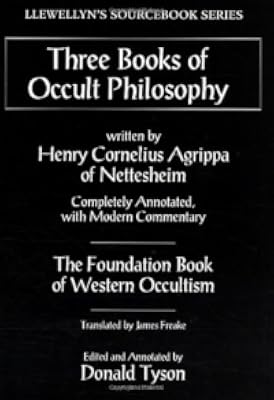
Three Books of Occult Philosophy
by Heinrich Cornelius Agrippa von Nettesheim
Three Books of Occult Philosophy (Collections and Selections — 1-3)
On This Page
Description
Three Books of Occult Philosophy (De Occulta Philosophia libri III) is Heinrich Cornelius Agrippa's study of occult philosophy, acknowledged as a significant contribution to the Renaissance philosophical discussion concerning the powers of ritual magic and its relationship with religion. The three books deal with Elemental, Celestial and Intellectual magic. The books outline the four elements, astrology, kabbalah, numbers, angels, God's names, the virtues and relationships with each other as show more well as methods of utilizing these relationships and laws in medicine, scrying, alchemy, ceremonies, origins of what are from the Hebrew, Greek, and Chaldean context. These arguments were common amongst other hermetic philosophers at the time and before. In fact, Agrippa's interpretation of magic is similar to the authors Marsilio Ficino, Pico della Mirandola and Johann Reuchlin's synthesis of magic and religion and emphasize an exploration of nature. Unlike many grimoires of the time, before and past, these books are more scholarly and intellectual than mysterious and foreboding. These books are often read as authoritative by those interested in the occult even today. Three Books of Occult Philosophy helped perpetuate the belief in modern popular culture that the Knights Templar practiced witchcraft. It was one of the first literary works to transform the accusation of idolatry against the Order, to magic use. show lessTags
Recommendations












Member Reviews
A reminder of how strange things used to be, from the weird stuff reading list. Henry Cornelius Agrippa of Nettesheim was a sort of Renaissance Man. He claimed to possess degrees in canon law, common law, and medicine; university records of the time (1486-1535) were less than comprehensive, so maybe he did. At various times he was a reasonably accomplished soldier in the armies of Emperor Maximillian, the Marquis of Montferrat and Maximillian Sforza of Milan; he was an ambassador from the Holy Roman Emperor to the court of Henry VIII of England; he served as personal physician to the Duke of Savoy and to Louise of Savoy, Queen Mother of France, and as a private physician in Switzerland and the Netherlands; and he lectured at various show more European universities. And, like many other intellectuals of the time, he became interested in the occult. (I note that what’s called “occult” now was well within the purview of a doctor in the 16th century).
Wading through this stuff is interesting. Cornelius Agrippa (the name he usually used) had to tread carefully to avoid the attentions of the Inquisition (at one point he was excommunicated). The Church was pretty dubious about magic, always ready to believe it involved dealing with demons; Agrippa worked around this by presenting demon facilitated magic as something to be avoided; by maintaining that some magical operations were assisted by angels or by “spirits” who were not evil; and by describing “natural” magic that worked with inherent properties of stones, herbs, astrology, numerology and so on, rather than by invoking a supernatural entity. He also does a great deal of circumlocution, citing various ancient authorities for magic operations rather than suggesting that he has tried them himself.
The amount of woowoo here is mind numbing. You can cure a fever by strapping live pigeons to your feet. The heart of a screech owl placed on the left breast of a sleeping woman will make her tell all her secrets. The gall of lizards attracts weasels. A needle coated in dung and packed with graveyard earth will protect a woman from unwanted sexual advances (you know, I bet that would actually work). Peony roots covered with beaver oil and menstrual blood will cure epilepsy. If a woman has enchanted you to fall in love with her, urinate in her right sleeve (but only out of doors) and the enchantment will be lifted (I bet that would work, too.). If you boil and eat the heart of the first bird you see on the Calends of November, you will understand the language of birds. And so on for a thousand pages or so.
It’s instructive to remember that everybody believed this stuff. The efficacy of magic was endorsed by the Church, and you could not only be burned alive for practicing it, you could also be burned for denying it. I suppose I shouldn’t be so smug; my Facebook feed is full of people informing me of the magical properties of turmeric or cucumbers or coconut oil or Bernie Sanders economics.
Agrippa was interested in magic squares. If you’ve ever looked at demonological works, they often present “sigils” of demons (and sometimes angels) that are complicated symbols made up of seemingly random connected lines and curves. Some of these are apparently completely invented; some are elaborations of Greek or Hebrew letters, but Agrippa generates some by tracing numerologically significant paths through magic squares. You use Hebrew numerals for your square, which are also Hebrew letters, and trace the name of the angel/demon/spirit in question to get his/her/its sigil. Agrippa generates the sigils of the Intelligences and Spirits of all the planets this way; for example, you can get the sigil of the Spirit of Mercury, Taphthartharath, by setting up an 8x8 magic square with Hebrew letters/numbers and tracing out Th (400) Ph (80) Th (400) R (200) Th (400) R (200) Th (400) without lifting your pencil. (This also reveals that Taphthartharath’s number is 2080; I imagine with a little more effort you could get the URL for his website).
Well, it was an interesting read. Agrippa seems to have been a decent fellow; he got in considerable trouble in France once defending an accused witch (he got her off, too. Or at least she wasn’t burned; she was in pretty bad shape after questioning and we don’t learn her subsequent history). As mentioned, it’s interesting to note that there is plenty of woowoo still with us. show less
Wading through this stuff is interesting. Cornelius Agrippa (the name he usually used) had to tread carefully to avoid the attentions of the Inquisition (at one point he was excommunicated). The Church was pretty dubious about magic, always ready to believe it involved dealing with demons; Agrippa worked around this by presenting demon facilitated magic as something to be avoided; by maintaining that some magical operations were assisted by angels or by “spirits” who were not evil; and by describing “natural” magic that worked with inherent properties of stones, herbs, astrology, numerology and so on, rather than by invoking a supernatural entity. He also does a great deal of circumlocution, citing various ancient authorities for magic operations rather than suggesting that he has tried them himself.
The amount of woowoo here is mind numbing. You can cure a fever by strapping live pigeons to your feet. The heart of a screech owl placed on the left breast of a sleeping woman will make her tell all her secrets. The gall of lizards attracts weasels. A needle coated in dung and packed with graveyard earth will protect a woman from unwanted sexual advances (you know, I bet that would actually work). Peony roots covered with beaver oil and menstrual blood will cure epilepsy. If a woman has enchanted you to fall in love with her, urinate in her right sleeve (but only out of doors) and the enchantment will be lifted (I bet that would work, too.). If you boil and eat the heart of the first bird you see on the Calends of November, you will understand the language of birds. And so on for a thousand pages or so.
It’s instructive to remember that everybody believed this stuff. The efficacy of magic was endorsed by the Church, and you could not only be burned alive for practicing it, you could also be burned for denying it. I suppose I shouldn’t be so smug; my Facebook feed is full of people informing me of the magical properties of turmeric or cucumbers or coconut oil or Bernie Sanders economics.
Agrippa was interested in magic squares. If you’ve ever looked at demonological works, they often present “sigils” of demons (and sometimes angels) that are complicated symbols made up of seemingly random connected lines and curves. Some of these are apparently completely invented; some are elaborations of Greek or Hebrew letters, but Agrippa generates some by tracing numerologically significant paths through magic squares. You use Hebrew numerals for your square, which are also Hebrew letters, and trace the name of the angel/demon/spirit in question to get his/her/its sigil. Agrippa generates the sigils of the Intelligences and Spirits of all the planets this way; for example, you can get the sigil of the Spirit of Mercury, Taphthartharath, by setting up an 8x8 magic square with Hebrew letters/numbers and tracing out Th (400) Ph (80) Th (400) R (200) Th (400) R (200) Th (400) without lifting your pencil. (This also reveals that Taphthartharath’s number is 2080; I imagine with a little more effort you could get the URL for his website).
Well, it was an interesting read. Agrippa seems to have been a decent fellow; he got in considerable trouble in France once defending an accused witch (he got her off, too. Or at least she wasn’t burned; she was in pretty bad shape after questioning and we don’t learn her subsequent history). As mentioned, it’s interesting to note that there is plenty of woowoo still with us. show less
The single most important book for the Western Esoteric Tradition. Agrippa's book is a complete reference on many aspects of magic and the occult, including astrology, geomancy, evocation, and alchemy. It is primarily a book of theory, but can be easily mined for practical ideas. The biggest problem that a lot of people have with "Three Books" is that, being written in a different cultural framework than our modern one, so a lot of archaic words and word definitions were used in the original English translation. This edition, edited and annotated by Donald Tyson, does not have that problem! Tyson has done a wonderful job of researching many of the ancient references and archaisms, as well as providing brief essays as appendices which show more explain many difficult concepts in more detail. show less
I tried to bury the claws of a crab under the sand, but no scorpions came out of it. I want my time back.
A veritable gold mine of information which no serious occultist can possibly do without having on the shelf. You will find yourself constantly going back to this book to research a great many number of topics. Donald Tyson should be congratulated for doing a fine job for his annotations which certainly flesh out the topics and help to make clear many of Agrippa's statements.
This is a very amazing new translation into English; one of the first in over 350 years. The translation is great, the books are gorgeous, and the translator is to be commended.
This is one of my absolute favourites. I love this comprehensive volume. If it occurs in magic, Agrippa has something to say about it.
This is one volume containing a set of three works of one of Europe's foundations of the European occult renaissance of their hermetic lexicon
Members
- Recently Added By
Lists

Book wishlist
78 works; 1 member

Books Recommended by ESOTERICA Youtube Channel (Dr Justin Sledge)
29 works; 1 member

The ESOTERICA Library by Dr. Justin Sledge (Foundational Primary Texts)
18 works; 1 member

The ESOTERICA Library by Dr. Justin Sledge (Early Modern Magic)
14 works; 1 member

Books in The Club Dumas
72 works; 1 member

el
1,139 works; 1 member
Author Information

47+ Works 1,800 Members
Born in Cologne, Germany, Henry Cornelius Agrippa of Nettesheim lived a life that combined action and adventure with scholarly pursuits. His early career was spent as a secretary and diplomat for the Holy Roman Emperor. Missions to Paris and London brought him into contact with new intellectual movements, and he immersed himself in the study of show more philosophy and theology. He learned Hebrew in order to read the Jewish cabalistic literature. His first great written work, The Occult Philosophy (De occulta philosophia), completed 1509-10 is a compendium offering a mystical interpretation of nature through such arcane methods as cabalistic manipulation of Hebrew words and Pythagorean numerology. It quickly established itself as a major handbook of Renaissance magic and deeply influenced such thinkers as Giordano Bruno. In the years following the writing of De occulta philosophia, Agrippa served as a soldier, lawyer, physician, and theologian. A virulent critic of the clergy and of scholastic theology, he engaged in bitter exchanges with theologically conservative opponents over his religious attitudes. Agrippa's own position lay between the intellectual reformism of Erasmus and the outright break with Catholicism represented by Martin Luther. However, Agrippa later moved away from his early confidence in the magical and mystical methods to an unquestioning biblical faith. Agrippa's most important later work Of the Vanitie and uncertaintie of artes and sciences (De incertitudine et vanitate scientiarum et artium) was published at Antwerp in 1530. In the work, Agrippa advocates a thoroughgoing rejection of learning and intellectual attainment in favor of a simple religious piety. That belief came to play an important role in the Renaissance revival of the skeptical tradition of antiquity. Shortly after the appearance of De incertitudine, Agrippa was imprisoned for heresy and died in exile in Grenoble, France. (Bowker Author Biography) show less
Some Editions
Series

Belongs to Publisher Series
Work Relationships
Common Knowledge
- Canonical title
- Three Books of Occult Philosophy
- Original title
- De Occulta Philosophia libri III
- Original publication date
- 1531
- People/Characters
- Cornelius Agrippa
- Important places
- Germany
- Important events
- 16th century; German Renaissance; Renaissance
- Last words
- (Click to show. Warning: May contain spoilers.)We ought therefore to allure the said Souls, by supernatural and coelestial powers duely administred, even by those things which do move the very harmony of the Soul, aswel imaginative, as rational and intellectual; as are Voices, Songs, Sound, Inchantments: and Religious things; as Prayers, Conjurations, Exorcismes, and other holy Rites, which may very commodiously be administred hereunto.
Classifications
Statistics
- Members
- 1,021
- Popularity
- 25,417
- Reviews
- 10
- Rating
- (4.15)
- Languages
- 8 — Czech, English, French, German, Hungarian, Italian, Latin, Spanish
- Media
- Paper, Audiobook, Ebook
- ISBNs
- 29
- ASINs
- 12