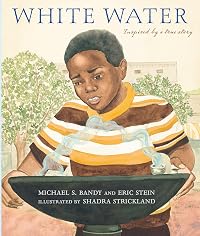
White Water
by Michael S. Bandy
On This Page
Description
After tasting the warm, rusty water from the fountain designated for African Americans, a young boy questions why he cannot drink the cool, refreshing water from the "Whites Only" fountain. Based on a true experience co-author Michael S. Bandy had as a boy.Tags
Recommendations

Member Reviews
Fans of illustrator Shadra Strickland know that not only does she create wonderful pictures, but she associates herself with books of the highest quality. This one is no exception.
Authors Bandy and Stein created this story from one of Bandy’s childhood memories of of being prohibited from drinking from a water fountain reserved for whites only. Set in the South in the early Sixties, White Water tells how a young black child, Michael, hates the taste of the water from the “colored” water fountain, and becomes obsessed with finding out what “white” water tastes like. One day he manages to sneak downtown to find out. As he partakes of the forbidden fruit, which tastes as bad as the water he is allowed to drink, a white woman sees show more him and yells, “Boy, you know you don’t belong here!” Michael, startled and afraid, falls, but then has an epiphany:
"Lying on the ground, all I could see was the pipe. I’d never seen it from that angle before. The same pipe fed both fountains! Two fountains. Two signs. But the same water in both!”
Evaluation: The Emperor’s New Clothes has nothing on this modern version of a web of lies spun to prop up an artificial system of power, presided over by those who don’t want the truth to be known. It’s really a terrific book, and the warm tones of the watercolor-and-ink illustrations add to its considerable appeal. The book is intended for readers from Kindergarten to Grade 3, but I highly recommend it for all ages. show less
Authors Bandy and Stein created this story from one of Bandy’s childhood memories of of being prohibited from drinking from a water fountain reserved for whites only. Set in the South in the early Sixties, White Water tells how a young black child, Michael, hates the taste of the water from the “colored” water fountain, and becomes obsessed with finding out what “white” water tastes like. One day he manages to sneak downtown to find out. As he partakes of the forbidden fruit, which tastes as bad as the water he is allowed to drink, a white woman sees show more him and yells, “Boy, you know you don’t belong here!” Michael, startled and afraid, falls, but then has an epiphany:
"Lying on the ground, all I could see was the pipe. I’d never seen it from that angle before. The same pipe fed both fountains! Two fountains. Two signs. But the same water in both!”
Evaluation: The Emperor’s New Clothes has nothing on this modern version of a web of lies spun to prop up an artificial system of power, presided over by those who don’t want the truth to be known. It’s really a terrific book, and the warm tones of the watercolor-and-ink illustrations add to its considerable appeal. The book is intended for readers from Kindergarten to Grade 3, but I highly recommend it for all ages. show less
Tells the story of a young boy, who parched with thirst, drinks from the black fountain and is disgusted by the taste of the water. He is sure that the water from the white's fountain must be amazing. He can't get it out of his mind. He skips school and sets out to find out, only to discover that it's exactly the same. The pipe feeding the fountains is the same pipe. He then begins to question his own beliefs and thinks, "Maybe everything I thought I couldn't do was just in my imagination," (40).
This book made me want to cry. I boy that lives in a time of segregation gets up the courage to drink from the "white" fountain, but it turns out it is just as gross as his. There is no difference between his fountain and theirs...
I enjoyed this book for a few reasons including the plot, the language, and how the book pushes readers. First, the story is about a young boy living in the segregated south. He describes his daily routine that he uses to go into town with his grandmother everyday. The young boy has to drink out of the "Colored" water fountain and becomes curious of what the "White" water fountain tastes like. The plot is organized very well by the way it sets up the main conflict of the story. I couldn't put the book down because of the suspense, "Suddenly I just had to know what the white water tasted like.", after this line, the rest of the story follows how the young boy will plan to sneak to the white fountain. I believe the big idea/message of show more this story is that you can accomplish anything no matter the odds against you. Second, the language in this book is very descriptive that includes every detail of what the main character is thinking and even imagining about. "All of a sudden, I was sitting in the middle of a giant water fountain. I had my arms open wide and my tongue out, ready to catch a drop". Lastly, this book pushes young readers to think about the tough issues that occurred in this country's past dealing with segregation and racism. It also provides a bigger message by the end of the story, "Maybe everything I thought I couldn't do was just in my imagination, too. That's when I realized-- I could do anything". show less
Michael is a young black boy who lives in a segregated world, one world for the white people and one for the colored. One day, when Michael is hot and thirsty, he takes a drink from the fountains for black people. The water tasted like “nasty, muddy, gritty yuck.” He saw a white boy drinking from the white fountain and Michael began to imagine what the white water tasted like. He imagined white water was pure and cold. He could not get the idea that he must try the white water out of his head. Finally, he snuck over to the white fountain and took a sip. It tasted just like the colored water! Michael was caught drinking from the white fountain and he fell down. When he fell, he noticed that the same water pipe brought the same water show more to both fountains! An epiphany for him.
“The signs over the fountains had put a bad idea in my head. But they were a lie. If they weren’t real, what else should I question? Maybe there were a lot of things---like that nasty old white water---that weren’t true. That had nothing to do with nothing. Maybe everything I thought I couldn’t do was just in my imagination, too. That’s when I realized---I could do anything.
Now I knew. And from that day on, I wouldn’t let anything stand in my way.” show less
“The signs over the fountains had put a bad idea in my head. But they were a lie. If they weren’t real, what else should I question? Maybe there were a lot of things---like that nasty old white water---that weren’t true. That had nothing to do with nothing. Maybe everything I thought I couldn’t do was just in my imagination, too. That’s when I realized---I could do anything.
Now I knew. And from that day on, I wouldn’t let anything stand in my way.” show less
Summary:
White Water is about a black little boy that is out on the town one hot day with his grandmother. He is exhausted, parched, and is sweating. He sees two water fountains. One fountain is for whites only the other for colored people. About that same time another little white boy was headed to the water fountain. It was finally the little black boy’s turn; the water was warm and nasty. He looked over at the little white boy only to see how the little white boy appeared to be enjoying his sip from the fountain. The little black boy could not help but wonder if the other fountain had cool and tasty water. Days passed and that’s only the thing the little black could think about. Finally one day he made a special trip to the show more white’s only water fountain, only to discover that they water tasted the same, warm and nasty. He had risked everything for nothing at all.
Personal Reaction:
This story is such a reality to mankind. How many times do we think some else is getting a better deal, only to find out that maybe they were just more grateful or appreciative then we were when we received the exact same thing. This story displayed stereotype, by allowing the reader to experience the inequality of the past. The little black boy was faced with Person –Against-Self, he knew that the right thing was to leave the white water fountain alone but his curiosity overpowered his will to abide by the law. This book helps the reader understand through the eyes of a child. This story also reveals that the climax wasn’t really worth the experience, but once again that’s children for you. I really liked this book.
Extension Ideas:
1. This book is a great icebreaker for allowing open discussion about racism.
2. Students will be challenged to illustrate the little black boy and the little white boy at the water fountains. show less
White Water is about a black little boy that is out on the town one hot day with his grandmother. He is exhausted, parched, and is sweating. He sees two water fountains. One fountain is for whites only the other for colored people. About that same time another little white boy was headed to the water fountain. It was finally the little black boy’s turn; the water was warm and nasty. He looked over at the little white boy only to see how the little white boy appeared to be enjoying his sip from the fountain. The little black boy could not help but wonder if the other fountain had cool and tasty water. Days passed and that’s only the thing the little black could think about. Finally one day he made a special trip to the show more white’s only water fountain, only to discover that they water tasted the same, warm and nasty. He had risked everything for nothing at all.
Personal Reaction:
This story is such a reality to mankind. How many times do we think some else is getting a better deal, only to find out that maybe they were just more grateful or appreciative then we were when we received the exact same thing. This story displayed stereotype, by allowing the reader to experience the inequality of the past. The little black boy was faced with Person –Against-Self, he knew that the right thing was to leave the white water fountain alone but his curiosity overpowered his will to abide by the law. This book helps the reader understand through the eyes of a child. This story also reveals that the climax wasn’t really worth the experience, but once again that’s children for you. I really liked this book.
Extension Ideas:
1. This book is a great icebreaker for allowing open discussion about racism.
2. Students will be challenged to illustrate the little black boy and the little white boy at the water fountains. show less
Set in a time of discrimination a young city boy named Michael was riding the bus with his mother when he got thirsty, he quickly rushed for the fountain but the water was disgusting. He saw a white boy drinking water and was curious as to if his big gulps were because the water was noticeably better. One day he goes to the city and tries the water from the whites-only fountain, where he was shocked that the taste was the same. When he falls after being caught he notices the pipes are connected and it is, in fact, the same water. This book is important to teach the history of segregated time and teach diversity. It teaches to question society and authority if things seem unfair. The plot of this book of benches, water, and simple daily show more living items we take for granted are seen as labeled for race in this book and allows all readers including the young to empathizes with people of these times and shows the curiosity and innocence of children in this time. This was a greatly developed book and the illustrations were great. show less
Members
- Recently Added By
Lists

Picture Books About Civil Rights
51 works; 4 members
Author Information
3 Works 470 Members
Awards and Honors
Classifications
Statistics
- Members
- 181
- Popularity
- 180,976
- Reviews
- 25
- Rating
- (4.25)
- Languages
- English
- Media
- Paper
- ISBNs
- 7
- ASINs
- 1