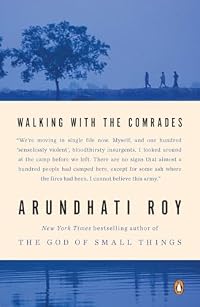
Walking with the Comrades
by Arundhati Roy
On This Page
Description
In early 2010, Roy traveled into the forests of Central India, homeland to millions of indigenous people, dreamland to some of the world's biggest mining corporations. The result is this... report from the heart of an unfolding revolution.Tags
Recommendations



























Member Reviews
Why is the government waging war against it's own people? It's poorest and most vulnerable people. Here is one reason. This company called Vedanta run by a Marwari wants to mine Aluminium in an area which tribals have called home for generations. This marwari is already worth billions, he is based in London. He wants to get even richer and in order for that to happen, he wants that aluminium. For this the land and the mountain from which the bauxite ore has to be mined have to be acquired, tribals evicted, the forests cut down, dams built etc.
This is just one story and several like this are being played over and over again like a broken record. The rapacious corporations are after the minerals in the tribal areas and will do anything show more to extract them to fill their already overflowing coffers and will use the Government and Security apparatus as the means for commiting genocide against it's own most vulnerable group of citizens.
The writing is on the wall, this is probably the revolution this country has been waiting for and should have happened several decades ago. show less
This is just one story and several like this are being played over and over again like a broken record. The rapacious corporations are after the minerals in the tribal areas and will do anything show more to extract them to fill their already overflowing coffers and will use the Government and Security apparatus as the means for commiting genocide against it's own most vulnerable group of citizens.
The writing is on the wall, this is probably the revolution this country has been waiting for and should have happened several decades ago. show less
In the north of India there is a war going on. A war that not many people outside India know about. A war that puts in antagonism the survival of many different tribes and the interest for exploitation of natural resources of a handful of powerful companies backed by the Indian state. A war that has been going on for decades and has caused thousands of deaths, displacement of entire populations, severe poverty and hunger, and the militarization of a considerable part of the Indian territory.
As part of this war, and on the side of the tribes and peoples living in the forest, the Naxalites have emerged as an armed-resistance group that has been fighting back the Indian state, its militarized police, its army, and the far-right show more paramilitary groups they have employed to take control of the areas of interest. While the armed hand of the state has been responsible for the burning of entire villages, the murder and rape of tribes that are nothing but a hindrance to the state and corporate India, the Naxalites, originally part of a Maoist Communist Party that has long been illegalized, has been classified as a "terrorist organization" and the "biggest threat to national security" for their organized resistance and defense of the most dispossessed people in the nation.
In 2010, Arundhati Roy managed to get access to the Naxalites and spend several weeks with them in the deep of the forest, living with them, walking hours a day to keep hiding, sharing their meals, and listening to their stories. In the aftermath of her time with them, she wrote a series of articles that details the history of the conflict, the context that brings about the need for armed resistance in India, and her first-hand experience with the group. These articles, published first in the Outlook magazine, were later compiled into this book.
The Naxalite uprising is probably the most important armed struggle currently going and one that cannot be ignored. Its existence and extent comes to show that it's the most dispossessed, those who have nothing to lose, who are the most likely to stand in arms against the oppressing capitalist powers. show less
As part of this war, and on the side of the tribes and peoples living in the forest, the Naxalites have emerged as an armed-resistance group that has been fighting back the Indian state, its militarized police, its army, and the far-right show more paramilitary groups they have employed to take control of the areas of interest. While the armed hand of the state has been responsible for the burning of entire villages, the murder and rape of tribes that are nothing but a hindrance to the state and corporate India, the Naxalites, originally part of a Maoist Communist Party that has long been illegalized, has been classified as a "terrorist organization" and the "biggest threat to national security" for their organized resistance and defense of the most dispossessed people in the nation.
In 2010, Arundhati Roy managed to get access to the Naxalites and spend several weeks with them in the deep of the forest, living with them, walking hours a day to keep hiding, sharing their meals, and listening to their stories. In the aftermath of her time with them, she wrote a series of articles that details the history of the conflict, the context that brings about the need for armed resistance in India, and her first-hand experience with the group. These articles, published first in the Outlook magazine, were later compiled into this book.
The Naxalite uprising is probably the most important armed struggle currently going and one that cannot be ignored. Its existence and extent comes to show that it's the most dispossessed, those who have nothing to lose, who are the most likely to stand in arms against the oppressing capitalist powers. show less
There's something stirring in India. A specter, if you will, of a dark time arisen and a dark time to come. Whether we call it capitalism, corporatism, or new (neo) Imperialism, the fact remains that those most affected by the shifting dynamics of contemporary industrialization will be the disenfranchised and the disinherited.
Arundhati Roy's (The God of Small Things, etc.) Walking with the Comrades waltzes straight into this new Indian world with passion and focus, chronicling her journey into the forests of India where Maoists and the few remaining indigenous people have dug in their heels. Each new day brings her closer to the heart of the movement that has set India's government on fire, spawning new counter-revolutionary police show more forces and new regulations and laws to strip people of their land for corporate profit. In the process, she crafts a disturbing narrative of the new Indian state, one
which will seem suspiciously familiar to Americans who know a little about the United States' history with the Native Americans.
Walking with the Comrades is a quick read, though by no means an easy one. Roy spends considerable time setting the stage for her walk with the Maoist "revolutionaries" in the forests of India. She provides cogent analyses of the Indian government's old and new programs for stifling dissent, the language they use, and the results of their activities. Likewise, she explores the history of communism in India, leading us through suppression, violent acts, revolts, and the mindset of the people on the ground -- the very comrades with which she walks. Walking with the Comrades, as such, is part of the grand tradition of travel narratives, but it is also an expansion of Roy's long and distinguished career as a novelist and cultural critic.
And it's the travel narrative aspect which is most compelling. True, Walking with the Comrades is about the political and economic situation in contemporary India, but it also an attempt to put a face on the great "security threat" of India. It's a clever tactic, because understanding that there are humans behind the mask of terror forces us to think about who we are fighting against, and why they are resisting. In the case of India, the Maoists are fighting a government that wants communism in all its forms destroyed, and the indigenous people protected by Maoists -- even if only for political gain -- moved off and adapted for industrial society -- at the expense of their traditions, native lands, etc. To realize who the Maoists are is to make blind faith to India's new cultural projects impossible, if not because we care about the Maoists and their goals -- most of us in the U.S. likely do not because we have a tendency to be ruthlessly anti-communist here -- then at least because we understand why they are doing what they do. Perhaps it's the optimist in me thinks that maybe reasonable compromise can be found in this cesspool of violence and hatred if only we can see the humanity in everything.
Still, some might be willing to dismiss Roy's work simply because she often provides polemics and doesn't seem altogether genuine when she concedes points to the opposition; in the case of Walking with the Comrades, Roy occasionally tries to suggest that the Indian government might have a solid rationale for some of their actions, yet the overwhelming majority of the book rips India to shreds, thereby weakening the conciliatory gesture. But to dismiss the book for this reason would be to discount what is clearly a problem that transcends borders and exposes the divisions and strategies utilized by a government bent not on compromises with indigenous people, but the destruction of their way of life. Even if you shrug Roy off as a wacky liberal, the facts point to a disturbing history which does not paint a pretty image for the Indian state. And even if you look at the other side, it's hard to ignore the words spoken by the people in charge, the projects set in place, the militarization of the police, and the general sense that things are not as they should be.
It's perhaps for that reason that I come out of Roy's book feeling unable to challenge the anger and disbelief she channels throughout her book, despite wearing my critical thinking cap during the reading process. Roy doesn't pull many punches when she attacks India's government and the corporations attached to it, but I found myself wondering why she bothered pulling the ones she did. If her facts are in order -- they are -- then what the Indian government is doing doesn't deserve conciliatory gestures, friendly discussion, or calm reasoning. Rather, it seems to me that to fight an extremist state, one must attack it with an extreme position. Roy certainly heads in that direction, and the result is an enormously educational reading experience. When I finished reading, I wondered where we are supposed to go from here. Maybe Roy will cover that in her next book...
Walking with the Comrades is one of the most compelling non-fiction books I have read this year, and certainly one worth remembering for years to come. If you're interested in contemporary Indian history or global capitalism, this is a book to add to your collection.
Read With:
Little Fuzzy by H. Beam Piper show less
Arundhati Roy's (The God of Small Things, etc.) Walking with the Comrades waltzes straight into this new Indian world with passion and focus, chronicling her journey into the forests of India where Maoists and the few remaining indigenous people have dug in their heels. Each new day brings her closer to the heart of the movement that has set India's government on fire, spawning new counter-revolutionary police show more forces and new regulations and laws to strip people of their land for corporate profit. In the process, she crafts a disturbing narrative of the new Indian state, one
which will seem suspiciously familiar to Americans who know a little about the United States' history with the Native Americans.
Walking with the Comrades is a quick read, though by no means an easy one. Roy spends considerable time setting the stage for her walk with the Maoist "revolutionaries" in the forests of India. She provides cogent analyses of the Indian government's old and new programs for stifling dissent, the language they use, and the results of their activities. Likewise, she explores the history of communism in India, leading us through suppression, violent acts, revolts, and the mindset of the people on the ground -- the very comrades with which she walks. Walking with the Comrades, as such, is part of the grand tradition of travel narratives, but it is also an expansion of Roy's long and distinguished career as a novelist and cultural critic.
And it's the travel narrative aspect which is most compelling. True, Walking with the Comrades is about the political and economic situation in contemporary India, but it also an attempt to put a face on the great "security threat" of India. It's a clever tactic, because understanding that there are humans behind the mask of terror forces us to think about who we are fighting against, and why they are resisting. In the case of India, the Maoists are fighting a government that wants communism in all its forms destroyed, and the indigenous people protected by Maoists -- even if only for political gain -- moved off and adapted for industrial society -- at the expense of their traditions, native lands, etc. To realize who the Maoists are is to make blind faith to India's new cultural projects impossible, if not because we care about the Maoists and their goals -- most of us in the U.S. likely do not because we have a tendency to be ruthlessly anti-communist here -- then at least because we understand why they are doing what they do. Perhaps it's the optimist in me thinks that maybe reasonable compromise can be found in this cesspool of violence and hatred if only we can see the humanity in everything.
Still, some might be willing to dismiss Roy's work simply because she often provides polemics and doesn't seem altogether genuine when she concedes points to the opposition; in the case of Walking with the Comrades, Roy occasionally tries to suggest that the Indian government might have a solid rationale for some of their actions, yet the overwhelming majority of the book rips India to shreds, thereby weakening the conciliatory gesture. But to dismiss the book for this reason would be to discount what is clearly a problem that transcends borders and exposes the divisions and strategies utilized by a government bent not on compromises with indigenous people, but the destruction of their way of life. Even if you shrug Roy off as a wacky liberal, the facts point to a disturbing history which does not paint a pretty image for the Indian state. And even if you look at the other side, it's hard to ignore the words spoken by the people in charge, the projects set in place, the militarization of the police, and the general sense that things are not as they should be.
It's perhaps for that reason that I come out of Roy's book feeling unable to challenge the anger and disbelief she channels throughout her book, despite wearing my critical thinking cap during the reading process. Roy doesn't pull many punches when she attacks India's government and the corporations attached to it, but I found myself wondering why she bothered pulling the ones she did. If her facts are in order -- they are -- then what the Indian government is doing doesn't deserve conciliatory gestures, friendly discussion, or calm reasoning. Rather, it seems to me that to fight an extremist state, one must attack it with an extreme position. Roy certainly heads in that direction, and the result is an enormously educational reading experience. When I finished reading, I wondered where we are supposed to go from here. Maybe Roy will cover that in her next book...
Walking with the Comrades is one of the most compelling non-fiction books I have read this year, and certainly one worth remembering for years to come. If you're interested in contemporary Indian history or global capitalism, this is a book to add to your collection.
Read With:
Little Fuzzy by H. Beam Piper show less
Why is the government waging war against it's own people? It's poorest and most vulnerable people. Here is one reason. This company called Vedanta run by a Marwari wants to mine Aluminium in an area which tribals have called home for generations. This marwari is already worth billions, he is based in London. He wants to get even richer and in order for that to happen, he wants that aluminium. For this the land and the mountain from which the bauxite ore has to be mined have to be acquired, tribals evicted, the forests cut down, dams built etc.
This is just one story and several like this are being played over and over again like a broken record. The rapacious corporations are after the minerals in the tribal areas and will do anything show more to extract them to fill their already overflowing coffers and will use the Government and Security apparatus as the means for commiting genocide against it's own most vulnerable group of citizens.
The writing is on the wall, this is probably the revolution this country has been waiting for and should have happened several decades ago. show less
This is just one story and several like this are being played over and over again like a broken record. The rapacious corporations are after the minerals in the tribal areas and will do anything show more to extract them to fill their already overflowing coffers and will use the Government and Security apparatus as the means for commiting genocide against it's own most vulnerable group of citizens.
The writing is on the wall, this is probably the revolution this country has been waiting for and should have happened several decades ago. show less
Ratings
Members
- Recently Added By
Author Information

58+ Works 29,408 Members
Suzanna Arundhati Roy, 1961 - Suzanna Roy was born November 24, 1961. Her parents divorced and she lived with her mother Mary Roy, a social activist, in Aymanam. Her mother ran an informal school named Corpus Christi and it was there Roy developed her intellectual abilities, free from the rules of formal education. At the age of 16, she left home show more and lived on her own in a squatter's colony in Delhi. She went six years without seeing her mother. She attended Delhi School of Architecture where she met and married fellow student Gerard Da Cunha. Neither had a great interest in architecture so they quit school and went to Goa. They stayed there for seven months and returned broke. Their marriage lasted only four years. Roy had taken a job at the National Institute of Urban Affairs and, while cycling down a road; film director Pradeep Krishen offered her a small role as a tribal bimbo in Massey Saab. She then received a scholarship to study the restoration of monuments in Italy. During her eight months in Italy, she realized she was a writer. Now married to Krishen, they planned a 26-episode television epic called Banyan Tree. They didn't shoot enough footage for more than four episodes so the serial was scrapped. She wrote the screenplay for the film In Which Annie Gives It Those Ones and Electric Moon. Her next piece caused controversy. It was an article that criticized Shekar Kapur's film Bandit Queen, which was about Phoolan Devi. She accused Kapur of misrepresenting Devi and it eventually became a court case. Afterwards, finished with film, she concentrated on her writing, which became the novel "A God of Small Things." It is based on what it was like growing up in Kerala. The novel contains mild eroticism and again, controversy found Roy having a public interest petition filed to remove the last chapter because of the description of a sexual act. It took Roy five years to write "A God of Small Things" and was released April 4, 1997 in Delhi. It received the Booker prize in London in 1997 and has topped the best-seller lists around the world. Roy is the first non-expatriate Indian author and the first Indian woman to win the Booker prize. (Bowker Author Biography) show less
Common Knowledge
- Important places
- India
Classifications
Statistics
- Members
- 178
- Popularity
- 183,284
- Reviews
- 4
- Rating
- (4.18)
- Languages
- Catalan, English
- Media
- Paper, Ebook
- ISBNs
- 4
- ASINs
- 3