
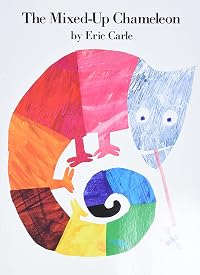
The Mixed-Up Chameleon
by Eric Carle
On This Page
Description
A bored chameleon wishes it could be more like all the other animals it sees, but soon decides it would rather just be itself. Cutouts along the edges of the pages display various animals and colors.Tags
Recommendations





Member Reviews
Be true to yourself and you can eat as many flies as you like has to be one of the weirdest morals ever, but I'm still not impressed with this transforming lizard and its self-image issues.
I loved this story so much more than I could have imagined. It tells the story of a chameleon going to visit a zoo and wishing it were like all the other animals (or having certain traits that they had). In this way, the chameleon transforms (with different traits) into every animal he wishes he could be like, as opposed to just the color. This tips off to the name THE MIXED-UP CHAMELEON as it is "mixed-up" with what kind of animal it is. In the end, it wishes to return back to being itself so that it can catch a fly. I personally loved the plot, the illustrations, and the message.
Reading Log #5
I liked the book The Mixed-Up Chameleon. It focuses on a Chameleon who is trying to find himself and figure out what is going to make him happy. The book portrays the message in a way that is easy for readers to understand. I also liked the illustrations and plot because it shows how to portray a message creatively.
One of the first reasons I liked the book was the illustrations. The Mixed-Up Chameleon is unhappy at the beginning of the story, which leads him to change into several different animals. Eric Carle uses colors and different animals to portray emotions of how the Chameleon is feeling. Another reason I liked the illustrations was, Eric Carle on each page focuses on just the Chameleon, and there is no extra show more pictures or words to take away from the focus of him. As the story progressed, each animal was a different color. On the very last page, there is a rainbow of all the colors used for each animal. The rainbow above the Chameleon when he is back to his true self-shows that even everything he wished for he is truly happy with just being himself.
The second reason I liked the book was the plot. The Mixed-Up Chameleon has a suspenseful plot that draws readers into the story. The story starts out with the Chameleon being alone and describes how he lives. Then it progresses to his conflict of not being happy. I liked the plot because the progression was graceful and easy to follow when reading. Once the story showed the Chameleon unhappy, it focused on him finding the zoo and wishing he could be different animals. The solution then ended with him not being happy as those other animals, and he wanted to be himself again. The plot made the story easy to follow along and recognize what the message was which sometimes can be hard for readers to notice.
The big idea of the story was to show that being who you are is what makes you happy. This big idea is an important lesson because trying to be something which is not you makes you unhappy. In the story, the Chameleon tried to be several different animals, and in the end, he only wanted to him himself, which shows readers being who you are is the way to be happy. show less
I liked the book The Mixed-Up Chameleon. It focuses on a Chameleon who is trying to find himself and figure out what is going to make him happy. The book portrays the message in a way that is easy for readers to understand. I also liked the illustrations and plot because it shows how to portray a message creatively.
One of the first reasons I liked the book was the illustrations. The Mixed-Up Chameleon is unhappy at the beginning of the story, which leads him to change into several different animals. Eric Carle uses colors and different animals to portray emotions of how the Chameleon is feeling. Another reason I liked the illustrations was, Eric Carle on each page focuses on just the Chameleon, and there is no extra show more pictures or words to take away from the focus of him. As the story progressed, each animal was a different color. On the very last page, there is a rainbow of all the colors used for each animal. The rainbow above the Chameleon when he is back to his true self-shows that even everything he wished for he is truly happy with just being himself.
The second reason I liked the book was the plot. The Mixed-Up Chameleon has a suspenseful plot that draws readers into the story. The story starts out with the Chameleon being alone and describes how he lives. Then it progresses to his conflict of not being happy. I liked the plot because the progression was graceful and easy to follow when reading. Once the story showed the Chameleon unhappy, it focused on him finding the zoo and wishing he could be different animals. The solution then ended with him not being happy as those other animals, and he wanted to be himself again. The plot made the story easy to follow along and recognize what the message was which sometimes can be hard for readers to notice.
The big idea of the story was to show that being who you are is what makes you happy. This big idea is an important lesson because trying to be something which is not you makes you unhappy. In the story, the Chameleon tried to be several different animals, and in the end, he only wanted to him himself, which shows readers being who you are is the way to be happy. show less
Summary:
This children’s picture book is about a ‘mixed-up chameleon’ who isn’t happy with himself. He thinks he leads a boring life and one day visits the zoo and sees all sorts of animals that he would rather be. He wishes he could be all of the animals and eventually becomes an unknown creature all mixed up with different animal body parts. When he sees a fly buzz by, he isn’t able to catch it because he doesn’t have his chameleon head or tongue anymore. He is saddened and has one final wish. He wishes he could be himself again and turns back into a regular chameleon.
Comments (opinions/arguments):
This is one of my favorite Eric Carle children’s books. I love the simple illustrations of the chameleon and how over time as show more he gains different animal body parts how goofy and funny he ends up looking. I can just see children having so much fun with the images and trying to predict what might come next. I also really like that the book incorporates little pictures of each animal on the page where he gains there body part as a reminder to the child and the color tabs that are incorporated as well. I also like how the book has cut outs on those pages so it’s an easy way to grab and turn back the pages for children’s small hands. This book is also wonderful for its underlying message that I think is very relatable to children as they grow up. Because the chameleon doesn’t like himself and wishes he were other animals, he begins to realize that he actually liked who he was very much. I think this is great because it will teach children about their own uniqueness and individuality. It will show them that its OK to be yourself! show less
This children’s picture book is about a ‘mixed-up chameleon’ who isn’t happy with himself. He thinks he leads a boring life and one day visits the zoo and sees all sorts of animals that he would rather be. He wishes he could be all of the animals and eventually becomes an unknown creature all mixed up with different animal body parts. When he sees a fly buzz by, he isn’t able to catch it because he doesn’t have his chameleon head or tongue anymore. He is saddened and has one final wish. He wishes he could be himself again and turns back into a regular chameleon.
Comments (opinions/arguments):
This is one of my favorite Eric Carle children’s books. I love the simple illustrations of the chameleon and how over time as show more he gains different animal body parts how goofy and funny he ends up looking. I can just see children having so much fun with the images and trying to predict what might come next. I also really like that the book incorporates little pictures of each animal on the page where he gains there body part as a reminder to the child and the color tabs that are incorporated as well. I also like how the book has cut outs on those pages so it’s an easy way to grab and turn back the pages for children’s small hands. This book is also wonderful for its underlying message that I think is very relatable to children as they grow up. Because the chameleon doesn’t like himself and wishes he were other animals, he begins to realize that he actually liked who he was very much. I think this is great because it will teach children about their own uniqueness and individuality. It will show them that its OK to be yourself! show less
The chameleon lives a very boring life, only catching flies and changing colors to match whatever he is standing by, until one day when the chameleon goes to the zoo. He sees so many different animals and wishes that he could be like each of them. But, the chameleon becomes so mixed up with trying to be like all the different animals, he can't even catch a fly anymore! The chameleon wishes he could be himself again.
I chose this book because it was one I loved as a kid but had forgotten about! Somehow, it manages to take an extremely simple concept and plot and tackle the topics of jealousy of others and self-acceptance. Children are drawn to its simplicity, in text and in illustration. I love the bold colors on top of the fairly plain show more backgrounds to help things stand out and keep it from looking busy. show less
I chose this book because it was one I loved as a kid but had forgotten about! Somehow, it manages to take an extremely simple concept and plot and tackle the topics of jealousy of others and self-acceptance. Children are drawn to its simplicity, in text and in illustration. I love the bold colors on top of the fairly plain show more backgrounds to help things stand out and keep it from looking busy. show less
"The Mixed-Up Chameleon" is illustrated by Eric Carle, a man famous for his collage style illustrations. He utilizes vibrant colors and paper to create pictures with depth and character. In this story, a chameleon is tired of being himself and wants to be like the creatures he sees at the zoo. He takes on pieces of them until he no longer feels like himself. He ends up wishing that he were himself again and able to catch that fly. The moral of the story is that we should be happy with who we are. I really like the moral and think sequencing of events could be taught through the story. The animals that chameleon tried to be like could be ordered with movable pictures. The Scholastic Readability of this story is grades PreK-2.
Eric Carle’s The Mixed Up Chameleon looks hungry and deflated with a gray marble color in the opening scene. Bored with the life of predictably changing color, little chameleon decides to visit the zoo where his wish are miraculously granted. With repetitive text, the series of transformations becomes hilarious as the chameleon accumulates a tails, fins, and a rainbow of colors in a collage of illustrations. The transformations add bold colors, textures, and shapes to little chameleon. The simple text has a smooth flowing repetition that helps young readers recognize repetitious words. The illustrations vary in color and are heavy lined, with a crisp appeal. The end of the story results in self reflection and encourages individual show more strengths rather than changing to be like others. With a great moral, catchy tone, and bright illustrations, this is a great book for beginning readers. show less
Members
- Recently Added By
Lists

Brightly Beaming Curriculum Books
281 works; 8 members

Youth: Zoology
128 works; 1 member

Written and Illustrated By
805 works; 1 member

A Practical Response to Gender Distress Books for Children
9 works; 1 member

Children's Picture Books with different kind of hybrids
14 works; 1 member
Author Information

585+ Works 194,354 Members
Eric Carle is an award-winning, children's picture book author and illustrator whose most recognized work is The Very Hungry Caterpillar Board Book. Carle was born to German parents in 1929 in Syracuse, New York. The family returned to Germany in 1935, moving to a suburb of Stuttgart. Carle disliked high school, quitting at the age of 16 before show more graduation. He was admitted as the youngest student to the Akademie der bildenden Kunste, an art school. After finishing at the Akademie, he worked as a poster designer for the U.S. Information Center in Germany until 1952, when he moved back to New York City. He was a graphic designer at the New York Times and later worked as an art director at L.W. Frohlich & Co. In 1963, Bill Martin, Jr. saw a poster of a red lobster that Carle had designed and asked him to illustrate Brown Bear, Brown Bear, What Do You See?, thus launching his freelance career. Among his many children's books are Dream Snow, Hello, Red Fox, The Very Clumsy Click Beetle, and Pancakes, Pancakes! His title The Artist Who Painted a Blue Horse made Publisher's Weekly Best Seller List for 2011. His title Brown Bear Brown Bear What to You See? made The New York Times Best Seller List for 2012. In 2015 he made The New Zealand Best Seller List with Love from the Very Hungry Caterpillar. Eric Carle, beloved children's book author and illustrator, died on May 23, 2021. He was 91. (Bowker Author Biography) show less
Some Editions
Awards and Honors
Notable Lists
Work Relationships
Has the adaptation
Common Knowledge
- Canonical title
- The Mixed-Up Chameleon
- Original title
- The Mixed-Up Chameleon
- Original publication date
- 1975
- People/Characters
- The Mixed-Up Chameleon
- Dedication
- Dedicated to all the children who have worked with me on this book.
- First words
- On a shiny green leaf sat a small green chameleon.
- Last words
- (Click to show. Warning: May contain spoilers.)I wish I could be myself.
The chameleon's wish came true.
And it caught the fly! - Original language
- English
Classifications
Statistics
- Members
- 4,963
- Popularity
- 2,819
- Reviews
- 104
- Rating
- (3.99)
- Languages
- 14 — Arabic, Chinese, Dutch, English, French, German, Gujarati, Hungarian, Italian, Korean, Somali, Spanish, Swedish, Turkish
- Media
- Paper
- ISBNs
- 54
- UPCs
- 1
- ASINs
- 10