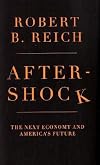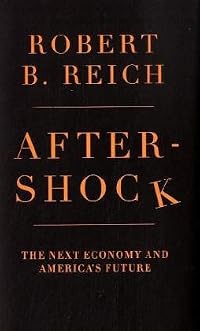
Aftershock: The Next Economy and America's Future
by Robert B. Reich
On This Page
Description
Celebrated economic policy maker and political theorist Robert B. Reich argues that the nation's 2008 economic collapse is the result of an increasing concentration of income and wealth at the top--and a middle class that had to go deeply into debt to maintain a decent standard of living. To ensure that prosperity is widely shared, he continues, requires the implementation of a much broader safety net for the middle class financed by higher marginal tax rates on the very wealthy.Tags
Recommendations


Member Reviews
Readers can tell that Robert Reich is a college teacher; it shows in this book. He is very good at explaining exactly what happened to the economy in this current climate and why it happened. More importantly, he outlines very well what will happen unless this nation and its people decide on some serious, substantial, meaningful changes. And yet, this is a short book, which makes it pretty easy to read. What I found fascinating is that what is happening is not really new for one. We faced a lot of this during the Great Depression. In some ways, the situation is the same, but the names and players have changed, so to speak.
The problem is not one of Americans simply having spent past their means, which they did. This is not to be denied. show more The real problem is their wages have not kept up with the times, and employers and the wealthy have broken the social contract where we all pay fairly and gain benefit from shared prosperity. When you have billionaires like Warren Buffet actually saying that he should be taxed a lot more, that is a hint of Professor Reich's argument. I found myself making a lot of little notes, which you can see in my reading updates for this book for the book offers some good points and a lot to think about. The potential scenario of an "Independence Party" candidate winning the White House along with Congress should scare the daylights out of people not matter what side of the political spectrum you are in. And yet, we get a very good explanation of how it will happen if things keep going at the same pace as well as how to avoid, which is the option that will take work. Many passages in this book caught my eye, but I think the one I want to share with readers right away is this one:
On page 145: "If nothing is done to counter present trends, the major fault line in American politics will no longer be between Democrats and Republicans, liberals and conservatives. It will be between the 'establishment'--political insiders, power brokers, the heads of American business, Wall Street, and the mainstream media--and an increasingly mad-as-hell populace determined to 'take back America' from them."
Now, take a guess who is going to "win" if the current crop of greedy, hate-and-fear mongering powers manage to keep on manipulating the angry and willfully ignorant. It does not look good, and maybe that is why I did not give this book five stars. I don't necessarily share Dr. Reich's optimism at the end of the book. However, overall, this is one book worth reading. show less
The problem is not one of Americans simply having spent past their means, which they did. This is not to be denied. show more The real problem is their wages have not kept up with the times, and employers and the wealthy have broken the social contract where we all pay fairly and gain benefit from shared prosperity. When you have billionaires like Warren Buffet actually saying that he should be taxed a lot more, that is a hint of Professor Reich's argument. I found myself making a lot of little notes, which you can see in my reading updates for this book for the book offers some good points and a lot to think about. The potential scenario of an "Independence Party" candidate winning the White House along with Congress should scare the daylights out of people not matter what side of the political spectrum you are in. And yet, we get a very good explanation of how it will happen if things keep going at the same pace as well as how to avoid, which is the option that will take work. Many passages in this book caught my eye, but I think the one I want to share with readers right away is this one:
On page 145: "If nothing is done to counter present trends, the major fault line in American politics will no longer be between Democrats and Republicans, liberals and conservatives. It will be between the 'establishment'--political insiders, power brokers, the heads of American business, Wall Street, and the mainstream media--and an increasingly mad-as-hell populace determined to 'take back America' from them."
Now, take a guess who is going to "win" if the current crop of greedy, hate-and-fear mongering powers manage to keep on manipulating the angry and willfully ignorant. It does not look good, and maybe that is why I did not give this book five stars. I don't necessarily share Dr. Reich's optimism at the end of the book. However, overall, this is one book worth reading. show less
After-Shock, The Next Economy and America’s Future, by Robert Reich (pp 146). This is, I believe, the only book I’ve read on economics, but Reich’s economics-for-idiots style made this a good place to start. He is the former Labor Secretary under Bill Clinton and is currently a professor at U of California at Berkeley. Much of the book is his take on the Great Recession of 2008, its causes, comparisons of economic conditions in other periods of the modern U.S. economy, and—as the subtitle states—ways the government can tackle what he sees as flaws in the U.S. economy, including a number of specific new policies. As you can guess, his findings and suggested solutions are likely to be attractive to the left and heretical to the show more right. I believe his basic premise is that we are in an economic fix in large part because of the widening gap between top earners and the middle & lower classes (meaning you and me). The current gap, arguably an abyss, mirrors similar statistics prior to the Great Depression. As wages have stagnated—-a decades long trend—the middle class no longer consumes at previous rates despite aggressive and arguably unhealthy borrowing. One significant impact of less buying power of the vast majority of Americans means they can buy only a fraction of this nation’s capacity to produce. That means they (we) are no longer capable of sustaining economic growth; our buying is no longer pumping the economy like it did when wages were higher and growing. One result of the concentration of money in the megarich is reduced domestic spending because the wealthy buy far less as a percentage of earnings than the rest of us. The middle class spend most of what we earn out of necessity, so if our share of the economy is smaller (and it is now much smaller), and we can pump far fewer dollars into that same economy. No surprise, Reich takes great exception to the conditions that led to the most recent and catastrophic recession, including a largely unregulated Wall Street and the concentration of banking in institutions. Why does that matter? Because when those banks and investors that are too big to fail crash, they are bailed out by the taxpayers (increasingly the lower wage masses), which means the wealthy are insulated from the negative impact of their own failures and the people least able to afford it bear the burden. (This is my unsophisticated takeaway.) The solutions Reich offers are ways to restore balance in the economy and to narrow, not close, the gap. You can read the book for those proposed solutions that go beyond higher tax rates for big business that has thrived while wage earners suffer.
This was a surprisingly interesting book, though I had to take it slowly to keep from frying my brain. show less
This was a surprisingly interesting book, though I had to take it slowly to keep from frying my brain. show less
“As mass production has to be accompanied by mass consumption, mass consumption, in turn, implies a distribution of wealth... Instead of achieving that kind of distribution, a giant suction pump had... drawn into a few hands an increasing portion of currently produced wealth. ...In consequence, as in a poker game where the chips were concentrated in fewer and fewer hands, the other fellows could stay in the game only by borrowing. When their credit ran out, the game stopped.”
This is from Robert Reich’s book Aftershock. It is a very good summary of what happened in 2008. Except that it isn’t Reich himself and it isn’t about 2008. Reich is quoting long-ago Fed chairman Marriner Eccles. And Eccles was writing not about 2008 but show more about 1929 and the Great Depression that followed.
Reich was Labor Secretary in Clinton’s first administration and is now Professor of Public Policy at Berkeley. His diagnosis, as set out in Aftershock, is simple; it is that the concentration of wealth in the hands of a few will make everyone poorer, because the rich don’t spend anything like enough to generate employment – that needs a mass market, with everyone participating. In fact, the process of wealth concentration had been going on for years before 2008. “The wages of the typical American hardly increased in the three decades leading up to the Crash of 2008, considering inflation. In the 2000s, they actually dropped,” says Reich, and goes on to explain that the economy has grown so much over that period that, had the benefits been divided equally, the typical person would be 60% better off.
If that’s the case, how come no-one seemed to notice this was happening for 30 years? Reich argues that the relative decline in income for most people was masked by longer hours; the participation of women as well as men in the workforce, generating dual incomes; and, most dangerously, by an explosion of credit. A quick look at house prices over the last 30 years suggests where much of that credit went. When the property bubble burst, the game, indeed, stopped.
This is a lucid and persuasive book. Reich writes well; his talent is to explicate and illuminate, rather than lecture. The same can be seen in the film Inequality for All, which arose from the book and sets out the same ideas; Reich comes across as a man of some warmth and humour and a natural communicator.
This book isn’t just a diagnosis, however; it’s a prognosis and prescription as well. And it’s on these two latter that the book does come unstuck a little.
The prognosis, Reich warns, is that if we’re unlucky Americans will at last say “Hell, we were screwed” but then draw quite the wrong conclusion from that, electing a right-wing, isolationist, populist and frightening President. (He is wise enough to make this a fictional character, though she slightly resembles a sort of Palin-Thatcher cross.) Losers of rigged games, as Reich rightly says, tend to get angry. His scenario may come true, but it is just as likely that Americans, and Brits, will vote for governments who see the need for greater equality, but that those governments will be hamstrung by markets, trade treaties and, in the US, legislative stasis. In that case people will, quietly first and then in greater numbers, drift away from the system, and society will lose its cohesion; government will become ineffective; and the Western world will slide into senescence and irrelevance.
Prof Reich also suggests a number of measures to address inequality. One is a “reverse income tax” that will subsidise the middle class (why does the US not appear to have a working class, one wonders?). The money would be added to paychecks. This reminds one of the system of poor relief devised by magistrates at Speenhamland in Berkshire at the end of the 18th century. “Speenhamland” was, when I was young, always taught as an example of the road to hell being paved with good intentions. It simply allowed employers to lower wages, thus accumulating wealth for themselves while making the public pay their wage bill. In fact, recent research has suggested that Speenhamland’s outcomes were not so clear-cut. Still, with many lower-paid workers in Western countries now drawing welfare to supplement their wages, one wonders whether we already have Speenhamland writ large. Wouldn’t we be better off having a much higher, and strongly enforced, minimum wage? Far from bankrupting employers, it’ll make us all richer in the end.
Reich also proposes a carbon tax to fund this wage subsidy. He suggests an indirect tax set at $35 a ton. In suggesting this, he is rather going where angels fear to tread. The whole argument of carbon tax vs. carbon market is a big messy one, and governments have so far had a hard time applying either. The price of carbon on the open market is nothing like $35, and taxing what is, in effect, a raw material at way above its market value may not be a good idea, particularly if emitters cannot buy in credits from the market to pay the tax. (If they could, the proposal might make some sense in environmental terms; it would greatly increase incentives to reduce emissions). I’d argue that carbon is best left in the separate box where it belongs.
The author also does not really address the whole question of governance. True, he clearly perceives poor governance as a driver of inequity; many of the evils of the last 30-odd years would not have arisen if the privileged hadn’t been able to buy power and influence through lobbyists, or hold politicians in thrall through campaign contributions. Reich therefore suggests measures to get money out of politics, and he is clearly right. What he does not discuss is the weakness of electoral systems that give voters a limited choice between at most two candidates, both of which will in effect be part of the system he deprecates. You want to throw the bums out? Give space for alternative candidates to stand.
Reich’s prognosis and prescription are incomplete, and are the reason why I give this book four stars and not five. But in a way that is not the point of Aftershock. There can be no prognosis or prescription without diagnosis, and the diagnosis in this book is spot-on. What is more, it is delivered with clarity, warmth and charm. Anyone who wants to know how we god into such a mess in 2008, and 1929, should read this book, then think for themselves – long and hard – about where we go next. show less
This is from Robert Reich’s book Aftershock. It is a very good summary of what happened in 2008. Except that it isn’t Reich himself and it isn’t about 2008. Reich is quoting long-ago Fed chairman Marriner Eccles. And Eccles was writing not about 2008 but show more about 1929 and the Great Depression that followed.
Reich was Labor Secretary in Clinton’s first administration and is now Professor of Public Policy at Berkeley. His diagnosis, as set out in Aftershock, is simple; it is that the concentration of wealth in the hands of a few will make everyone poorer, because the rich don’t spend anything like enough to generate employment – that needs a mass market, with everyone participating. In fact, the process of wealth concentration had been going on for years before 2008. “The wages of the typical American hardly increased in the three decades leading up to the Crash of 2008, considering inflation. In the 2000s, they actually dropped,” says Reich, and goes on to explain that the economy has grown so much over that period that, had the benefits been divided equally, the typical person would be 60% better off.
If that’s the case, how come no-one seemed to notice this was happening for 30 years? Reich argues that the relative decline in income for most people was masked by longer hours; the participation of women as well as men in the workforce, generating dual incomes; and, most dangerously, by an explosion of credit. A quick look at house prices over the last 30 years suggests where much of that credit went. When the property bubble burst, the game, indeed, stopped.
This is a lucid and persuasive book. Reich writes well; his talent is to explicate and illuminate, rather than lecture. The same can be seen in the film Inequality for All, which arose from the book and sets out the same ideas; Reich comes across as a man of some warmth and humour and a natural communicator.
This book isn’t just a diagnosis, however; it’s a prognosis and prescription as well. And it’s on these two latter that the book does come unstuck a little.
The prognosis, Reich warns, is that if we’re unlucky Americans will at last say “Hell, we were screwed” but then draw quite the wrong conclusion from that, electing a right-wing, isolationist, populist and frightening President. (He is wise enough to make this a fictional character, though she slightly resembles a sort of Palin-Thatcher cross.) Losers of rigged games, as Reich rightly says, tend to get angry. His scenario may come true, but it is just as likely that Americans, and Brits, will vote for governments who see the need for greater equality, but that those governments will be hamstrung by markets, trade treaties and, in the US, legislative stasis. In that case people will, quietly first and then in greater numbers, drift away from the system, and society will lose its cohesion; government will become ineffective; and the Western world will slide into senescence and irrelevance.
Prof Reich also suggests a number of measures to address inequality. One is a “reverse income tax” that will subsidise the middle class (why does the US not appear to have a working class, one wonders?). The money would be added to paychecks. This reminds one of the system of poor relief devised by magistrates at Speenhamland in Berkshire at the end of the 18th century. “Speenhamland” was, when I was young, always taught as an example of the road to hell being paved with good intentions. It simply allowed employers to lower wages, thus accumulating wealth for themselves while making the public pay their wage bill. In fact, recent research has suggested that Speenhamland’s outcomes were not so clear-cut. Still, with many lower-paid workers in Western countries now drawing welfare to supplement their wages, one wonders whether we already have Speenhamland writ large. Wouldn’t we be better off having a much higher, and strongly enforced, minimum wage? Far from bankrupting employers, it’ll make us all richer in the end.
Reich also proposes a carbon tax to fund this wage subsidy. He suggests an indirect tax set at $35 a ton. In suggesting this, he is rather going where angels fear to tread. The whole argument of carbon tax vs. carbon market is a big messy one, and governments have so far had a hard time applying either. The price of carbon on the open market is nothing like $35, and taxing what is, in effect, a raw material at way above its market value may not be a good idea, particularly if emitters cannot buy in credits from the market to pay the tax. (If they could, the proposal might make some sense in environmental terms; it would greatly increase incentives to reduce emissions). I’d argue that carbon is best left in the separate box where it belongs.
The author also does not really address the whole question of governance. True, he clearly perceives poor governance as a driver of inequity; many of the evils of the last 30-odd years would not have arisen if the privileged hadn’t been able to buy power and influence through lobbyists, or hold politicians in thrall through campaign contributions. Reich therefore suggests measures to get money out of politics, and he is clearly right. What he does not discuss is the weakness of electoral systems that give voters a limited choice between at most two candidates, both of which will in effect be part of the system he deprecates. You want to throw the bums out? Give space for alternative candidates to stand.
Reich’s prognosis and prescription are incomplete, and are the reason why I give this book four stars and not five. But in a way that is not the point of Aftershock. There can be no prognosis or prescription without diagnosis, and the diagnosis in this book is spot-on. What is more, it is delivered with clarity, warmth and charm. Anyone who wants to know how we god into such a mess in 2008, and 1929, should read this book, then think for themselves – long and hard – about where we go next. show less
There’s much to like about this book. Its central claim about the increasing inequalities between the richest Americans and the middle class are irrefutable and supported with good historical analysis. Reich identifies three realities which have pacified the middle class: women in workplace, increased credit, increased work hours. Arguing that these cannot be sustained, he believes—probably rightly so—that we’re heading for a day of reckoning. It’s in his proposals to stave this catastrophe where Reich missteps—mostly because he has a fundamental misunderstanding of human nature. Instead of seeing people as complex beings who require purposeful lives who can’t be fully satisfied with consumption, Reich proves himself the show more economist and assumes that all jobs are created equal and that as long as a person finds work, they’ll be able to find happiness in their ability to bring home a paycheck. In fairness, Reich is better than most economists. At times he does recognize that monetary acquisition does not correlate to increased happiness. But even so, his policies seek to increase production (What should we produce, Mr. Reich? We have everything we need.) and thereby increasing the number of available jobs. Like a 2010 politician, Reich seems to think that more jobs is the answer, not taking into account that people devoting their work lives to fulfilling the human whims of the market is unsustainable. show less
This is one of the books I have collected during my four-year stay in New York. These years were very difficult for me and I was plagued by a sense of deep disappointment with the dissonance between my image of America and the reality I lived every day. Even in affluent New York, you can see that things are going wrong for the majority of the working-class, you can see the growing divide between Walmart shoppers and the clients of 5th Avenue, it is not pretty.
I tried to understand all this by accumulating books on the subject of the financial crisis and the mortgage fiasco. I had a nascent interest in economical theory that I never developed because as worker in the giant mill of the city I had too much to worry about, and never any show more time to think. In comparison to most Americans I had a cushy and well-paid job, but the unease of living in this human mill permeated my soul and I had to escape to preserve my sanity. Now I catch up with my reading and learn about the source of my unease.
This book gives an excellent idea about what is happening in the American economy. It even gives a dire prediction about the rise of populism (a version of which has indeed come true in the Trump presidency). What is put forward here is that the state must keep a basic bargain with its working class. They need to be able always to buy what they produce. Because oncethe working-class are unable to do so, having exhausted their coping strategies and sources of credit, the economy will also stop growing. Higher taxes for the rich are not a punishment, they have to be applied to the advantage of everyone including the rich who will make bigger profits in a growing economy. The middle class is the engine that keeps the economy running, buying products and services, so by curtailing their spending power and limiting it to paying for necessities like healthcare and education the market will face an inevitable slowdown. It is a very potent idea and I think it has its merit. I have anecdotal evidence from comparing Berlin to New York. show less
I tried to understand all this by accumulating books on the subject of the financial crisis and the mortgage fiasco. I had a nascent interest in economical theory that I never developed because as worker in the giant mill of the city I had too much to worry about, and never any show more time to think. In comparison to most Americans I had a cushy and well-paid job, but the unease of living in this human mill permeated my soul and I had to escape to preserve my sanity. Now I catch up with my reading and learn about the source of my unease.
This book gives an excellent idea about what is happening in the American economy. It even gives a dire prediction about the rise of populism (a version of which has indeed come true in the Trump presidency). What is put forward here is that the state must keep a basic bargain with its working class. They need to be able always to buy what they produce. Because oncethe working-class are unable to do so, having exhausted their coping strategies and sources of credit, the economy will also stop growing. Higher taxes for the rich are not a punishment, they have to be applied to the advantage of everyone including the rich who will make bigger profits in a growing economy. The middle class is the engine that keeps the economy running, buying products and services, so by curtailing their spending power and limiting it to paying for necessities like healthcare and education the market will face an inevitable slowdown. It is a very potent idea and I think it has its merit. I have anecdotal evidence from comparing Berlin to New York. show less
At under 200 pages, this book is too short. It is divided into three parts. Part I presents a good but still too complicated version of the rising inequality in American society. Reich's account will be familiar to readers of Paul Krugman or Elizabeth Warren. Middle class Americans have to work harder and more to keep up in the rat race (Reich's three coping strategies: women entering the workforce, working longer hours, drawing down savings/increasing debts), while public safety nets are weakening and healthcare and catastrophic risks are privatized. The classic promise "if you work hard, you will succeed" doesn't work any more. A tiny minority, the plutocracy, cashes in all the benefits and prevents a more equitable distribution of show more income. Reich calls this the bargain broken.
Part II is titled "backlash" and deals with political and populist reactions to part I. He starts with a rather implausible 2020 presidential election victory of a Palinesque Independence Party candidate (against candidates Chelsea Clinton and George P. Bush). Anger created out of a lower standard of living and less shopping possibilities while the plutocrats resume to bathe in money . Here it is where I part company with Reich's analysis. Populist anger against the rich is unlikely in the United States of America. Firstly, the corporations control all media. Secondly, the peasants have totally bought the plutocracy's framing. Just like medieval serfs or Third World citizens only revolt(ed) in times of famine or existential crisis but never questioned the layers of society, America's current popular unrest does not target the plutocracy but even weaker economic parties (such as immigrants or foreign companies). Thus the backlash is inflicted on the wrong actors. Longstanding limping democracies such as Italy and Argentina show that inequality persists despite popular anger.
In part III, Reich develops a sensible, textbook-like plan of economic measures to curb inequality. In an ideal world, his plan would be adopted the next day. Reich has to appeal to the Democrats, their ideals and their longterm self-interest to undertake the transformation process. Unfortunately, the sweet melody of money is much more alluring to most politicians than Reich's message. Reich does not even have the ear of the Democratic Party. I venture that the writing of this book was mainly triggered because Reich could not get his message through in private. He should have used an additional fifty pages to sketch a winning strategy for his message.
Currently, the economic analysis of the rising US inequality is getting better. Out of Krugman, Moore, Taibbi, Reich and Warren, a common narrative is emerging. It still needs sharpening to survive against the reptilian brain explanations of his opponents. The next step is creating organizations to sustain and amplify the message. Unfortunately, this runs against the Bowling Alone trend of diminishing social capital. The message has to reach and capture the suburbs to be successful. Finally, politicians need reliable populist support to stay on message and prevent their co-optation by the plutocracy. As long as these elements are not in place, Reich's vision remains a dream and the United States will continue to drift. show less
Part II is titled "backlash" and deals with political and populist reactions to part I. He starts with a rather implausible 2020 presidential election victory of a Palinesque Independence Party candidate (against candidates Chelsea Clinton and George P. Bush). Anger created out of a lower standard of living and less shopping possibilities while the plutocrats resume to bathe in money . Here it is where I part company with Reich's analysis. Populist anger against the rich is unlikely in the United States of America. Firstly, the corporations control all media. Secondly, the peasants have totally bought the plutocracy's framing. Just like medieval serfs or Third World citizens only revolt(ed) in times of famine or existential crisis but never questioned the layers of society, America's current popular unrest does not target the plutocracy but even weaker economic parties (such as immigrants or foreign companies). Thus the backlash is inflicted on the wrong actors. Longstanding limping democracies such as Italy and Argentina show that inequality persists despite popular anger.
In part III, Reich develops a sensible, textbook-like plan of economic measures to curb inequality. In an ideal world, his plan would be adopted the next day. Reich has to appeal to the Democrats, their ideals and their longterm self-interest to undertake the transformation process. Unfortunately, the sweet melody of money is much more alluring to most politicians than Reich's message. Reich does not even have the ear of the Democratic Party. I venture that the writing of this book was mainly triggered because Reich could not get his message through in private. He should have used an additional fifty pages to sketch a winning strategy for his message.
Currently, the economic analysis of the rising US inequality is getting better. Out of Krugman, Moore, Taibbi, Reich and Warren, a common narrative is emerging. It still needs sharpening to survive against the reptilian brain explanations of his opponents. The next step is creating organizations to sustain and amplify the message. Unfortunately, this runs against the Bowling Alone trend of diminishing social capital. The message has to reach and capture the suburbs to be successful. Finally, politicians need reliable populist support to stay on message and prevent their co-optation by the plutocracy. As long as these elements are not in place, Reich's vision remains a dream and the United States will continue to drift. show less
Many years ago when I was in college (back when dinosaurs roamed the earth), there were no required courses other than the ones for your major. You better believe I didn’t crack a math or science text for four years. But, once I graduated and entered the real world, I discovered that there is a reason why those courses are taught. Contrary to what many disgruntled students will tell you, that knowledge is relevant to everyday life.
Take economics, for instance. I didn’t take it in school, but I started reading up on it afterwards. It was the era of WIN (Whip Inflation Now) and the Laffer Curve and waiting breathlessly for the money supply number. What did all of this mean? I slogged through economics tomes written for a popular show more audience, reading and re-reading the dense prose only to come away with a vague notion of the concepts that the authors were trying to convey.
I don’t know if some of that knowledge finally began to sink in or if economists are dumbing down their books but lately I seem to be able to finally grasp economic theories. And they are all theories. Back in the Reagan years, Keynesian economics was declared dead. In the aftermath of The Great Recession, Keynes is looking pretty prescient.
In his book, "Aftershock", Robert B. Reich offers his own theory as to the cause of the Great Recession. He lays out the evidence that the concentration of wealth in the hands of the top one percent of the population, leaving the middle class with stagnant or falling incomes forcing Americans to pile on debt just to stay even, was the root cause of the debacle that is still affecting our economy today. He points out that the same conditions existed prior to the Great Depression.
Everyone seems to be able to agree that the only way to get the economy moving again is if the middle class starts borrowing and spending again. The only way that that is going to happen is if we can put everyone back to work. Reich disagrees, pointing out that full employment didn’t help the middle class before the Great Recession because the jobs that were available didn’t pay as much as the jobs that had been outsourced. The same is true today. Many people who have found work, are working part-time or working at jobs that pay significantly less than the jobs they lost. He devotes his last chapter of "Aftershock" to his suggestions for fixing the structural problems of our economy.
Like the old Chinese curse, we live in interesting times. As we struggle to find a way to kick-start our economy, we would do well to remember that the Great Depression dragged on for years until the government was willing to go deeply into debt to fund the wartime economy which offered many good paying middle class jobs and launched decades of prosperity. show less
Take economics, for instance. I didn’t take it in school, but I started reading up on it afterwards. It was the era of WIN (Whip Inflation Now) and the Laffer Curve and waiting breathlessly for the money supply number. What did all of this mean? I slogged through economics tomes written for a popular show more audience, reading and re-reading the dense prose only to come away with a vague notion of the concepts that the authors were trying to convey.
I don’t know if some of that knowledge finally began to sink in or if economists are dumbing down their books but lately I seem to be able to finally grasp economic theories. And they are all theories. Back in the Reagan years, Keynesian economics was declared dead. In the aftermath of The Great Recession, Keynes is looking pretty prescient.
In his book, "Aftershock", Robert B. Reich offers his own theory as to the cause of the Great Recession. He lays out the evidence that the concentration of wealth in the hands of the top one percent of the population, leaving the middle class with stagnant or falling incomes forcing Americans to pile on debt just to stay even, was the root cause of the debacle that is still affecting our economy today. He points out that the same conditions existed prior to the Great Depression.
Everyone seems to be able to agree that the only way to get the economy moving again is if the middle class starts borrowing and spending again. The only way that that is going to happen is if we can put everyone back to work. Reich disagrees, pointing out that full employment didn’t help the middle class before the Great Recession because the jobs that were available didn’t pay as much as the jobs that had been outsourced. The same is true today. Many people who have found work, are working part-time or working at jobs that pay significantly less than the jobs they lost. He devotes his last chapter of "Aftershock" to his suggestions for fixing the structural problems of our economy.
Like the old Chinese curse, we live in interesting times. As we struggle to find a way to kick-start our economy, we would do well to remember that the Great Depression dragged on for years until the government was willing to go deeply into debt to fund the wartime economy which offered many good paying middle class jobs and launched decades of prosperity. show less
Members
- Recently Added By
Talk Discussions
Past Discussions
Robert B. Reich vs. ? in Pro and Con (April 2012)
Author Information

25+ Works 4,481 Members
Robert B. Reich was born in Scranton, Pennsylvania on June 24, 1946. He received a B.A. from Dartmouth College in 1968, a M.A. from Oxford University in 1970, and a J.D. from Yale University. Reich was an assistant to the Solicitor General in the U.S. Department of Justice from 1974 to 1976. He directed the policy planning staff of the Federal show more Trade Commission from 1976 to 1981 and taught on the faculty of Harvard University's John F. Kennedy School of Government from 1981 to 1992. He served as the 22nd Secretary of Labor from 1993 to 1997 under President Bill Clinton. He became the University Professor and the Maurice B. Hexter Professor of Social and Economic Policy at Brandies University in 1997. He is currently the Chancellor's Professor of Public Policy at the Goldman School of Public Policy at the University of California, Berkeley. Reich has written numerous books including Locked in the Cabinet; Reason: Why Liberals Will Win the Battle for America; Supercapitalism: The Transformation of Business, Democracy, and Everyday Life; Aftershock: The Next Economy and America's Future; Saving Capitalism: For the Many, Not the Few; and The Common Good. In 2003, he was awarded the Vaclev Havel Foundation Prize for his pioneering work in economic and social thought. (Bowker Author Biography) show less
Awards and Honors
Distinctions
Common Knowledge
- Canonical title
- Aftershock: The Next Economy and America's Future
- Original title
- Aftershock: The Next Economy and America's Future
- Original publication date
- 2010
- Related movies
- Inequality for All (2013 | IMDb)
- Dedication*
- Für Ella Reich-Sharpe und ihre Generation
- First words*
- Im September 2009, am Vorabend eines Treffens der 20 grössten Wirtschaftsnationen der Welt, bekräftigte der amerikanische Finanzminister Timothy Geithner in einer Bewertung der wirtschaftlichen Ereignisse in den USA im Vorf... (show all)eld der Grossen Rezession die landläufige Auffassung, die Amerikaner hätten "über eine viel zu lange Zeit zu viel gekauft und zu wenig gespart".
- Last words*
- (Click to show. Warning: May contain spoilers.)Es wird die Vernunft wählen, und eine grundlegende Reform ist die einzige sinnvolle Operation, die Amerika offensteht.
*Some information comes from Common Knowledge in other languages. Click "Edit" for more information.
Classifications
- Genres
- Economics, Nonfiction, General Nonfiction, Business, Politics and Government, History
- DDC/MDS
- 330.973 — Social sciences Economics Economics Economic geography and history North America United States
- LCC
- HC106.84 .R45 — Social sciences Economic history and conditions Economic history and conditions By region or country
- BISAC
Statistics
- Members
- 540
- Popularity
- 54,637
- Reviews
- 23
- Rating
- (3.99)
- Languages
- 5 — English, French, German, Italian, Portuguese
- Media
- Paper, Audiobook, Ebook
- ISBNs
- 17
- ASINs
- 14