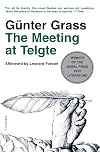
The Meeting at Telgte
by Günter Grass
On This Page
Description
"In 1647, as the Thirty Years' War was drawing to its close, a group of poets from all parts of Germany gather at the pilgrimage town of Telgte, for the purpose of strengthening the last remaining bond within a divided nation: its language and literature. They meet and part in disarray, yet manage to discuss their manuscripts with all the liveliness of friendship and force of rivalry, against a background of brutality and anguish ... The fictitious meeting of 1647 is the replay of a real show more meeting of German poets and writers, known as Group 47, at the end of another devastating war three hundred years later"--Cover. show lessTags
Recommendations














Member Reviews
This is a remarkable book. Set in Germany in 1647, one year before the end of the Thirty Years’ War, a group of authors, poets, critics and publishers are invited to meet, read and discuss each others’ works and above all to produce an appeal to those political powers seeking peace. A fascinating look at the literary world of 17th century Germany, with reference to the literary society Group 47 created in Germany after the end of the Second World War in 1947, it still has meaning, whether intentional or accidental, for readers in the 21st century.
This was one of the forgotten fare of one of those Grass clusters in the late 1990s. I reread this a few years ago after reading C.V. Wedgwood's history of the Thirty Year War. It is certainly thinner Grass, equating his own Gruppe 47 with the efforts to restore civilization after that bloodbath in the anything but Holy Roman Empire.
If someone is short on time or for other reasons not willing to read Grass’s long novels, he should start with this allegory focussing the encounters of German writers in the fifties, relocated to the period of the Thirty Years War. Consumable in a single day.
Yikes, I tell a lie. I'm not currently reading it, I'm too scared to. I need somebody out there to give me some encouragement. I was thinking of Matt, but I see it's only on your to be done shelf.
I've been reading German literature (etc) from straight after WWII and this seems like I should give it a go, but when I opened it up, I discovered really I had to start at the end with a rather terrifyingly complicated account of the period in which it is set and the people whom the reader will meet.
To be honest, I put it back on my physical to-read-shelf. How to overcome my cowardice?
I've been reading German literature (etc) from straight after WWII and this seems like I should give it a go, but when I opened it up, I discovered really I had to start at the end with a rather terrifyingly complicated account of the period in which it is set and the people whom the reader will meet.
To be honest, I put it back on my physical to-read-shelf. How to overcome my cowardice?
Yikes, I tell a lie. I'm not currently reading it, I'm too scared to. I need somebody out there to give me some encouragement. I was thinking of Matt, but I see it's only on your to be done shelf.
I've been reading German literature (etc) from straight after WWII and this seems like I should give it a go, but when I opened it up, I discovered really I had to start at the end with a rather terrifyingly complicated account of the period in which it is set and the people whom the reader will meet.
To be honest, I put it back on my physical to-read-shelf. How to overcome my cowardice?
I've been reading German literature (etc) from straight after WWII and this seems like I should give it a go, but when I opened it up, I discovered really I had to start at the end with a rather terrifyingly complicated account of the period in which it is set and the people whom the reader will meet.
To be honest, I put it back on my physical to-read-shelf. How to overcome my cowardice?
Yikes, I tell a lie. I'm not currently reading it, I'm too scared to. I need somebody out there to give me some encouragement. I was thinking of Matt, but I see it's only on your to be done shelf.
I've been reading German literature (etc) from straight after WWII and this seems like I should give it a go, but when I opened it up, I discovered really I had to start at the end with a rather terrifyingly complicated account of the period in which it is set and the people whom the reader will meet.
To be honest, I put it back on my physical to-read-shelf. How to overcome my cowardice?
I've been reading German literature (etc) from straight after WWII and this seems like I should give it a go, but when I opened it up, I discovered really I had to start at the end with a rather terrifyingly complicated account of the period in which it is set and the people whom the reader will meet.
To be honest, I put it back on my physical to-read-shelf. How to overcome my cowardice?
"Ieri sarà quel che domani è stato" un incipit che dice che il senso, il fine o anche solo il fluire (razionale) della storia è solo un'illusione, al più una fola ideologica atta a giustificare, nella sedicente razionalità dello sviluppo della civiltà, ogni decisione attuale come "doverosa" conseguenza del passato.
A Telgte nel 1647, alla fine della Guerra dei Trent'anni, come a Berlino nel 1947, alla fine della Seconda Guerra Mondiale, la letteratura riafferma il suo ruolo e la sua capacità di consolidare un popolo ed una nazione attraverso la ricostruzione di una lingua comune condivisa, che è la ricostruzione di un modo di sentire e di convivere civilmente. Allora (Telgte) contro l'insensata guerra infinita tra Spagnoli, show more Svedesi, Francesi e Tedeschi di vario tipo, che si concluse con la polverizzazione del nascente stato in una miriade di principatini, ducatelli e giurisdizioni di natura varia (anche di tipo religioso); trecent'anni dopo per contribuire ad estirpare dal linguaggio comune la prosopopea che il nazismo, come una vera e propria arma, aveva utilizzato per controllare il linguaggio e -quindi- le menti.
In Italia i letterati dell'800 (da Berchet in poi) si coordinarono fortemente, in modo analogo, per contribuire alla nascita del popolo italiano (cosa quasi riuscita -a dire il vero- solo ben più di un secolo dopo).
Questo libro deve moltissimo alla traduzione splendida di Bruna Bianchi, che forgia in italiano una appassionata poesia barocca, novello Metastasio, accompagnando il testo con una sua Nota esplicativa sul senso dii questo "romanzo" e con un glossario, sempre suo, preziosissimo per orientarsi meglio, se -come può capitare- non si fosse esperti di Germanistica e di Poesia tedesca del '600.
Bellissimo. show less
A Telgte nel 1647, alla fine della Guerra dei Trent'anni, come a Berlino nel 1947, alla fine della Seconda Guerra Mondiale, la letteratura riafferma il suo ruolo e la sua capacità di consolidare un popolo ed una nazione attraverso la ricostruzione di una lingua comune condivisa, che è la ricostruzione di un modo di sentire e di convivere civilmente. Allora (Telgte) contro l'insensata guerra infinita tra Spagnoli, show more Svedesi, Francesi e Tedeschi di vario tipo, che si concluse con la polverizzazione del nascente stato in una miriade di principatini, ducatelli e giurisdizioni di natura varia (anche di tipo religioso); trecent'anni dopo per contribuire ad estirpare dal linguaggio comune la prosopopea che il nazismo, come una vera e propria arma, aveva utilizzato per controllare il linguaggio e -quindi- le menti.
In Italia i letterati dell'800 (da Berchet in poi) si coordinarono fortemente, in modo analogo, per contribuire alla nascita del popolo italiano (cosa quasi riuscita -a dire il vero- solo ben più di un secolo dopo).
Questo libro deve moltissimo alla traduzione splendida di Bruna Bianchi, che forgia in italiano una appassionata poesia barocca, novello Metastasio, accompagnando il testo con una sua Nota esplicativa sul senso dii questo "romanzo" e con un glossario, sempre suo, preziosissimo per orientarsi meglio, se -come può capitare- non si fosse esperti di Germanistica e di Poesia tedesca del '600.
Bellissimo. show less
Aug 9, 2014Italian
Members
- Recently Added By
Lists

Die besten Werke der deutschsprachigen Erzählliteratur von 1924 bis 2024
100 works; 2 members
Author Information

Günter Wilhelm Grass was born on October 16, 1927 in the Free City of Danzig, which is now Gdansk, Poland. He was a member of the Hitler Youth and at the age of 17, he was drafted into the German army. Near the end of the war, he served as a tank gunner in the 10th SS Panzer Division. He was captured by the Americans and forced to visit the newly show more liberated Dachau concentration camp. After his release from a POW camp in 1946, he worked in a potash mine and as a stonemason's apprentice and studied painting and sculpture in Düsseldorf. His first novel, The Tin Drum, was published in 1959. It was adapted into a film and won the Academy Award for Best Foreign Film in 1979. His other works included Cat and Mouse, Dog Years, From the Diary of a Snail, The Flounder, The Rat, and Crabwalk. He also wrote a memoir entitled Peeling the Onion. He received the Nobel Prize for Literature in 1999. He was also a political activist and liberal provocateur. He advocated for environmental conservation, debt relief for poor countries, and generous policies regarding political asylum. He died on April 13, 2015 at the age of 87. (Bowker Author Biography) show less
Some Editions
Awards and Honors
Distinctions
Notable Lists
Series
Belongs to Publisher Series
Work Relationships
Is contained in
Has as a student's study guide
Common Knowledge
- Canonical title
- The Meeting at Telgte
- Original title
- Das Treffen in Telgte
- Original publication date
- 1979
- People/Characters*
- Paul Gerhardt; Hans Jacob Christoffel von Grimmelshausen; Daniel Czepko von Reigersfeld; Johannes Scheffler; Christian Hoffmann von Hoffmannswaldau; Paul Fleming (show all 20); Freidrich von Logau; Georg Phillipp Harsdörfer; Filip von Zesen; Sigmund von Birken; Georg von Greflinger; Julius Wilhelm Zincgref; Johann Lauremberg; Johann Michael Moscherosch; Johann Rist; Andreas Gryphius; Martin Opitz; Friedrich Spee von Langenfeld; Georg-Rudolf Weckherlin; Simon Dach
- Important places*
- Telgte
- Important events
- Thirty Years' War
- Dedication
- A Hans Werner Richter
- First words
- Ieri sarà quel che domani è stato. Le nostre storie d'oggi non hanno bisogno di essere accadute adesso. Questa qui è cominciata più di trecent'anni or sono. Altre storie lo stesso. Talmente remota è l'origine di ogni sto... (show all)ria che agisca in Germania. Quanto ebbe inizio a Telgte, io lo trascrivo, perché un amico, uno che nel quarantesettesimo anno del nostro secolo ha radunato i propri pari intorno a sé, vuol festeggiare il settantesimo compleanno; solo che è più vecchio, molto più vecchio - e noi, i suoi amici del presente, siamo tutti, con lui, grigio cenere di quel tempo andato.
- Last words
- (Click to show. Warning: May contain spoilers.)Nessuno ci andò perduto. Tutti arrivammo, Ma in quel secolo nessuno ci ha mai più radunati a Telgte o in un altro posto. Io so fino a che punto ci siano mancati ulteriori incontri. So chi io fossi allora. So anche altre cose. Solo chi abbia dato alle fiamme la Locanda del Ponte, questo non lo so, non lo so...
- Original language*
- Deutsch
*Some information comes from Common Knowledge in other languages. Click "Edit" for more information.
Classifications
- Genres
- Fiction and Literature, General Fiction, Historical Fiction
- DDC/MDS
- 833.914 — Literature & rhetoric German & related literatures German fiction 1900- 1900-1990 1945-1990
- LCC
- PT2613 .R338 .T713 — Language and Literature German, Dutch and Scandinavian literatures German literature Individual authors or works 1860/70-1960
- BISAC
Statistics
- Members
- 416
- Popularity
- 74,787
- Reviews
- 7
- Rating
- (3.35)
- Languages
- 11 — Danish, Dutch, English, Finnish, French, German, Italian, Norwegian (Bokmål), Polish, Spanish, Swedish
- Media
- Paper, Audiobook, Ebook
- ISBNs
- 35
- ASINs
- 14