On This Page
Description
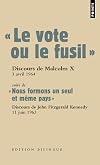
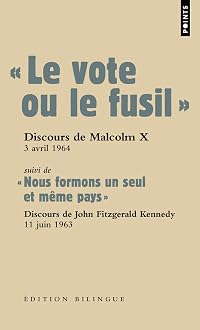
En 1963, un sie?cle apre?s l'abolition de l'esclavage, la discrimination raciale est toujours d'actualite? aux E?tats-Unis. Sous la pression grandissante des militants noirs, John F. Kennedy annonce la promulgation d'une loi visant a? faire des Noirs ame?ricains des citoyens comme les autres,Tags
Member Reviews
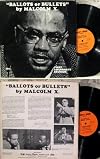
C'est un petit livre contenant deux discours sur les droits civiques des Noirs aux Etats-Unis, à savoir un discours de [[Malcolm X]] intitulé "Le Vote ou le Fusil" et un autre de [[John Fitzgerald Kennedy]], antérieur, intitulé quant à lui "Nous formons un seul et même pays". Deux visions très différentes pour une même opinion sur la quête des doits civiques. Deux discours puissants, forts, viscéraux. Malcolm X se lance dans un combat définitif, JFK essaie de changer la loi mais aussi la mentalité du moindre de ses compatriotes.
Dans mon opinion, ces textes n'ont rien perdu et sont toujours aussi importants. Cette collection de discours chez Points ne m'a jamais déçu : on connaît tous une phrase célèbre de l'un ou show more l'autre discours, mais peu les ont lus en entier, alors que ça vaut vraiment le détour. show less
Dans mon opinion, ces textes n'ont rien perdu et sont toujours aussi importants. Cette collection de discours chez Points ne m'a jamais déçu : on connaît tous une phrase célèbre de l'un ou show more l'autre discours, mais peu les ont lus en entier, alors que ça vaut vraiment le détour. show less
Jun 23, 2011French
Members
- Recently Added By
Author Information

40+ Works 13,271 Members
Born in Omaha, Nebraska, and the son of a Baptist minister, Malcolm Little grew up with violence. Whites killed several members of his family, including his father. As a youngster, he went to live with a sister in Boston where he started a career of crime that he continued in New York's Harlem as a drug peddler and pimp. While serving a prison show more term for burglary in 1952, he converted to Islam and undertook an intensive program of study and self-improvement, movingly detailed in "Autobiography of Malcolm X." He wrote constantly to Elijah Muhammad (Elijah Poole, 1897--1975), head of the black separatist Nation of Islam, which already claimed the loyalty of several of his brothers and sisters. Upon release from prison, Little went to Detroit, met with Elijah Muhammad, and dropped the last name Little, adopting X to symbolize the unknown African name his ancestors had been robbed of when they were enslaved. Soon he was actively speaking and organizing as a Muslim minister. In his angry and articulate preaching, he condemned white America for its treatment of blacks, denounced the integration movement as black self-delusion, and advocated black control of black communities. During the turbulent 1960's, he was seen as inflammatory and dangerous. In 1963, a storm broke out when he called President Kennedy's assassination a case of "chickens coming home to roost," meaning that white violence, long directed against blacks, had now turned on itself. The statement was received with fury, and Elijah Muhammad denounced him publicly. Shocked and already disillusioned with the leader because of his reputed involvement with several women, Malcolm X went on a pilgrimage to Mecca and then traveled to several African countries, where he was received as a fellow Muslim. When he returned home, he was bearing a new message: Islam is a religion that welcomes and unites people of all races in the Oneness of Allah. On the night of February 21, 1965, as he was preaching at Harlem's Audubon Ballroom, he was assassinated. (Bowker Author Biography) show less
Common Knowledge
- Canonical title
- Ballots or Bullets [sound recording]
Classifications
- Genre
- General Fiction
- BISAC
Statistics
- Members
- 6
- Popularity
- 3,048,393
- Reviews
- 1
- Rating
- (5.00)
- Languages
- English, French, German
- Media
- Paper
- ISBNs
- 2
- UPCs
- 1
- ASINs
- 1