
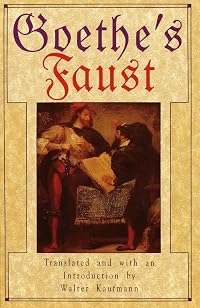
Goethe's Faust: Part One and Sections from Part Two
by Johann Wolfgang von Goethe
On This Page
Description
The best translation of Faust available, this volume provides the original German text and its English counterpart on facing pages. Walter Kaufmann's translation conveys the poetic beauty and rhythm as well as the complex depth of Goethe's language. Includes Part One and selections from Part Two.Tags
Recommendations







Member Reviews
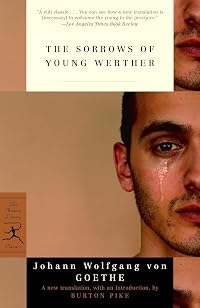
Even with my knuckledragging German I can appreciate that Goethe knows how to rhyme. And there's a fair few laughs here, like when Mephisto advises Faust to study medicine so he can get close to naked chicks. And the farting witches. But neither the plot nor the characters have the complexity, the subtlety, the verisimilitude of Shakespeare. It's basically didactic and, especially in Part II (of which translator Walter Kaufman mercifully spares us the majority) descends into daft allegory. Still, I at least had fun with this unlike the dreadful Young Werther.
There have been many writings of the Faust story; in this one, Goethe tries his hand at the fable. Faust sells his soul to the devil in return for some rather nebulous gains. The story is told in poetry rather than prose, and some of the poetry is a bit dense. There is also a lot more than is needed to tell the story, making this particular play impossible to present in this form on a modern American stage (of course, it might still work in Germany, where they don't have the same expectations). This translation includes the German original side by side with the translation; although I am not able to read German, it is interesting to see it in its original form, and for German readers, that gives them the ability to check the translation show more and see if they agree. The ending veered very close to a universalist view of heaven and hell; probably not too surprising from a freethinker like Goethe who tended to some rather heterodox opinions. show less
This is really quite good although the second-half isn't as good as first. Its a lot funnier than i expected, maybe its not supposed to be but i couldn't help laughing at how bad a demon Mephistopheles is. His power is incredibly limited, almost everything he does is through secondary means, he hires a witch, a water-spirit or some super-soldiers, he also can't access Greek hell or 'The Mothers'.
The Mothers is probably the best part of Faust being very Lovecraftian. The other best bit is near the start when Faust wants to meet the most beautiful woman in the world, i'm not going to say what happens other than demons are really sneaky ;) .
Overall theres a lot to like although it goes off the boil towards the end.
The Mothers is probably the best part of Faust being very Lovecraftian. The other best bit is near the start when Faust wants to meet the most beautiful woman in the world, i'm not going to say what happens other than demons are really sneaky ;) .
Overall theres a lot to like although it goes off the boil towards the end.
Yep, it's actually epic fantasy. Don't let the stage actors or the music and the poetry fool you. There's demons, vast battlefields, an epic battle for one's soul with TWO WHOLE HOSTS fighting, and, of course, there's that thing about the toothpick and getting Helen of Troy pregnant.
The original is in German. There MIGHT be something in that. An interesting story. Or perhaps Goethe was one hell of a weird artist.
Actually, scratch that, he was. Like an opium dream.
Breakdown: I loved the poetry and most of the translation. It was pretty neat. What there was of the original story was slightly convoluted and drawn out. The battle was pretty cool, too.
It's Faust. A classic tale. But you know what?
I LIKE MARLOWE'S BETTER.
The original is in German. There MIGHT be something in that. An interesting story. Or perhaps Goethe was one hell of a weird artist.
Actually, scratch that, he was. Like an opium dream.
Breakdown: I loved the poetry and most of the translation. It was pretty neat. What there was of the original story was slightly convoluted and drawn out. The battle was pretty cool, too.
It's Faust. A classic tale. But you know what?
I LIKE MARLOWE'S BETTER.
So much has been written about this great work that I really have nothing to add to the conversation except the admittedly childish observation that when the characters narrate their sword fights it sounds hilariously sexual.
From page 349 of the Kaufman edition:
From page 349 of the Kaufman edition:
MEPHISTO: Unsheathe your toothpick, don’t delay;
Thrust out at him, and I shall parry.
VALENTINE: Then parry that!
MEPHISTO: Of course.
VALENTINE: And that.
MEPHISTO: All right.
VALENTINE: I think the Devil must be in this fight.
What could that be? My hand is getting lame.
MEPHISTO (to Faust): Thrust home!
VALENTINE (falls): Oh God!
My edition was the (purported) Coleridge translation. I'm not enough of a literary scholar to judge this work comprehensively, but I can say that I great enjoyed the play of language. At the same time, the characters and plots were deeply alien to my sensibilities. A fascinating and foundational work either way.
This is an abridged version of the massive play. This was abridged, cut, and translated into English for a BBC radio adaption in the 1940s.
The play itself is meant to be a closet drama - ie. its meant to be read and not exactly played and acted out on a stage in front of an audience.
It is a tremendous play and a massive and tremendous piece of work/literature. I have trouble though deciding on **** or ***1/2, but I'll give it the benefit of the doubt and go with ****. It's a bit deep with the satire, going into Greek mythologies (esp. in Part II) and it draws from a number of sources, some German, some classical Greek/Roman, some Shakespearean, and English. It's a hard play to wra your head around as the verse isn't aptly descriptive show more of the events and a large amount of 'reading between the lines' needs to be done. Overall it is a highly recommended work that should be read for no other reason than to at least acknowledge how Goethe is a great writer and to feel some sort of semblance of culture emanating from the work. show less
The play itself is meant to be a closet drama - ie. its meant to be read and not exactly played and acted out on a stage in front of an audience.
It is a tremendous play and a massive and tremendous piece of work/literature. I have trouble though deciding on **** or ***1/2, but I'll give it the benefit of the doubt and go with ****. It's a bit deep with the satire, going into Greek mythologies (esp. in Part II) and it draws from a number of sources, some German, some classical Greek/Roman, some Shakespearean, and English. It's a hard play to wra your head around as the verse isn't aptly descriptive show more of the events and a large amount of 'reading between the lines' needs to be done. Overall it is a highly recommended work that should be read for no other reason than to at least acknowledge how Goethe is a great writer and to feel some sort of semblance of culture emanating from the work. show less
Members
- Recently Added By
Author Information

3,042+ Works 51,433 Members
Johann Wolfgang von Goethe, 1749-1832 Johann Wolfgang von Goethe was born in Frankfurt am Main. He was greatly influenced by his mother, who encouraged his literary aspirations. After troubles at school, he was taught at home and gained an exceptionally wide education. At the age of 16, Goethe began to study law at Leipzig University from 1765 to show more 1768, and he also studied drawing with Adam Oeser. After a period of illness, he resumed his studies in Strasbourg from 1770 to 1771. Goethe practiced law in Frankfurt for two years and in Wetzlar for a year. He contributed to the Frankfurter Gelehrte Anzeigen from 1772 to 1773, and in 1774 he published his first novel, self-revelatory Die Leiden des Jungen Werthers. In 1775 he was welcomed by Duke Karl August into the small court of Weimar, where he worked in several governmental offices. He was a council member and member of the war commission, director of roads and services, and managed the financial affairs of the court. Goethe was released from day-to-day governmental duties to concentrate on writing, although he was still general supervisor for arts and sciences, and director of the court theatres. In the 1790s Goethe contributed to Friedrich von Schiller´s journal Die Horen, published Wilhelm Meister's Apprenticeship, and continued his writings on the ideals of arts and literature in his own journal, Propyläen. The first part of his masterwork, Faust, appeared in 1808, and the second part in 1832. Goethe had worked for most of his life on this drama, and was based on Christopher Marlowe's Faust. From 1791 to 1817, Goethe was the director of the court theatres. He advised Duke Carl August on mining and Jena University, which for a short time attracted the most prominent figures in German philosophy. He edited Kunst and Altertum and Zur Naturwissenschaft. Goethe died in Weimar on March 22, 1832. He and Duke Schiller are buried together, in a mausoleum in the ducal cemetery. (Bowker Author Biography) show less
All Editions
Some Editions
Work Relationships
Inspired
Common Knowledge
- Canonical title
- Goethe's Faust: Part One and Sections from Part Two
- Original title
- Faust Erster und zweiter Teil
- Original publication date
- 1808 (part 1) (part 1); 1832 (part 2) (part 2); 1961 (English: Walter Kaufmann) (English: Walter Kaufmann)
- People/Characters
- Faust
- Dedication
- To Frieda and Eva Wunderlich in gratitude
- First words
- Again you show yourselves, you wavering Forms,
Revealed, as you once were, to clouded vision.
You come back, wavering forms, out of the past
In which you first appeared to clouded eyes.
Walter Kaufmann translation
Introduction by Walter Kaufmann, 1960: Goethe is generally recognized as the greatest German of all time, and Faust as his most important single work. • • - Last words
- (Click to show. Warning: May contain spoilers.)All of the transient Is parable, only: The insufficient,
Here, grows to reality: The indescribable, Here, is done: Woman, eternal, Beckons us on.
(Click to show. Warning: May contain spoilers.)Chorus Mysticus:
What is destructible
Is but a parable;
What fails ineluctably,
Here it was seen,
Here it was action;
The Eternal-Feminine
Lures to perfection. - Blurbers
- Spender, Stephen
- Original language
- German
- Canonical DDC/MDS
- 832.6
- Canonical LCC
- PT2026.F2 K3
- Disambiguation notice
- This is a bilingual edition (german - english) edited by Walter Kaufman, and contains part 1 and selections of part 2. Please do not combine with other editions.
Classifications
- Genres
- Fiction and Literature, Poetry
- DDC/MDS
- 832.6 — Literature & rhetoric German & related literatures German drama 1750–1832 : 18th century; classical period; romantic period
- LCC
- PT2026 .F2 .K3 — Language and Literature German, Dutch and Scandinavian literatures German literature Individual authors or works 1700-ca. 1860/70 Goethe Translations
- BISAC
Statistics
- Members
- 2,670
- Popularity
- 6,947
- Reviews
- 18
- Rating
- (3.90)
- Languages
- English, German
- Media
- Paper, Ebook
- ISBNs
- 3
- ASINs
- 12