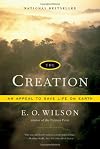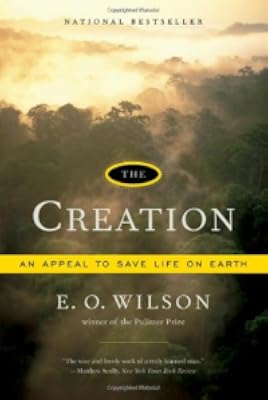
The Creation: An Appeal to Save Life on Earth
by Edward O. Wilson
On This Page
Description
" Like Rachel Carson's Silent Spring, this is a book about the fate of the earth and the survival of our planet. Wilson attempts to bridge the seemingly irreconcilable worlds of fundamentalism and science. Passionately concerned about the state of the world, he draws on his own personal experiences and expertise as an entomologist, and prophesies that half the species of plants and animals on Earth could either have gone or at least are fated for early extinction by the end of our present show more century. This is not a bitter, predictable rant against fundamentalist Christians or deniers of Darwin; rather, Wilson, a leading "secular humanist," draws upon his own rich background as a boy in Alabama who "took the waters," and seeks not to condemn this new generation of Christians but to address them on their own terms.--From publisher description. show lessTags
Recommendations




Member Reviews
"Science and religion are the two most powerful forces of society. Together they can save the Creation."
This short (175 p) book begins with a letter to a Southern Baptist Pastor, a fixture of E. O. Wilson's childhood in Alabama, with a plea to set aside differences and find common ground to save the biodiversity of earth. "You are well prepared to present the theological and moral arguments for saving the Creation. ... I will now lay before you and others who may wish to hear it the scientific argument." And so he does, addressing the hypothetical Pastor briefly in each chapter, but speaking as a scientist. I would have preferred a dialogue, a demonstration of this common cause. And yet Wilson can be religious in tone, more so than show more usual in this book.
Humanity went wrong in the neolithic, he says, a bit hyperbolically, or evoking religious imagery. "We strayed from nature with the beginning of civilization roughly ten thousand years ago. That quantum leap beguiled us with an illusion of freedom from the world that had given us birth." ... "We have been trying ever since to ascend from Nature instead of to Nature. The consequence is both bewildering complexity of scientific knowledge, and dangerous ignorance of the biodiversity that sustains us.
The effects of our presence are summarized by the acronym HIPPO, and fleshed out with statistics and examples:
H : habitat loss
I : invasive species
P : pollution
P : population
O : overharvesting
What to do? He outlines a program of biology, "broadly applied" and "exactly guided". "Scientists are to science what masons are to cathedrals." Biology has three dimensions: (1) each species, from its molecular composition to its place in an ecosystem, (2) mapping biological diversity in a range from local habits to the entire planet (3) reconstructing the history of each species, gene, ecosystem. This is an enormous agenda. Currently, resources are skewed toward the molecular and cellular level and medical applications, toward the "explorer-naturalists of a new age" investigating microscopic ecosystems. The rest, however, is nowhere near complete. He proposes an Encyclopedia of Life, with a web page for each species, with information about its genetic code, its ecological niche, its geographic distribution, its relevance to humans. (The Encyclopedia of Life (http://eol.org/) now exists, created in response to a TED talk (http://www.ted.com/talks/e_o_wilson_on_saving_life_on_earth.html).) And this is not an ivory tower enterprise; enthusiasm and involvement of the public are essential to the cause, and focus of the chapter Citizen Science. (Example: bioblitzes.)
This is E. O. Wilson, so of course there are ants. Mystery ant #1: During the 1500s, a series of ant plagues in the the West Indies wreaked havoc on gardens and orchards. (Bartolomé de las Casas believed this was God's punishment for mistreating the Taino.) Which species of ant? And why then? This is a tale of invasive species, but the ants were already there. Mystery ant #2: The pitchfork ant has jaws that inspired its name. What are they for? An appeal in Notes from Underground got an answer. "There is nothing more satisfying to younger scientists than showing up older ones."
Alarming and sweet, and recommended.
(read 22 Feb 2012) show less
This short (175 p) book begins with a letter to a Southern Baptist Pastor, a fixture of E. O. Wilson's childhood in Alabama, with a plea to set aside differences and find common ground to save the biodiversity of earth. "You are well prepared to present the theological and moral arguments for saving the Creation. ... I will now lay before you and others who may wish to hear it the scientific argument." And so he does, addressing the hypothetical Pastor briefly in each chapter, but speaking as a scientist. I would have preferred a dialogue, a demonstration of this common cause. And yet Wilson can be religious in tone, more so than show more usual in this book.
Humanity went wrong in the neolithic, he says, a bit hyperbolically, or evoking religious imagery. "We strayed from nature with the beginning of civilization roughly ten thousand years ago. That quantum leap beguiled us with an illusion of freedom from the world that had given us birth." ... "We have been trying ever since to ascend from Nature instead of to Nature. The consequence is both bewildering complexity of scientific knowledge, and dangerous ignorance of the biodiversity that sustains us.
The effects of our presence are summarized by the acronym HIPPO, and fleshed out with statistics and examples:
H : habitat loss
I : invasive species
P : pollution
P : population
O : overharvesting
What to do? He outlines a program of biology, "broadly applied" and "exactly guided". "Scientists are to science what masons are to cathedrals." Biology has three dimensions: (1) each species, from its molecular composition to its place in an ecosystem, (2) mapping biological diversity in a range from local habits to the entire planet (3) reconstructing the history of each species, gene, ecosystem. This is an enormous agenda. Currently, resources are skewed toward the molecular and cellular level and medical applications, toward the "explorer-naturalists of a new age" investigating microscopic ecosystems. The rest, however, is nowhere near complete. He proposes an Encyclopedia of Life, with a web page for each species, with information about its genetic code, its ecological niche, its geographic distribution, its relevance to humans. (The Encyclopedia of Life (http://eol.org/) now exists, created in response to a TED talk (http://www.ted.com/talks/e_o_wilson_on_saving_life_on_earth.html).) And this is not an ivory tower enterprise; enthusiasm and involvement of the public are essential to the cause, and focus of the chapter Citizen Science. (Example: bioblitzes.)
This is E. O. Wilson, so of course there are ants. Mystery ant #1: During the 1500s, a series of ant plagues in the the West Indies wreaked havoc on gardens and orchards. (Bartolomé de las Casas believed this was God's punishment for mistreating the Taino.) Which species of ant? And why then? This is a tale of invasive species, but the ants were already there. Mystery ant #2: The pitchfork ant has jaws that inspired its name. What are they for? An appeal in Notes from Underground got an answer. "There is nothing more satisfying to younger scientists than showing up older ones."
Alarming and sweet, and recommended.
(read 22 Feb 2012) show less
As I said back in August when I reviewed his Nature Revealed, E.O. Wilson is one of the scientific writers whose works I enjoy most, and I've finally gotten to spend an afternoon with his most recent book: The Creation: An Appeal to Save Life on Earth (2006, W.W. Norton & Co.). Written in the form of an open letter to a (fictitious) southern Baptist minister, Wilson's appeal is a heartfelt and science-based call for a joining of the scientific and religious forces in cooperation to halt and reverse human-caused destruction of the planet's ecosystems.
Like Owen Gingerich in God's Universe (review), Wilson is able to make a coherent argument without resorting to personal assaults on those who view things differently. His premise - that all show more humans have an interest in preserving the Earth's diversity, and ought to work together to do so - is simple, and expressed here in clear, understandable language. Beyond this, Wilson revisits some of the points he makes more expansively in Consilience and other works regarding the apparent biological basis behind some elements of "human nature."
In several of the later chapters, Wilson suggests several ways in which education of biological sciences can be improved, and also offers some ideas about how to allow children to connect with nature (this section reminded me much of my own childhood). Finally, he argues that the time has come for human beings to make a fundamental decision: we will work together to stop the destruction of the planet, or will we continue along our present path? By overcoming what he calls "metaphysical differences," Wilson maintains, the former can be achieved.
Highly recommended for anyone whose interests run to the protection of biological diversity and those who can offer reasoned discussions on its behalf.
http://philobiblos.blogspot.com/2007/01/book-review-creation.html show less
Like Owen Gingerich in God's Universe (review), Wilson is able to make a coherent argument without resorting to personal assaults on those who view things differently. His premise - that all show more humans have an interest in preserving the Earth's diversity, and ought to work together to do so - is simple, and expressed here in clear, understandable language. Beyond this, Wilson revisits some of the points he makes more expansively in Consilience and other works regarding the apparent biological basis behind some elements of "human nature."
In several of the later chapters, Wilson suggests several ways in which education of biological sciences can be improved, and also offers some ideas about how to allow children to connect with nature (this section reminded me much of my own childhood). Finally, he argues that the time has come for human beings to make a fundamental decision: we will work together to stop the destruction of the planet, or will we continue along our present path? By overcoming what he calls "metaphysical differences," Wilson maintains, the former can be achieved.
Highly recommended for anyone whose interests run to the protection of biological diversity and those who can offer reasoned discussions on its behalf.
http://philobiblos.blogspot.com/2007/01/book-review-creation.html show less
The Creation by Harvard scientist Edward O. Wilson, one of the founders of the modern biodiversity movement. I picked it up last September, when Wilson spoke at the University of Puget Sound, my alma mater. In his mid-70s, he’s still sharp as a tack and still wonderfully involved in doing real science, studying his beloved ants and varied ecosystems, and traveling to field work sites in South America and islands off southeast Asia. His talk was largely a synopsis of his book, which he wrote in the style of a letter to a fictious Baptist pastor.
From an unashamedly scientific perspective, Wilson builds up a case for common ground with the religious community. Both camps have an interest in preserving the “creation.” Scientists see show more the great interdependent diversity of life around the modern world under threat from pollution, over-development, and foolish destruction. Christians must surely be interested in taking care of the earth, too; it being the place God gave them, not to be squandered or recklessly destroyed.
It’s a short little book (or a long letter, depending how you look at it) and it wanders into topics or arguments that seem a bit off the subject from time to time. But it is an enjoyable light read by a genuine scientist, not simply a science writer. Wilson signed my new copy of The Creation (and also The Diversity of Life, one of his earlier books that I already owned). I proudly added them to my autograph shelf, which already had books by a few scientists, science writers, historians, novelists, an actor, a clown, and a politician.
Find more of my reviews at Mostly NF show less
From an unashamedly scientific perspective, Wilson builds up a case for common ground with the religious community. Both camps have an interest in preserving the “creation.” Scientists see show more the great interdependent diversity of life around the modern world under threat from pollution, over-development, and foolish destruction. Christians must surely be interested in taking care of the earth, too; it being the place God gave them, not to be squandered or recklessly destroyed.
It’s a short little book (or a long letter, depending how you look at it) and it wanders into topics or arguments that seem a bit off the subject from time to time. But it is an enjoyable light read by a genuine scientist, not simply a science writer. Wilson signed my new copy of The Creation (and also The Diversity of Life, one of his earlier books that I already owned). I proudly added them to my autograph shelf, which already had books by a few scientists, science writers, historians, novelists, an actor, a clown, and a politician.
Find more of my reviews at Mostly NF show less
Structured as a letter by the Harvard biologist to a Pastor, it is an attempt to seek common grounds between science and religion when it comes to dealing with the current environmental crisis. The first parts are about a diagnosis of the alarming rate of extinction of species and the destruction of their habitats. It is also a paean to the diversity of life, why it really matters to preserve as much wilderness areas as possible. The end of the book is thought provoking as it gives a short discussion on Intelligent Design, a theory that Wilson--self-branded as a humanist scientist--argues against.
It seemed like a slightly less sciency and more explicit iteration of Biophilia--which is okay because I loved both. Anyone curious about Wilson but wary about scientific jargon would do well to start with the Creation.
Recently there's been lots of discussion about the need for scientists and theologians to find common ground. In particular, I've always wondered why many churches don't seem to be advocates for nature and the environment. E.O. Wilson, an evolutionary biologist and award-winning author is in a wonderful position to articulate these concerns. Written as a letter to a pastor, makes a clear case that it's time to take action.
This is a collection of letters to a Baptist minister, trying to convince him that the religious community should take part in the effort to save life on Earth. While his arguments are convincing, they fail to speak to the target audience. I didn't care for the emphasis on biology or the argument that we should save endangered species because we haven't yet studied them. There is a higher calling which Wilson should have spoken to if he was going to address a minister.
Members
- Recently Added By
Lists

The Great Courses: Earth at the Crossroads
48 works; 1 member
Author Information

72+ Works 18,005 Members
He was born in Birmingham, Alabama, in 1929. He is currently Pellegrino University Research Professor & Honorary Curator in Entomology of the Museum of Comparative Zoology at Harvard. He is on the Board of Directors of the Nature Conservancy, Conservation International & the American Museum of Natural History. He lives in Lexington, Massachusetts. show more (Bowker Author Biography) show less
Awards and Honors
Awards
Distinctions
Series
Belongs to Publisher Series
Common Knowledge
- Canonical title*
- La creazione: un appello per salvare la vita sulla terra
- Original publication date
- 2006
*Some information comes from Common Knowledge in other languages. Click "Edit" for more information.
Classifications
- Genres
- Science & Nature, Nonfiction, General Nonfiction, Religion & Spirituality, Economics, Philosophy
- DDC/MDS
- 333.9516 — Society, government, & culture Economics Economics of land and energy Other natural resources Biofuel, biodiversity, wildlife refuges Biodiversity & Conservation Biology Conservation Biology
- LCC
- QH303 .W55 — Science Natural history – Biology Biology (General)
- BISAC
Statistics
- Members
- 728
- Popularity
- 38,801
- Reviews
- 13
- Rating
- (3.70)
- Languages
- 8 — Catalan, English, French, German, Italian, Portuguese, Croatian, Spanish
- Media
- Paper, Audiobook, Ebook
- ISBNs
- 13
- ASINs
- 7