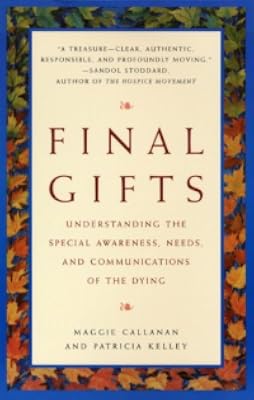
Final Gifts: Understanding the Special Awareness, Needs, and Communications of the Dying
by Maggie Callanan, Patricia Kelley
On This Page
Description
In this moving and compassionate book, hospice nurses Maggie Callanan and Patricia Kelley share their intimate experiences with patients at the end of life, drawn from more then twenty years experience tending the terminally ill. --Tags
Recommendations












Member Reviews
Back when I was a doula, I had this thought that working with women through the birthing process must be similar to working in hospice with people who were dying. I didn't share this thought with many people. In general, I would try not to mention death to pregnant women, and I worried that anyone not involved in doula work might think I was just weird. But to me---next to being born, which for most of us is stored only in our implicit memory and therefore inaccessible with our conscious methods of "remembering"---giving birth was the closest one could get to the process of dying without actually dying. I kept this notion largely to myself and quietly kept my eyes out for people who'd worked with both laboring women and dying people to show more either confirm or disprove this idea, all the while wondering if I dared try doula-ing to the dying and finding out for myself.
And then I started this book and read in the third chapter:
The authors go on to draw parallels between the medicalization of birth and the medicalization of death, in which both natural processes were moved out of the sphere of home and family and into the closed-off corridors of medical facilities. Birth and death became events cloaked in secrecy and silence rather than transitions to be experienced surrounded by those who love us. Thankfully, this trend seems to be shifting.
Mostly the book is made up of brief accounts of the last moments of dozens of individuals. I read these with the emotion and enthusiasm with which I used to read birth stories in the days before I'd ever attended a birth or given birth myself. I read them hungrily, with the sense that there is a hidden truth in them and that I need only see these stories from the proper angle for this truth to be revealed.
The authors point out the similarities between different stories, and encourage the reader to find significance in these similarities. They give suggestions for maintaining the awareness and open-mindedness necessary to receive the often cryptic or confusing messages that dying people sometimes try to convey. They encourage the reader to remember that the dying person is still a person---an individual going through a momentous transition and experiencing a wide range of emotions and sensations that we can only guess at. The authors encourage compassion and connection, and they talk with reverence about the honor of being a part of these families' lives, if only for a short time.
This is all so very similar to how I feel about being with a woman in labor. Probably in part because it was so familiar, the insights from these stories helped ease some of my fears about my own inevitable death. They helped me to see the beauty in the transition and the many gifts that the dying have to offer us, and it reminded me that emotional pain isn't always bad, isn't always something to avoid. The message I got from this book is that there is tremendous power and grace in opening ourselves to the emotional pain that accompanies death. It is a beautiful, powerful book, and I would recommend it to everyone. (My only caveat: I would caution against reading it sitting in the back of the library story room while your children are in Story Time. People seem to feel a little uncomfortable when a woman is choking back sobs while children sing "Head, Shoulders, Knees, and Toes".) show less
And then I started this book and read in the third chapter:
"As nurses who care for the dying, we see ourselves as the counterparts of birthing coaches or midwives, who assist in bringing life from the womb into the world. At the other end of life, we help to ease the transition from life through death to whatever exists beyond."
The authors go on to draw parallels between the medicalization of birth and the medicalization of death, in which both natural processes were moved out of the sphere of home and family and into the closed-off corridors of medical facilities. Birth and death became events cloaked in secrecy and silence rather than transitions to be experienced surrounded by those who love us. Thankfully, this trend seems to be shifting.
Mostly the book is made up of brief accounts of the last moments of dozens of individuals. I read these with the emotion and enthusiasm with which I used to read birth stories in the days before I'd ever attended a birth or given birth myself. I read them hungrily, with the sense that there is a hidden truth in them and that I need only see these stories from the proper angle for this truth to be revealed.
The authors point out the similarities between different stories, and encourage the reader to find significance in these similarities. They give suggestions for maintaining the awareness and open-mindedness necessary to receive the often cryptic or confusing messages that dying people sometimes try to convey. They encourage the reader to remember that the dying person is still a person---an individual going through a momentous transition and experiencing a wide range of emotions and sensations that we can only guess at. The authors encourage compassion and connection, and they talk with reverence about the honor of being a part of these families' lives, if only for a short time.
This is all so very similar to how I feel about being with a woman in labor. Probably in part because it was so familiar, the insights from these stories helped ease some of my fears about my own inevitable death. They helped me to see the beauty in the transition and the many gifts that the dying have to offer us, and it reminded me that emotional pain isn't always bad, isn't always something to avoid. The message I got from this book is that there is tremendous power and grace in opening ourselves to the emotional pain that accompanies death. It is a beautiful, powerful book, and I would recommend it to everyone. (My only caveat: I would caution against reading it sitting in the back of the library story room while your children are in Story Time. People seem to feel a little uncomfortable when a woman is choking back sobs while children sing "Head, Shoulders, Knees, and Toes".) show less
I thought this would be hard to read, depressing. Death is not a subject any of us want to read about. I was surprised to find this an enjoyable read. I felt comfort not discomfort as I expected. Death is always near and lately for me it's gotten far to close, two family members had close calls this year. I was scared out of my mind, and I isolated in my fear. The experiences shown in this book offer a different view on death, the great transition. Listening a learned quality that is in short supply is vital, as it should be during all of life's seasons. This author listened without judgement, with only the need to hear them. What they said made the passing so much easier, with no religious base. I think this is a must read for show more everyone, we all have to deal with death we should understand the dying process for us and them show less
Final Gifts is a book about communicating with the dying. It was recommended to me and lent to me, and I put off reading it longer than I should have before passing it on to the next person. It is a good book, and I wish more people who are faced with the loss of a loved one could and would read it before finding themselves in that situation. Many times we are frustrated by a sense of helplessness and loss of control when faced with the loss of someone we love, and we fear for ourselves and for them. This book helps one in learning to listen to what the dying person is saying, not just hearing them, but actually listening, and as such it is warm and wise and uplifting.
This book addresses an uncomfortable subject with grace, sensitivity and even humor sometimes. None of us wants to think about dying but at some point we will be sitting by someone's bedside feeling helpless. This book offers comfort and wisdom, and even a bit of wonder and magic.
One of the most frustrating things about being with a person who's dying is a sense of helplessness combined with ignorance. What is the person feeling, what does he WANT, are some of the things he says delusional or do they have a greater meaning?
This book helps answer many of those questions, and gives clear examples of these things. If you will be spending time with a person who is nearing death, I highly recommend this book. And for all that many people find death depressing, I have to say I found this book both comforting and extremely uplifting.
This book helps answer many of those questions, and gives clear examples of these things. If you will be spending time with a person who is nearing death, I highly recommend this book. And for all that many people find death depressing, I have to say I found this book both comforting and extremely uplifting.
If someone you love is dying, read this book. The insights of the two authors - palliative-care nurses both - are invaluable. This book helped me to hear my mother's truest needs, and to respond with real, honest comfort and reassurance, during the last days of her life. I cannot recommend this book highly enough.
Five years after its first publication, with more than 150,000 copies in print, Final Gifts has become a classic. In this moving and compassionate book, hospice nurses Maggie Callanan and Patricia Kelley share their intimate experiences with patients at the end of life, drawn from more than twenty years experience tending the terminally ill.
Through their stories we come to appreciate the near-miraculous ways in which the dying communicate their needs, reveal their feelings, and even choreograph their own final moments; we also discover the gifts—of wisdom, faith, and love—that the dying leave for the living to share.
Filled with practical advice on responding to the requests of the dying and helping them prepare emotionally and show more spiritually for death, Final Gifts shows how we can help the dying person live fully to the very end. show less
Through their stories we come to appreciate the near-miraculous ways in which the dying communicate their needs, reveal their feelings, and even choreograph their own final moments; we also discover the gifts—of wisdom, faith, and love—that the dying leave for the living to share.
Filled with practical advice on responding to the requests of the dying and helping them prepare emotionally and show more spiritually for death, Final Gifts shows how we can help the dying person live fully to the very end. show less
Members
- Recently Added By
Lists

Books for helping to cope with serious illness/dying
19 works; 2 members

Grief, Loss, Bereavement & Spiritual Care
13 works; 1 member
Author Information

2 Works 1,298 Members
4 Works 1,197 Members
Common Knowledge
- Original publication date
- 1992
- Dedication
- To Erin and Eric — The Sunshine in My Life And of Whom I Am Most Proud (MC)
Dedicated with Love To Sara, David, Wendell, and Craig. (PK) - First words
- Joe paced anxiously -- back and forth -- at the foot of Laura's bed.
- Last words
- (Click to show. Warning: May contain spoilers.)This book is our memorial to all of them.
Classifications
- Genres
- Nonfiction, General Nonfiction, Religion & Spirituality
- DDC/MDS
- 155.937 — Philosophy & psychology Psychology Differential and developmental psychology Environmental psychology Influences of Traumatic Experiences and Bereavement Death and Dying
- LCC
- BF789 .D4 .C25 — Philosophy, Psychology and Religion Psychology Psychology
- BISAC
Statistics
- Members
- 1,183
- Popularity
- 21,155
- Reviews
- 12
- Rating
- (4.22)
- Languages
- Dutch, English, German
- Media
- Paper, Ebook
- ISBNs
- 9
- ASINs
- 7
