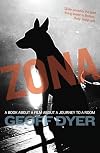
Zona: A Book About a Film About a Journey to a Room
by Geoff Dyer
On This Page
Description
An analysis of the film "Stalker" describes the author's thirty-year fascination with the film and evaluates how it reflects both European cinema and the deepest desires of the human psyche.Tags
Recommendations






















Member Recommendations
Member Reviews
This is a book about the experience of watching Andrei Tarkovsky's 'Stalker'. It is a fine example of form meeting function. The author recognises that some aspects of filmic experience will be subjective while others will be more universal and the structure and content of the book reflects that. In some areas he discusses the more generally recognised themes of time and space and he does so with diligence and poise. In others he documents his own specific reaction, for example, to a character smoking on screen. Dyer also reflects the realist/metaphysical duality of the film in his mixing of high and low linguistic registers. On top of that, he mirrors Tarkovsky's play with time and space by ranging across his own experiences of show more watching the film at different times and places.
I think this is possibly the first book I have read of any that both informs and confirms precisely my own reactions to a piece of art. Dyer pulls off the difficult task of deepening my knowledge of the more objective theories to Tarkovsky's work while affirming my own subjective responses to it. I do not imaging that reading this would be as stimulating without having watched and appreciated 'Stalker', but I suspect it would still be fun. show less
I think this is possibly the first book I have read of any that both informs and confirms precisely my own reactions to a piece of art. Dyer pulls off the difficult task of deepening my knowledge of the more objective theories to Tarkovsky's work while affirming my own subjective responses to it. I do not imaging that reading this would be as stimulating without having watched and appreciated 'Stalker', but I suspect it would still be fun. show less
The struggle of Dyer's writing (and perhaps his life) has been to find out what he really wants. His books are generally him viewing himself through the cognitive lens of other people's thoughts and art. This time the focusing device is Tarkovsky's film, STALKER, which Dyer ruminates, is all about finding out what one really wants, and the perils that lie within (and at the conclusion of) such a quest. One of Dyer's lightest writings, ZONA is just barely a book rather than an essay, due only to the sheer volume of personal illustrations and digressions he attaches to his main text. These textual turns upon himself, like the over-arching task/quest mentioned previously make this also his most personal and seemingly cranky book (how he show more hates cigarettes! And burnt matches! OH!!), well in the literary tradition of those other UK cranks, V. S. Naipaul and Martin Amis. However, finding what he wants, what is worth wanting & hoping for, as well as the worth of hope are revealed in these grumpy, yet thoughtful details as they were to him in Tarkovsky's classic. show less
http://wp.me/puHkv-3bA
Andrei Tarkovsky's 'Stalker' may be one of the greatest films ever made, but for this viewer it’s mostly laboured, inconsistent, portentous and yet inconsequential, and dreary. ‘I do know,’ Dyer writes on page 10, ‘that if I had not seen Stalker in my early twenties my responsiveness to the world would have been radically diminished.’ So I guess it’s too late for me in my mid 60s.
Still, I’m always fascinated when someone I respect differs wildly from me about a book or movie, so I settled down to read.
The book isn’t a learned dissertation. It’s pretty much a blow by blow account of the movie, interspersed with making-of anecdotes, snippets of autobiography, descriptions of how other films have show more been influenced by Stalker or refer to it, and reflections both serious and self-mocking on his own lifework as a writer. He probes at the reason the film has fascinated him so much. In true essayist style, he chases off on detours, airs his snobbery, throws harsh adjectives at films he doesn’t like , and quotes more or less casually from a vast range of cultural touchstones: Kundera and Wordsworth, Rilke and Billy Collins, Coetzee and Nadezhda Mandelstam, Cate Blanchett and Igmar Bergman, Bob Dylan and Bjork, Christian Marclay’s The Clock and James Turrell’s light sculptures. There’s a very funny account of his idiosyncratic response to Steven Soderbergh’s 2002 remake of Solaris, and an amusing account of some missed sexual opportunities.
I can’t say the book improved my appreciation of Tarkovsky in general or 'Stalker' in particular. But I enjoyed spending a little more than 200 pages in Geoff Dyer's company as he engages with a movie that he has watched many times and been fascinated by for more than 30 years. show less
Andrei Tarkovsky's 'Stalker' may be one of the greatest films ever made, but for this viewer it’s mostly laboured, inconsistent, portentous and yet inconsequential, and dreary. ‘I do know,’ Dyer writes on page 10, ‘that if I had not seen Stalker in my early twenties my responsiveness to the world would have been radically diminished.’ So I guess it’s too late for me in my mid 60s.
Still, I’m always fascinated when someone I respect differs wildly from me about a book or movie, so I settled down to read.
The book isn’t a learned dissertation. It’s pretty much a blow by blow account of the movie, interspersed with making-of anecdotes, snippets of autobiography, descriptions of how other films have show more been influenced by Stalker or refer to it, and reflections both serious and self-mocking on his own lifework as a writer. He probes at the reason the film has fascinated him so much. In true essayist style, he chases off on detours, airs his snobbery, throws harsh adjectives at films he doesn’t like , and quotes more or less casually from a vast range of cultural touchstones: Kundera and Wordsworth, Rilke and Billy Collins, Coetzee and Nadezhda Mandelstam, Cate Blanchett and Igmar Bergman, Bob Dylan and Bjork, Christian Marclay’s The Clock and James Turrell’s light sculptures. There’s a very funny account of his idiosyncratic response to Steven Soderbergh’s 2002 remake of Solaris, and an amusing account of some missed sexual opportunities.
I can’t say the book improved my appreciation of Tarkovsky in general or 'Stalker' in particular. But I enjoyed spending a little more than 200 pages in Geoff Dyer's company as he engages with a movie that he has watched many times and been fascinated by for more than 30 years. show less
This is a book about a film about a journey to a room, as the book's subtitle says. A book about the experience of watching Tarkovsky's Stalker, a movie the author loves. He says "if I had not seen Stalker in my early twenties my responsiveness to the world would have been radically diminished".
I don't think you have to have a vivid memory of that movie to enjoy this book, because I have only a dim memory of it, perhaps because I did not see it "live" (when it was first released). However, I think you have to share Dyer's experience of seeing many movies, over a long period of time. I think mainly you have to have some movie that plays the role in your life that Stalker does in his.
I enjoyed this book very much. I like the way Dyer show more writes, and I like his idea that something you see when you're young both enlarges and limits your perception—enlarges, because what you see makes the scope of cinema wider (or whatever art it is); limits, because once you've been astounded by something, you're not going to be astounded again in the same way by anything else.
I also went through a period of watching innumerable movies. For me it was in grad school. But it's like he says: you gradually watch these masterpieces and become familiar with the "grammar and history of cinema" so that a movie like Stalker is accessible and approachable.
He also says the best movie of your life, whatever you think it is, is something you saw in your teens or twenties. This may be true; may not be. I'm still asking people.
This is a wonderful book for people who are nuts for cinema. show less
I don't think you have to have a vivid memory of that movie to enjoy this book, because I have only a dim memory of it, perhaps because I did not see it "live" (when it was first released). However, I think you have to share Dyer's experience of seeing many movies, over a long period of time. I think mainly you have to have some movie that plays the role in your life that Stalker does in his.
I enjoyed this book very much. I like the way Dyer show more writes, and I like his idea that something you see when you're young both enlarges and limits your perception—enlarges, because what you see makes the scope of cinema wider (or whatever art it is); limits, because once you've been astounded by something, you're not going to be astounded again in the same way by anything else.
I also went through a period of watching innumerable movies. For me it was in grad school. But it's like he says: you gradually watch these masterpieces and become familiar with the "grammar and history of cinema" so that a movie like Stalker is accessible and approachable.
He also says the best movie of your life, whatever you think it is, is something you saw in your teens or twenties. This may be true; may not be. I'm still asking people.
This is a wonderful book for people who are nuts for cinema. show less
Quick review. I may write more later.
I recommend this for anyone who's seen the movie Stalker (a science-fiction road trip by director Andrei Tarkovsky that's a modern classic of Russian film) and for anyone who wants a glimpse into the mind of a true cinephile.
By "true cinephile" I mean not an aficionado of film, but a habitué of the cinema as a physical place, someone for whom cinema-going is — and, more to the point, was — an essential part of the movie-consuming process.
The key thing that occurred to me as I read Dyer's book about this fairly infrequently viewed movie is that there's a clear and maudlin parallel between his concept of cinema and the facts of the world in which the film was made. Both were systems defined by show more a culture of significant deficits. The movie was released in 1979, during what we have come to understand as the waning years of Soviet communism, an economic engine that worked, when it did work, in fits and starts covered up by a veneer of bravado saber-rattling.
Dyer's depiction of his core film-going years is one in which his viewing was defined not by what he wanted to see — the case in our Netflix-friendly, Tivo-enriched, BitTorrent-supported era — but by what was available. I think his depiction of how limits shaped cultural consumption is on par with what Jonathan Lethem accomplished in his recent 33 1/3 book on Talking Heads' album Fear of Music. Lethem has a clear view of his past, but doesn't wallow in it. Dyer's evident nostalgia for that period is at times like that of Stalinists who miss standing in line for a loaf of bread — it is, more than anything, an act of willful disregard for modernity.
Dyer's relative distaste — his adoption of the robe and role of the old fogey — for the world in which he finds himself isn't just related to film. He evidences a professor emeritus' generational cluelessness, for example when he riffs about how the index finger has less of a privileged role in our post-rotary-phone age. Clearly this is an individual with limited experience on a touch-screen device. (At the risk of venturing into the sort of first-person aside that is very much Dyer's mode: I had a severe cut on my right index finger while I was reading a hardback copy Dyer's book. I found that using my touchpad on my laptop and the screens of my phone, iPad, and iPod Touch to be an initially painful and, later, at best awkward experience, as bandaids impeded use, as did the wound's scab as it formed.)
Beyond that, Zona is a book about obsessions, both Dyer's for the film and Tarkovsky's for the process of filming. The book is frustrating, because it feels like it was written fairly quickly, and benefited from limited acts of revision. Still, the full range of associations that Dyer draws within the film's working parts and between the film and the world at at large is phenomenal. The personal asides have gotten the book a good amount of negative attention, but I think of them as an expression of how much the movie — how much movie-going — bleeds into Dyer's sense of his own life. A lot of critiques of those personal asides neglect to note that they appear mostly as footnotes, not in the actual main body text of the book. Then again, those footnotes are often so long as to make it unclear on the page which one is reading: the main or the supporting text. At least in the hardcover book, there is no apparent distinction in how both are treated typographically. There is simply a thin line dividing them.
As I read the book, I came to think of that thin line as being not unlike the line in Stalker that divides the world from the Zone that is the initial destination of the title character and his traveling companions.
There are references to sound throughout — especially a certain “clang” that Dyer seems to feel is the movie’s intrinsic soundmark. I was a bit anxious about their potential absence from the narrative in advance of reading the book, because after scouring many reviews before reading Dyer’s actual text — taking a slow approach somewhat aligned with the film’s own vision of a journey: reading various writings about this book about a film about a journey to a room before reading the book itself — I found little mention of sound. The score to Stalker is by Edward Artemiev, one of the most essential electronic musicians in Russian history (I interviewed his son, Artemiy Artemiev, who runs the label Electroshock, back in 2003: "Shock the Bear"), and the music is an essential part of the movie's structure and effect (I highly recommend listening to the track titled "Train"). It’s quite likely that the “clang” that registers with Dyer is the railway noise that Artemiev folded into his richly layered, yet still often threadbare-ambient, score. I read Tatiana Yegorova’s book Edward Artemiev’s Musical Universe when it was first released, and I think I’m going to stalk it now for its Stalker material. show less
I recommend this for anyone who's seen the movie Stalker (a science-fiction road trip by director Andrei Tarkovsky that's a modern classic of Russian film) and for anyone who wants a glimpse into the mind of a true cinephile.
By "true cinephile" I mean not an aficionado of film, but a habitué of the cinema as a physical place, someone for whom cinema-going is — and, more to the point, was — an essential part of the movie-consuming process.
The key thing that occurred to me as I read Dyer's book about this fairly infrequently viewed movie is that there's a clear and maudlin parallel between his concept of cinema and the facts of the world in which the film was made. Both were systems defined by show more a culture of significant deficits. The movie was released in 1979, during what we have come to understand as the waning years of Soviet communism, an economic engine that worked, when it did work, in fits and starts covered up by a veneer of bravado saber-rattling.
Dyer's depiction of his core film-going years is one in which his viewing was defined not by what he wanted to see — the case in our Netflix-friendly, Tivo-enriched, BitTorrent-supported era — but by what was available. I think his depiction of how limits shaped cultural consumption is on par with what Jonathan Lethem accomplished in his recent 33 1/3 book on Talking Heads' album Fear of Music. Lethem has a clear view of his past, but doesn't wallow in it. Dyer's evident nostalgia for that period is at times like that of Stalinists who miss standing in line for a loaf of bread — it is, more than anything, an act of willful disregard for modernity.
Dyer's relative distaste — his adoption of the robe and role of the old fogey — for the world in which he finds himself isn't just related to film. He evidences a professor emeritus' generational cluelessness, for example when he riffs about how the index finger has less of a privileged role in our post-rotary-phone age. Clearly this is an individual with limited experience on a touch-screen device. (At the risk of venturing into the sort of first-person aside that is very much Dyer's mode: I had a severe cut on my right index finger while I was reading a hardback copy Dyer's book. I found that using my touchpad on my laptop and the screens of my phone, iPad, and iPod Touch to be an initially painful and, later, at best awkward experience, as bandaids impeded use, as did the wound's scab as it formed.)
Beyond that, Zona is a book about obsessions, both Dyer's for the film and Tarkovsky's for the process of filming. The book is frustrating, because it feels like it was written fairly quickly, and benefited from limited acts of revision. Still, the full range of associations that Dyer draws within the film's working parts and between the film and the world at at large is phenomenal. The personal asides have gotten the book a good amount of negative attention, but I think of them as an expression of how much the movie — how much movie-going — bleeds into Dyer's sense of his own life. A lot of critiques of those personal asides neglect to note that they appear mostly as footnotes, not in the actual main body text of the book. Then again, those footnotes are often so long as to make it unclear on the page which one is reading: the main or the supporting text. At least in the hardcover book, there is no apparent distinction in how both are treated typographically. There is simply a thin line dividing them.
As I read the book, I came to think of that thin line as being not unlike the line in Stalker that divides the world from the Zone that is the initial destination of the title character and his traveling companions.
There are references to sound throughout — especially a certain “clang” that Dyer seems to feel is the movie’s intrinsic soundmark. I was a bit anxious about their potential absence from the narrative in advance of reading the book, because after scouring many reviews before reading Dyer’s actual text — taking a slow approach somewhat aligned with the film’s own vision of a journey: reading various writings about this book about a film about a journey to a room before reading the book itself — I found little mention of sound. The score to Stalker is by Edward Artemiev, one of the most essential electronic musicians in Russian history (I interviewed his son, Artemiy Artemiev, who runs the label Electroshock, back in 2003: "Shock the Bear"), and the music is an essential part of the movie's structure and effect (I highly recommend listening to the track titled "Train"). It’s quite likely that the “clang” that registers with Dyer is the railway noise that Artemiev folded into his richly layered, yet still often threadbare-ambient, score. I read Tatiana Yegorova’s book Edward Artemiev’s Musical Universe when it was first released, and I think I’m going to stalk it now for its Stalker material. show less
I inished reading "Zona" by Geoff Dyer. It is an interesting book about "Stalker" by Tarkovsky but also about Dyer himself, what he reads, what he watches, what he likes and quite definitely what he dislikes, his hopes and wishes, were he granted access to the Room. I enjoyed reading this. The references are fascinating. His side excursions at times amusing, sometimes a bit too much about him.
Who cares what anyone else thinks about Stalker, one the most subjective and solipsistic examples of narrative cinema ever put to film? Well, I needed to think about Stalker for a project so I read this book and I wanted to read Geoff Dyer for a long time.
stalker
What happens in the Zone stays in the Zone. I’m getting ahead of myself. Stalker is kind of like Van Morrison’s voice and that horrible Greil Marcus book about Van Morrison was still leaving a bad taste in my mouth. Zona was very readable and I did get some factoids about Tarkovsky I didn’t know but really I’ve avoided biographical information about Tarkovsky because, you know, Stalker, it is a film you dream not something you think about. I’ll leave the thinking to show more the fools. Dyer’s prose are almost too slick. He effortless weaves anecdotal experiences about the film, historical data scree, and critical scalpel work. He’s obviously showing off how easily he can do this and it is kind of annoying. He also tries to hard to prove that even though he is now a silver fox, he is still up on hip music and capital D drugs. At least he acknowledges the debt the film has to LS capital D (at least to how it is perceived in the West). What I love is that he clearly gets little visual details wrong about the film (clearly HE CANNOT BE GETTING little details wrong about the film) but I think he wants the reader to go and watch it and scream and shout, “Dr. Dyer! But! But! But!” alá Codrescu’s Posthuman Dada Guide. Watch the film fools.
stalker
dier (just a little bit)
Don’t mind if I do.
I definitely want to read The Missing of the Somme.
====================
Gotta get this in somewhere: * is to ** as They Live is to Stalker. show less
stalker
What happens in the Zone stays in the Zone. I’m getting ahead of myself. Stalker is kind of like Van Morrison’s voice and that horrible Greil Marcus book about Van Morrison was still leaving a bad taste in my mouth. Zona was very readable and I did get some factoids about Tarkovsky I didn’t know but really I’ve avoided biographical information about Tarkovsky because, you know, Stalker, it is a film you dream not something you think about. I’ll leave the thinking to show more the fools. Dyer’s prose are almost too slick. He effortless weaves anecdotal experiences about the film, historical data scree, and critical scalpel work. He’s obviously showing off how easily he can do this and it is kind of annoying. He also tries to hard to prove that even though he is now a silver fox, he is still up on hip music and capital D drugs. At least he acknowledges the debt the film has to LS capital D (at least to how it is perceived in the West). What I love is that he clearly gets little visual details wrong about the film (clearly HE CANNOT BE GETTING little details wrong about the film) but I think he wants the reader to go and watch it and scream and shout, “Dr. Dyer! But! But! But!” alá Codrescu’s Posthuman Dada Guide. Watch the film fools.
stalker
dier (just a little bit)
Don’t mind if I do.
I definitely want to read The Missing of the Somme.
====================
Gotta get this in somewhere: * is to ** as They Live is to Stalker. show less
Members
- Recently Added By
Author Information

32+ Works 6,069 Members
Geoff Dyer was born in Cheltenham in 1958. He currently lives in London.
Awards and Honors
Distinctions
Common Knowledge
- Canonical title
- Zona: A Book About a Film About a Journey to a Room
- Original publication date
- 2011
- Related movies
- Stalker (1979 | IMDb)
- Epigraph
- I watched the film until the film became a kind of blindness.
-G.C. Waldrep, 'D.W. Griffith at Gettysburg'
After all, the best way of talking about what you love is to speak of it lightly.
- Albert Camus, 'A Short Guide to Towns Without a Past' - Dedication
- TO REBECCA
- First words
- An empty bar, possibly not even open, with a single table, no bigger than a small round table, but higher, the sort you lean against - there are no stools - while you stand and drink.
- Last words
- (Click to show. Warning: May contain spoilers.)Eventually the noise diminishes and the train passes and there is just the rattle of the train that has passed and her eyes, her watching eyes, and her face and head, resting on the table, watching us watching her, fading to black.
- Blurbers
- Wood, James
Classifications
- Genres
- Nonfiction, Biography & Memoir
- DDC/MDS
- 791.43 — Arts & recreation Recreation, sports, and performing arts Public performances Motion pictures, radio, television, podcasting Motion pictures
- LCC
- PN1997 .S6577 .D94 — Language and Literature Literature (General) Literature (General) Drama Motion pictures Plays, scenarios, etc.
- BISAC
Statistics
- Members
- 352
- Popularity
- 89,707
- Reviews
- 10
- Rating
- (3.85)
- Languages
- English, German, Italian, Spanish
- Media
- Paper, Ebook
- ISBNs
- 11
- ASINs
- 3