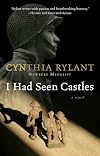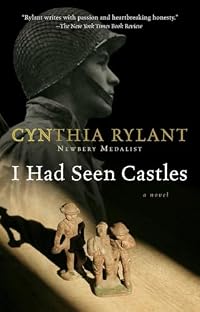
I Had Seen Castles
by Cynthia Rylant
On This Page
Description
Now an old man, John is haunted by memories of enlisting to fight in World War II, a decision which forced him to face the horrors of war and changed his life forever.Tags
Recommendations







Member Reviews
This is not meant to be a book of suspense. From the very beginning we know that the narrator is telling us the story of his experiences during World War II from many years since that time. We need not even have any suspense about the fate of his relationship with the girl he left behind, as it's reasonably clear that he's alone when he tells us the story.
Rather, this is a story of what happened to one boy when the U.S. entered WWII. Told with incredible detail, Rylant puts us inside the head of a seventeen-year-old boy who can think of nothing else but joining the army and doing his patriotic duty. Until he meets Ginny, who challenges all of his beliefs about war and patriotism. Looking back on it, he is able to recognize her extreme show more courage in speaking out against war and encouraging him to register as a conscientious objector, but at the time, all he could see was all the other boys going off to war, even though he knew that all too many of them were not coming home.
He joins up as soon as he is able and is shipped off to the European front. His patriotic ideals last for a while, but soon he admits that he is killing the enemy only to stay alive himself. Ginny's letters ring too true to bear, and eventually he stops writing back to her. When he returns from the war, she and her family have moved away, and he is never able to find her again.
This is also not a book of regret, although clearly the narrator regrets in some way the loss of Ginny, and the loss of his own innocence when he went away to war. But this is a book of truth. Rylant doesn't sugarcoat the nature of war or the effect it has on those who must fight it, both on the battlefield and at home. show less
Rather, this is a story of what happened to one boy when the U.S. entered WWII. Told with incredible detail, Rylant puts us inside the head of a seventeen-year-old boy who can think of nothing else but joining the army and doing his patriotic duty. Until he meets Ginny, who challenges all of his beliefs about war and patriotism. Looking back on it, he is able to recognize her extreme show more courage in speaking out against war and encouraging him to register as a conscientious objector, but at the time, all he could see was all the other boys going off to war, even though he knew that all too many of them were not coming home.
He joins up as soon as he is able and is shipped off to the European front. His patriotic ideals last for a while, but soon he admits that he is killing the enemy only to stay alive himself. Ginny's letters ring too true to bear, and eventually he stops writing back to her. When he returns from the war, she and her family have moved away, and he is never able to find her again.
This is also not a book of regret, although clearly the narrator regrets in some way the loss of Ginny, and the loss of his own innocence when he went away to war. But this is a book of truth. Rylant doesn't sugarcoat the nature of war or the effect it has on those who must fight it, both on the battlefield and at home. show less
I can't remember where I heard about this one, probably the Maud list, but I had to request it through ILL. It was worth the wait. I'm a huge Rylant fan and have been ever since I read Gooseberry Park. This couldn't be more different, but it's exquisite.
The protagonist is an old man looking back on the little bit of time leading up to and encompassing WWII, which he fought in. The tone is removed but not flat, not unemotional but also not too immediate for comfort. The story is really a love story interwoven with the story of how war can sabotage the purest things, how even the bravest boys can die and how the innocent are maimed. I adored it, start to finish.
The protagonist is an old man looking back on the little bit of time leading up to and encompassing WWII, which he fought in. The tone is removed but not flat, not unemotional but also not too immediate for comfort. The story is really a love story interwoven with the story of how war can sabotage the purest things, how even the bravest boys can die and how the innocent are maimed. I adored it, start to finish.
Young, hopefull, energetic and idealist John Dante is 17 when the Japanese bomb Pearl Harbor. Swept away with patriotism, John eagerly awaits his 18th birthday when he can enlist in WWII.
Years later, now retired, John tells the reader his story of how his war experiences shaped and changed him.
Rylant writes with compassion, insight and poetic sparseness of beauty. This is a small book that packs a big wallop.
Sadly, because it is labeled Young Adult, many may never read this incredible gem!
Highly recommended.
Years later, now retired, John tells the reader his story of how his war experiences shaped and changed him.
Rylant writes with compassion, insight and poetic sparseness of beauty. This is a small book that packs a big wallop.
Sadly, because it is labeled Young Adult, many may never read this incredible gem!
Highly recommended.
Disjointed, but moving. Rylant tackles an excruciating story. I appreciate the attempt.
There are a mere 23 pages devoted to the military experience and war in this book ( of less than 100 pages), but they are horrifying, and I’d like to scrub them from my memory.
There are a mere 23 pages devoted to the military experience and war in this book ( of less than 100 pages), but they are horrifying, and I’d like to scrub them from my memory.
John Dante is a seventeen-year-old boy caught up in the throes of new love--and the dawn of the Second World War. His leaving, his fighting, and his homecoming encompass the main parts of the book, revealing a very human struggle in the midst of a global conflict.
I randomly recalled reading this book, specifically the very last lines, a few weeks ago, and I wanted to see if it lived up to the memories. It definitely does. Rylant has an amazing way of making an individual experience universal, of building incredible emotional resonance in a surprisingly small space--only about 20,000 words. Highly, highly recommended.
I randomly recalled reading this book, specifically the very last lines, a few weeks ago, and I wanted to see if it lived up to the memories. It definitely does. Rylant has an amazing way of making an individual experience universal, of building incredible emotional resonance in a surprisingly small space--only about 20,000 words. Highly, highly recommended.
This short, spare book tells the story of a patriotic, idealistic boy who is forever changed when sent to fight on the front lines of WWII. His struggle to find meaning and "normalcy" after the war ends and he returns home is haunting.
Curriculum: This a time when young service men and women are returning home from war struggling with many of the same issues as the protagonist of this book. John is eager to go off to war and do his duty, but his experiences at war and his struggles on his return make him consider the cost and the worth of the fighting. This is a very relevant topic for students today.
Rylant, C. (1993). I had seen castles. San Diego: Harcourt Brace.
Curriculum: This a time when young service men and women are returning home from war struggling with many of the same issues as the protagonist of this book. John is eager to go off to war and do his duty, but his experiences at war and his struggles on his return make him consider the cost and the worth of the fighting. This is a very relevant topic for students today.
Rylant, C. (1993). I had seen castles. San Diego: Harcourt Brace.
An intense novel framed like a memoir. Told in the first person by a WWII veteran, John Dante, the story is difficult to read at times and uplifting at other times.
The gung ho young boys who signed up to go to war - they did not know what they were in for.
John does not tell of all his years at battle, but he does relate a number of the more difficult experiences.
The gung ho young boys who signed up to go to war - they did not know what they were in for.
John does not tell of all his years at battle, but he does relate a number of the more difficult experiences.
Members
- Recently Added By
Lists

Sonlight Books
1,487 works; 25 members

Books That Made Us Cry
278 works; 145 members
Author Information

286+ Works 113,310 Members
Cynthia Rylant was born on June 6, 1954 in Hopewell, Virginia. She attended and received degrees at Morris Harvey College, Marshall University, and Kent State University. Rylant worked as an English professor and at the children's department of a public library, where she first discovered her love of children's literature. She has written more show more than 100 children's books in English and Spanish, including works of fiction, nonfiction, and poetry. Her novel Missing May won the 1993 Newbery Medal and A Fine White Dust was a 1987 Newbery Honor book. Rylant wrote A Kindness, Soda Jerk, and A Couple of Kooks and Other Stories, which were named as Best Book for Young Adults. When I was Young in the Mountains and The Relatives Came won the Caldecott Award. She has many popular picture books series, including Henry and Mudge, Mr. Putter and Tabby and High-Rise Private Eyes. (Bowker Author Biography) show less
Awards and Honors
Awards
Distinctions
Common Knowledge
- Original publication date
- 1993
- Important events
- World War II
- Epigraph
- No, what my heart will be is a tower.
And I will be right out on its rim:
nothing else will be there, only pain
and what can't be said, only the world.
-Rainer Maria Rilke
from "The Solitary Man" - First words
- Pittsburgh was darkness.
- Quotations
- Ginny was so exceptional ... and so extremely courageous in so cowardly a time. Cowardly in the sense that dissension of any kind, any questioning of the rightness of our declaring war, was simply not tolerated. Anyone agai... (show all)nst the war was, by association, against the young soldiers fighting it, and therefore without conscience. Protesters were beaten and abused. There could be no thinking for oneself. Not then.
I killed to keep from dying. I killed to protect the boys in my squad. the history books would eventually say that I killed for the ideals of human liberty. But the history books would be dead wrong. - Last words
- (Click to show. Warning: May contain spoilers.)And I still love you.
Classifications
Statistics
- Members
- 338
- Popularity
- 93,239
- Reviews
- 10
- Rating
- (3.99)
- Languages
- English
- Media
- Paper
- ISBNs
- 8
- ASINs
- 4