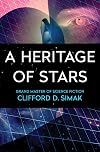
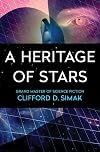
A Heritage of Stars
by Clifford D. Simak
On This Page
Description
A man hunts for lost knowledge in a future society that's reverted to a primitive tribal state in this novel by the author of Way Station. More than a thousand years have passed since humankind intentionally destroyed its treacherous technology, choosing to revert back to a primitive tribal state. In this society the rusting brain cases of long-inert robots are considered trophies, and the scant knowledge that has survived is doled out to an inquisitive few in monastery-like "universities." show more It is at one such center of learning that young Tom Cushing first reads of the legendary "Place of Going to the Stars," rumored to exist on a high butte somewhere in the western part of the land. Driven by enthusiasm and an insatiable need to track the myth to its source, Tom sets out on an amazing trek across what was once called "America," teaming up with a witch, the world's last remaining robot, and other odd companions. But all the astonishing discoveries and dangers they encounter along the way will pale before the revelations that await them at journey's end. Clifford D. Simak, award-winning science fiction Grand Master, offers a breathtaking vision of the future that is both dystopian and hopeful in equal measure. In A Heritage of Stars, he boldly displays the heart, intelligence, and awesome imaginative powers that have established him as one of the all-time greatest authors of speculative fiction. show lessTags
Recommendations










Member Reviews
When I read a Simak story, I imagine the following scene. Clifford and I are seated in rocking chairs on a large wraparound porch, at a rustic log cabin deep in the Wisconsin woods. He has a piece of grass that’s gone to seed in the corner of his mouth. It’s past dusk and we’ve just finished a fine dinner of venison and root vegetables. A wisp of smoke rises from the stone chimney, as Clifford likes to keep a modest fire burning continuously. You can smell the fire in the air along with the earthy and musty scents of the deep forest. A guitar and a shotgun lean against the cabin behind us. I ask Clifford to tell me another tale. He refuses at first, but after some requisite pleading, he begrudgingly agrees. As he tells the tale, show more first the forest, then the cabin dissolve and the story plays out all around us . . .
“When it came to hope, you do not write off even the faintest hope of all. You held on to every hope; you cherish all, you let none get away.”
This is not Simak’s best book. It’s not in the top five. I’m sure many would dislike it as it has some flaws. But I enjoyed its leisurely pace and Simak’s trademark ability to evoke nostalgia. It reminds me of his ‘Cemetery World,’ as both stories have a similar structure of introducing a set of mysteries, then following an odd cast of characters as they journey to the answers. For me, the best parts are the travels through nature as Simak is at his best describing the Midwest wilderness. His love of nature shines through his prose. The story is set thousands of years in the future on a post-apocalyptic earth. All technology has been destroyed and mankind is in a dark age with scattered settlements and roaming bands of barbarians. The beginning of the tale does indeed establish some mystery and wonder and provides the curiosity to carry us through a subdued wilderness journey, where the main character picks up a band of odd fellow travelers along the way. It delighted me that the University where I teach (University of Minnesota), plays a key role in the tale. It’s not only the last remaining University, but possible the last remaining stronghold of intellectuals and cache of knowledge. However, I wasn’t impressed with Simak’s character building in this book as some of the characters border on silly. The ending is rich with ideas and provides plenty of closure, but it’s abrupt and more telling than show. The book begins and ends with large sections of exposition that first explain the world-building and at the end, explain the resolution of the mysteries. But a passage at the end of Chapter 15 might sum it up best: “It doesn’t matter, laddie boy,” she told him. “It’s been a lovely trip.”
I love the serenity and melancholy that Simak educes. I enjoy his descriptions of nature. I like the questions he asks and appreciate his storytelling skill. A wonder-filled adventure, set in a relatively tame post-apocalyptic future, where the journey exceeds the destination. Three and a half stars. show less
“When it came to hope, you do not write off even the faintest hope of all. You held on to every hope; you cherish all, you let none get away.”
This is not Simak’s best book. It’s not in the top five. I’m sure many would dislike it as it has some flaws. But I enjoyed its leisurely pace and Simak’s trademark ability to evoke nostalgia. It reminds me of his ‘Cemetery World,’ as both stories have a similar structure of introducing a set of mysteries, then following an odd cast of characters as they journey to the answers. For me, the best parts are the travels through nature as Simak is at his best describing the Midwest wilderness. His love of nature shines through his prose. The story is set thousands of years in the future on a post-apocalyptic earth. All technology has been destroyed and mankind is in a dark age with scattered settlements and roaming bands of barbarians. The beginning of the tale does indeed establish some mystery and wonder and provides the curiosity to carry us through a subdued wilderness journey, where the main character picks up a band of odd fellow travelers along the way. It delighted me that the University where I teach (University of Minnesota), plays a key role in the tale. It’s not only the last remaining University, but possible the last remaining stronghold of intellectuals and cache of knowledge. However, I wasn’t impressed with Simak’s character building in this book as some of the characters border on silly. The ending is rich with ideas and provides plenty of closure, but it’s abrupt and more telling than show. The book begins and ends with large sections of exposition that first explain the world-building and at the end, explain the resolution of the mysteries. But a passage at the end of Chapter 15 might sum it up best: “It doesn’t matter, laddie boy,” she told him. “It’s been a lovely trip.”
I love the serenity and melancholy that Simak educes. I enjoy his descriptions of nature. I like the questions he asks and appreciate his storytelling skill. A wonder-filled adventure, set in a relatively tame post-apocalyptic future, where the journey exceeds the destination. Three and a half stars. show less
This was written in 1977, but it feels a lot older than that; there's a definite Golden Age style to it. The plot is simple enough: about 1500 years ago, humans smashed most of their technology, purged the knowledge of how to rebuild it from their libraries, and has been living in a generally savage state ever since. The main character was raised in a university that seems more like a monastery, which may be the only place of learning left on the planet. He comes across a vague reference to a starport, decides to look for it, and the book is the story of his journey.
As I would expect in Golden Age SF, the characters are rather flat, but they're not the point. The book exists to tell more of a philosophical story, to ask what might come show more after technology, and whether humanity could claw its way back from a self-imposed primitive state to a new semblance of civilization. In the 1500 years or so since the unexplained revolt, there hasn't been any progress of note; will our hero's journey lead him to the catalyst his people need?
There are a couple of clunkers in the storytelling. For one thing, the "History" that is quoted a few times is described as written in small script to conserve paper, but its author is rather more verbose than I would expect in that case. There are also references to discovered notes; if paper is so precious, who would waste it on notes? An old man met on the journey refers to "cleaning his clock" as slang for beating someone up; is that really an idiom that would survive 1500 years of no technology more advanced than spears and bows? All the same, these are rather minor flaws for this type of work, and I am inclined to forgive them in the name of nostalgia.
In the end, the question remains unanswered...but there's hope, and that's more than there had been before. I could easily imagine "A Canticle for Leibowitz" taking place in another part of this world, and it treads rather similar ground. It's a nice book for those of us who cut our teeth on the Golden Age classics, but modern readers may well find it lacking. show less
As I would expect in Golden Age SF, the characters are rather flat, but they're not the point. The book exists to tell more of a philosophical story, to ask what might come show more after technology, and whether humanity could claw its way back from a self-imposed primitive state to a new semblance of civilization. In the 1500 years or so since the unexplained revolt, there hasn't been any progress of note; will our hero's journey lead him to the catalyst his people need?
There are a couple of clunkers in the storytelling. For one thing, the "History" that is quoted a few times is described as written in small script to conserve paper, but its author is rather more verbose than I would expect in that case. There are also references to discovered notes; if paper is so precious, who would waste it on notes? An old man met on the journey refers to "cleaning his clock" as slang for beating someone up; is that really an idiom that would survive 1500 years of no technology more advanced than spears and bows? All the same, these are rather minor flaws for this type of work, and I am inclined to forgive them in the name of nostalgia.
In the end, the question remains unanswered...but there's hope, and that's more than there had been before. I could easily imagine "A Canticle for Leibowitz" taking place in another part of this world, and it treads rather similar ground. It's a nice book for those of us who cut our teeth on the Golden Age classics, but modern readers may well find it lacking. show less
In a post-apocalyptic, post-technological society where mankind has declined to barbarism, a potato farmer sets his heart on the legend of "The Place of Going To The Stars", as written on scraps of paper (now a scarce resource) in a speculative history.
Not one of Simak's best. From the off, there is a lot of suspension of disbelief required of the reader for the setting, but given the more mystical/Wizard-of-Oz-esque narrative style, I was willing to go along with it. For a while it's a plodding, but cosy read. Simak's prose and dialogue can range from clunky and stilted to beautiful and literary. Here it's a real hodge-podge.
The whole thing was clinging to a solid 3-star cliff edge for much of the way and then had its fingers crushed show more by the colossal exposition dump in the last act, sending it tumbling down into the depths of an unforgiving rating. The quality drop is so steep that it was tempting to give this 1 star, but that would be disproportionate to my enjoyment early on, so here's a generous "2".
All I have left to read of Simak is from his later years, and I don't think much from this period is thought of very highly. I am optimistically hoping there's some underrated gold to find still, as I persevere in my quest for completion. show less
Not one of Simak's best. From the off, there is a lot of suspension of disbelief required of the reader for the setting, but given the more mystical/Wizard-of-Oz-esque narrative style, I was willing to go along with it. For a while it's a plodding, but cosy read. Simak's prose and dialogue can range from clunky and stilted to beautiful and literary. Here it's a real hodge-podge.
The whole thing was clinging to a solid 3-star cliff edge for much of the way and then had its fingers crushed show more by the colossal exposition dump in the last act, sending it tumbling down into the depths of an unforgiving rating. The quality drop is so steep that it was tempting to give this 1 star, but that would be disproportionate to my enjoyment early on, so here's a generous "2".
All I have left to read of Simak is from his later years, and I don't think much from this period is thought of very highly. I am optimistically hoping there's some underrated gold to find still, as I persevere in my quest for completion. show less
This short SF novel from 1977 is set long after the collapse of technological civilization, and follows a man who has spent time in what may be the only remaining university, studying preserved human knowledge. There, he hears a legend about somewhere called The Place of Going to the Stars, and sets off to seek it out, picking up a variety of strange traveling companions on the way.
The writing and story are pleasant enough, in a low-key sort of way typical of Simak, and there are some nice touches of good old SF sense of wonder stuff at the end. I did have some suspension-of-disbelief problems with it, though, especially at the beginning. It's not the way it buys into the reality of psychic powers; that was so common in 70s SF, and it show more so often made for entertaining story elements, that even a hardcore skeptic like me can just shrug and accept it. It's also not that the protagonist just happens to randomly encounter exactly the people and information he needs to complete his quest, as there's a certain kind of fairy-tale logic to that that actually mostly works.
No, it's the world-building I have some issues with. The way the collapse of civilization happened isn't quite convincing to me, at least not the way Simak presents it, and the details of what survives from the former civilization and what doesn't are odd, too, in ways that are entirely too plot-convenient. Come on, is a 1500-year-old paper map still going to be readable after being carried around in someone's backpack? And the main character feels far too much like someone with a 20th-century perspective rather than a plausible product of his own time and culture, even accounting for the fact that he's read a lot of old books.
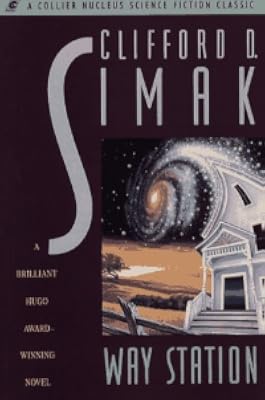
Still, the further I read on, the less most of that bothered me. And I'd say that if you're in the mood for a bit of vintage SF -- and, unlike a lot of the more experimental stuff of the 70s, this undoubtedly had a bit of a vintage feel even then -- you could do a lot worse. If what you're looking for, though, is a first introduction to Simak, I would recommend Way Station instead. show less
The writing and story are pleasant enough, in a low-key sort of way typical of Simak, and there are some nice touches of good old SF sense of wonder stuff at the end. I did have some suspension-of-disbelief problems with it, though, especially at the beginning. It's not the way it buys into the reality of psychic powers; that was so common in 70s SF, and it show more so often made for entertaining story elements, that even a hardcore skeptic like me can just shrug and accept it. It's also not that the protagonist just happens to randomly encounter exactly the people and information he needs to complete his quest, as there's a certain kind of fairy-tale logic to that that actually mostly works.
No, it's the world-building I have some issues with. The way the collapse of civilization happened isn't quite convincing to me, at least not the way Simak presents it, and the details of what survives from the former civilization and what doesn't are odd, too, in ways that are entirely too plot-convenient. Come on, is a 1500-year-old paper map still going to be readable after being carried around in someone's backpack? And the main character feels far too much like someone with a 20th-century perspective rather than a plausible product of his own time and culture, even accounting for the fact that he's read a lot of old books.
Still, the further I read on, the less most of that bothered me. And I'd say that if you're in the mood for a bit of vintage SF -- and, unlike a lot of the more experimental stuff of the 70s, this undoubtedly had a bit of a vintage feel even then -- you could do a lot worse. If what you're looking for, though, is a first introduction to Simak, I would recommend Way Station instead. show less
Interesting book that shows a future over 1500 years after the collapse of civilization and one man's attempt to restart it. This is very much a product of it's times (early 1970's), where people were attempting to come to grasps with the rapid technological changes happening in the world. Definitely not the most action-packed book that I've ever read, and I'm not sure that I agree with the central premise ((not a spoiler!) that mankind eventually rebels so thoroughly against technology that all tech is destroyed, to the extent that even pages are ripped from the few remaining books that might've otherwise helped rebuild society), but it was definitely thought-provoking.
This is only the second Simak novel that I've read (the other one show more - [b:The Visitors|191003|The Visitors|Clifford D. Simak|https://d.gr-assets.com/books/1203026235s/191003.jpg|2381578] - was read while I was in high school over 30 years ago), although I've read some short stories of his. I think that I'll seek out others of his. show less
This is only the second Simak novel that I've read (the other one show more - [b:The Visitors|191003|The Visitors|Clifford D. Simak|https://d.gr-assets.com/books/1203026235s/191003.jpg|2381578] - was read while I was in high school over 30 years ago), although I've read some short stories of his. I think that I'll seek out others of his. show less
Tom Cushing, a young man in a post-apocalyptic future where humanity has reverted to tribal life after destroying its advanced technology, embarks on a quest to find the legendary "Place of Going to the Stars" to uncover lost knowledge, encountering strange companions and alien artifacts on a journey exploring humanity's lost potential and future destiny.
Dystopian future
Interesting mix of travelers trying to save humanity. Not a "solved" story, which I liked. I'll be reading more Simak.
Interesting mix of travelers trying to save humanity. Not a "solved" story, which I liked. I'll be reading more Simak.
Members
- Recently Added By
Author Information

389+ Works 25,310 Members
Some Editions
Awards and Honors
Awards
Series
Belongs to Publisher Series
Work Relationships
Common Knowledge
- Canonical title
- A Heritage of Stars
- Original title
- A Heritage of Stars
- Original publication date
- 1977
- First words
- One of the curious customs to arise out of the Collapse was the practice of pyramiding robotic brain cases, in the same manner that certain ancient Asiatic barbarians raised pyramids of human heads that later turned into s... (show all)kulls, to commemorate a battle.
- Last words
- (Click to show. Warning: May contain spoilers.)"Yes, you are right. It has been all of that."
- Original language*
- Inglés
*Some information comes from Common Knowledge in other languages. Click "Edit" for more information.
Classifications
Statistics
- Members
- 612
- Popularity
- 47,748
- Reviews
- 14
- Rating
- (3.43)
- Languages
- 7 — English, French, German, Lithuanian, Portuguese, Russian, Spanish
- Media
- Paper, Audiobook, Ebook
- ISBNs
- 13
- ASINs
- 18