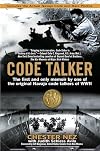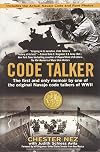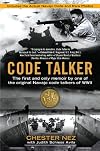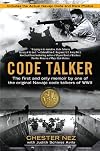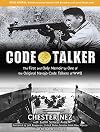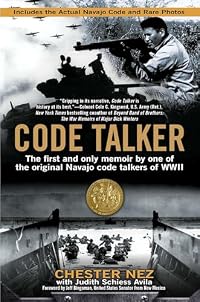
Code Talker: The First and Only Memoir by One of the Original Navajo Code Talkers of WWII
by Chester Nez
On This Page
Description
Chester Nez, the last surviving member of the original twenty-nine code talkers, discusses his life growing up in the Checkerboard Area of the Navajo reservation, and shares the story of how he helped the United States develop and implement a secret military language based on his native language during World War II that became the only unbroken code in modern warfare.Tags
Recommendations




Member Reviews
Listening to the audio was very much like sitting at grandfather Nez' feet and hearing his life story. The story line is focused, but the language is repetitive and unoriginal, which made for some fidgitys.
But I was glad to have heard the bulk of it, as Nez' contribution to the war was significant, and he certainly deserves a respectful listen. So I didn't squirm or roll my eyes in his presence.
I learned a lot more about the Pacific war theater than I have been exposed to before, and that was also a good thing.
I will probably move on to other accounts of this aspect of the war, and sample some of the fiction as well.
PS: What a brilliant communication coding concept!
But I was glad to have heard the bulk of it, as Nez' contribution to the war was significant, and he certainly deserves a respectful listen. So I didn't squirm or roll my eyes in his presence.
I learned a lot more about the Pacific war theater than I have been exposed to before, and that was also a good thing.
I will probably move on to other accounts of this aspect of the war, and sample some of the fiction as well.
PS: What a brilliant communication coding concept!
Code Talker by Chester Nez is a recounting of the Navajo Nation's invaluable contribution to the WWII war effort in the Pacific theater by the only living member of the original 29 Code Talkers. His recollections were then transcribed by co-author Judith Schiess Avila.
Before getting to the development of the code, Nez describes his childhood, his time in a boarding school — back in the unfortunate days when English was enforced and the speaking of Navajo resulted in punishment. Named Betoli by his family, it was at the boarding school that he was forcefully renamed Chester Nez.
Nez's emersion in English, though gave him a valuable skill when he and twenty-eight other Navajo men joined the Marines. They were brought together to create a show more double encrypted code that could be spoken over the radio from one Navajo trained in the code to another. By making a spoken code back in the days before computer encryption, the time needed to relay a message was slashed to mere minutes (instead of hours). The accuracy of the message went up and the ability of the Japanese (or anyone else listening) to decode it was impossible. As Nez reminds readers in every interview transcript I've read, a Navajo speaker not trained in the code wouldn't understand the message any better than anyone else hearing it.
Although I've been fascinated with Navajo culture — and the language — since 1990, this is the first time I've read anything about the Code Talkers. What drew me to the book is, of course, Chester Nez's firsthand account. Now, that he was one of the creators of the code is a special bonus. But it should be noted that all 400 Code Talkers had important parts to play. The code was also expanded over time by later speakers.
The copy I read came from my wonderful local library, but I would like to own a copy. It's something I want to re-read. show less
Before getting to the development of the code, Nez describes his childhood, his time in a boarding school — back in the unfortunate days when English was enforced and the speaking of Navajo resulted in punishment. Named Betoli by his family, it was at the boarding school that he was forcefully renamed Chester Nez.
Nez's emersion in English, though gave him a valuable skill when he and twenty-eight other Navajo men joined the Marines. They were brought together to create a show more double encrypted code that could be spoken over the radio from one Navajo trained in the code to another. By making a spoken code back in the days before computer encryption, the time needed to relay a message was slashed to mere minutes (instead of hours). The accuracy of the message went up and the ability of the Japanese (or anyone else listening) to decode it was impossible. As Nez reminds readers in every interview transcript I've read, a Navajo speaker not trained in the code wouldn't understand the message any better than anyone else hearing it.
Although I've been fascinated with Navajo culture — and the language — since 1990, this is the first time I've read anything about the Code Talkers. What drew me to the book is, of course, Chester Nez's firsthand account. Now, that he was one of the creators of the code is a special bonus. But it should be noted that all 400 Code Talkers had important parts to play. The code was also expanded over time by later speakers.
The copy I read came from my wonderful local library, but I would like to own a copy. It's something I want to re-read. show less
I was vaguely familiar with the Code Talkers prior to reading this book. I found it extremely interesting to read Chester Nez's memoir: the story about his Navajo youth at home and the beliefs engrained by his family, his life adjustments and education at boarding school, the origins of the code talkers, his strong sense of duty on-the-ground as a Marine in some of the most deadly battles in the South Pacific during WWII, and his life afterwards.
This was a captivating, page turner.
This was a captivating, page turner.
As a military veteran, I'm always fascinated by military history. This book did not let me down with regard to how the Navajo Code Talkers came into being and what they went through during World War II. One of the unexpected benefits of this book was learning more about Navajo life prior to WWII, since Chester Nez's narrative provides some details on his growing up and how that impacted his service during the war.
Though I'm not normally a fan of military memoirs, I was surprised to find myself reading most of this book in one sitting, and that part being during Chester Nez's service. The battles are well explained and give excellent context for the dangerous mission Nez and the other code talkers accomplished.
The parts explaining Nez's childhood, especially the Great Livestock Massacre (For all the reading I did on The Great Depression as a Political Science major in college, I never read about that part of the Indian Reorganization Act, a fact that still makes me seethe) were equally engaging. Readers will learn much about early 20th Century Navajo life and World War II's Pacific Theater from this book.
Nez's voice comes through strongly in show more this memoir and the information and chapters are well-organized. Though it's not the best writing out there, it certainly very good and the Nez's compelling life story more than compensates for sometimes lackluster description. Overall, an informative and engaging read, which is really all I ask from a biography/memoir anyway. show less
The parts explaining Nez's childhood, especially the Great Livestock Massacre (For all the reading I did on The Great Depression as a Political Science major in college, I never read about that part of the Indian Reorganization Act, a fact that still makes me seethe) were equally engaging. Readers will learn much about early 20th Century Navajo life and World War II's Pacific Theater from this book.
Nez's voice comes through strongly in show more this memoir and the information and chapters are well-organized. Though it's not the best writing out there, it certainly very good and the Nez's compelling life story more than compensates for sometimes lackluster description. Overall, an informative and engaging read, which is really all I ask from a biography/memoir anyway. show less
Chester Nez was a Navajo who grew up in the Checkerboard surrounded by a loving, traditional clan. He learns English and white ways when he is sent to boarding school. When WWII breaks out he joins the Marines and is assigned to the Code Talkers. They were involved in the most intense fighting in the Pacific and were instrumental in the Japanese defeat with the use of their code. Chester lived a very interesting life and did his best to keep the old ways alive. Very interesting life, well told.
Chester Nez is an inspirational man. He does not sugar coat the war or his part in it. He also does not complain about his treatment by society. He just delivers his story with a frankness that is inspiring.
I like that he shares the beliefs of his people and how those beliefs have helped him through the difficult times. He was a great man, who along with all of the code talkers, deserves are respect.
I like that he shares the beliefs of his people and how those beliefs have helped him through the difficult times. He was a great man, who along with all of the code talkers, deserves are respect.
Members
- Recently Added By
Published Reviews
ThingScore 75
Code Talker is an excellent book on the topic of the Navajo code talkers. It provides new insight into the development of the code and the Navajo cultural and historical background.
added by Delfi_r
Lists

Best Biographies, Autobiographies and Memoirs
464 works; 156 members

Stories of War and Revolution
143 works; 54 members

Native American Heritage
52 works; 2 members
Author Information

2 Works 724 Members
All Editions
Some Editions
Awards and Honors
Work Relationships
Has the (non-series) sequel
Common Knowledge
- Canonical title
- Code Talker: The First and Only Memoir by One of the Original Navajo Code Talkers of WWII
- Original publication date
- 2011-11
- People/Characters
- Chester Nez
- Important events
- World War II
- Dedication
- This book is dedicated to the 420 World War II Navajo Marine code talkers - men who developed and implemented an unbreakable communications system that helped ensure the American defeat of the Japanese in the Pacifi... (show all)c war.
When the war ended, other combatants were free to discuss their roles in the service and to receive recognition for their actions. But the Marines instructed us, the code talkers, to keep our accomplishments secret. We kept our own counsel, hiding our deeds from family, friends, and acquaintances. Our code was finally declassified in 1968, twenty-three years after the war's end.
This book may be my story, but it is written for all of these men.
May they and their loved ones walk in beauty. - First words
- "I'm no hero." Chester Nez chuckles.
- Last words
- (Click to show. Warning: May contain spoilers.)It's been a good life - so far.
- Disambiguation notice
- This book is not the same as "The Life and Times of the Code Talker" though it is about and by the same people.
Classifications
Statistics
- Members
- 723
- Popularity
- 38,780
- Reviews
- 19
- Rating
- (4.15)
- Languages
- English
- Media
- Paper, Audiobook, Ebook
- ISBNs
- 12
- ASINs
- 8