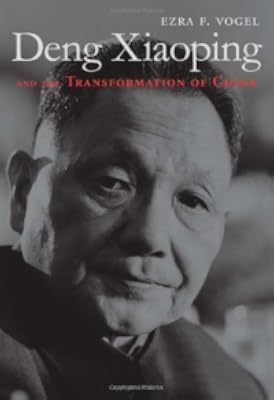
Deng Xiaoping and the Transformation of China
by Ezra F. Vogel
On This Page
Description
Perhaps no one in the twentieth century had a greater long-term impact on world history than Deng Xiaoping. And no scholar of contemporary East Asian history and culture is better qualified than Ezra Vogel to disentangle the many contradictions embodied in the life and legacy of China's boldest strategist. Once described by Mao Zedong as a "needle inside a ball of cotton," Deng was the pragmatic yet disciplined driving force behind China's radical transformation in the late twentieth show more century. He confronted the damage wrought by the Cultural Revolution, dissolved Mao's cult of personality, and loosened the economic and social policies that had stunted China's growth. Obsessed with modernization and technology, Deng opened trade relations with the West, which lifted hundreds of millions of his countrymen out of poverty. Yet at the same time he answered to his authoritarian roots, most notably when he ordered the crackdown in June 1989 at Tiananmen Square. Deng's youthful commitment to the Communist Party was cemented in Paris in the early 1920's, among a group of Chinese student-workers that also included Zhou Enlai. Deng returned home in 1927 to join the Chinese Revolution on the ground floor. In the fifty years of his tumultuous rise to power, he endured accusations, purges, and even exile before becoming China's preeminent leader from 1978 to 1989 and again in 1992. When he reached the top, Deng saw an opportunity to creatively destroy much of the economic system he had helped build for five decades as a loyal follower of Mao-and he did not hesitate. show lessTags
Recommendations






Member Reviews
One after reading this book wonders why he's (Deng) isn't called Deng 'The GOAT' Xiaoping. Then one remembers he died 30ish years ago. One kids (mostly).
Ok sincere apologies to any Chinese person or any relatives of Deng if you (somehow??) read that introduction- I'll get serious now:
My aim with this book was to get to know my neighbors and Mao seemed a bit.. off (no wonder lol I rated the commie mannifesto 1-star). Deng seemed better-headed and more rational (regardless he had his allegiance to the govt/country and not to the people). Perhaps I just came to like him after listening for 33 hours about his life.
The book is a great starting point about the environment pre-Xi Jinping and post-Mao allowing me to understand what roughly show more happened in-between but what I didn't expect was lessons in it too from Deng.
I think the biggest one I've learnt is to embrace change in your own way. Sometimes it may be seen as something negative (Deng going from the cheery type to later becoming quieter during- I believe the civil war) or positive (Deng opening up the country, making allies in the right places, etc).
Stagnancy is caused by fear and ego- get rid of both. Try because practice is the sole criterion of truth ey? Thanks Deng (Yes I'm aware of the standoff on '86) show less
Ok sincere apologies to any Chinese person or any relatives of Deng if you (somehow??) read that introduction- I'll get serious now:
My aim with this book was to get to know my neighbors and Mao seemed a bit.. off (no wonder lol I rated the commie mannifesto 1-star). Deng seemed better-headed and more rational (regardless he had his allegiance to the govt/country and not to the people). Perhaps I just came to like him after listening for 33 hours about his life.
The book is a great starting point about the environment pre-Xi Jinping and post-Mao allowing me to understand what roughly show more happened in-between but what I didn't expect was lessons in it too from Deng.
I think the biggest one I've learnt is to embrace change in your own way. Sometimes it may be seen as something negative (Deng going from the cheery type to later becoming quieter during- I believe the civil war) or positive (Deng opening up the country, making allies in the right places, etc).
Stagnancy is caused by fear and ego- get rid of both. Try because practice is the sole criterion of truth ey? Thanks Deng (Yes I'm aware of the standoff on '86) show less
This is an in-depth and balanced biography of Deng Xiaoping, who took the reins of ruling a rather messy China after the disasters of the Great Leap Forward and the Cultural Revolution, and gradually raised it to the China that we now know today.
It is well-written, in-depth and neutral in tone; it describes the good and bad effects his reforms had on China.
This biography also highlights the key people who were at Deng's side during his reign (Zhou Enlai, Chen Yun, Hua Guofeng, Zhao Ziyang, Li Peng, Deng Liqun etc) and the opponents who were not so keen on his introduction of radical reforms to the country (the infamous Gang Of Four, in particular Jiang Qing).
The only bad things about the book are the sheer size of volume (which is not show more surprising) and that Vogel has chosen to write in accordance to how he carried out his reforms.
On overall, Deng may come across to the reader as a highly intelligent and ruthless leader; but also well-liked, respected by the Party and the Chinese public who remain grateful to him for ending much of the poverty and starvation they faced, and being a good parent to his family and wife. show less
It is well-written, in-depth and neutral in tone; it describes the good and bad effects his reforms had on China.
This biography also highlights the key people who were at Deng's side during his reign (Zhou Enlai, Chen Yun, Hua Guofeng, Zhao Ziyang, Li Peng, Deng Liqun etc) and the opponents who were not so keen on his introduction of radical reforms to the country (the infamous Gang Of Four, in particular Jiang Qing).
The only bad things about the book are the sheer size of volume (which is not show more surprising) and that Vogel has chosen to write in accordance to how he carried out his reforms.
On overall, Deng may come across to the reader as a highly intelligent and ruthless leader; but also well-liked, respected by the Party and the Chinese public who remain grateful to him for ending much of the poverty and starvation they faced, and being a good parent to his family and wife. show less
Deng Xiaoping was one of the extraordinary characters of his century, and, if it can be said of any historian, Ezra F. Vogel does not simplify the man or the world he lived in. This book was invaluable to my understanding of contemporary China. Years later, when I think about China, I still often find myself leafing through Vogel's index.
An enormous, fascinating view of the man who had, after a century and a half of agony, brought China into the modern age, and brought hundreds of millions out of poverty.
Deng is not an easy man to write about, due to the nature of his work, his government, and the fact that he didn't take notes and instead memorized everything. Many Chinese government archives also remain off-limits.
After spending less then a hundred pages on the first fifty years of his life, the next six hundred are devoted to his rise to power, diplomatic relations, and economic reforms. His leadership and reforms were not wholly certain - he had to outmaneuver the bloodthirsty 'Gang of Four', and one of Mao's chosen successors in order to gain power. But then, he show more took a collaborative approach, and refused to recreate a personality cult.
Deng did not merely throw open the gates and declare 'free markets' as Gorbachev did. Instead, he prepared his power base, experimented on a small scale with cities, worked carefully with foreign governments to create favorable conditions and a well-trained and equipped workforce. His most famous quote, taken from a country proverb, that the color of the cat doesn't matter so long as it catches mice, is a signature of his leadership. Pragmatism before ideology. "Don't argue, try it. If it works, let it spread."
Deng brought China prosperity, but not democracy. It is disconcerting to note that Deng was a key figure in some of Mao's worst excesses. The most unfortunate blot on his memory is the Student Uprisings and Tiananmen. He retired soon after. But he is not unique in that regard. Nearly every Asian country in the 20th century (to say nothing of any country) has had its own troubles.
But a more firm testament to his memory came later - when he went to visit the cities of the Special Economic Zones he helped create, as a sort of post-retirement vacation, he was still spontaneously welcomed as a hero and an 'uncle/grandfather' to the people. After all, one can give his policies the credit of saving hundreds of millions of people from poverty.
There is still much to be done, and the continued monolithic power of the CCP is by no means certain - its economic rise is continuing. It has surpassed Germany and Japan with ease, and now is second only to the United States in GDP. Deng brought China forward and made it prosperous. It will be seen if someone as visionary as him makes it free. show less
Deng is not an easy man to write about, due to the nature of his work, his government, and the fact that he didn't take notes and instead memorized everything. Many Chinese government archives also remain off-limits.
After spending less then a hundred pages on the first fifty years of his life, the next six hundred are devoted to his rise to power, diplomatic relations, and economic reforms. His leadership and reforms were not wholly certain - he had to outmaneuver the bloodthirsty 'Gang of Four', and one of Mao's chosen successors in order to gain power. But then, he show more took a collaborative approach, and refused to recreate a personality cult.
Deng did not merely throw open the gates and declare 'free markets' as Gorbachev did. Instead, he prepared his power base, experimented on a small scale with cities, worked carefully with foreign governments to create favorable conditions and a well-trained and equipped workforce. His most famous quote, taken from a country proverb, that the color of the cat doesn't matter so long as it catches mice, is a signature of his leadership. Pragmatism before ideology. "Don't argue, try it. If it works, let it spread."
Deng brought China prosperity, but not democracy. It is disconcerting to note that Deng was a key figure in some of Mao's worst excesses. The most unfortunate blot on his memory is the Student Uprisings and Tiananmen. He retired soon after. But he is not unique in that regard. Nearly every Asian country in the 20th century (to say nothing of any country) has had its own troubles.
But a more firm testament to his memory came later - when he went to visit the cities of the Special Economic Zones he helped create, as a sort of post-retirement vacation, he was still spontaneously welcomed as a hero and an 'uncle/grandfather' to the people. After all, one can give his policies the credit of saving hundreds of millions of people from poverty.
There is still much to be done, and the continued monolithic power of the CCP is by no means certain - its economic rise is continuing. It has surpassed Germany and Japan with ease, and now is second only to the United States in GDP. Deng brought China forward and made it prosperous. It will be seen if someone as visionary as him makes it free. show less
A first-rate biography of not just one of the great men of the 20th Century, but of the age he shaped in China. It is readable, readable at times to the point of gripping me like a good novel would. He makes clear the complexity of the governance of China. That governing China is complex is an obvious concept, but to this point - I am no China scholar - it always appeared to be Mao running the show then a bunch of other guys, with no back-ups. In fact the interplay of idea and personality is fascinating.
The author does not address one interesting moral question in detail. The massacre of at least 400 students and others during the 4 June 1989 incident was clearly morally reprehensible. If China was actually at risk of breakup, with a show more return to the clashes of right and left, I wonder what would have, could have, been the human cost. This is a form of algebra that western countries don't normally use, but it was certainly one uppermost in Deng's mind.
Grand read. show less
The author does not address one interesting moral question in detail. The massacre of at least 400 students and others during the 4 June 1989 incident was clearly morally reprehensible. If China was actually at risk of breakup, with a show more return to the clashes of right and left, I wonder what would have, could have, been the human cost. This is a form of algebra that western countries don't normally use, but it was certainly one uppermost in Deng's mind.
Grand read. show less
Ezra F. Vogel has outdone himself with his highly informative work on Deng Xiaoping, who has and is more and more turning out to be one of the most influential and significant leaders of the 20th Century.
Vogel has written this book so that those of us in the
USA who are not China scholars can readily understand the complex ways in which China has evolved over time and the decisions made by it's leaders that would not happen here due to the cultural
differences and the way in which the governments work.
Deng comes across as a brilliant and courageous man who is confidant and strong enough to follow through with his beliefs. I think he has made a huge
contribution to his country. Most of my life I always looked at China from the Mao show more perspective. There are
many challenges for the ruling party and it's huge and
diverse population and geography, but the changes
that have and are taking place are quite remarkable.
A great read and highly educational for me and I cannot thank Ezra Vogel enough for writing this wonderful book which many Americans should read. show less
Vogel has written this book so that those of us in the
USA who are not China scholars can readily understand the complex ways in which China has evolved over time and the decisions made by it's leaders that would not happen here due to the cultural
differences and the way in which the governments work.
Deng comes across as a brilliant and courageous man who is confidant and strong enough to follow through with his beliefs. I think he has made a huge
contribution to his country. Most of my life I always looked at China from the Mao show more perspective. There are
many challenges for the ruling party and it's huge and
diverse population and geography, but the changes
that have and are taking place are quite remarkable.
A great read and highly educational for me and I cannot thank Ezra Vogel enough for writing this wonderful book which many Americans should read. show less
Ratings
Members
- Recently Added By
Lists

"the china pill"
96 works; 2 members

China / Hong Kong / Taiwan
25 works; 1 member
Author Information

15+ Works 789 Members
Ezra F. Vogel is the author of Deng Xiaoping and the Transformation of China, a finalist for the National Book Critics Circle Award and winner of the Lionel Gelber Prize, and of the international bestseller Japan as Number One. He was Henry Ford II Professor of the Social Sciences Emeritus at Harvard University.
Awards and Honors
Awards
Distinctions
Common Knowledge
- People/Characters
- Deng Xiaoping
- Important places
- China
Classifications
- Genres
- History, Nonfiction, Biography & Memoir, General Nonfiction, Politics and Government
- DDC/MDS
- 951.05092 — History & geography History of Asia East Asia: China, Taiwan, Hong Kong, Korea History 1949- (People's Republic, 20th century)
- LCC
- DS778 .T39 .V64 — History of Europe, Asia, Africa and Oceania Asia History of Asia China History
- BISAC
Statistics
- Members
- 417
- Popularity
- 74,240
- Reviews
- 6
- Rating
- (4.15)
- Languages
- Chinese, English, Turkish
- Media
- Paper, Audiobook, Ebook
- ISBNs
- 10
- ASINs
- 4