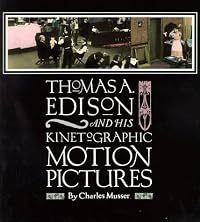
Thomas A Edison and His Kinetographic Motion Pictures
by Charles Musser
On This Page
Description
Much controversy has surrounded Thomas A. Edison's role in the birth of motion pictures. His earliest biographers gave all honor to him; later historians gave credit to his assistants or to foreign inventors whose recognition Edison stole. Charles Musser provides a balanced assessment, arguing that while Edison left the day-to-day experimentation to his talented employees, he provided the ideas and encouragement as well as financial support. Without him, the technical hurdles would not have show more been overcome so quickly. As time went on, and innovations in the motion picture business shifted from improving machines to improving the moving pictures themselves and the meyhods of exhibiting them, Edison's Laboratory lost its advantage. After three decades of patent wars and attempted monopolization of cameras and projectors, the battle moved away from the inventor and toward the producers and nickelodeon owners. Edison briefly experimented with a home movie projector, to steal a march on his rivals, but he was way ahead of his time. After thirty years, he closed down his movie studio and moved on to other projects. This brief, informative story of Edison's key contributions to the invention of motion pictures is heavily illustrated and beautifully designed. show lessTags
Members
- Recently Added By
Author Information
14+ Works 230 Members
Charles Musser is Professor of American Studies and Film and Media Studies at Yale University. He is the author of The Emergence of Cinema: The American Screen to 1907 and producer of the documentary Errol Morris: A Lightning Sketch.
Classifications
Statistics
- Members
- 16
- Popularity
- 1,513,806
- Languages
- English
- Media
- Paper
- ISBNs
- 2