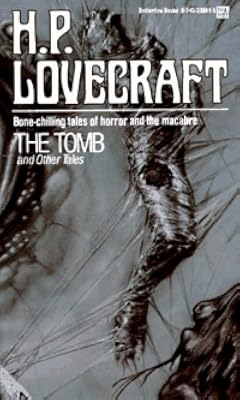
The Tomb and Other Tales
by H. P. Lovecraft (Contributor)
On This Page
Description
The Tomb tells of Jervas Dudley, a self-confessed day-dreamer. While still a child, he discovers the entrance to a mausoleum, belonging to the family Hyde, whose nearby family mansion had burnt down many years previously. The entrance to the mausoleum is padlocked and slightly ajar. Jervas attempts to break the padlock, but is unable. Dispirited, he takes to sleeping beside the tomb. Eventually, inspired by reading Plutarch's Lives, Dudley decides to patiently wait until it is his time to show more gain entrance to the tomb. show lessTags
Recommendations














Member Reviews
I am a champion of those tales which are consider'd E'ch-Pi-El's "minor" works because I find so many of them so peculiar and enchanting, playful and provocative. This paperback from Del Rey has an excellent sampling of Lovecraft's less familiar stories, and although I would not recommend this as a beginning place for those who are new to Lovecraft's Works, I can confess that I adore most of its Contents.
"The Festival" remains a keen favourite, and I love the atmosphere invested in the creation of Kingsport and its occult ways. The story is, unlike most of Lovecraft's tales, absolutely supernatural. "He" is another story of which I am fond, despite its slight expression of Lovecraft's wretched racism. Again, it is an excellent study in show more weird atmosphere, conjuring the weird mood of Outside otherness that Lovecraft felt to be a vital component in the weird tale. "The Strange High House in the Mist" is another tale set in mythic Kingsport.
The very early "The Alchemist" is, despite the youthfulness of its author, a rather good story. I never paid the story much attention until I listen'd to a reading of it online, during which I was completely captivated.
The fragments are my favourite portion of this slim collection. "Azathoth" is thought by some scholars to be an early experimental beginning for what eventually became "The Dream-Quest of Unknown Kadath." "The Descendant" has long interested me, to the point where I sometimes fancy that I'd like to complete it--although I wou'd never tie my own byline to that of Lovecraft's. In his correspondence, Lovecraft mentions many such experiments with fiction that he has discarded and destroyed; and it makes me moan to think of the perhaps hundreds of such tidbits that we have lost because of HPL's habit of throwing away so much of his experiments in weird writing. "The Book" is very curious--a retelling in prose of the first three sonnets from FUNGI FROM YUGGOTH. The story was completed by another writer, and that version was included by Ramsey Campbell in his Arkham House anthology, NEW TALES OF THE CTHULHU MYTHOS. "The Thing in the Moonlight" is not entirely by Lovecraft, being a letter that he wrote to Donald Wandrei describing a dream. The beginning and ending portions of the tale were added by another bloke when he published his extended version in his fanzine. Because the "story" is not entirely by Lovecraft and was never intended by him to be published, S. T. Joshi has removed it from all of his editions of Lovecraft's tales. show less
"The Festival" remains a keen favourite, and I love the atmosphere invested in the creation of Kingsport and its occult ways. The story is, unlike most of Lovecraft's tales, absolutely supernatural. "He" is another story of which I am fond, despite its slight expression of Lovecraft's wretched racism. Again, it is an excellent study in show more weird atmosphere, conjuring the weird mood of Outside otherness that Lovecraft felt to be a vital component in the weird tale. "The Strange High House in the Mist" is another tale set in mythic Kingsport.
The very early "The Alchemist" is, despite the youthfulness of its author, a rather good story. I never paid the story much attention until I listen'd to a reading of it online, during which I was completely captivated.
The fragments are my favourite portion of this slim collection. "Azathoth" is thought by some scholars to be an early experimental beginning for what eventually became "The Dream-Quest of Unknown Kadath." "The Descendant" has long interested me, to the point where I sometimes fancy that I'd like to complete it--although I wou'd never tie my own byline to that of Lovecraft's. In his correspondence, Lovecraft mentions many such experiments with fiction that he has discarded and destroyed; and it makes me moan to think of the perhaps hundreds of such tidbits that we have lost because of HPL's habit of throwing away so much of his experiments in weird writing. "The Book" is very curious--a retelling in prose of the first three sonnets from FUNGI FROM YUGGOTH. The story was completed by another writer, and that version was included by Ramsey Campbell in his Arkham House anthology, NEW TALES OF THE CTHULHU MYTHOS. "The Thing in the Moonlight" is not entirely by Lovecraft, being a letter that he wrote to Donald Wandrei describing a dream. The beginning and ending portions of the tale were added by another bloke when he published his extended version in his fanzine. Because the "story" is not entirely by Lovecraft and was never intended by him to be published, S. T. Joshi has removed it from all of his editions of Lovecraft's tales. show less
It is surprising how many of Lovecraft's signature themes are already fully evident in this, his first horror story. The nature of madness and reality, an inherited curse, seeking after forbidden knowledge, and a fated demise are all here. The narrator is very reminiscent of Hildred Castaigne from Robert Chambers' "The Repairer of Reputations" (in [b:The King in Yellow and Other Horror Stories|129798|The King in Yellow and Other Horror Stories|Robert W. Chambers|https://images.gr-assets.com/books/1416873291s/129798.jpg|954927]), as well as many of Poe's madmen. However, Lovecraft adds an element; there is the strong suggestion that Jervas' madness springs from a true apprehension: that of his actual lineage and ultimate place, shall we show more say, in the scheme of things.
(Moved 2015 review to the individual work Sept. 2017 to make room to review the collection under its own entry.) show less
(Moved 2015 review to the individual work Sept. 2017 to make room to review the collection under its own entry.) show less
"Sedibus ut saltem placidis in morte quiescam" (“En un lugar placentero, cuando muera, me sea dado descansar”) - Virgilio
Siguiendo con la continuación de los relatos cortos de H. P. Lovecraft, leemos La Tumba (The Tomb), la historia de Jervas Dudley, quien vivió siempre en esferas alejadas del mundo real y se siente obsesionado por una antigua cripta... ¿en qué punto la obsesión puede tornarse en locura? o ¿ acaso fue algo más?...
Siguiendo con la continuación de los relatos cortos de H. P. Lovecraft, leemos La Tumba (The Tomb), la historia de Jervas Dudley, quien vivió siempre en esferas alejadas del mundo real y se siente obsesionado por una antigua cripta... ¿en qué punto la obsesión puede tornarse en locura? o ¿ acaso fue algo más?...
Contains some of his earliest work, a few unfinished short fragments, and none of the major stories. Some are rather enjoyable though, my favourite being the Horror at Red Hook.
3 stars oc
3 stars oc
This extraordinary collection features 13 spine-tingling tales of delicious terror by the unquestioned master of the horror genre, as well as portions of stories he never fully completed. Discover how the mind of H.P. Lovecraft worked, and how much his early and late stories tell about this intriguing writer.
Not bad, writing feels a bit archaic but translates the strange vibe well enough.
This is a good collection of Lovecraft's work with some early fragments and two stories written as a teenager that are good, better than most of his adult ones. There is also a chronology of his works at the back. "Must rleads" are "The Strange High House in the Mist" and his only sci-fi story "In the Walls of Eryx".
Members
- Recently Added By
Lists

Weird and Weirder Fiction
270 works; 35 members

Books Read in 2025
4,091 works; 97 members
Author Information

Howard Phillips Lovecraft, 1890 - 1937 H. P. Lovecraft was born on August 20, 1890 in Providence, Rhode Island. His mother was Sarah Susan Phillips Lovecraft and his father was Winfield Scott Lovecraft, a traveling salesman for Gorham & Co. Silversmtihs. Lovecraft was reciting poetry at the age of two and when he was three years old, his father show more suffered a mental breakdown and was admitted to Butler Hospital. He spent five years there before dying on July 19, 1898 of paresis, a form of neurosyphillis. During those five years, Lovecraft was told that his father was paralyzed and in a coma, which was not the case. His mother, two aunts and grandfather were now bringing up Lovecraft. He suffered from frequent illnesses as a boy, many of which were psychological. He began writing between the ages of six and seven and, at about the age of eight, he discovered science. He began to produce the hectographed journals, "The Scientific Gazette" (1899-1907) and "The Rhode Island Journal of Astronomy" (1903-07). His first appearance in print happened, in 1906, when he wrote a letter on an astronomical matter to The Providence Sunday Journal. A short time later, he began writing a monthly astronomy column for The Pawtuxet Valley Gleaner - a rural paper. He also wrote columns for The Providence Tribune (1906-08), The Providence Evening News (1914-18), The Asheville (N.C.) Gazette-News (1915). In 1904, his grandfather died and the family suffered severe financial difficulties, which forced him and his mother to move out of their Victorian home. Devastated by this, he apparently contemplated suicide. In 1908, before graduating from high school, he suffered a nervous breakdown. He didn't receive a diploma and failed to get into Brown University, both of which caused him great shame. Lovecraft was not heard from for five years, re-emerging because of a letter he wrote in protest to Fred Jackson's love story in The Argosy. His letter was published in 1913 and caused great controversy, which was noted by Edward F. Daas, President of the United Amateur Press Association (UAPA). Daas invited Lovecraft to join the UAPA, which he did in early 1914. He eventually became President and Official Editor of the UAPA and served briefly as President of the rival National Amateur Press Association (NAPA). He published thirteen issues of his own paper, The Conservative (1915-23) and contributed poetry and essays to other journals. He also wrote some fiction which titles include "The Beast in the Cave" (1905), "The Alchemist" (1908), "The Tomb" and "Dagon" (1917). In 1919, Lovecraft's mother was deteriorating, mentally and physically, and was admitted to Butler Hospital. On May 24, 1921, his mother died from a gall bladder operation. While attending an amateur journalism convention in Boston, Lovecraft met his future wife Sonia Haft Greene, a Russian Jew. They were married on March 3, 1924 and Lovecraft moved to her apartment in Brooklyn. Sonia had a shop on Fifth Avenue that went bankrupt. In 1925, Sonia went to Cleveland for a job and Lovecraft moved to a smaller apartment in the Red Hook district of Brooklyn. In 1926, he decided to move back to Providence. Lovecraft had his aunts bar his wife, Sonia, from going to Providence to start a business because he couldn't have the stigma of a tradeswoman wife. They were divorced in 1929. After his return to Providence, he wrote his greatest fiction, which included the titles "The Call of Cthulhu" (1926), "At the Mountains of Madness" (1931), and "The Shadow Out of Time" (1934-35). In 1932, his aunt, Mrs. Clark, died; and he moved in with his other aunt, Mrs. Gamwell, in 1933. Suffering from cancer of the intestine, Lovecraft was admitted to Jane Brown Memorial Hospital and on March 15, 1937 he died. (Bowker Author Biography) show less
All Editions
Some Editions
Series
Belongs to Publisher Series
Work Relationships
Is contained in
Contains
Common Knowledge
- Canonical title
- The Tomb and Other Tales
- Original publication date
- 1965
- People/Characters
- Jervas Dudley; Jervas Dudley (last of the Dudleys & Hydes) ['The Tomb'] (last of the Dudleys & Hydes)
- Original language
- English
- Canonical DDC/MDS
- 813.087340
Classifications
- Genres
- Horror, Fiction and Literature, Fantasy
- DDC/MDS
- 813.087340 — Literature & rhetoric American literature in English American fiction in English By type Genre fiction Adventure fiction Horror fiction; Ghost fiction Weird fiction Cosmic horror
- LCC
- PS3523 .O833 — Language and Literature American literature American literature Individual authors 1900-1960
- BISAC
Statistics
- Members
- 1,239
- Popularity
- 19,892
- Reviews
- 13
- Rating
- (3.67)
- Languages
- 6 — English, Greek, Italian, Portuguese, Russian, Spanish
- Media
- Paper, Ebook
- ISBNs
- 28
- ASINs
- 28