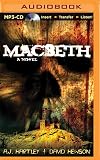
Macbeth
by A. J. Hartley, David Hewson
On This Page
Description
A novelized adaptation of Shakespeare's play follows Macbeth and his wife as they develop a plan to keep Scotland united but find themselves entangled in a web of murder and treachery.Tags
Recommendations





















Member Reviews
Great narration by Alan Cumming on this expanded version of the "Scottish Play"
I completely enjoyed this in any case, but having Alan Cumming narrate it with a Scottish burr kicked it into 5 star territory for me. Some may not see the point of a novel-sized expansion to Shakespeare's "Scottish Play," but I found Hartley's & Hewson's to be both respectful of the original material and inventive in its enhancements.
There is a whole long prelude of the war with Norwegian King Sweno (actually Svein Knutsson in history) before we even get to Act 1 Scene 1 with the witches on the heath. The witches are portrayed as three very different types ranging from young teenager to crone. Lady Macbeth gets her own name at last ("Skena") and is less the show more villainess. King Duncan is more of a hideous depraved lecher who is rather deserving of his fate. The porter (with much fewer jokes) doubles as the lead murderer (which is a nice nod to how the actual Shakespearean actor probably had to double up on roles), Banquo's and Fleance's tie in to the later Stewart kings of Scotland is greatly expanded on. etc. etc. Most of the best lines of the play are quoted in their original context, but the borrowing is kept to a minimum.
It all had me researching the historical basis for the characters, cross-checking against the play, and greatly adding to my enjoyment. A very well done job! show less
I completely enjoyed this in any case, but having Alan Cumming narrate it with a Scottish burr kicked it into 5 star territory for me. Some may not see the point of a novel-sized expansion to Shakespeare's "Scottish Play," but I found Hartley's & Hewson's to be both respectful of the original material and inventive in its enhancements.
There is a whole long prelude of the war with Norwegian King Sweno (actually Svein Knutsson in history) before we even get to Act 1 Scene 1 with the witches on the heath. The witches are portrayed as three very different types ranging from young teenager to crone. Lady Macbeth gets her own name at last ("Skena") and is less the show more villainess. King Duncan is more of a hideous depraved lecher who is rather deserving of his fate. The porter (with much fewer jokes) doubles as the lead murderer (which is a nice nod to how the actual Shakespearean actor probably had to double up on roles), Banquo's and Fleance's tie in to the later Stewart kings of Scotland is greatly expanded on. etc. etc. Most of the best lines of the play are quoted in their original context, but the borrowing is kept to a minimum.
It all had me researching the historical basis for the characters, cross-checking against the play, and greatly adding to my enjoyment. A very well done job! show less
This is Shakespeare's play retold as a well-written blood and thunder historical novel; it has the feel of Bernard Cornwell about it. It's great stuff, full of battles, murder and treachery, of course, but the novel format allows for much greater depth of character, Macbeth emerging as a man of stark contrasts, for much of the novel regarded as humane and too soft by Highland standards. His wife (here called Skena) emerges much more sympathetically than in the play. Duncan is here a dirty old man and his sons feckless. Banquo is a loyal, betrayed companion in arms. The real villain of the piece is the porter, Fergus, who carries out all the murders except that of Duncan himself. The three witches are much more individuals than a trio, show more and there is even a backstory for each of them. The novel is as historically inaccurate as the play, but this is great stuff. 5/5 show less
Not an adaptation of the play, instead Hartley and Hewson have expanded the storyline as a novel, filling in the plot with transitional scenes and offstage scenes as well as altering the language to allow for easier reading than the play. It gives a new perspective on the Macbeths. Hewson's afterword is interesting and informative and explains which parts of the story coincides with Shakespeare's work and with history. It was written exclusively for audio and was brilliantly narrated by [[Alan Cumming]]. An inspired work.
Audible had a sale a little while ago in which ten editors each chose ten books to sell for $4.95. I got the email saying "books from your wishlist are on sale!" but the link didn't take me to any of them, so I ended up clicking through the ten pages to see what was out there. And when I landed on one page that featured Macbeth: A Novel and hailed it as "The Perfect Audiobook", I closed the tab without looking further. If this person thinks that is the perfect audiobook, our tastes are clearly incompatible.
"Inspired by 'The Bard' + written exclusively for audio + Alan Cumming narrating" – yes, these are the reasons it should have been great. How could it go wrong?
In so many ways. In so, so many ways.
You may have heard the saying show more "If it ain't broke, don't fix it"? The Scottish play really was not broken. But, boy did A.J. Hartley and David Hewson feel they needed to "fix" it. By "fix", meaning "reword the language that has endured and flourished for over four hundred years and add superfluous information"… There's got to be a better way to morph a play into a novel.
Take the wyrd sisters' first prophecies:
First Witch: All hail, Macbeth! hail to thee, thane of Glamis!
Second Witch: All hail, Macbeth, hail to thee, thane of Cawdor!
Third Witch: All hail, Macbeth, thou shalt be king hereafter!
They say little more than that, and then are gone, leaving upheaval as if they'd hurled a boulder into a still pond. There's nothing more needed. Yet these authors felt the need to put more in. A bunch more. They broke up the rhythm of Shakespeare's words, and padded the hell out of the scene, and … why? Don't get me wrong – it's a fine, fun idea, the novelization of Shakespeare; obviously, I was intrigued – I bought it. I listened to [part of] it. But it feels like all opportunities are completely missed. There's nothing new here.
The same holds true of Duncan's choice to declare an heir. Especially when the actor in the role fills the bill, the scene in the play is powerful. Throwing more and more words at it just dilutes it. The converse is also true – I realized that a couple of passages from the play actually use more words than these authors, and their editing resulted in a dumbing down.
Shakespeare used verse very specifically. To take a passage he related in verse and hammer it down into the prosiest of prose, without in any other way ramping up the drama of the moment, leaves it toothless.
I've read a handful of adaptations of Jane Austen, swiveled POV's and whatnot, and the main problem most of these pose is that the new writer's writing is placed in direct comparison to Jane's, much to the present–day writer's detriment. It takes a certain amount of skill to handle a retelling or expansion while avoiding the comparison. And if comparison to Jane is hazardous, how bad an idea is it to hold your writing up against … William Shakespeare's? I mean … William bloody Shakespeare.
Example time:
THEIRS: "Sleep tight, Duncan," he thought, "for this is a knell that summons you to heaven … or to hell."
("Sleep tight"? Really?)
HIS: I go, and it is done; the bell invites me.
Hear it not, Duncan; for it is a knell
That summons thee to heaven or to hell.
THEIRS: "Tragic in the present yet glorious in the future…You shall beget kings, though never reign yourself"
HIS: First Witch: Lesser than Macbeth, and greater.
Second Witch: Not so happy, yet much happier.
Third Witch: Thou shalt get kings, though thou be none:
So all hail, Macbeth and Banquo!
THEIRS: "I could have done the deed. I will if need be."
HIS: …Had he not resembled
My father as he slept, I had done't.
Shakespeare did a damn fine job getting the points across: Macbeth adores his wife. These guys seem to think no reader will ever get that without being beaten about the head with it.
So that was the language as compared to the original. If you're going to do a takeoff on Shakespeare, brace yourself for the fact that you will be compared (unfavorably) to Shakespeare. The writing in and of itself is not impressive, even without that contrast.
There's a good and solid reason Shakespeare didn't show Macbeth murdering Duncan. It's not necessary. It has more impact offstage. The same goes for Lady M's followup; the same goes for Malcolm and Donalbain realizing they've been set up; the same goes for … oh, just about every scene added. It's padding. It all serves to emphasize how lean and pared down the play is. The shortest of Shakespeare's plays, it says what it needs to and – no more.
As for the content … They placed a very large order with Captain Obvious, and another with Anachronisms R Us. There may have been four-poster beds in Scotland around the year 1000, but – put it this way: I don't trust the authors, so I automatically doubt anything that seems even slightly off. They mention a "sideshow prop"; according to the etymology website I usually refer to, "sideshow" dates to 1855. Someone tells someone "Don't look so glum": from Middle English gloumen (v.) "become dark" (c.1300).
The authors also received a substantial delivery from the Cliché Closet – "The quiet before the storm" "snatching victory from the jaws of defeat" – and these are not, afaik, sayings Shakespeare came up with. ("Victory" seems to date from the 1800's.) Macbeth: "A man of the people!"
This Duncan is a cross between Shakespeare's vision (who was necessarily saintly, due to James VI) and the historical image – corrupt and selfish and swiving with a veneer of holiness. Oh, look, he just raped a 12-year-old girl. These authors didn't seem to want anyone in the play to be worth the air they breathe. I'm not fond of the idea of not liking Banquo. And I don't like this Banquo. Part of the power of the play is that Banquo, a good and honest man and a dear old friend of Macbeth's, is a sacrifice to the situation. The clarity of it, the straightforwardness of it, is important. And Macduff's wife is a shrew? Wonderful idea. Oh, AND Malcolm and Donalbain are "little liked", and "vicious, striving younger versions of their father". Malcolm is a sadist who tortured Cawdor. So… Maccers is the hero, eh?
The attack on the Vikings right at the beginning, killing them basically in their sleep, sets the stage for Duncan's fate. What's hilarious is that Macbeth is made to say, "I've never murdered a sleeping man before, let alone a king."tugs on Maccers's sleeve Uh, yer thaneship? Vikings? Belladonna? Hellloooo?
What is this with "picking apples straight off the tree", as if it was something unusual and only found in exotic places? Apples grew in Scotland. And what is this with using the little boy Ewen to poison the guards?! That's horrible. The kid is smart – you don't think he's going to put two and two together? "The child was not your fault" – uh, yeah he was. Entirely. "Hey, kid, see this wine? It's the most awesomest wine there ever was! It's wonderful! It's liquid sunshine! It's magical! You can't have any!" Yeah, never saw that coming.
"It was the shriek of a woman, loud and anguished" – way to dilute the impact of the "cries of women" later. Woops, there goes Lady Macbeth, humming a little tune and scrubbing at her hands. Oh please.
Lady M is given a name. So, if Lady Maccers is Skena ("Skena Macbeth" just … no), what's HIS name? Hm? His wife (even in bed) and his best friend, a friend since childhood, call him simply "Macbeth". Hmph.
The girl has a tattoo of three salmon in woad on her front. She also has small, perfect, white teeth like a child's. Know how I know this? I was told. Three times. In great, repetitive detail. From her POV, from Macbeth's, and from Lady M's. Three times in two and a half hours. Too much.
If it was just itself, it might be fine; it's hard to tell. The writing isn't dreadful, just … error–ridden. And so very not Shakespeare. Don’t get me wrong: I wouldn't ever expect Shakespearian quality – just good. There is no added depth provided for any of the characters, no exploration of a setting only sketched in in the play, no new elements which aren't ludicrous, and the writing is mediocre at best. Basically, there's no reason for this book.
I wanted this not only because it's based on the Bard, and I love Macbeth, but also because of Alan Cumming who is awesome. He was a – no, the major selling point for this book, and he was the only reason I made it as far as I did. ("But it's Alan Cumming!") However … Samhain is pronounced "Sam hane" Oh, Alan Cumming. That hurts, man. (For the record, I've always heard that it was correctly "Sowen", though now I find it should perhaps be "Savahn". (I think it depends on where you're at.)) No matter – "Sam Hane" is not correct.
Altogether dreadful. I only wish I'd listened to it in time to return it on Audible. show less
"Inspired by 'The Bard' + written exclusively for audio + Alan Cumming narrating" – yes, these are the reasons it should have been great. How could it go wrong?
In so many ways. In so, so many ways.
You may have heard the saying show more "If it ain't broke, don't fix it"? The Scottish play really was not broken. But, boy did A.J. Hartley and David Hewson feel they needed to "fix" it. By "fix", meaning "reword the language that has endured and flourished for over four hundred years and add superfluous information"… There's got to be a better way to morph a play into a novel.
Take the wyrd sisters' first prophecies:
First Witch: All hail, Macbeth! hail to thee, thane of Glamis!
Second Witch: All hail, Macbeth, hail to thee, thane of Cawdor!
Third Witch: All hail, Macbeth, thou shalt be king hereafter!
They say little more than that, and then are gone, leaving upheaval as if they'd hurled a boulder into a still pond. There's nothing more needed. Yet these authors felt the need to put more in. A bunch more. They broke up the rhythm of Shakespeare's words, and padded the hell out of the scene, and … why? Don't get me wrong – it's a fine, fun idea, the novelization of Shakespeare; obviously, I was intrigued – I bought it. I listened to [part of] it. But it feels like all opportunities are completely missed. There's nothing new here.
The same holds true of Duncan's choice to declare an heir. Especially when the actor in the role fills the bill, the scene in the play is powerful. Throwing more and more words at it just dilutes it. The converse is also true – I realized that a couple of passages from the play actually use more words than these authors, and their editing resulted in a dumbing down.
Shakespeare used verse very specifically. To take a passage he related in verse and hammer it down into the prosiest of prose, without in any other way ramping up the drama of the moment, leaves it toothless.
I've read a handful of adaptations of Jane Austen, swiveled POV's and whatnot, and the main problem most of these pose is that the new writer's writing is placed in direct comparison to Jane's, much to the present–day writer's detriment. It takes a certain amount of skill to handle a retelling or expansion while avoiding the comparison. And if comparison to Jane is hazardous, how bad an idea is it to hold your writing up against … William Shakespeare's? I mean … William bloody Shakespeare.
Example time:
THEIRS: "Sleep tight, Duncan," he thought, "for this is a knell that summons you to heaven … or to hell."
("Sleep tight"? Really?)
HIS: I go, and it is done; the bell invites me.
Hear it not, Duncan; for it is a knell
That summons thee to heaven or to hell.
THEIRS: "Tragic in the present yet glorious in the future…You shall beget kings, though never reign yourself"
HIS: First Witch: Lesser than Macbeth, and greater.
Second Witch: Not so happy, yet much happier.
Third Witch: Thou shalt get kings, though thou be none:
So all hail, Macbeth and Banquo!
THEIRS: "I could have done the deed. I will if need be."
HIS: …Had he not resembled
My father as he slept, I had done't.
Shakespeare did a damn fine job getting the points across: Macbeth adores his wife. These guys seem to think no reader will ever get that without being beaten about the head with it.
So that was the language as compared to the original. If you're going to do a takeoff on Shakespeare, brace yourself for the fact that you will be compared (unfavorably) to Shakespeare. The writing in and of itself is not impressive, even without that contrast.
There's a good and solid reason Shakespeare didn't show Macbeth murdering Duncan. It's not necessary. It has more impact offstage. The same goes for Lady M's followup; the same goes for Malcolm and Donalbain realizing they've been set up; the same goes for … oh, just about every scene added. It's padding. It all serves to emphasize how lean and pared down the play is. The shortest of Shakespeare's plays, it says what it needs to and – no more.
As for the content … They placed a very large order with Captain Obvious, and another with Anachronisms R Us. There may have been four-poster beds in Scotland around the year 1000, but – put it this way: I don't trust the authors, so I automatically doubt anything that seems even slightly off. They mention a "sideshow prop"; according to the etymology website I usually refer to, "sideshow" dates to 1855. Someone tells someone "Don't look so glum": from Middle English gloumen (v.) "become dark" (c.1300).
The authors also received a substantial delivery from the Cliché Closet – "The quiet before the storm" "snatching victory from the jaws of defeat" – and these are not, afaik, sayings Shakespeare came up with. ("Victory" seems to date from the 1800's.) Macbeth: "A man of the people!"
This Duncan is a cross between Shakespeare's vision (who was necessarily saintly, due to James VI) and the historical image – corrupt and selfish and swiving with a veneer of holiness. Oh, look, he just raped a 12-year-old girl. These authors didn't seem to want anyone in the play to be worth the air they breathe. I'm not fond of the idea of not liking Banquo. And I don't like this Banquo. Part of the power of the play is that Banquo, a good and honest man and a dear old friend of Macbeth's, is a sacrifice to the situation. The clarity of it, the straightforwardness of it, is important. And Macduff's wife is a shrew? Wonderful idea. Oh, AND Malcolm and Donalbain are "little liked", and "vicious, striving younger versions of their father". Malcolm is a sadist who tortured Cawdor. So… Maccers is the hero, eh?
The attack on the Vikings right at the beginning, killing them basically in their sleep, sets the stage for Duncan's fate. What's hilarious is that Macbeth is made to say, "I've never murdered a sleeping man before, let alone a king."tugs on Maccers's sleeve Uh, yer thaneship? Vikings? Belladonna? Hellloooo?
What is this with "picking apples straight off the tree", as if it was something unusual and only found in exotic places? Apples grew in Scotland. And what is this with using the little boy Ewen to poison the guards?! That's horrible. The kid is smart – you don't think he's going to put two and two together? "The child was not your fault" – uh, yeah he was. Entirely. "Hey, kid, see this wine? It's the most awesomest wine there ever was! It's wonderful! It's liquid sunshine! It's magical! You can't have any!" Yeah, never saw that coming.
"It was the shriek of a woman, loud and anguished" – way to dilute the impact of the "cries of women" later. Woops, there goes Lady Macbeth, humming a little tune and scrubbing at her hands. Oh please.
Lady M is given a name. So, if Lady Maccers is Skena ("Skena Macbeth" just … no), what's HIS name? Hm? His wife (even in bed) and his best friend, a friend since childhood, call him simply "Macbeth". Hmph.
The girl has a tattoo of three salmon in woad on her front. She also has small, perfect, white teeth like a child's. Know how I know this? I was told. Three times. In great, repetitive detail. From her POV, from Macbeth's, and from Lady M's. Three times in two and a half hours. Too much.
If it was just itself, it might be fine; it's hard to tell. The writing isn't dreadful, just … error–ridden. And so very not Shakespeare. Don’t get me wrong: I wouldn't ever expect Shakespearian quality – just good. There is no added depth provided for any of the characters, no exploration of a setting only sketched in in the play, no new elements which aren't ludicrous, and the writing is mediocre at best. Basically, there's no reason for this book.
I wanted this not only because it's based on the Bard, and I love Macbeth, but also because of Alan Cumming who is awesome. He was a – no, the major selling point for this book, and he was the only reason I made it as far as I did. ("But it's Alan Cumming!") However … Samhain is pronounced "Sam hane" Oh, Alan Cumming. That hurts, man. (For the record, I've always heard that it was correctly "Sowen", though now I find it should perhaps be "Savahn". (I think it depends on where you're at.)) No matter – "Sam Hane" is not correct.
Altogether dreadful. I only wish I'd listened to it in time to return it on Audible. show less
Macbeth is probably my favorite tragedy of Shakespeare's, and I very much enjoyed this novel, which provides greater depth and detail to the tale. It's not just an effort to place the play in novel form - the authors provide a foreword and afterword which explain how they went about taking inspiration from both the play, actual history, and their own imaginations. It's a rich, occasionally overblown, narrative, solidly contextualized in the historical setting of 11th century Scotland.
The audio, as narrated by the great Scottish actor Alan Cumming, is a delight.
4 stars
The audio, as narrated by the great Scottish actor Alan Cumming, is a delight.
4 stars
I LOVE THIS STORY! It gripped me from the start, never let go until the final words of the author in the afterword. Alan Cumming is a wonderful narrator for it, his voice set the mood and his accent was easy to listen to, not difficult to understand. For those of you who languish between the novels of G.R.R.Martin, this would be a terrific filler.
Inspired by the play by Shakespeare, and the history of the 1000s in England, Wales and Scotland, Hartley and Hewson have fleshed out the characters, they made me like the Macbeths, not approve of their deeds, but like them. They also described the times, people and places in vivid details. I'm surprised I enjoyed this so much, considering the blood, filth and darkness of it, but I was show more fascinated and engrossed in the tale. I have always enjoyed the drama of The Scottish Play, but now I have such a wonderful background to put to it. show less
Inspired by the play by Shakespeare, and the history of the 1000s in England, Wales and Scotland, Hartley and Hewson have fleshed out the characters, they made me like the Macbeths, not approve of their deeds, but like them. They also described the times, people and places in vivid details. I'm surprised I enjoyed this so much, considering the blood, filth and darkness of it, but I was show more fascinated and engrossed in the tale. I have always enjoyed the drama of The Scottish Play, but now I have such a wonderful background to put to it. show less
This book surprised me by living up to the challenge of expounding on Shakespeare's tale.
Of course, this is the tradition Shakespeare worked in, where stories belonged to no one, and the point was: Does your telling of the story we all know entertain us or teach us something?
The Macbeth and Lady Macbeth of this novel are brutal, sad, tormented souls, realized in a way a novel does, and not simply novelized. Well done.
Of course, this is the tradition Shakespeare worked in, where stories belonged to no one, and the point was: Does your telling of the story we all know entertain us or teach us something?
The Macbeth and Lady Macbeth of this novel are brutal, sad, tormented souls, realized in a way a novel does, and not simply novelized. Well done.
Members
- Recently Added By
Lists

Books Read in 2016
4,666 works; 199 members
Author Information

41+ Works 1,944 Members
Andrew James Hartley is the Robinson Professor of Shakespeare Studies at the University of North Carolina at Charlotte, USA. He is author of The Shakespeare Dramaturg and a performance history of Julius Caesar, was the editor of the performance journal Shakespeare Bulletin from 2003-13, and is an Associate Artist at Georgia Shakespeare.

Common Knowledge
- Canonical title
- Macbeth
- Original publication date
- 2012-05-22
- People/Characters
- Macbeth
Classifications
Statistics
- Members
- 188
- Popularity
- 174,266
- Reviews
- 21
- Rating
- (3.78)
- Languages
- English
- Media
- Paper, Audiobook, Ebook
- ISBNs
- 7
- UPCs
- 1
- ASINs
- 6