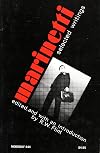
Marinetti: Selected Writings
by Filippo Tommaso Marinetti
On This Page
Tags
Recommendations























Member Reviews
Not for nothing was Marinetti known as the “Caffeine of Europe”. His aim was to snap the intelligenstsia, the politicians, the populace, anyone who would listen to him, out of the past, out of sentimentality, into the future, into electrification, and to do it as fast and as stylishly, as unreflectingly and mercilessly as he inhumanly could do. He acted the role of the prophet, intoxicated with possibility, a vision of society moving at the speed of an electron, splintering the clunkiness of wood and tradition in a wake of soundwaves by wheels and engines and wings. He wanted man to become machine, and to wage and glory in war on his fellow machine, and to exalt in art, poetry, and dance at the same time.
It is a dizzy mixture that show more makes up his selection of his writings here, from art manifestos, allegorical fiction, memoir, invective, to poetry, politics, and proselytizing. We hear a lot about his “invention” of “Words in Freedom”. Here the form fits the content - a sort of high speed multi-sensory thinking out loud on the page that lacks punctuation and blurs ideas together in communicative association (a bit like Finnegan’s Wake, but with a purpose, and ten years earlier). Even when he is not deliberately writing like this, there are hints of it in the fluidity of thought and association of ideas. But this is a book of real contrasts. Sometimes his inspired use of metaphor unwillingly carries the reader along with his death driven dreaming, other times it jars like Nietzsche’s painfully vain autobiography, and he unmasks himself. The tightrope act between the dreaming poet, and the self-important impresario of the future is not one that he quite has the delicacy of balance to maintain in all his writings here, and yet he does it in some of his better ones.
I have read nothing like this collection here before. Marinetti has left a huge cultural impact over the years, in the spheres of art and literature high and low (especially anything modernist), film, technology, and in society at large. And this volume is worth reading for that reason, and because it can still provoke thought, while giving us a view onto the intellectual climate of cultural, technological, and societal change in the early 20th Century. However, it is not without its caveats, and there is a lot of questionable value here too in some of what he says (let’s not forget he was a bit of a Fascist). show less
It is a dizzy mixture that show more makes up his selection of his writings here, from art manifestos, allegorical fiction, memoir, invective, to poetry, politics, and proselytizing. We hear a lot about his “invention” of “Words in Freedom”. Here the form fits the content - a sort of high speed multi-sensory thinking out loud on the page that lacks punctuation and blurs ideas together in communicative association (a bit like Finnegan’s Wake, but with a purpose, and ten years earlier). Even when he is not deliberately writing like this, there are hints of it in the fluidity of thought and association of ideas. But this is a book of real contrasts. Sometimes his inspired use of metaphor unwillingly carries the reader along with his death driven dreaming, other times it jars like Nietzsche’s painfully vain autobiography, and he unmasks himself. The tightrope act between the dreaming poet, and the self-important impresario of the future is not one that he quite has the delicacy of balance to maintain in all his writings here, and yet he does it in some of his better ones.
I have read nothing like this collection here before. Marinetti has left a huge cultural impact over the years, in the spheres of art and literature high and low (especially anything modernist), film, technology, and in society at large. And this volume is worth reading for that reason, and because it can still provoke thought, while giving us a view onto the intellectual climate of cultural, technological, and societal change in the early 20th Century. However, it is not without its caveats, and there is a lot of questionable value here too in some of what he says (let’s not forget he was a bit of a Fascist). show less
Being a choice of the outrageous founder of the Futurist movement in literature. This is a good selection of the short essays he called "Manifestos", his novel The Untamables, and his memoirs. The best of his writing is outstanding and one can see what an influence he was on a lot of 20th century avantist writing. The novel is by far the best portion of the book; it is unique in its abstracted, absurdist plot plot and carefully unstrucyured syntax, yet reminiscent of the French decadent poets of the nineteenth century, the, late Nietzsche of Thus Spake Zarathustra, and the early work of his British contemporaries Yeats and Wyndham Lewis. The manifestos read fairly well, too, but the memoirs are not nearly as interesting or readable; he show more does nothing to make the long-forgotten figures and events he describes come alive, and ending the book with such a dreary slog left an unpleasing aftertaste. show less
Ratings
Members
- Recently Added By
Author Information

95+ Works 710 Members
Born in Egypt and educated in Paris, Marinetti gained a reputation as a writer in French long before he launched the "futurist movement" with his manifesto of February 20, 1909, in Le Figaro. Proclaiming an ideal of "words in liberty," that manifesto elicited high praise from Wyndham Lewis, Guillaume Apollinaire, Ezra Pound, and D. H. Lawrence, as show more well as the Italians Aldo Palazzeschi, Giovanni Papini, and Ardengo Soffici. After his French works were translated into Italian, he was arrested and spent two months in an Italian jail for immorality. Despite the notoriety of his first manifesto, the subsequent Technical Manifesto of 1912 epitomizes the essence of futurism: the glorification of war, masculinity, violence, and the machine. As William De Sua correctly wrote: "Of all his works, the Technical Manifesto alone should secure his place among such figures as Pablo Picasso, Ezra Pound, Igor Stravinsky, and Guillaume Apollinaire as one of the greatest movers and shapers of modern art." (Bowker Author Biography) show less
Common Knowledge
- Canonical title
- Marinetti: Selected Writings
- People/Characters
- Marinetti
- Important places
- Paris, France; Rome, Italy
Classifications
Statistics
- Members
- 52
- Popularity
- 585,838
- Reviews
- 2
- Rating
- (4.40)
- Languages
- English
- Media
- Paper
- ISBNs
- 3