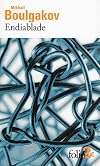
Endiablade ou comment des jumeaux causèrent la mort d'un chef de bureau
by Mikhaïl Boulgakov
On This Page
Tags
Recommendations






















Member Reviews
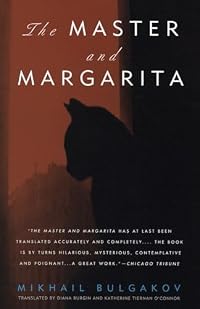
Bulgakov's Diaboliad was written before The master and Margarita, and in some ways reads like a preview of the novel. From the beginning, when the inoffensive, timid Korotkov, employed as a clerk--he hopes "for life"--in the Central Depot for Matches makes one small blunder, to the bitter end, when he jumps to his death and "a sun the colour of blood explodes in his head", surreal events unfold with the increasing frenzy similar to that in the novel, where the Devil and his retinue cause havoc. The devil as such doesn't appear in the Diaboliad, it's the entire web of rules, people and events that entraps and ruins Korotkov, that is devilish. But some avatars of the Devil may be seen in the infernal dwarf twins, perhaps even in Korotkov show more himself, in the brief moment of rebellion near the end, when he's lost his official identity and laughs that nobody can force him to do anything anymore--he doesn't exist. A troublesome cat is there too (Behemoth as kitten?) Bulgakov's comic brio is as vibrant here as in the novel, and there's more than a touch of the theatre of the absurd. (At the start of the story, lack of cash leads to the workers being paid in kind--Korotkov takes home boxes of matches; his neighbour who works in a wine factory brings back dozens of bottles of the Mass wine. They do some desultory trading; the matches mostly don't work, Korotkov gets unsatisfactorily drunk on substandard church booze). show less
Une courte nouvelle fantastique où il utilise déjà ce genre pour dénoncer les dérives du système soviétique (bureaucratie, inefficacité de la production, arbitraire). Un homme face à l’arbitraire, il devient fou, le monde qui l’entoure est encore plus fou. Un avant goût du “maître et marguerite”. Une lecture courte agréable.
Dec 17, 2010French
Ratings
Members
- Recently Added By
Author Information

360+ Works 34,914 Members
Mikhail Afanasevich Bulgakov was a Russian playwright, novelist, and short-story writer best known for his use of humor and satire. He was born in Kiev, Ukraine, on May 15, 1891, and graduated from the Medical School of Kiev University in 1916. He served as a field doctor during World War I. Bulgakov's association with the Moscow Art Theater began show more in 1926 with the production of his play The Days of the Turbins, which was based on his novel The White Guard. His work was popular, but since it ridiculed the Soviet establishment, was frequently censored. His satiric novel The Heart of a Dog was not published openly in the U.S.S.R. until 1987. Bulgakov's plays including Pushkin and Moliere dealt with artistic freedom. His last novel, The Master and Margarita, was not published until 1966-67 and in censored form. Bulgakov died in Moscow on March 10, 1940. (Bowker Author Biography) A practicing physician like Anton Chekhov, Mikhail Afanasevich Bulgakov became a popular writer and playwright in the comparatively easier political climate of the Soviet Union during the 1920s. The civil war and its internecine horrors became one of his major themes as did the new Soviet society. His early prose is often satiric, with strong elements of the fantastic and grotesque, but it also contains the themes of guilt and personal responsibility that become so crucial in his later work. Bulgakov wrote a number of important plays that provoked bitter attacks in the press, and he was shut out of the theater and literature in 1929. Only a direct appeal to Stalin allowed Bulgakov to resume a professional career. Even then, however, some publishing houses and theaters rejected some of his important works, such as the novel Life of Monsieur de Moliere (1933). Bulgakov's masterpiece written over a number of years and only published decades after his death is the novel Master and Margarita (1966-67). Combining two principal plot lines-Satan's visit to contemporary Moscow and the trial and execution of Jesus in biblical Judaea-the work may be read on many levels, from the purely satiric to the allegorical. It has been acclaimed as one of the most important achievements of twentieth-century Russian fiction. Today, Bulgakov is celebrated for both his plays and his novels. Several of his plays are public favorites and standard fare in Russian theaters. Bulgakov died in Moscow on March 10, 1940. (Bowker Author Biography) show less
Series
Belongs to Publisher Series
Work Relationships
Is contained in
Common Knowledge
- Canonical title*
- Diabolade
- Disambiguation notice
- It contains only Diablerie and no other story.
*Some information comes from Common Knowledge in other languages. Click "Edit" for more information.
Classifications
Statistics
- Members
- 62
- Popularity
- 498,079
- Reviews
- 2
- Rating
- (3.89)
- Languages
- 8 — Czech, Dutch, Estonian, French, Greek, Italian, Russian, Swedish
- Media
- Paper
- ISBNs
- 7