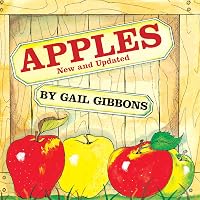
Apples
by Gail Gibbons
On This Page
Description
Explains how apples were brought to America, how they grow, their traditional uses and cultural significance, and some of the varieties grown.Tags
Recommendations







Member Reviews
This book was an in depth look at apples, both their history and their life cycle. There are definitions throughout the book that define difficult vocabulary, such as “pollination”.
The illustrations are very detailed and show each part of the plant. However, the illustrations are not diverse at all. It looks like maybe the illustrator attempted to incorporate diversity in a few places, but I had to bring the book close to my eyes to make sure. All characters in the book are illustrated with rosy cheeks and positive expressions, which was almost humorous.
The book covers a lot of ground, which is interesting. It goes over the apple's life cycle, their place in our culture, their place in our economy, how we get them, etc. The book show more opened the door to many different conversations, which was wonderful. Right away I knew they would enjoy several activities that relate to the book, such as a grocery center, baking an apple pie, using cut apples as stamps, etc. I also liked the added bonus of this book being a great way to discuss community, and how many different people it takes just to simply buy an apple at the store. show less
The illustrations are very detailed and show each part of the plant. However, the illustrations are not diverse at all. It looks like maybe the illustrator attempted to incorporate diversity in a few places, but I had to bring the book close to my eyes to make sure. All characters in the book are illustrated with rosy cheeks and positive expressions, which was almost humorous.
The book covers a lot of ground, which is interesting. It goes over the apple's life cycle, their place in our culture, their place in our economy, how we get them, etc. The book show more opened the door to many different conversations, which was wonderful. Right away I knew they would enjoy several activities that relate to the book, such as a grocery center, baking an apple pie, using cut apples as stamps, etc. I also liked the added bonus of this book being a great way to discuss community, and how many different people it takes just to simply buy an apple at the store. show less
G. Gibbons writes a stunning look into the subject of apples. This informational look at many things apples introduces concepts such as: the first American colonists and Native Americans, Johnny Appleseed, varieties of apples, how to bake an apple pie, parts of an apple, harvest, things one can do with apples, and many more. Some new vocabulary is introduced in this book as well including: the parts of the apple and words such as pollination and dormant. I think this is a stunning book that covers a large subject very well. The illustrations and visuals are charming and hold up to the text perfectly. For ages: 5-8. Source: Pierce County Library system
Great for Kindergarten though 2nd Apple science lessons and labeling, Gibbons explains the history of apples in American, the parts of the apple, color washed beautiful illustrations, minimal text for younger readers
Fantastic informational text on apples. The illustrations are colorful and detailed and the text is written at a level appropriate for young children. Words in the text that may be difficult for students are defined using illustrations. "Apples" describes the process apples go through from seedlings to market and is told with emphasis on the seasons. This would be a great text for explaining about apples, the life cycle, and consumerism.
Apples is a non fiction, information book. It first starts off with the history of the apple and how the pilgrims brought seeds and seedlings from England to North America. The book explains how apple trees grow, gives their dimensions, and how seeds are transported. Gibbons also explains the different parts of the apple in the book. Towards the end of the book, it explains how to plant apple trees, their nutritional value, the many different things apples are used for, and the several varieties of apples. This book is absolutely amazing and can be used for a history or even a science lesson for elementary students. I LOVE this book!!! :)
I loved the book Apples by Gail Gibbons because it goes into great detail about apples. The book begins by explaining what apples are and the history of apples. The book even includes parts of the apple, types of apples, and how pollination works. The author uses amazing illustrations that walk the reader through each step. The book shows pictures of the apple parts with labels. The illustrations show what each type of apple looks like. My favorite part of the book is towards the end. The author shows you how to plant and care for your own apple tree. The pictures show exactly how to plant the tree and care for it. It also shows how to make apple cider and apple pie, something I never knew how to make. The illustrations in many of these show more pages are step by step, showing the reader each detail. This helped me to learn all about apples. The final page in this book goes into more facts and details about apples. One of the facts says, “The states of Washington, New York, Michigan, Pennsylvania and California produce the most apples in the United States” (Gibbons, p. 30). I never knew apples could grow so close to where I live. The big idea of this book is to get the reader to learn more about apples and all the ways in which we use them. show less
This book was a summary of the different types of apples there are, and it went over the history of apples. Apples have been in existence for almost two million years. Colonists, as well as the Indians, brought apples and apple seeds with them from England. In the 1800s, a man named John Chapman traveled across the U.S. planting apple seeds, and he later became known as Johnny Appleseed. I thought this was a good book to teach kindergarten aged kids about apples. Reading this book made me kind of hungry, and want to eat an apple. Teachers use this book in their classrooms as they teach the Johnny Appleseed story. I would have my kids bring apples to class and they could eat them for a snack after recess. I would use this book as a show more Social Studies lesson, since it gave the history of an apple, and where they originated. Good book, and was easy to read! show less
Members
- Recently Added By
Author Information

167+ Works 57,932 Members
Gail Gibbons was born in 1944 in Oak Park, Illinois. She received a degree in graphic design from the University of Illinois. She got a job doing artwork for television shows in New York City. She was eventually offered a job creating art for a children's show, where some of the children asked her if she had ever considered doing a children's show more books. Her first book, Willy and His Wheel Wagon, was published in 1975. Since then she has written and illustrated more than 170 non-fiction books for children including Nature's Green Umbrella: Tropical Rain Forests. (Bowker Author Biography) show less
Common Knowledge
- People/Characters
- Johnny Appleseed (John Chapman)
Classifications
Statistics
- Members
- 1,622
- Popularity
- 13,892
- Reviews
- 49
- Rating
- (4.06)
- Languages
- English
- Media
- Paper, Audiobook, Ebook
- ISBNs
- 21
- ASINs
- 3