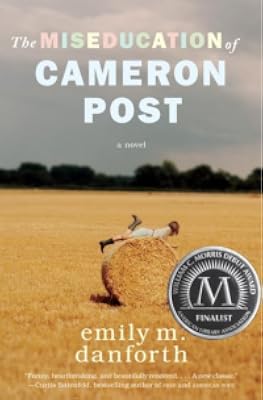
The Miseducation of Cameron Post
by Emily M. Danforth
On This Page
Description
In the early 1990s, when gay teenager Cameron Post rebels against her conservative Montana ranch town and her family decides she needs to change her ways, she is sent to a gay conversion therapy center.Tags
Recommendations






Member Reviews
The Miseducation of Cameron Post is written with beautiful, evocative language that really makes the summers (and a couple Christmases) in Montana feel present, and the nostalgic memories of the early 1990s suddenly vivid.
I avoided reading it for years because I prefer alternate universe stories where homophobia doesn't exist or is minimal, rather than this kind of "problem" story. I'm also uncomfortable reading about the heavy use of drugs and alcohol. I knew about the homophobic content but had no idea about the extent of pot use when I picked up the book.
To be honest, I was deeply immersed in the story and enjoyed the writing style a lot, but also I probably shouldn't have read it at all. danforth says she was inspired to write the show more story after learning about conversion therapy, and the second half of the book is about Cam's experiences at such an institution for young people. It was frustrating for me to read about this fictional place which is honestly a lot more mild than anything I've ever heard of or experienced, but also it brought back a lot of the ugly stuff I experienced as a young queer person without really addressing any of it.
It felt to me that danforth did a lot of research but maybe didn't really understand the situation or wanted to have a light touch, so she keeps the whole episode in soft focus with only a little bit of direct commentary on how harmful and abusive these religious practices can be for queer kids, especially the conversion therapy. Also, too, Cam as the narrator is ambivalent at best about religion and isn't sure if she really believes any of it, which seems to keep her from engaging too much - but she does allude occasionally to how she feels like the place and fake therapy is getting to her and messing with her head despite herself, without really saying how. I would have really liked more clarity and statements about that, because as it was, I was really distressed to have all the stuff I worked out in therapy being brought back up without much comment or analysis. It was just there, mostly accepted because Cam didn't notice or understand, and my immersion in Cam's narrative made it too immediate to me.
But anyway, I did love the first half of the book. Cam is telling the story from a future date and acknowledges here and there where she misunderstood things or re-orders events, which isn't very common in first-person novels, and I enjoyed it a lot. The first half is about Cam entering adolescence and all of the identity-exploration and growing up that involves, and also realizing that she likes girls around the same time that her parents die unexpectedly. She lives in a small, conservative town, and it's 1989, so she doesn't take it very well, but also can't change who she is. Her grief and guilt guide her actions as she grows older, and I thought danforth did a lovely job showing this. The chapters are roughly grouped by years, but Cam's growth (coming of age) is also marked by changes in her friendships and her interests in movies, swimming, or a part-time job. The narrative is wonderful at showing without actually saying what is going on with Cam and how she feels - because, of course, even in an extended flashback, a first-person narrative doesn't always connect dots or see the importance in things that an outsider, the reader, might.
Most of the novel takes place in the summers, which is probably symbolic somehow, but I'm not in school anymore so I'm not going to put too much effort into figuring out the fine details, only that the summers are when Cam explores her identity most and has a certain freedom to her days - it's during the school year, in winter, when she buttons up and endures everyone else trying to direct her. She has a few bad traits like a lot of teens, which give her character some life even as it felt frustrating to read as wheel-spinning or the opposite of growth, and which probably also have symbolic importance: the pot smoking, but also she has a habit of stealing little things and always avoiding serious topics.
So it's a good book - funny and touching and lovely as appropriate - but for me, the first half is stronger than the second. I feel like the conversion therapy section loses a lot of the life of the first part and the not-quite-right feeling I had about the details is unfortunate. I'm also not a fan of how it dredged up old emotions and anxieties without providing a really good narrative catharsis. While there is one, it's more about Cam's grief and dealing with her parents' death than it is about the conversion therapy.
I can see why this book won awards and got noticed, especially with the state of queer books the way it was in 2012, but I would be careful who I recommended this to. People who weren't raised religious or don't have the anti-queer religious background may be okay with it, but folks like me who got the lessons about being unnatural, or innately sinful (whether these were deliberate instruction or passively learned), and who struggle with it still might want to take a breather or have someone to talk to while reading. I really wish I had better trigger/content warnings in advance, but I don't really know what they could have been. show less
I avoided reading it for years because I prefer alternate universe stories where homophobia doesn't exist or is minimal, rather than this kind of "problem" story. I'm also uncomfortable reading about the heavy use of drugs and alcohol. I knew about the homophobic content but had no idea about the extent of pot use when I picked up the book.
To be honest, I was deeply immersed in the story and enjoyed the writing style a lot, but also I probably shouldn't have read it at all. danforth says she was inspired to write the show more story after learning about conversion therapy, and the second half of the book is about Cam's experiences at such an institution for young people. It was frustrating for me to read about this fictional place which is honestly a lot more mild than anything I've ever heard of or experienced, but also it brought back a lot of the ugly stuff I experienced as a young queer person without really addressing any of it.
It felt to me that danforth did a lot of research but maybe didn't really understand the situation or wanted to have a light touch, so she keeps the whole episode in soft focus with only a little bit of direct commentary on how harmful and abusive these religious practices can be for queer kids, especially the conversion therapy. Also, too, Cam as the narrator is ambivalent at best about religion and isn't sure if she really believes any of it, which seems to keep her from engaging too much - but she does allude occasionally to how she feels like the place and fake therapy is getting to her and messing with her head despite herself, without really saying how. I would have really liked more clarity and statements about that, because as it was, I was really distressed to have all the stuff I worked out in therapy being brought back up without much comment or analysis. It was just there, mostly accepted because Cam didn't notice or understand, and my immersion in Cam's narrative made it too immediate to me.
But anyway, I did love the first half of the book. Cam is telling the story from a future date and acknowledges here and there where she misunderstood things or re-orders events, which isn't very common in first-person novels, and I enjoyed it a lot. The first half is about Cam entering adolescence and all of the identity-exploration and growing up that involves, and also realizing that she likes girls around the same time that her parents die unexpectedly. She lives in a small, conservative town, and it's 1989, so she doesn't take it very well, but also can't change who she is. Her grief and guilt guide her actions as she grows older, and I thought danforth did a lovely job showing this. The chapters are roughly grouped by years, but Cam's growth (coming of age) is also marked by changes in her friendships and her interests in movies, swimming, or a part-time job. The narrative is wonderful at showing without actually saying what is going on with Cam and how she feels - because, of course, even in an extended flashback, a first-person narrative doesn't always connect dots or see the importance in things that an outsider, the reader, might.
Most of the novel takes place in the summers, which is probably symbolic somehow, but I'm not in school anymore so I'm not going to put too much effort into figuring out the fine details, only that the summers are when Cam explores her identity most and has a certain freedom to her days - it's during the school year, in winter, when she buttons up and endures everyone else trying to direct her. She has a few bad traits like a lot of teens, which give her character some life even as it felt frustrating to read as wheel-spinning or the opposite of growth, and which probably also have symbolic importance: the pot smoking, but also she has a habit of stealing little things and always avoiding serious topics.
So it's a good book - funny and touching and lovely as appropriate - but for me, the first half is stronger than the second. I feel like the conversion therapy section loses a lot of the life of the first part and the not-quite-right feeling I had about the details is unfortunate. I'm also not a fan of how it dredged up old emotions and anxieties without providing a really good narrative catharsis. While there is one, it's more about Cam's grief and dealing with her parents' death than it is about the conversion therapy.
I can see why this book won awards and got noticed, especially with the state of queer books the way it was in 2012, but I would be careful who I recommended this to. People who weren't raised religious or don't have the anti-queer religious background may be okay with it, but folks like me who got the lessons about being unnatural, or innately sinful (whether these were deliberate instruction or passively learned), and who struggle with it still might want to take a breather or have someone to talk to while reading. I really wish I had better trigger/content warnings in advance, but I don't really know what they could have been. show less
A lesbian coming-of-age story set in Montana in the early 90s. Cameron Post first kisses a girl the day before her parents die suddenly in a car crash, after which she's left in the custody of her deeply religious aunt, who becomes desperate to help "fix" her after her complicated relationship with another teenage girl becomes public.
It's well-written in quiet, gentle, and yet effective way, and does an excellent job of capturing the feeling of what it's like to be an adolescent. And there's an incredible, almost tragic poignancy to the way in which so many of the people in Cameron's life are genuinely loving and well-meaning, even as the "help" they try to give her is anything but.
I'm not 100% sure how I feel about the ending and the show more questions it leaves unanswered about what happens next, but I am nevertheless a little surprised by just how much I liked this one, given that novels about teenagers can be kind of hit-or-miss for me. show less
It's well-written in quiet, gentle, and yet effective way, and does an excellent job of capturing the feeling of what it's like to be an adolescent. And there's an incredible, almost tragic poignancy to the way in which so many of the people in Cameron's life are genuinely loving and well-meaning, even as the "help" they try to give her is anything but.
I'm not 100% sure how I feel about the ending and the show more questions it leaves unanswered about what happens next, but I am nevertheless a little surprised by just how much I liked this one, given that novels about teenagers can be kind of hit-or-miss for me. show less
I... am not 1000% sure of what to say about this book. I finished it about twelve seconds ago and I'm... angry I think. Just a little. And incredibly glad I read it. And angry that it didn't exist for me to read when I was fifteen. Because had there been more stories about lesbians available to me, I might have realized what was going on in my own head a lot earlier than sort of nineteen, more like twenty-two. The whole reason I bought this book was because I read about it being banned by a bunch of ignorant homophobic parents. They claimed it wasn't due to all of the gay, gay content their precious teenagers would be reading but because of the instructions for how to perform lesbian oral sex. I read the parents letter. Then I show more immediately laughed out loud for about five minutes and then went to buy the book on amazon.
(Just in case you were hoping for some instructions for performing oral on a lady, there aren't any. I was, frankly just a little disappointed:)
There ARE sex scenes and drug use (pretty minor, some pot) in the novel. And, I can see where a parent might not want their child reading about it, but I think they would be wrong. There is nothing overly graphic, nothing that I wouldn't feel comfortable handing off to a child if I had one. I think we are far too prudish when it comes to sex, and if teenagers had this novel, or were talked to about sex without making it seem dirty, then everyone would have a lot less problems. Definitely gay teenagers. Kids should be able to talk about this stuff.
In truth this is a novel every teenager should read. Lesbian, straight, boy, girl, or neither. It's a novel about a girl finding herself and growing up.
It's worth it for the writing and the narration voice of Cameron alone. God. I will pick up whatever else this author churns out. Pretty much no questions asked.
There are parts that were hard for me to read, just because they hit a little close to home and it pisses me off that there are people alive that still think places like the school Cameron is sent to should exist. That they are in fact doing good and helping people. It just... it makes me furious. This book made me furious. It made me cry. It made me laugh. And it stuck somewhere in my gut that I doubt will be going away anytime soon.
Everyone fucking read it. show less
(Just in case you were hoping for some instructions for performing oral on a lady, there aren't any. I was, frankly just a little disappointed:)
There ARE sex scenes and drug use (pretty minor, some pot) in the novel. And, I can see where a parent might not want their child reading about it, but I think they would be wrong. There is nothing overly graphic, nothing that I wouldn't feel comfortable handing off to a child if I had one. I think we are far too prudish when it comes to sex, and if teenagers had this novel, or were talked to about sex without making it seem dirty, then everyone would have a lot less problems. Definitely gay teenagers. Kids should be able to talk about this stuff.
In truth this is a novel every teenager should read. Lesbian, straight, boy, girl, or neither. It's a novel about a girl finding herself and growing up.
It's worth it for the writing and the narration voice of Cameron alone. God. I will pick up whatever else this author churns out. Pretty much no questions asked.
There are parts that were hard for me to read, just because they hit a little close to home and it pisses me off that there are people alive that still think places like the school Cameron is sent to should exist. That they are in fact doing good and helping people. It just... it makes me furious. This book made me furious. It made me cry. It made me laugh. And it stuck somewhere in my gut that I doubt will be going away anytime soon.
Everyone fucking read it. show less
"I told myself that I didn’t believe any of that shit, but there it was, repeated to me day after day after day. And when you’re surrounded by a bunch of mostly strangers experiencing the same thing, unable to call home, tethered to routine on ranchland miles away from anybody who might have known you before, might have been able to recognize the real you if you told them you couldn’t remember who she was, it’s not really like being real at all. It’s plastic living. It’s living in a diorama. It’s living the life of one of those prehistoric insects encased in amber: suspended, frozen, dead but not, you don’t know for sure."
I really liked this book, and writing up this review I had to amend my original rating - as is the show more sign of any good book that makes you think.
The Miseducation of Cameron Post was advertised as a YA novel, and maybe it is one, but I did not read it as such. Cameron is in her early teens when the story begins in 1989. What struck me from the outset of the story is how sensitive the narration was to the time it is set in. There are a lot of references to music and tv programmes of the time but they are not used to club you over the head and make you feel the time period. In fact, when we get to know Cameron and her family, the book very much made me anticipate what their day to day routines would have looked like before the narration tells us about it.
I guess the story resonated with me in that way because the fictional Cameron in 1989 is only a couple of years older than me. Like Cameron, I spent my afternoons roaming around with friends whilst my grandparents watched Perry Mason and Matlock. Anyway, this is probably where the similarities end, but to me it illustrates that The Miseducation of Cameron Post is not strictly a YA novel, but also one written for a generation of parents who may have had difficulties to deal with Cameron's generation, and my generation, growing up at that time. I will come back to this point a little later.
It's difficult to discuss the book without giving away much of the story, so if you don't want to read spoilers - stop here.
Cameron is gay and much of the first half of the book deals with the story of a teenager who comes to terms with her sexuality. It also deals with the story of a teenager who has lost her parents and has to come to terms with loss and grief.
As a movie fan Cameron seeks a lot of comfort in films and music.
"But if renting all those movies had taught me anything more than how to lose myself in them, it was that you only actually have perfectly profound little moments like that in real life if you recognize them yourself, do all the fancy shot work and editing in your head, usually in the very seconds that whatever is happening is happening. And even if you do manage to do so, just about never does anyone else you’re with at the time experience that exact same kind of moment, and it’s impossible to explain it as it’s happening , and then the moment is over."
Cameron is a great character. She's snarky, funny, tough, subtle, smart, gentle, and very aware of her surroundings. Cameron is also unafraid to be true to herself and even she falls in love.
"I tried to turn off my lamp and sleep, on top of the covers, my shirt and hair wet, the fan on, the phone lying on the bed next to me, but it was still early and I wasn’t tired. I played one of the new mixes from Lindsey, a bunch of bands and singers I’d not yet heard of, but it felt like too much work to try to really listen to new songs sung by new voices, too much thinking, somehow, so I changed to Tom Petty and felt sorry for myself and then mad at myself for feeling like that and then sorry for myself again."
Of course, her family and community are not comfortable with Cameron's sexuality and when she is found out, her family sends her to God's Promise, a religious institution that specialises in reforming homosexual teenagers.
The second half of the book describes her life at the "reform school", the friends she makes, the hypocrisy of an institution that seems to have fewer objections to recreational drug use than to human nature.
Although God's Promise, the reform school, is not physically mistreating the "disciples" the book clearly describes the incompetence of the staff and the absurdity and incoherence of a religious argument against homosexuality - but the "disciples", having being abandoned by their families and homeless, are powerless.
"I could hear Lindsey in my head telling me to say Really? Well, if homosexuality is just like the sin of murder, then who dies, exactly, when homosexuals get together to sin? But Lindsey wasn’t sitting there with the two of them. And Lindsey wasn’t exiled to Promise for at least a year. So I kept the Lindsey part of me quiet."
Even when events reach their crisis point, Cameron and her friends are left to their own devices. So they make a choice.
"And there was a whole world beyond that shoreline, beyond the forest, beyond the knuckle mountains, beyond, beyond, beyond, not beneath the surface at all, but beyond and waiting."
At first the ending seems like a cop out, like the easy solution to the books problem of the three teenagers escaping from the confines of God's Promise, but then it made me think, too, because one has to think what would become of them. Would they find shelter somewhere? Would they stay together and find a way to start their lives? Or would they be swallowed up like many runaways?
You see this is where I had a change of mind about who the book was written for. Because reading the ending from the perspective of a YA, the ending might seem filled with hope. However, reading as someone who's witnessed friends in similar circumstances at that time or maybe as a parent would, I cannot help but wonder what became of the three, and I cannot help but be concerned for them.
After all, it was not just Tom Petty's Into the Great Wide Open that acts as a soundtrack to the book but I was also reminded of another song that was reflected some of the issues of the time - Runaway Train.
I really liked this book, and writing up this review I had to amend my original rating - as is the show more sign of any good book that makes you think.
The Miseducation of Cameron Post was advertised as a YA novel, and maybe it is one, but I did not read it as such. Cameron is in her early teens when the story begins in 1989. What struck me from the outset of the story is how sensitive the narration was to the time it is set in. There are a lot of references to music and tv programmes of the time but they are not used to club you over the head and make you feel the time period. In fact, when we get to know Cameron and her family, the book very much made me anticipate what their day to day routines would have looked like before the narration tells us about it.
I guess the story resonated with me in that way because the fictional Cameron in 1989 is only a couple of years older than me. Like Cameron, I spent my afternoons roaming around with friends whilst my grandparents watched Perry Mason and Matlock. Anyway, this is probably where the similarities end, but to me it illustrates that The Miseducation of Cameron Post is not strictly a YA novel, but also one written for a generation of parents who may have had difficulties to deal with Cameron's generation, and my generation, growing up at that time. I will come back to this point a little later.
It's difficult to discuss the book without giving away much of the story, so if you don't want to read spoilers - stop here.
Cameron is gay and much of the first half of the book deals with the story of a teenager who comes to terms with her sexuality. It also deals with the story of a teenager who has lost her parents and has to come to terms with loss and grief.
As a movie fan Cameron seeks a lot of comfort in films and music.
"But if renting all those movies had taught me anything more than how to lose myself in them, it was that you only actually have perfectly profound little moments like that in real life if you recognize them yourself, do all the fancy shot work and editing in your head, usually in the very seconds that whatever is happening is happening. And even if you do manage to do so, just about never does anyone else you’re with at the time experience that exact same kind of moment, and it’s impossible to explain it as it’s happening , and then the moment is over."
Cameron is a great character. She's snarky, funny, tough, subtle, smart, gentle, and very aware of her surroundings. Cameron is also unafraid to be true to herself and even she falls in love.
"I tried to turn off my lamp and sleep, on top of the covers, my shirt and hair wet, the fan on, the phone lying on the bed next to me, but it was still early and I wasn’t tired. I played one of the new mixes from Lindsey, a bunch of bands and singers I’d not yet heard of, but it felt like too much work to try to really listen to new songs sung by new voices, too much thinking, somehow, so I changed to Tom Petty and felt sorry for myself and then mad at myself for feeling like that and then sorry for myself again."
Of course, her family and community are not comfortable with Cameron's sexuality and when she is found out, her family sends her to God's Promise, a religious institution that specialises in reforming homosexual teenagers.
The second half of the book describes her life at the "reform school", the friends she makes, the hypocrisy of an institution that seems to have fewer objections to recreational drug use than to human nature.
Although God's Promise, the reform school, is not physically mistreating the "disciples" the book clearly describes the incompetence of the staff and the absurdity and incoherence of a religious argument against homosexuality - but the "disciples", having being abandoned by their families and homeless, are powerless.
"I could hear Lindsey in my head telling me to say Really? Well, if homosexuality is just like the sin of murder, then who dies, exactly, when homosexuals get together to sin? But Lindsey wasn’t sitting there with the two of them. And Lindsey wasn’t exiled to Promise for at least a year. So I kept the Lindsey part of me quiet."
Even when events reach their crisis point, Cameron and her friends are left to their own devices. So they make a choice.
"And there was a whole world beyond that shoreline, beyond the forest, beyond the knuckle mountains, beyond, beyond, beyond, not beneath the surface at all, but beyond and waiting."
At first the ending seems like a cop out, like the easy solution to the books problem of the three teenagers escaping from the confines of God's Promise, but then it made me think, too, because one has to think what would become of them. Would they find shelter somewhere? Would they stay together and find a way to start their lives? Or would they be swallowed up like many runaways?
You see this is where I had a change of mind about who the book was written for. Because reading the ending from the perspective of a YA, the ending might seem filled with hope. However, reading as someone who's witnessed friends in similar circumstances at that time or maybe as a parent would, I cannot help but wonder what became of the three, and I cannot help but be concerned for them.
After all, it was not just Tom Petty's Into the Great Wide Open that acts as a soundtrack to the book but I was also reminded of another song that was reflected some of the issues of the time - Runaway Train.
The author brought Montana's summers and small-town, late 80s vibe to life.
I found the pacing in the first half of the novel considerably slower than the second half -- the first half being Cameron's childhood running amok with her friends in abandoned hospitals, through store aisles, and with the various girls and women she's met; the second half being her time with the conversion camp.
Still, I really enjoyed living in her world for a while. I've highlighted so many passages that I love, not just the gorgeous descriptions of the passing seasons, but the ones about Cameron with her grandmother and her friends too.
The characters' relationships with each other -- messy and sometimes fleeting and sometimes inspiringly strong -- were the show more most memorable parts of the book for me. I think it's because the author depicts all her characters fairly, like people. It shows in how Cameron always finds something sympathetic in others, and eventually in herself. She doesn't always find them likeable or forgivable, but she exudes a lot of love for people regardless, as well as a lot of hope for her own future.
This is a bit of a long quote, but it's one of my favorites:
Ahh what a hopeful book. show less
I found the pacing in the first half of the novel considerably slower than the second half -- the first half being Cameron's childhood running amok with her friends in abandoned hospitals, through store aisles, and with the various girls and women she's met; the second half being her time with the conversion camp.
Still, I really enjoyed living in her world for a while. I've highlighted so many passages that I love, not just the gorgeous descriptions of the passing seasons, but the ones about Cameron with her grandmother and her friends too.
The characters' relationships with each other -- messy and sometimes fleeting and sometimes inspiringly strong -- were the show more most memorable parts of the book for me. I think it's because the author depicts all her characters fairly, like people. It shows in how Cameron always finds something sympathetic in others, and eventually in herself. She doesn't always find them likeable or forgivable, but she exudes a lot of love for people regardless, as well as a lot of hope for her own future.
This is a bit of a long quote, but it's one of my favorites:
I walked down the steps and all the way out into the center of the backyard, the dead lawn coated with just enough snow and ice for my footsteps to crunch, like over a thick layer of cornflakes. I looked up. That prairie wind had torn loose a whole string of Christmas lights from along the roofline and then had caught the string in its gust, was holding it aloft for moments at a time and then letting it dip, sometimes far enough to crash against the roof, before shooting it skyward again. It calmed me down to see that this was what was making the noise, it relieved me, all at once, made me a kind of giddy. And it was beautiful too, this lighted string thrashing against the dark night.
“What is it, Spunky?” Grandma called from the doorway.
“It’s lights,” I yelled.
“What is it?” she yelled back.
“Come see,” I yelled.
She did. She hurried out with an afghan draped around her, her big slippers on. She stood next to me, looked up, smiled. “Look at that,” she said, her words coming out in steamy puffs. “They’re still all lit up.”
“I know,” I said. “It’s neat.”
“It is neat,” she said. “That’s one way to put it.”
I put my arm around her. She put her arm around me. From out there in the backyard, in the ice wind, for as long as we could stand to, we watched that string of lights dip and soar and crash and rise again.
Ahh what a hopeful book. show less
This is a beautifully written novel about a girl who loses her parents and is raised by a well-meaning, but prejudiced aunt who is a member of a right-wing Christian mega-church. We first meet Cameron Post when she's twelve years old on the day her parents die in an accident. It's also the first day she kisses a girl. The story follows her through her teen years, set against the backdrop of rural Montana in the early 1990s.
Cameron is not exactly a lovable character. After her parents' death she clamps her emotions down, becomes obsessed with watching movies on VHS, develops a bit of a drug and alcohol problem, and enters a series of questionable relationships. But she is a gifted athlete and a good student, so it seems like she's going show more to make it to college without getting caught committing the "sin" of homosexual behavior. Now, would this be a good story if she skated through? Yeah, I don't think so.
The heart of this novel is the time Cameron spends at a private Christian "rehabilitation" school for gay teenagers. Honestly, who thought putting a bunch of gay teenagers together would discourage them from being who they are? It's at the school that Cameron develops deeper friendships and decides to take control of her life, and really face what happened to her parents. Discussing the effect the school has on Cameron would be a great way to explain irony.
If YA weren't so hot right now, I'm sure this would've been considered an adult novel and not a teen one. What makes a book "teen" as opposed to "literary fiction about being a teenager"? While I was reading TMOCP, I kept thinking of the book [b:Prep|9844|Prep|Curtis Sittenfeld|http://d.gr-assets.com/books/1320501476s/9844.jpg|2317177] by Curtis Sittenfeld. If Prep were published this year, would it be considered YA? show less
Cameron is not exactly a lovable character. After her parents' death she clamps her emotions down, becomes obsessed with watching movies on VHS, develops a bit of a drug and alcohol problem, and enters a series of questionable relationships. But she is a gifted athlete and a good student, so it seems like she's going show more to make it to college without getting caught committing the "sin" of homosexual behavior. Now, would this be a good story if she skated through? Yeah, I don't think so.
The heart of this novel is the time Cameron spends at a private Christian "rehabilitation" school for gay teenagers. Honestly, who thought putting a bunch of gay teenagers together would discourage them from being who they are? It's at the school that Cameron develops deeper friendships and decides to take control of her life, and really face what happened to her parents. Discussing the effect the school has on Cameron would be a great way to explain irony.
If YA weren't so hot right now, I'm sure this would've been considered an adult novel and not a teen one. What makes a book "teen" as opposed to "literary fiction about being a teenager"? While I was reading TMOCP, I kept thinking of the book [b:Prep|9844|Prep|Curtis Sittenfeld|http://d.gr-assets.com/books/1320501476s/9844.jpg|2317177] by Curtis Sittenfeld. If Prep were published this year, would it be considered YA? show less
Un-put-downable!
Cameron Post was twelve years old when she first kissed a girl. Her best friend Irene Klauson, in the Klausons' hayloft, one hot, sweltering June afternoon before the start of seventh grade.
The very next day, Cam's parents died. En route to the annual camping trip, their car jumped a guardrail at Quake Lake - where Joanie Wynton (now Joanie Post) and her family had escaped death by earthquake and flood decades earlier.
So begins The Miseducation of Cameron Post: The afternoon my parents died, I was out shoplifting with Irene Klauson.
The year is 1989, long before most Americans had heard of gay marriage, at a time when voters were repealing gay rights legislation not just in middle America, but on the West Coast as well. show more Growing up in the conservative, church-going small town of Miles City, Montana, Cameron doesn't know what to make of her budding feelings for her best friend - and for the girls who will follow: Lindsey, Cam's main competition during the summer swim meets; Coley, her impossibly gorgeous high school classmate and fellow church member; and Mona, an experienced college-aged lifeguard/Coley rebound.
Cam's upbringing falls to two extended family members: Grandma Post, a regular visitor at the Post house; and Joanie's sister Ruth, a born-again Christian who's practically a stranger to the newly orphaned girl. While the Posts were semi-practicing Christians (church on holidays, mostly), Ruth makes attendance at an evangelical mega-church mandatory, with participation in the youth group Firepower close behind. Here Cam is treated to weekly lectures on the sin of sexual perversion, homosexuality chief among them.
When Cam is finally outed, Ruth sends her to Pastor Rick's new school for troubled teens, God's Promise Christian Discipleship Program. Spoiler alert: it's not too far from Quake Lake, providing ample opportunity for the story to come full circle. (Cam initially blames her own "deviant" behavior for her parents' deaths: the accident was God's way of punishing her. In time - and, ironically, with a little help from God's Promise cold-as-ice psychologist Lydia - Cam chooses to believe otherwise.)
The Miseducation of Cameron Post is a stunning debut from emily m. danforth. Cameron, Irene, Coley, Jamie, Lindsey, Mona - these are some of the most authentic fictional teenagers I've ever had the pleasure of meeting. One part repudiation of ex-gay "therapy," three parts coming of age story, Cameron's tale is painfully relatable. While The Miseducation of Cameron Post is most likely to strike a chord with gay and lesbian teens grappling with their sexuality and society's reaction to it, it's not just for LGBTQ teens. Or teens, period. From Cam's mechanical attempts to make it work with best bud Jamie, to her kleptomaniacal shoplifting habit and penchant for breaking into creepy abandoned buildings, there's a little bit of Cam in all of us: awkward, unsure, hostile, sarcastic, rebellious, easily embarrassed, occasionally betrayed by our own adolescent bodies.
While Cam's journey is mostly removed from politics - she's less concerned with labels than being true to who she is - we do get a more radical element in the form of Lindsey, a Seattle native who serves as Cam's lesbian mentor and lifeline to lesbian culture outside of Montana. There's also Mona the lifeguard, who reminds Cam that the world is bigger than Miles City, and fellow God's Promise disciples/potheads Jane Fonda and Adam Red Eagle. Adam further blurs the boundaries between "gay" and "straight"; a Winkte, he describes himself as a pre or third gender that's both male and female. Not gay, not transgender, just different. While at God's Promise, Adam and Cam engage in makeout sessions which Cam compares to those shared with Lindsey - fun but not emotionally serious - thus further illustrating the complex nature of human sexuality.
The era (late '80s/early '90s) and setting (small town Montana) loom large in The Miseducation of Cameron Post; so much so that both are major characters unto themselves. As a native New Yorker, I didn't connect so much with the latter; but having been born just a year after Cam, the constant stream of '90s references (Rented VHS tapes! Snail mail! Mix tapes!) stirred up a whole well of buried memories - not all of them bad. Cam's mundane, day-to-day experiences serve as a reminder of what life was like pre-Internet: before Netflix, before instant messaging, before email. Back when care packages took weeks to arrive at their destination, renting movies meant checking them out in person, and research entailed asking a living, breathing librarian for assistance. (Now imagine doing that as a closeted kid in a small town, where everyone knows your name and gossip spreads like wildfire.)
There's so, so much more to love about this story, but I'll leave you to discover it on your own.
The Miseducation of Cameron Post is rather hefty at 480 pages - not that that's a bad thing! I savored every word, and felt that the story ended exactly when it needed to (although I can't deny that I almost want to know what comes next for Cameron Post). It's a lengthy read, but one that's never boring or slow-going. This one's going in my reread pile, for sure.
http://www.easyvegan.info/2014/07/28/the-miseducation-of-cameron-post-by-emily-m... show less
Cameron Post was twelve years old when she first kissed a girl. Her best friend Irene Klauson, in the Klausons' hayloft, one hot, sweltering June afternoon before the start of seventh grade.
The very next day, Cam's parents died. En route to the annual camping trip, their car jumped a guardrail at Quake Lake - where Joanie Wynton (now Joanie Post) and her family had escaped death by earthquake and flood decades earlier.
So begins The Miseducation of Cameron Post: The afternoon my parents died, I was out shoplifting with Irene Klauson.
The year is 1989, long before most Americans had heard of gay marriage, at a time when voters were repealing gay rights legislation not just in middle America, but on the West Coast as well. show more Growing up in the conservative, church-going small town of Miles City, Montana, Cameron doesn't know what to make of her budding feelings for her best friend - and for the girls who will follow: Lindsey, Cam's main competition during the summer swim meets; Coley, her impossibly gorgeous high school classmate and fellow church member; and Mona, an experienced college-aged lifeguard/Coley rebound.
Cam's upbringing falls to two extended family members: Grandma Post, a regular visitor at the Post house; and Joanie's sister Ruth, a born-again Christian who's practically a stranger to the newly orphaned girl. While the Posts were semi-practicing Christians (church on holidays, mostly), Ruth makes attendance at an evangelical mega-church mandatory, with participation in the youth group Firepower close behind. Here Cam is treated to weekly lectures on the sin of sexual perversion, homosexuality chief among them.
When Cam is finally outed, Ruth sends her to Pastor Rick's new school for troubled teens, God's Promise Christian Discipleship Program. Spoiler alert: it's not too far from Quake Lake, providing ample opportunity for the story to come full circle. (Cam initially blames her own "deviant" behavior for her parents' deaths: the accident was God's way of punishing her. In time - and, ironically, with a little help from God's Promise cold-as-ice psychologist Lydia - Cam chooses to believe otherwise.)
The Miseducation of Cameron Post is a stunning debut from emily m. danforth. Cameron, Irene, Coley, Jamie, Lindsey, Mona - these are some of the most authentic fictional teenagers I've ever had the pleasure of meeting. One part repudiation of ex-gay "therapy," three parts coming of age story, Cameron's tale is painfully relatable. While The Miseducation of Cameron Post is most likely to strike a chord with gay and lesbian teens grappling with their sexuality and society's reaction to it, it's not just for LGBTQ teens. Or teens, period. From Cam's mechanical attempts to make it work with best bud Jamie, to her kleptomaniacal shoplifting habit and penchant for breaking into creepy abandoned buildings, there's a little bit of Cam in all of us: awkward, unsure, hostile, sarcastic, rebellious, easily embarrassed, occasionally betrayed by our own adolescent bodies.
While Cam's journey is mostly removed from politics - she's less concerned with labels than being true to who she is - we do get a more radical element in the form of Lindsey, a Seattle native who serves as Cam's lesbian mentor and lifeline to lesbian culture outside of Montana. There's also Mona the lifeguard, who reminds Cam that the world is bigger than Miles City, and fellow God's Promise disciples/potheads Jane Fonda and Adam Red Eagle. Adam further blurs the boundaries between "gay" and "straight"; a Winkte, he describes himself as a pre or third gender that's both male and female. Not gay, not transgender, just different. While at God's Promise, Adam and Cam engage in makeout sessions which Cam compares to those shared with Lindsey - fun but not emotionally serious - thus further illustrating the complex nature of human sexuality.
The era (late '80s/early '90s) and setting (small town Montana) loom large in The Miseducation of Cameron Post; so much so that both are major characters unto themselves. As a native New Yorker, I didn't connect so much with the latter; but having been born just a year after Cam, the constant stream of '90s references (Rented VHS tapes! Snail mail! Mix tapes!) stirred up a whole well of buried memories - not all of them bad. Cam's mundane, day-to-day experiences serve as a reminder of what life was like pre-Internet: before Netflix, before instant messaging, before email. Back when care packages took weeks to arrive at their destination, renting movies meant checking them out in person, and research entailed asking a living, breathing librarian for assistance. (Now imagine doing that as a closeted kid in a small town, where everyone knows your name and gossip spreads like wildfire.)
There's so, so much more to love about this story, but I'll leave you to discover it on your own.
The Miseducation of Cameron Post is rather hefty at 480 pages - not that that's a bad thing! I savored every word, and felt that the story ended exactly when it needed to (although I can't deny that I almost want to know what comes next for Cameron Post). It's a lengthy read, but one that's never boring or slow-going. This one's going in my reread pile, for sure.
http://www.easyvegan.info/2014/07/28/the-miseducation-of-cameron-post-by-emily-m... show less
Members
- Recently Added By
Lists

Best Lesbian Fiction (And Narrative Non-Fiction)
155 works; 36 members

Banned Books Week 2014
268 works; 63 members

Lesbian young adult fiction
50 works; 1 member

Books discovered on LibraryThing
256 works; 36 members

Top Five Books of 2014
1,064 works; 398 members

Books Set in Montana
9 works; 4 members

HarperCollins Publishers
144 works; 3 members

Books Read in 2019
4,052 works; 110 members

Diverse Reading Challenge 2020
31 works; 1 member

Books Read in 2020
4,379 works; 123 members

Books Read in 2021
5,361 works; 113 members

Books Read in 2018
4,360 works; 110 members

School library books removed after TX state legislator inquiry
429 works; 6 members

Books Mentioned in the A+ Autostraddle Pop Up Discords Nov 2022 & Dec 2022
223 works; 3 members

Books recommended by Calgary Public Library staff
1,588 works; 4 members

Hazel & Katniss & Harry & Starr Podcast
195 works; 1 member
Author Information

3 Works 3,493 Members
Awards and Honors
Awards
Distinctions
Notable Lists
Series
Belongs to Publisher Series
Work Relationships
Has the adaptation
Common Knowledge
- Original publication date
- 2012-02-07
- People/Characters
- Cameron Post; Coley Taylor; Irene Klausen; Aunt Ruth Wynton; Grandma Post; Jaime Lowry (show all 21); Lindsey Lloyd; Ray Eisler; Jane Fonda; Adam Red Eagle; Reverend Rick Roneous; Lydia March; Viking Erin; Mark Turner; Ty Taylor; Brett Eaton; Pastor Crawford; Margot Keenan; Coach Ted; Dave Hammond; Mona Harris
- Important places
- Miles City, Montana, USA
- Related movies
- The Miseducation of Cameron Post (2018 | IMDb)
- Dedication
- For my parents, Duane and Sylvia Danforth, who filled our home with books and stories
- First words
- The afternoon my parents died, I was out shoplifting with Irene Klauson.
- Last words
- (Click to show. Warning: May contain spoilers.)And there was a whole world beyond that shoreline, beyond the forest, beyond the knuckle mountains, beyond, beyond, beyond, not beneath the surface at all, but beyond and waiting.
- Blurbers
- Woodson, Jacqueline; Garden, Nancy; Sittenfeld, Curtis
- Original language
- English
- Canonical DDC/MDS
- 813.6
- Canonical LCC
- PZ7.D2136
Classifications
Statistics
- Members
- 1,822
- Popularity
- 11,982
- Reviews
- 74
- Rating
- (4.08)
- Languages
- English, Italian, Spanish, Portuguese (Portugal)
- Media
- Paper, Audiobook, Ebook
- ISBNs
- 21
- UPCs
- 1
- ASINs
- 7