

On This Page
Description
Multiple Nebula and Hugo Award-winner Greg Bear returns to the Earth of his acclaimed novel Eon—a world devastated by nuclear war. The crew of the asteroid-starship Thistledown has thwarted an attack by the Jarts by severing their link to the Way, an endless corridor that spans universes. The asteroid settled into orbit around Earth and the tunnel snaked away, forming a contained universe of its own. Forty years later, on Gaia, Rhita Vaskayza recklessly pursues her legacy, seeking an show more Earth once again threatened by forces from within and without. For physicist Konrad Korzenowski, murdered for creating The Way, and resurrected, is compelled by a faction determined to see it opened once more. And humankind will discover just how entirely they have underestimated their ancient adversaries.. show less
Tags
Recommendations








Member Reviews
I liked this book better than its predecessor, Eon.
For one thing, Bear summed up the nature of the Way with a concise metaphor instead of the bits and pieces of, for me, confusing superscience that were in the last novel. One character describes the Way thus: "The tunnel itself an immense tapeworm curling through the guts of the real universe, pores opening onto other universes equally real but not our own, other times real and equally real"
That character is Pavel Mirsky. He went off, down the Way with other humans at the end of Eon. Now he’s back from the end of time and, seemingly, from another universe.
Secondly, other characters from the prior novel appear, and they mostly manage to be more interesting this time.
Of the Old Native show more stock, as the members of the Hexamon refer to the humans that survived the nuclear war of 2015, the major returning characters are Gary Lanier, now acting as a liaison and administrator between the Hexamon’s recovery efforts – managed, of course, from Thistledown orbiting Earth – and those stuck on Earth. He’s now married to Karen.
Patricia Vasquez, the supergenius of Eon, is mostly offstage, but her granddaughter, Rhita, is a major character. Bear, however, would have been better off without the happy coda to the novel where Patricia gets returned to her family at the end in a world where Thistledown aka Stone doesn’t exist and, presumably, there will also be no nuclear war.
Among the Hexamon, Konrad Korzenowski, creator of the Way, is back and a major player. And, of course, Olmy, general fixer – military man, secret agent, and policeman – for the upper echelons of the Hexamon is back.
The third reason I liked this novel better is its skepticism, or at least consideration, of the transhuman themes of uploaded minds, body modifications, and synthetic personalities. Not only does the novel take the broad ramifications of those ideas seriously. Bear also casts a skeptical eye on that old value of political in a more coherent way than the earlier novel.
I liked the skeptical eye Bear cast – at least in seemed to me – on a couple of utopian notions that show up in sf novels: immortality and a unified humanity. “Contrast and conflict” are necessary to maintain a stable universe, Mirsky tells us in his deposition from the future. But, as the novel shows, contrast and conflict may not be necessary in the political universe of humans, but they are certainly a constant.
The story has three major arenas of conflict.
Rhita journeys from Rhodes to Alexandria, seat of Imperial intrigue, where Vasquez eventually ended up after gaining some influence with Kleopatra, ruler of that Earth’s long-lived Ptolemic Dynasty. Rhita will eventually be driven to Central Asia where the “clavicle”, the tool that opens up the Way and used by Vasquez in a futile attempt to return home at the end of Eon is.
The survivors of the Death on Earth harbor various resentments against the Hexamon after the Sundering of Thistledown from the Way and concentration on rebuilding civilization on Earth.
On the one hand, the paternalism of the Hexamon is resented. After all, the Hexamon is descended from another Earth where the survivors rebuilt civilization after their own version of a nuclear war. Why should the people of Earth not be allowed the self-reliance and independence the Hexamon’s ancestors had? It’s also a sometimes heavy-handed paternalism with campaigns of therapy to get the minds of the natives right. The Hexamon even considered releasing mind-altering biological plagues on Earth.
The natives of Earth resent the Hexamon being skimpy with longevity treatments and mental implants that allow personalities to exist after death. Not that all the natives want that. A split in the marriage of Karen and Gary has occurred. Karen has accepted Hexamon longevity treatments. Gary has not. Indeed, he does not think the culture and politics of the Old Natives is suited to such technologies. They have not had the long cultural adaptations to them that the Hexamon has. Needless to say, Gary, aging 40 years since the first novel while Karen remains youthful strained things.
In the Hexamon itself, that cultural evolution hasn’t occurred just in response to various transhuman’s technologies. The Way has shaped it as well. One faction wants to open it back up. The other thinks the Hexamon should return to its origins on Earth albeit not the exact Earth of their history.
The final conflict takes inside the head of Olmy. He has discovered a Hexamon secret. One of the alien Jart who have occupied the Way was captured over a century ago and hidden. Olmy must decide whether he wants to investigate its psychology and risk the fate of previous investigators – death or insanity – as the Jart tries to assault or suborn the mental implants of its interrogators.
Into all this, Mirsky returns with a fantastic tale from, well, beyond the end of time and the universe. His personality and memories are verified by an old surviving colleague of his. He seems human but his very story suggests otherwise.
After the events of Eon, Mirsky traveled down the Way with others and died in the last way left to immortals: “to forget one’s self and to be forgotten by others”. He relates how he entered, at the “finite but unbounded” “blister” at the end of the Way, the “egg of a new universe”. They cannot survive as material entities. They expand this blister into a new universe where they exist as god-like entities with a single will shaping worlds. But they find out that “contrast and conflict” is necessary for a stable universe and theirs is decaying rapidly. Across time (this is all rather poetic and mystic and I very well might have misunderstood it after one reading and a skimming) they hear their descendants who also aren’t really individuated but of a “more practical, hardier intelligence”. They have become the Final Mind.
Mirsky is charged with bringing a message back from the End of Time and this pocket universe. The Way must be opened again and then destroyed. The universe cannot die (or, at least, die only badly) with the tapeworm of the Worm in its guts. There is some hint, I don’t think it’s entirely clear, that the enemy Jarts serve the Final Mind that humanity has merged into.
The Jarts are revealed, in their actions, not as destroyers of humanity but archivers, preservers of worlds. Granted, this means, as happens to Rhita’s world, wiping human worlds out and preserving their individual memories and their civilizations as information packages to be given to their “final commanders”, the Final Mind.
There is as much mysticism in this novel as Eon but the confusing superscience rationalization is less. Bear may tack on a final chapter giving a happy ending to Vasquez’s existence (whether there is continuity with the woman of the prior novel or if she is just a recreation was not clear to me), but the main message is that death and conflict are necessary, seemingly of cultural and political orders.
The Hexamon destroys the Way and blows up Thistledown, seemingly committing itself to Earth. How the people of Earth will be ruled and what technology they will get from the Hexamon is unclear.
Olmy decides to go to an alien world before the Way closes up.
The novel ends with what two sentences that seem to be Bear’s metaphor for life. Mirsky and Lanier have committed themselves to some kind of mental wandering through time: “We search for points of interest, until we come to the end. And then?”.
Ultimately, though, I think Bear’s The Forge of God and Blood Music, also sharing themes of radical science and apocalyptic change, are better and more coherent novels. Bear’s plot is not entirely clear. I don’t think the physics or logic of his superscience are intelligible.
And I suspect Bear wasn’t actually going for a prescriptive statement but a normative one. Humans will have fundamental disagreements on what change to embrace, when, and to what extent. show less
For one thing, Bear summed up the nature of the Way with a concise metaphor instead of the bits and pieces of, for me, confusing superscience that were in the last novel. One character describes the Way thus: "The tunnel itself an immense tapeworm curling through the guts of the real universe, pores opening onto other universes equally real but not our own, other times real and equally real"
That character is Pavel Mirsky. He went off, down the Way with other humans at the end of Eon. Now he’s back from the end of time and, seemingly, from another universe.
Secondly, other characters from the prior novel appear, and they mostly manage to be more interesting this time.
Of the Old Native show more stock, as the members of the Hexamon refer to the humans that survived the nuclear war of 2015, the major returning characters are Gary Lanier, now acting as a liaison and administrator between the Hexamon’s recovery efforts – managed, of course, from Thistledown orbiting Earth – and those stuck on Earth. He’s now married to Karen.
Patricia Vasquez, the supergenius of Eon, is mostly offstage, but her granddaughter, Rhita, is a major character. Bear, however, would have been better off without the happy coda to the novel where Patricia gets returned to her family at the end in a world where Thistledown aka Stone doesn’t exist and, presumably, there will also be no nuclear war.
Among the Hexamon, Konrad Korzenowski, creator of the Way, is back and a major player. And, of course, Olmy, general fixer – military man, secret agent, and policeman – for the upper echelons of the Hexamon is back.
The third reason I liked this novel better is its skepticism, or at least consideration, of the transhuman themes of uploaded minds, body modifications, and synthetic personalities. Not only does the novel take the broad ramifications of those ideas seriously. Bear also casts a skeptical eye on that old value of political in a more coherent way than the earlier novel.
I liked the skeptical eye Bear cast – at least in seemed to me – on a couple of utopian notions that show up in sf novels: immortality and a unified humanity. “Contrast and conflict” are necessary to maintain a stable universe, Mirsky tells us in his deposition from the future. But, as the novel shows, contrast and conflict may not be necessary in the political universe of humans, but they are certainly a constant.
The story has three major arenas of conflict.
Rhita journeys from Rhodes to Alexandria, seat of Imperial intrigue, where Vasquez eventually ended up after gaining some influence with Kleopatra, ruler of that Earth’s long-lived Ptolemic Dynasty. Rhita will eventually be driven to Central Asia where the “clavicle”, the tool that opens up the Way and used by Vasquez in a futile attempt to return home at the end of Eon is.
The survivors of the Death on Earth harbor various resentments against the Hexamon after the Sundering of Thistledown from the Way and concentration on rebuilding civilization on Earth.
On the one hand, the paternalism of the Hexamon is resented. After all, the Hexamon is descended from another Earth where the survivors rebuilt civilization after their own version of a nuclear war. Why should the people of Earth not be allowed the self-reliance and independence the Hexamon’s ancestors had? It’s also a sometimes heavy-handed paternalism with campaigns of therapy to get the minds of the natives right. The Hexamon even considered releasing mind-altering biological plagues on Earth.
The natives of Earth resent the Hexamon being skimpy with longevity treatments and mental implants that allow personalities to exist after death. Not that all the natives want that. A split in the marriage of Karen and Gary has occurred. Karen has accepted Hexamon longevity treatments. Gary has not. Indeed, he does not think the culture and politics of the Old Natives is suited to such technologies. They have not had the long cultural adaptations to them that the Hexamon has. Needless to say, Gary, aging 40 years since the first novel while Karen remains youthful strained things.
In the Hexamon itself, that cultural evolution hasn’t occurred just in response to various transhuman’s technologies. The Way has shaped it as well. One faction wants to open it back up. The other thinks the Hexamon should return to its origins on Earth albeit not the exact Earth of their history.
The final conflict takes inside the head of Olmy. He has discovered a Hexamon secret. One of the alien Jart who have occupied the Way was captured over a century ago and hidden. Olmy must decide whether he wants to investigate its psychology and risk the fate of previous investigators – death or insanity – as the Jart tries to assault or suborn the mental implants of its interrogators.
Into all this, Mirsky returns with a fantastic tale from, well, beyond the end of time and the universe. His personality and memories are verified by an old surviving colleague of his. He seems human but his very story suggests otherwise.
After the events of Eon, Mirsky traveled down the Way with others and died in the last way left to immortals: “to forget one’s self and to be forgotten by others”. He relates how he entered, at the “finite but unbounded” “blister” at the end of the Way, the “egg of a new universe”. They cannot survive as material entities. They expand this blister into a new universe where they exist as god-like entities with a single will shaping worlds. But they find out that “contrast and conflict” is necessary for a stable universe and theirs is decaying rapidly. Across time (this is all rather poetic and mystic and I very well might have misunderstood it after one reading and a skimming) they hear their descendants who also aren’t really individuated but of a “more practical, hardier intelligence”. They have become the Final Mind.
Mirsky is charged with bringing a message back from the End of Time and this pocket universe. The Way must be opened again and then destroyed. The universe cannot die (or, at least, die only badly) with the tapeworm of the Worm in its guts. There is some hint, I don’t think it’s entirely clear, that the enemy Jarts serve the Final Mind that humanity has merged into.
The Jarts are revealed, in their actions, not as destroyers of humanity but archivers, preservers of worlds. Granted, this means, as happens to Rhita’s world, wiping human worlds out and preserving their individual memories and their civilizations as information packages to be given to their “final commanders”, the Final Mind.
There is as much mysticism in this novel as Eon but the confusing superscience rationalization is less. Bear may tack on a final chapter giving a happy ending to Vasquez’s existence (whether there is continuity with the woman of the prior novel or if she is just a recreation was not clear to me), but the main message is that death and conflict are necessary, seemingly of cultural and political orders.
The Hexamon destroys the Way and blows up Thistledown, seemingly committing itself to Earth. How the people of Earth will be ruled and what technology they will get from the Hexamon is unclear.
Olmy decides to go to an alien world before the Way closes up.
The novel ends with what two sentences that seem to be Bear’s metaphor for life. Mirsky and Lanier have committed themselves to some kind of mental wandering through time: “We search for points of interest, until we come to the end. And then?”.
Ultimately, though, I think Bear’s The Forge of God and Blood Music, also sharing themes of radical science and apocalyptic change, are better and more coherent novels. Bear’s plot is not entirely clear. I don’t think the physics or logic of his superscience are intelligible.
And I suspect Bear wasn’t actually going for a prescriptive statement but a normative one. Humans will have fundamental disagreements on what change to embrace, when, and to what extent. show less
I loved *Eon* but liked this even better. It's nice to read "hard" SF that bothers to limn decent characters, so you can care about them AND have your "sensawunda" into the bargain.
Eternity is one very good novella, intermixed with an okay novella, and a mediocre one. Unfortunately, the mediocre one is the most important.
Roughly 30 years after the events of Eon, the characters are trying to make sense of what comes next.
The good part is Rhita, granddaughter of Patricia Vasquez from Eon, stranded on an alternate Earth dominated by Ptolemaic heirs of Alexander the Great. A gifted scholar, carrying the strange artifacts of her grandmother, Rhita lives in a deft, Greek inspired alternate Earth, and has to negotiate a way to open a gate back to the Way, without understanding the consequences. I loved the glimpses of alternate history, and wished there were more of that.
The okay novella follows Olmy, as he show more investigates the great secret of the Jart War. It seems that at some point, Hexamon Defense captured a Jart and hit it away in Thistledown. Olmy's last mission is to interrogate the Jart, a combination of diplomacy, cryptography, and mind-to-mind combat. It turns out the Jarts a cybernetic collective, with a goal of archiving every lived experience. They are interesting antagonists, though the military aspect of the series has always been a weak point.
The mediocre novella follows Lanier, now an old man who has refused regenerative medicine, and the political struggle between rebuilding Earth in the aftermath of a nuclear war, and reopening the Way. Pavel Mirsky reappears, an avatar of a godlike intelligence at the end of time, with a dangerous message. The Way must be destroyed for the universe to reach its fulfillment. The politics and cosmology are scattershot, and the meditates about death and the growing distance between Lanier and his wife Karen little more than cliches. show less
Roughly 30 years after the events of Eon, the characters are trying to make sense of what comes next.
The good part is Rhita, granddaughter of Patricia Vasquez from Eon, stranded on an alternate Earth dominated by Ptolemaic heirs of Alexander the Great. A gifted scholar, carrying the strange artifacts of her grandmother, Rhita lives in a deft, Greek inspired alternate Earth, and has to negotiate a way to open a gate back to the Way, without understanding the consequences. I loved the glimpses of alternate history, and wished there were more of that.
The okay novella follows Olmy, as he show more investigates the great secret of the Jart War. It seems that at some point, Hexamon Defense captured a Jart and hit it away in Thistledown. Olmy's last mission is to interrogate the Jart, a combination of diplomacy, cryptography, and mind-to-mind combat. It turns out the Jarts a cybernetic collective, with a goal of archiving every lived experience. They are interesting antagonists, though the military aspect of the series has always been a weak point.
The mediocre novella follows Lanier, now an old man who has refused regenerative medicine, and the political struggle between rebuilding Earth in the aftermath of a nuclear war, and reopening the Way. Pavel Mirsky reappears, an avatar of a godlike intelligence at the end of time, with a dangerous message. The Way must be destroyed for the universe to reach its fulfillment. The politics and cosmology are scattershot, and the meditates about death and the growing distance between Lanier and his wife Karen little more than cliches. show less
At the end of 'Eon', the Way, the artificial universe in the form of an infinite tunnel was separated from Thistledown, the asteroid/starship that served as the Way's anchor in our universe. Some characters chose to stay in the Way and explore its infinite length; others chose to stay in Earth space and assist the inhabitants of the planet in reconstruction after a nuclear war. Now, forty years later, someone appears on Earth who ought not to be there, with a fantastic story and an even more astonishing request.
'Eon' was mainly taken up with gosh-wowery at the Way and the worlds that could be accessed from it. The characters were only reasonably well-drawn, and some didn't even come up to that standard; but just as I felt over the show more relationship between 'The Forge of God' and its sequel, 'Anvil of Stars', that Bear's writing had undergone something of a transformation between the first and second books, and the second novel was more engaging, with better characterisation, so I felt with 'Eternity'. Having introduced us to the Way, the Hexamon and its politics, the characters and some of their histories, in this second book Bear gets to grips with some of the implications of the "Sundering", the separation of the Way and the asteroid; and some of the characters undergo major transformations, not all of which could have been foretold.
One of the characters from the first book, the mathematician Patricia Vasquez, only makes it into this one as the grandmother of one of the p.o.v. characters in a parallel world now isolated from the Way. This world is quite interesting, being a society descended from Graeco-Roman Egypt in a world where Christianity never gained a serious foothold, and Bear makes a good stab at depicting a world very different from our own. Perhaps my one complaint about the book is that having spent a lot of time setting up Patricia Vasquez's grand-daughter in this alternate reality, Bear then abandons her for a major part of the last third of the book until she is effectively sacrificed to allow the essence of her grandmother to be placed back in her own best of all possible worlds. I was less than happy about that.
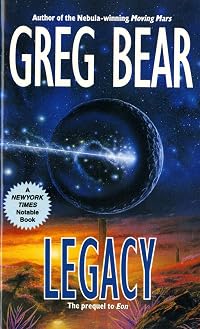
But overall, I found this book quite engaging and an exemplar of what a sequel ought to be about. The story started in 'Eon' ends here, and the final book in the series, 'Legacy', is a prequel. show less
'Eon' was mainly taken up with gosh-wowery at the Way and the worlds that could be accessed from it. The characters were only reasonably well-drawn, and some didn't even come up to that standard; but just as I felt over the show more relationship between 'The Forge of God' and its sequel, 'Anvil of Stars', that Bear's writing had undergone something of a transformation between the first and second books, and the second novel was more engaging, with better characterisation, so I felt with 'Eternity'. Having introduced us to the Way, the Hexamon and its politics, the characters and some of their histories, in this second book Bear gets to grips with some of the implications of the "Sundering", the separation of the Way and the asteroid; and some of the characters undergo major transformations, not all of which could have been foretold.
One of the characters from the first book, the mathematician Patricia Vasquez, only makes it into this one as the grandmother of one of the p.o.v. characters in a parallel world now isolated from the Way. This world is quite interesting, being a society descended from Graeco-Roman Egypt in a world where Christianity never gained a serious foothold, and Bear makes a good stab at depicting a world very different from our own. Perhaps my one complaint about the book is that having spent a lot of time setting up Patricia Vasquez's grand-daughter in this alternate reality, Bear then abandons her for a major part of the last third of the book until she is effectively sacrificed to allow the essence of her grandmother to be placed back in her own best of all possible worlds. I was less than happy about that.
But overall, I found this book quite engaging and an exemplar of what a sequel ought to be about. The story started in 'Eon' ends here, and the final book in the series, 'Legacy', is a prequel. show less
Sequel to Eon, and even more "space opera" vs. hard-SF. Humans (of many different generations) interacting, aliens, very little new physics (the best part of Eon).
If you read and enjoyed Eon, it's probably worth reading this for the conclusion. If you like hard-SF, it won't be great. If you like space opera, it's probably ok, but it's far from the best space opera. Maybe 3.5 vs. 3 but the length and my expectations being high kind of hurt it. Pretty good as an audiobook, maybe better than the written book.
One great thing -- it pretty much wraps up the Way series. There is a third book in the series, but it's basically a prequel, and based on not loving these, I won't read it (way too many other good books), but if you loved this series show more maybe it's worth it. show less
If you read and enjoyed Eon, it's probably worth reading this for the conclusion. If you like hard-SF, it won't be great. If you like space opera, it's probably ok, but it's far from the best space opera. Maybe 3.5 vs. 3 but the length and my expectations being high kind of hurt it. Pretty good as an audiobook, maybe better than the written book.
One great thing -- it pretty much wraps up the Way series. There is a third book in the series, but it's basically a prequel, and based on not loving these, I won't read it (way too many other good books), but if you loved this series show more maybe it's worth it. show less
The sequel to Eon, in which man has a permanent settlement on the asteroid ship, but now has to deal with some ancient enemies of mankind. Like Eon, it is gripping and brilliant at times, but inter sped with just enough technobabble to make finishing feel more like a job than a treat.
A good follow up to the first book (though it registers here as the third ... guess I'll find out for sure when I read the "last" one). This book gets even further into some of the spiritual / super far out sci-fi realm with plenty of deus ex machina (semi-literally), though it still managers to be a very interesting story.
Members
- Recently Added By
Lists

Simulated Reality in Fiction
124 works; 7 members
Author Information

140+ Works 47,140 Members
Greg Bear was born in San Diego, California, on August 20, 1951. He received a Bachelor of Arts degree from San Diego State University in 1973. At age 14, he began submitting pieces to magazines and at 15 he sold his first story to Robert Lowndes' Famous Science Fiction. It would be five years before he sold another piece, but by 23 he was selling show more stories regularly. He has written more than 30 science fiction and fantasy books and has won numerous awards for his work. In 1984, Hardfought and Blood Music won the Nebula Awards for best novella and novelette; Blood Music went on to win the Hugo Award. The novel version of that story, also called Blood Music, won the Prix Apollo in France. In 1987, Tangents won the Hugo and Nebula awards for best short story. He also won a Nebula in 1994 for Moving Mars and in 2001 for Darwin's Radio. Both Dinosaur Summer and Darwin's Radio have been awarded the Endeavour for best novel published by a Northwest science fiction author. He is also an illustrator and his work has appeared in Galaxy, Fantasy and Science Fiction, and Vertex, and in both hardcover and paperback books. He was a founding member of ASFA, the Association of Science Fiction Artists. His works include City at the End of Time, Hull Zero Three, The Mongoliad, Mariposa, Halo: Cryptum, Halo: Primordium and Halo: Silentium. (Bowker Author Biography) show less
Some Editions
Series


Belongs to Publisher Series
Work Relationships
Is contained in
Has as a commentary on the text
Common Knowledge
- Canonical title*
- Ewigkeit
- Original title
- Eternity
- Original publication date
- 1988
- People/Characters
- Rhita; Ser Olmy; Pavel Mirsky; Ry Oyu
- Important places
- The Way; Axis City; Thistledown
- Epigraph
- Only when space is rolled up like a piece of leather will there be an end to suffering, apart from knowing God. --Svetasvatara Upanisad, VI 20
- Dedication
- For David McClintock; friend, fellow admirer of Olaf Stapledon, and above all, bookseller.
- First words
- In the end, there is cruelty and death alone over the land.
- Last words
- (Click to show. Warning: May contain spoilers.)And then?
- Blurbers
- Clarke, Arthur C.
- Original language
- English
*Some information comes from Common Knowledge in other languages. Click "Edit" for more information.
Classifications
Statistics
- Members
- 2,185
- Popularity
- 9,251
- Reviews
- 23
- Rating
- (3.58)
- Languages
- 9 — Czech, Dutch, English, Finnish, French, German, Italian, Romanian, Spanish
- Media
- Paper, Audiobook, Ebook
- ISBNs
- 31
- ASINs
- 18