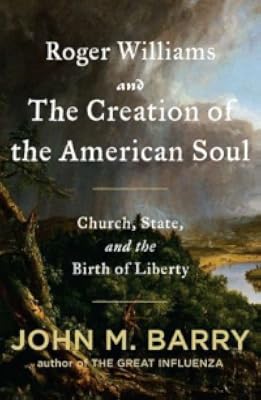
Roger Williams and the Creation of the American Soul: Church, State, and the Birth of Liberty
by John M. Barry
On This Page
Description
An acclaimed historian and "New York Times"-bestselling author offers a revelatory look at how Roger Williams shaped the nature of religion, political power, and individual rights in America.Tags
Recommendations
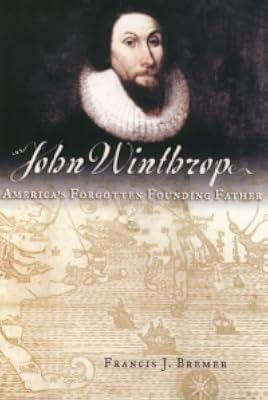


Member Reviews
This book tells a remarkable tale about a remarkable man living during remarkable times. If it wasn't real history, it would read as very compelling historical fiction featuring a larger-than-life protagonist. But it really did happen. After reading his book, I also have little doubt that Barry's interpretation is about as accurate a description as you are likely to find.
Roger Williams was born circa 1603 in England and died in 1683. He is arguably the father of the concept of separating state from church, politics from religion. He was not the first to conceive of the idea but he was the first to 'walk the walk' as it were by founding a community in the New World that allowed its residents the freedom to worship God as they wished show more without fear of persecution. That community was, and is, Providence, Rhode Island. A generation later, Williams' writings and ideas influenced and informed many of the founding fathers of the United States.
What surprised me while reading this was the fact that Williams was such a maverick in his thinking. I always had a vague idea in mind that the puritans must have been a tolerant bunch since they were escaping persecution in England. What this book informed me is that they were even more intolerant than the English! John Winthrop, governor of the new colonial charter, had a vision for Massachusetts of a "city on a hill", that would shine a beacon of religious conversion unto the wilds of the new world. There was no room for any religious view outside of the puritan one in that vision. Anyone who dared put voice to a dissenting opinion about the nature of religion was banished - often after having their ears cut off! Further offenses against the status quo resulted in even more severe punishment, up to and including being put to death. As a matter of fact, there was a lot of killing described in this book. Many historical figures in both England and New England died violently as a result of heretical convictions. The most horrific method entailed hanging the victim, cutting him down before he died, then disemboweling and drawing and quartering him while still alive. Even King Charles I was executed for treason in 1649. The crowd that gathered to see that particular spectacle was described as shouting with a joyful roar as his head was mounted on a spike on a wall of the Tower of London as though, "... a great victory had been won." Barbaric times. Navigating these treacherous religious and political waters, Roger Williams changed the world with his ideas and also managed to keep his ears, tongue and head until he died of old age at ~80 years old. This speaks volumes to his intelligence, charisma, and personal bravery.
Regarding the book's narrative; As I stated at the beginning, Barry narrates a story that reads like historical fiction. The facts are exhaustively and impressively researched but are also laid out in a riveting fashion. Further reading on the subject is easily found by way of the included bibliography. After a bit of a slow start where Barry describes the political and social landscape of England that Roger Williams grew up in, the book really hits its stride when the focus shifts to the New World. An outgoing personality and deep-thinking individual, Williams was the first Englishman to take time to study and befriend the native Indians. Doing so saved his life on more than one occasion when he angered the puritans in Massachusetts and his Indian friends gave him sanctuary.
Williams' logical thinking, and early influence from such notables as Sir Edward Coke and Sir Francis Bacon, led him to take the view that, "each man is sovereign in his own head", and, "his home is as his own castle." These are rights that we take for granted today but, in those days, few people believed this! In fact, most western people in the 17th century believed in the divine right of kings to rule. That the king's position was appointed directly from God and that, as a result, the king could do no wrong. Today, we view British royalty mostly as wealthy people with no real political power. In Williams' day, the king held the lives of his subjects, (not citizens!), in his hands and there was no one to dispute his divine right to do as he wished with those lives - until Williams came along and began publishing his well-considered thoughts about personal freedoms. Again, how he managed to expound these ideas and keep his head is simply astonishing!
This book is highly recommended to anyone even remotely interested in this period of English and American history. It really is a remarkable work that manages to entertain while it educates. A rare thing, that. show less
Roger Williams was born circa 1603 in England and died in 1683. He is arguably the father of the concept of separating state from church, politics from religion. He was not the first to conceive of the idea but he was the first to 'walk the walk' as it were by founding a community in the New World that allowed its residents the freedom to worship God as they wished show more without fear of persecution. That community was, and is, Providence, Rhode Island. A generation later, Williams' writings and ideas influenced and informed many of the founding fathers of the United States.
What surprised me while reading this was the fact that Williams was such a maverick in his thinking. I always had a vague idea in mind that the puritans must have been a tolerant bunch since they were escaping persecution in England. What this book informed me is that they were even more intolerant than the English! John Winthrop, governor of the new colonial charter, had a vision for Massachusetts of a "city on a hill", that would shine a beacon of religious conversion unto the wilds of the new world. There was no room for any religious view outside of the puritan one in that vision. Anyone who dared put voice to a dissenting opinion about the nature of religion was banished - often after having their ears cut off! Further offenses against the status quo resulted in even more severe punishment, up to and including being put to death. As a matter of fact, there was a lot of killing described in this book. Many historical figures in both England and New England died violently as a result of heretical convictions. The most horrific method entailed hanging the victim, cutting him down before he died, then disemboweling and drawing and quartering him while still alive. Even King Charles I was executed for treason in 1649. The crowd that gathered to see that particular spectacle was described as shouting with a joyful roar as his head was mounted on a spike on a wall of the Tower of London as though, "... a great victory had been won." Barbaric times. Navigating these treacherous religious and political waters, Roger Williams changed the world with his ideas and also managed to keep his ears, tongue and head until he died of old age at ~80 years old. This speaks volumes to his intelligence, charisma, and personal bravery.
Regarding the book's narrative; As I stated at the beginning, Barry narrates a story that reads like historical fiction. The facts are exhaustively and impressively researched but are also laid out in a riveting fashion. Further reading on the subject is easily found by way of the included bibliography. After a bit of a slow start where Barry describes the political and social landscape of England that Roger Williams grew up in, the book really hits its stride when the focus shifts to the New World. An outgoing personality and deep-thinking individual, Williams was the first Englishman to take time to study and befriend the native Indians. Doing so saved his life on more than one occasion when he angered the puritans in Massachusetts and his Indian friends gave him sanctuary.
Williams' logical thinking, and early influence from such notables as Sir Edward Coke and Sir Francis Bacon, led him to take the view that, "each man is sovereign in his own head", and, "his home is as his own castle." These are rights that we take for granted today but, in those days, few people believed this! In fact, most western people in the 17th century believed in the divine right of kings to rule. That the king's position was appointed directly from God and that, as a result, the king could do no wrong. Today, we view British royalty mostly as wealthy people with no real political power. In Williams' day, the king held the lives of his subjects, (not citizens!), in his hands and there was no one to dispute his divine right to do as he wished with those lives - until Williams came along and began publishing his well-considered thoughts about personal freedoms. Again, how he managed to expound these ideas and keep his head is simply astonishing!
This book is highly recommended to anyone even remotely interested in this period of English and American history. It really is a remarkable work that manages to entertain while it educates. A rare thing, that. show less
Summary: A study of the life of Roger Williams focusing on the intellectual influences upon Williams, his journey to Massachusetts, banishment and founding of Rhode Island, and his signal ideas of freedom of conscience and government by consent of the governed.
Questions of church and state, a "Christian" vision for America, and the battle to be free to believe as one wills and practice those beliefs are as contemporary as the most recent national elections, but trace back to our very beginnings in New England. Reading this account of the life of Roger Williams gives me a deeper appreciation of a figure who laid the groundwork of the protections of both religious liberty and from religious tyranny that we enjoy, and the recognition of show more the human right of freedom of conscience.
Many accounts of Williams' life begin with his banishment from Massachusetts and his flight into the wilderness, taking shelter with the Narragansetts he had befriended, and then establishing the town that would become Providence, leading eventually to the chartering of Rhode Island and Providence Plantations. This account begins by tracing his youthful apprenticeship with Edward Coke, one of the greatest legal minds of the age, and a steadfast resister of royal tyranny, whose resistance resulted in his going to the Tower of London. He also closely observed Francis Bacon, the great scientist, but also chancellor to King James, and from him developed a commitment to reaching conclusions by evidence that led later to his own independence in forming theological views, leading to his break with the founders in Massachusetts.
Like many Puritans, Williams, who for a time was sheltered as a "chaplain" to a distinguished family, faced the scrutiny of Bishop Laud, and like many, fled to America. The Massachusetts colony was established with a vision of being a "city on the hill" where Christian faith shaped every aspect of the colony's life and where religious and governmental functions were closely enough aligned to be at one. Williams, exposed to this theocratic government concluded that government could enforce only those parts of the law (the second table) having to do with human beings relationships with each other. To try to enforce the first would be to intrude upon the individual conscience. Williams also reached conclusions that questioned the basis upon which colonists obtained the native people's land. Eventually, the authorities, including close friends from England, banished him and even attempted at one point to seize him by force and take him to England, where he likely would have been executed. Only flight in mid-winter saved him, and led to the beginnings of Rhode Island.
From the beginning, Williams vision was to set up a place, not where anarchy ruled, but where conscience was free and people could believe and worship as they pleased (or not). At various points we see Williams fending off Massachusetts, Plymouth, and Connecticut from carving up Rhode Island, even as he also intercedes with Native tribes to avert war with the colonists.
Eventually this leads to a return of Williams to the England he had fled to obtain a charter that would formally recognize Rhode Island (and Providence Plantations--its full name) as a colony in its own right. Furthermore, Williams is proposing the radical idea of a colony with no state church. The account of how he does this, as well as a significant work he published during a second visit, The Bloudy Tenent is fascinating, and along with the early influences in his life, often overlooked. In The Bloudy Tenent he argues both for freedom of conscience and for the idea that the state's power to govern should derive from the consent of the governed. These ideas, via John Locke, shaped the thinking of the founders.
Williams did not remain unscarred in all the conflicts he faced. After his banishment, he took up briefly with the Baptists, but then never again joined or formed a church. He continued to believe, but his significant contributions would be in the learning of Native languages and his relations with Native peoples, his leadership in Rhode Island and politically savvy relations in England, and his political thought that laid the foundations for freedom of conscience, religious liberty and freedom from religious tyranny, which has also frustrated efforts to enforce a Christian conscience upon the nation that continues to this day.
Barry offers a narrative that helps us see the combination of intellectual influences and life events that shaped the thought and actions of Williams. It strikes me that the peculiar genius and grace of Williams was to create a space for the liberties and form of government he believed in without attacking those who attacked him. He worked skillfully and shrewdly and yet as a man of peace in the midst of warring factions in the colonies and civil conflict with bloody executions in England. It seems we could use more like him. show less
Questions of church and state, a "Christian" vision for America, and the battle to be free to believe as one wills and practice those beliefs are as contemporary as the most recent national elections, but trace back to our very beginnings in New England. Reading this account of the life of Roger Williams gives me a deeper appreciation of a figure who laid the groundwork of the protections of both religious liberty and from religious tyranny that we enjoy, and the recognition of show more the human right of freedom of conscience.
Many accounts of Williams' life begin with his banishment from Massachusetts and his flight into the wilderness, taking shelter with the Narragansetts he had befriended, and then establishing the town that would become Providence, leading eventually to the chartering of Rhode Island and Providence Plantations. This account begins by tracing his youthful apprenticeship with Edward Coke, one of the greatest legal minds of the age, and a steadfast resister of royal tyranny, whose resistance resulted in his going to the Tower of London. He also closely observed Francis Bacon, the great scientist, but also chancellor to King James, and from him developed a commitment to reaching conclusions by evidence that led later to his own independence in forming theological views, leading to his break with the founders in Massachusetts.
Like many Puritans, Williams, who for a time was sheltered as a "chaplain" to a distinguished family, faced the scrutiny of Bishop Laud, and like many, fled to America. The Massachusetts colony was established with a vision of being a "city on the hill" where Christian faith shaped every aspect of the colony's life and where religious and governmental functions were closely enough aligned to be at one. Williams, exposed to this theocratic government concluded that government could enforce only those parts of the law (the second table) having to do with human beings relationships with each other. To try to enforce the first would be to intrude upon the individual conscience. Williams also reached conclusions that questioned the basis upon which colonists obtained the native people's land. Eventually, the authorities, including close friends from England, banished him and even attempted at one point to seize him by force and take him to England, where he likely would have been executed. Only flight in mid-winter saved him, and led to the beginnings of Rhode Island.
From the beginning, Williams vision was to set up a place, not where anarchy ruled, but where conscience was free and people could believe and worship as they pleased (or not). At various points we see Williams fending off Massachusetts, Plymouth, and Connecticut from carving up Rhode Island, even as he also intercedes with Native tribes to avert war with the colonists.
Eventually this leads to a return of Williams to the England he had fled to obtain a charter that would formally recognize Rhode Island (and Providence Plantations--its full name) as a colony in its own right. Furthermore, Williams is proposing the radical idea of a colony with no state church. The account of how he does this, as well as a significant work he published during a second visit, The Bloudy Tenent is fascinating, and along with the early influences in his life, often overlooked. In The Bloudy Tenent he argues both for freedom of conscience and for the idea that the state's power to govern should derive from the consent of the governed. These ideas, via John Locke, shaped the thinking of the founders.
Williams did not remain unscarred in all the conflicts he faced. After his banishment, he took up briefly with the Baptists, but then never again joined or formed a church. He continued to believe, but his significant contributions would be in the learning of Native languages and his relations with Native peoples, his leadership in Rhode Island and politically savvy relations in England, and his political thought that laid the foundations for freedom of conscience, religious liberty and freedom from religious tyranny, which has also frustrated efforts to enforce a Christian conscience upon the nation that continues to this day.
Barry offers a narrative that helps us see the combination of intellectual influences and life events that shaped the thought and actions of Williams. It strikes me that the peculiar genius and grace of Williams was to create a space for the liberties and form of government he believed in without attacking those who attacked him. He worked skillfully and shrewdly and yet as a man of peace in the midst of warring factions in the colonies and civil conflict with bloody executions in England. It seems we could use more like him. show less
The founding of the smallest state and its secular character are directly attributed to him and inspired the Founding Fathers, but Roger Williams is a man from a complex time in both England and colonial America. John M. Barry’s Roger Williams and the Creation of the American Soul: Church, State, and the Birth of Liberty is not only a biography of Williams but a cultural, political, and religious history of his time.
While it takes a while for Barry to focus on Williams and his soon-to-be very revolutionary thinking, he sets the groundwork not only for Williams intellectual and religious development but also the political and cultural context of his life. First and foremost is the political view of the early Stuart monarchs of divine show more right of kings going up against Magna Carta and Parliament that will eventually set off the English Civil War, and alongside it was the struggle over the Church of England and those Puritans who would not conform to practices that looked decidedly “popish”. It is easy to forget sometimes that England and its American colonies interacted before 1763 and the lead up to the American Revolution, but Barry plainly illustrates that events in each did have an impact on one another whether religiously or politically. Roger Williams’ vision of separation of church and state has come up against John Winthrop’s “city on a hill”, ironically a Puritan version of conform or else mirroring what was happening in England, throughout American history and this was central to Barry’s book even as he followed the live and struggles of Williams. One of the biggest takeaways from the book is that history does not happen in a vacuum as the development of Roger Williams’ revolutionary idea came from a messy political and religious background.
Roger Williams and the Creation of the American Soul is not only a book about the life of Williams, but Barry shows how Williams was influenced by not only important personages he came in contact with but also how he influenced them. show less
While it takes a while for Barry to focus on Williams and his soon-to-be very revolutionary thinking, he sets the groundwork not only for Williams intellectual and religious development but also the political and cultural context of his life. First and foremost is the political view of the early Stuart monarchs of divine show more right of kings going up against Magna Carta and Parliament that will eventually set off the English Civil War, and alongside it was the struggle over the Church of England and those Puritans who would not conform to practices that looked decidedly “popish”. It is easy to forget sometimes that England and its American colonies interacted before 1763 and the lead up to the American Revolution, but Barry plainly illustrates that events in each did have an impact on one another whether religiously or politically. Roger Williams’ vision of separation of church and state has come up against John Winthrop’s “city on a hill”, ironically a Puritan version of conform or else mirroring what was happening in England, throughout American history and this was central to Barry’s book even as he followed the live and struggles of Williams. One of the biggest takeaways from the book is that history does not happen in a vacuum as the development of Roger Williams’ revolutionary idea came from a messy political and religious background.
Roger Williams and the Creation of the American Soul is not only a book about the life of Williams, but Barry shows how Williams was influenced by not only important personages he came in contact with but also how he influenced them. show less
This book and a fiction book I read at the same time, [b: The Handmaid's Tale|38447|The Handmaid's Tale|Margaret Atwood|https://d.gr-assets.com/books/1294702760s/38447.jpg|1119185], provided interesting commentary on each other, although I hadn't known before starting them that they had similar themes. Both deal with freedom of conscience and a hero who resists the societal and legal requirements to conform inwardly to a particular interpretation of Christian moral code.
RW & the Creation of the American Soul's hero is Roger Williams, who was a theologian, statesman, and a founder of Rhode Island. Contra especially John Winthrop and the Massachusetts Bay Colony, which was to be the City Upon a Hill, Williams argued that people should show more have freedom of conscience. That meant that people shouldn't be imprisoned for their thoughts, although the Second Table of the Law (those of the Ten Commandments dealing with community) could still be enforced. He founded Providence Plantation with these ideals, which made Rhode Island a sanctuary for religious misfits.
I also found it very interesting that Williams argued passionately for the land rights of the Native Americans. He found some traction for this idea, though in the end this argument was less successful than freedom of conscience. I hadn't realized that this type of non-colonizing thought was part of the English-American discussion before it was too late to do anything about it.
Williams was even a proto-abolitionist; so, between these three ideas, he was quite a modern thinker while also being a sincere and devout Christian.
This is a well-written biography which goes very deep into Williams's influences. I would recommend it to anyone interested in American and/or church history. show less
RW & the Creation of the American Soul's hero is Roger Williams, who was a theologian, statesman, and a founder of Rhode Island. Contra especially John Winthrop and the Massachusetts Bay Colony, which was to be the City Upon a Hill, Williams argued that people should show more have freedom of conscience. That meant that people shouldn't be imprisoned for their thoughts, although the Second Table of the Law (those of the Ten Commandments dealing with community) could still be enforced. He founded Providence Plantation with these ideals, which made Rhode Island a sanctuary for religious misfits.
I also found it very interesting that Williams argued passionately for the land rights of the Native Americans. He found some traction for this idea, though in the end this argument was less successful than freedom of conscience. I hadn't realized that this type of non-colonizing thought was part of the English-American discussion before it was too late to do anything about it.
Williams was even a proto-abolitionist; so, between these three ideas, he was quite a modern thinker while also being a sincere and devout Christian.
This is a well-written biography which goes very deep into Williams's influences. I would recommend it to anyone interested in American and/or church history. show less
What we owe to Mr. Williams
"What are all the Contentions and Wars of this World about (generally) but for greater Dishes and Bowls of Porridge?" —Roger Williams, in a letter to Major John Mason, June 22, 1670
When I was a child in first grade, making hand-turkeys and Indian war bonnets out of construction paper to decorate the classroom for Thanksgiving, we learned that the Pilgrims came to the New World "to be free to practice their religion." What that meant, exactly, was never explained. As first graders we were more interested in the discovery of Indian popcorn and the possibility of pumpkin pie than we were in the forces that drove a group of men and women (and children) to get on a boat and cross an ocean to start a new life. show more They wanted freedom—something that, as far as we were concerned, came with the territory. With being in America. Like corn and maple syrup, and Indians.
I'm sorry to say that my concept of freedom of religion in America, of freedom in general, remained similarly un-nuanced for almost the whole of the next thirty years, until a terrorist attack on the United States sent the country into a tailspin, careening down a course that seemed, to me, the exact opposite of the principles those original Pilgrims had come to these shores to practice.
There have been many repercussions to the 9/11 attacks. One personal one for me was a renewed attention to the Constitution of the United States (which seemed to be daily in jeopardy) and the circumstances and people that surrounded its creation. This, in turn, lead to a renewed feeling of admiration and awe for the founding fathers—admiration for their sense of vision and ambition, awe for the fact that by and large, it worked. "Freedom" to speak and act according to one's conscience, without the fear of retribution from some authority, freedom in the sense of personal liberty, still works.
As it turns out, one of the reasons it works is because of Mr. Roger Williams. And that story that my teachers told me about the Pilgrims coming to America for religious freedom? Well, they weren't exactly lying, but it was a little more complicated than that.
Roger Williams is best known in America as the founder of the Rhode Island "plantation," and perhaps also as the founder of the First Baptist Church, but according to John M. Barry he might also be the founder of the founders of the country. Barry's book, Roger Williams and the Creation of the American Soul: Church, State, and the Birth of Liberty, documents how many of the ideas at the center of the American Revolution—ideas about personal liberty, freedom of expression, freedom of conscience, separation of church and state, and the concept of a democratic government where sovereignty resides in the will of its people, not a divinely ordained king or council—all of these can be traced back in some fashion to the half-forgotten but wholly remarkable theologian and political thinker named Roger Williams. His theories influenced not just the political figures of his day (who tended to be aghast and appalled at them) but also philosophers and political figures of later ages. Men like John Milton, whose later work shows clear evidence of his friendship with Williams and who's ideas about freedom of conscience parallel Williams' own. Or John Locke, whose on work is built on Williams' idea of a completely secular civil government. Even Thomas Jefferson, the man who most identify as the ideological soul of the American Revolution, owes his famous call for a "wall of separation between Church and State" to Roger Williams. Williams said it first, 130 years earlier.
"This book was supposed to be about the home front in World War I," writes Barry a bit plaintively in his afterward, "...to investigate the role of religion in American public life as part of a larger story." But it is clear that the personality of Roger Williams exerts a kind of irresistible force even this far removed from those early Colonial beginnings. He simply takes over the story Barry wanted to tell. The "larger story" Barry found himself facing turned out to be the story of the debate about religion and politics—the two things we are told never, ever to bring to the dinner table. I have this mental image of the author working feverishly, excitedly on his book, but finding himself utterly unable to talk to friends and family about it. "What are you working on now, John dear?" "Oh, a book about religion and politics..." "How nice. Pass the gravy boat please."
The origin of the debate between religion and politics in America lay in the conflict between two seventeenth century Puritan thinkers: Roger Williams, who founded Rhode Island based on the principle of the separation of church and state, and John Winthrop, who founded Massachusetts in order to build "a city on a hill" in which the church was the state. So as it turns out, those Puritans didn't come to the new world for freedom of religion, but for the freedom to practice their religion.
It's a significant distinction. Puritans had been harassed and harried in England for defying the official Anglican Church of England, and by extension, the head of that church, the King, but they were all for the creation of their own near-theocratic society. And people who chose to defy or even simply question the tenets of their new city on the hill could suffer some pretty severe punishments. Lopping off ears and hands and other protruding body parts (yes, those too) being a favorite seventeenth century punishment for any number of offenses. Puritan authorities did not prove any more merciful or less bloody than their counterparts for the Crown when it came to enforcing their Biblically-inspired laws.
Roger Williams and the Creation of the American Soul is both a political biography of a man, and the intellectual biography of an idea—the idea of personal liberty as the foundation for civil society. It is a complicated topic—politics in late sixteenth and early seventeenth century England were especially fraught, as anyone who has ever seen a Shakespeare play can attest. And the tangled history of the relationship of secular authority to religious authority is even more so. But Barry navigates the complexities of both civil disputes like those over the Divine Right of Kings versus the rule of Common Law, and theological disputes, like the fine but exceedingly important distinctions held between Anglican and Calvinist doctrine regarding the concept of predestination, and he does so with ease and a sure hand. Thus, even though fully a third of the book is devoted to the religious conflicts in England and the struggles of its monarchs to impose their absolute will upon the people they ruled, it is background that serves to frame the work of Williams himself, who appears all the more remarkable against the chaotic times in which he lived. Indeed, it is a minor miracle that he lived at all, since his friends and patrons had a way of getting themselves thrown into the Tower of London or beheaded.
But as adept as Barry is in his coverage of shifting political tides and religious ideals, this is not the strongest or most rewarding part of his book. The reward is in his illumination of the character of Roger Williams himself. The man must have been extremely charismatic in life, because even on paper his seems to be almost force majeure.
Roger Williams' star began to rise when at the age of thirteen he was noticed by Sir Edward Coke for, of all things, his proficiency with shorthand. (Williams would go on to show a talent for mastering many languages, but this one is the most idiosyncratic). Coke was the leading English barrister of the day—possibly the leading English jurist of all time—and the man who established the primacy of Common Law over the will of the monarch. In effect, establishing that even the King had to obey the law. It is Coke who is attributed with the saying "an Englishman's home is his castle." Roger Williams, as Coke's protégé, attended him in his various stations as Speaker of the House of Commons, chief justice for the Court of Commons, attorney general for two kings, member of the King's Bench, and member of the Privy Council. He was in the room when Coke actually argued with King James I and told him, very respectfully but adamantly, that his royal highness was in error on a point of the law. Roger Williams himself was on speaking terms with the King's son, Charles (later, Charles I) although he apparently didn't think much of him.
Williams also knew, and admired, Sir Francis Bacon, the great empiricist and natural philosopher who insisted that logic wasn't logical if it ignored observable evidence. And it perhaps speaks to Williams' originality of mind that he could find so much to admire in Bacon's ideas, since Bacon and his own mentor, Edward Coke, detested each other personally. As the author points out, it could hardly have been a better training ground for an original thinker. Roger Williams found himself literally at the center stage where modern political and scientific thought were beginning to contend against forms of civil society that had stood for thousands of years.
Ah to be young, brilliant, and in England in the midst of a civil crisis. Eventually Williams' own religious and political views would put him into royal disfavor and he would do what many others decided to do in similar circumstances—go west, young man. Flee to America, where he would be safe from royal pressure to conform to the Church of England, and more to the point safe from arrest, and free to exercise his own conscience. Unfortunately, as Barry points out, the Puritan colonies established in America had no intention of allowing anyone to freely exercise their own conscience. Conformity was still demanded, it was just a different kind of conformity.
If there is a pattern to Williams' life it is that he possessed a singular talent for winning the friendship and admiration of people, whilst being an unrepentant, unbending irritant to persons in authority. Barry ascribes this effect to Williams' own steadfast integrity—a thing which tends to irritate people who have none—and his intelligence, especially in his willingness to subject even his own assumptions and beliefs to rigorous questioning. His character, then, was universally understood to be completely honest. His learning, of the highest order. And since a man who has seen the King of England in a temper tantrum is not inclined to be easily intimidated, colonial authorities in Massachusetts found to their consternation that Williams was beyond the reach of their influence. Plus, he had advanced the rather disturbing theory that Indians should be paid for the land the colony had settled, which sat well with no one who had settled on any.
Williams was nothing but respectful of the men with whom he had disagreements on matters of religious doctrine and civil government. But they could not force him to act against his own conscience. So eventually, they banished him to the wilds of Rhode Island, little expecting that there he would found a colony of his own, based on complete religious freedom, and that this colony would not only not become a den of anarchy and licentiousness of godless persons, but would thrive, be a model of civil order and harmony, and become in turn a model for other new settlements. So shocked were the Massachusetts authorities that they even attempted to invade Rhode Island on a pretext and annex it, thus bringing it back into the fold of their own city on the hill. No less a person than Oliver Cromwell (who met and admired Williams) told Massachusetts to desist and leave Rhode Island alone.
Barry spends little time on Roger Williams' personal life, except insofar as it affected or was affected by his public life and developing views of personal liberty. But the man himself still shines through. Certainly, as the author points out, Williams' seemed to crave a kind of absolute personal liberty—the kind of freedom that sends pioneers into the wilderness to carve out their own piece of heaven. He had a gift for maintaining friendships with people who were enemies to each other—as his relationship with Coke and Bacon shows. Even at the height of his conflicts with the authorities in Massachusetts, he remained good friends with the governor, John Winthrop, who admired Williams very much and even went into business with him on occasion.
Williams also was intellectually curious. The Native Americans that most colonists did their best to ignore, Williams found fascinating. He learned the Naragansett language, spent days in a canoe visiting different tribes, and published a book on their language and customs that even today is considered highly accurate. Williams became the de facto mediator between many white and Indian disputes, and once even diffused an Indian uprising in Massachusetts by walking into a war council—the only white man among 1500 natives—and convincing the tribes not to fight. The settlers in the Massachusetts colony were profoundly grateful for his intervention, although they couldn't tell him so since Williams had been banned from the colony for his dangerous opinions.
He was profoundly, passionately religious. He believed in the word of God. But he was never blindly loyal to the word of man, and his intellectual honesty caused him to forever search backwards for scriptural justification for his beliefs. In fact he was so unflinchingly rigorous in his studies, that he came to the agonizing conclusion that no current church could have true "Apostolic Succession" (that is, a true line of spiritual authority passed down from Christ). Too much time and corruption had occurred over the millenia. So he felt he had no choice but to leave his own church, "casting himself loose," forever to be a "Seeker" without the comfort of being part of a covenant.
So it is clear he was incredibly brave.
And no doubt, Barry writes, incredibly strong. To get about in the wilds of Rhode Island where horses were scarce to nonexistent, one usually had to walk or travel by canoe. Williams probably had arms like tree trunks.
And he was committed to his ideal: the creation of a free society where the governing body had no say over an individual's personal conscience. That is, his beliefs. Just how committed Williams was to this idea was shown towards the end of his life when Rhode Island became the refuge for several Quaker communities. Quakers were a bit like the hippies of the day—all emotion and seeking the inner light and doing outrageous things like smashing bottles in churches and running naked in the aisles. They would have adored Woodstock.
Most civil authorities at the time imposed harsh punishments on Quakers caught within their jurisdiction. In some cases they even disregarded their own laws and found excuses to circumvent standard practice in order to deal in justly harsh manner with these religious radicals they considered a threat to civil order. Williams also hated the Quaker beliefs—not because it was "disorderly" but because it seemed to lack any rational foundation. It was a religion of emotion, not wisdom. Williams considered it to be intellectually lazy. An abdication of a person's responsibility to consult and question their own conscience in all things.
Nevertheless, when neighboring colonies exerted pressure on Rhode Island to expel, make an example of, or even execute the Quakers in their colony, Williams and the Rhode Island civil authorities refused. The Quaker religion was ridiculous, but in their city not on a hill, one had every right to be as ridiculous in their faith as one wished.
The story of Roger Williams and the development of his theories of personal liberty and the necessity of the separation of Church and State is not an obscure tale about an irrelevant moment in early American history. Nations, even this nation, still routinely try to circumvent established law for "reasons of state" as King James I would put it. Nowadays we say "for national security." It is a temptation that can have drastic consequences. Charles I pushed religious conformity "for reasons of state" with such force he ended up beheaded on his own gallows. "The question," writes Barry, "of whether the end of national security justifies extraconstitutional means is alive now as it was four hundred years ago."
Nor is the idea of the separation of Church and State—the ultimate guarantee of freedom of expression, and freedom of religion—a simple truism in American culture. The tenor of political debate is increasingly invaded by the language of religion. Sometimes even legislation inspired by religious doctrine makes its way into the law. Freedom, almost any politician's re-election campaign commercial will tell you, is a thing that must be constantly defended.
Roger Williams would concur. But he would also tell us is that freedom is best defended when we fight for it not for ourselves, but for the rights of those with whom we do not agree. show less
"What are all the Contentions and Wars of this World about (generally) but for greater Dishes and Bowls of Porridge?" —Roger Williams, in a letter to Major John Mason, June 22, 1670
When I was a child in first grade, making hand-turkeys and Indian war bonnets out of construction paper to decorate the classroom for Thanksgiving, we learned that the Pilgrims came to the New World "to be free to practice their religion." What that meant, exactly, was never explained. As first graders we were more interested in the discovery of Indian popcorn and the possibility of pumpkin pie than we were in the forces that drove a group of men and women (and children) to get on a boat and cross an ocean to start a new life. show more They wanted freedom—something that, as far as we were concerned, came with the territory. With being in America. Like corn and maple syrup, and Indians.
I'm sorry to say that my concept of freedom of religion in America, of freedom in general, remained similarly un-nuanced for almost the whole of the next thirty years, until a terrorist attack on the United States sent the country into a tailspin, careening down a course that seemed, to me, the exact opposite of the principles those original Pilgrims had come to these shores to practice.
There have been many repercussions to the 9/11 attacks. One personal one for me was a renewed attention to the Constitution of the United States (which seemed to be daily in jeopardy) and the circumstances and people that surrounded its creation. This, in turn, lead to a renewed feeling of admiration and awe for the founding fathers—admiration for their sense of vision and ambition, awe for the fact that by and large, it worked. "Freedom" to speak and act according to one's conscience, without the fear of retribution from some authority, freedom in the sense of personal liberty, still works.
As it turns out, one of the reasons it works is because of Mr. Roger Williams. And that story that my teachers told me about the Pilgrims coming to America for religious freedom? Well, they weren't exactly lying, but it was a little more complicated than that.
Roger Williams is best known in America as the founder of the Rhode Island "plantation," and perhaps also as the founder of the First Baptist Church, but according to John M. Barry he might also be the founder of the founders of the country. Barry's book, Roger Williams and the Creation of the American Soul: Church, State, and the Birth of Liberty, documents how many of the ideas at the center of the American Revolution—ideas about personal liberty, freedom of expression, freedom of conscience, separation of church and state, and the concept of a democratic government where sovereignty resides in the will of its people, not a divinely ordained king or council—all of these can be traced back in some fashion to the half-forgotten but wholly remarkable theologian and political thinker named Roger Williams. His theories influenced not just the political figures of his day (who tended to be aghast and appalled at them) but also philosophers and political figures of later ages. Men like John Milton, whose later work shows clear evidence of his friendship with Williams and who's ideas about freedom of conscience parallel Williams' own. Or John Locke, whose on work is built on Williams' idea of a completely secular civil government. Even Thomas Jefferson, the man who most identify as the ideological soul of the American Revolution, owes his famous call for a "wall of separation between Church and State" to Roger Williams. Williams said it first, 130 years earlier.
"This book was supposed to be about the home front in World War I," writes Barry a bit plaintively in his afterward, "...to investigate the role of religion in American public life as part of a larger story." But it is clear that the personality of Roger Williams exerts a kind of irresistible force even this far removed from those early Colonial beginnings. He simply takes over the story Barry wanted to tell. The "larger story" Barry found himself facing turned out to be the story of the debate about religion and politics—the two things we are told never, ever to bring to the dinner table. I have this mental image of the author working feverishly, excitedly on his book, but finding himself utterly unable to talk to friends and family about it. "What are you working on now, John dear?" "Oh, a book about religion and politics..." "How nice. Pass the gravy boat please."
The origin of the debate between religion and politics in America lay in the conflict between two seventeenth century Puritan thinkers: Roger Williams, who founded Rhode Island based on the principle of the separation of church and state, and John Winthrop, who founded Massachusetts in order to build "a city on a hill" in which the church was the state. So as it turns out, those Puritans didn't come to the new world for freedom of religion, but for the freedom to practice their religion.
It's a significant distinction. Puritans had been harassed and harried in England for defying the official Anglican Church of England, and by extension, the head of that church, the King, but they were all for the creation of their own near-theocratic society. And people who chose to defy or even simply question the tenets of their new city on the hill could suffer some pretty severe punishments. Lopping off ears and hands and other protruding body parts (yes, those too) being a favorite seventeenth century punishment for any number of offenses. Puritan authorities did not prove any more merciful or less bloody than their counterparts for the Crown when it came to enforcing their Biblically-inspired laws.
Roger Williams and the Creation of the American Soul is both a political biography of a man, and the intellectual biography of an idea—the idea of personal liberty as the foundation for civil society. It is a complicated topic—politics in late sixteenth and early seventeenth century England were especially fraught, as anyone who has ever seen a Shakespeare play can attest. And the tangled history of the relationship of secular authority to religious authority is even more so. But Barry navigates the complexities of both civil disputes like those over the Divine Right of Kings versus the rule of Common Law, and theological disputes, like the fine but exceedingly important distinctions held between Anglican and Calvinist doctrine regarding the concept of predestination, and he does so with ease and a sure hand. Thus, even though fully a third of the book is devoted to the religious conflicts in England and the struggles of its monarchs to impose their absolute will upon the people they ruled, it is background that serves to frame the work of Williams himself, who appears all the more remarkable against the chaotic times in which he lived. Indeed, it is a minor miracle that he lived at all, since his friends and patrons had a way of getting themselves thrown into the Tower of London or beheaded.
But as adept as Barry is in his coverage of shifting political tides and religious ideals, this is not the strongest or most rewarding part of his book. The reward is in his illumination of the character of Roger Williams himself. The man must have been extremely charismatic in life, because even on paper his seems to be almost force majeure.
Roger Williams' star began to rise when at the age of thirteen he was noticed by Sir Edward Coke for, of all things, his proficiency with shorthand. (Williams would go on to show a talent for mastering many languages, but this one is the most idiosyncratic). Coke was the leading English barrister of the day—possibly the leading English jurist of all time—and the man who established the primacy of Common Law over the will of the monarch. In effect, establishing that even the King had to obey the law. It is Coke who is attributed with the saying "an Englishman's home is his castle." Roger Williams, as Coke's protégé, attended him in his various stations as Speaker of the House of Commons, chief justice for the Court of Commons, attorney general for two kings, member of the King's Bench, and member of the Privy Council. He was in the room when Coke actually argued with King James I and told him, very respectfully but adamantly, that his royal highness was in error on a point of the law. Roger Williams himself was on speaking terms with the King's son, Charles (later, Charles I) although he apparently didn't think much of him.
Williams also knew, and admired, Sir Francis Bacon, the great empiricist and natural philosopher who insisted that logic wasn't logical if it ignored observable evidence. And it perhaps speaks to Williams' originality of mind that he could find so much to admire in Bacon's ideas, since Bacon and his own mentor, Edward Coke, detested each other personally. As the author points out, it could hardly have been a better training ground for an original thinker. Roger Williams found himself literally at the center stage where modern political and scientific thought were beginning to contend against forms of civil society that had stood for thousands of years.
Ah to be young, brilliant, and in England in the midst of a civil crisis. Eventually Williams' own religious and political views would put him into royal disfavor and he would do what many others decided to do in similar circumstances—go west, young man. Flee to America, where he would be safe from royal pressure to conform to the Church of England, and more to the point safe from arrest, and free to exercise his own conscience. Unfortunately, as Barry points out, the Puritan colonies established in America had no intention of allowing anyone to freely exercise their own conscience. Conformity was still demanded, it was just a different kind of conformity.
If there is a pattern to Williams' life it is that he possessed a singular talent for winning the friendship and admiration of people, whilst being an unrepentant, unbending irritant to persons in authority. Barry ascribes this effect to Williams' own steadfast integrity—a thing which tends to irritate people who have none—and his intelligence, especially in his willingness to subject even his own assumptions and beliefs to rigorous questioning. His character, then, was universally understood to be completely honest. His learning, of the highest order. And since a man who has seen the King of England in a temper tantrum is not inclined to be easily intimidated, colonial authorities in Massachusetts found to their consternation that Williams was beyond the reach of their influence. Plus, he had advanced the rather disturbing theory that Indians should be paid for the land the colony had settled, which sat well with no one who had settled on any.
Williams was nothing but respectful of the men with whom he had disagreements on matters of religious doctrine and civil government. But they could not force him to act against his own conscience. So eventually, they banished him to the wilds of Rhode Island, little expecting that there he would found a colony of his own, based on complete religious freedom, and that this colony would not only not become a den of anarchy and licentiousness of godless persons, but would thrive, be a model of civil order and harmony, and become in turn a model for other new settlements. So shocked were the Massachusetts authorities that they even attempted to invade Rhode Island on a pretext and annex it, thus bringing it back into the fold of their own city on the hill. No less a person than Oliver Cromwell (who met and admired Williams) told Massachusetts to desist and leave Rhode Island alone.
Barry spends little time on Roger Williams' personal life, except insofar as it affected or was affected by his public life and developing views of personal liberty. But the man himself still shines through. Certainly, as the author points out, Williams' seemed to crave a kind of absolute personal liberty—the kind of freedom that sends pioneers into the wilderness to carve out their own piece of heaven. He had a gift for maintaining friendships with people who were enemies to each other—as his relationship with Coke and Bacon shows. Even at the height of his conflicts with the authorities in Massachusetts, he remained good friends with the governor, John Winthrop, who admired Williams very much and even went into business with him on occasion.
Williams also was intellectually curious. The Native Americans that most colonists did their best to ignore, Williams found fascinating. He learned the Naragansett language, spent days in a canoe visiting different tribes, and published a book on their language and customs that even today is considered highly accurate. Williams became the de facto mediator between many white and Indian disputes, and once even diffused an Indian uprising in Massachusetts by walking into a war council—the only white man among 1500 natives—and convincing the tribes not to fight. The settlers in the Massachusetts colony were profoundly grateful for his intervention, although they couldn't tell him so since Williams had been banned from the colony for his dangerous opinions.
He was profoundly, passionately religious. He believed in the word of God. But he was never blindly loyal to the word of man, and his intellectual honesty caused him to forever search backwards for scriptural justification for his beliefs. In fact he was so unflinchingly rigorous in his studies, that he came to the agonizing conclusion that no current church could have true "Apostolic Succession" (that is, a true line of spiritual authority passed down from Christ). Too much time and corruption had occurred over the millenia. So he felt he had no choice but to leave his own church, "casting himself loose," forever to be a "Seeker" without the comfort of being part of a covenant.
So it is clear he was incredibly brave.
And no doubt, Barry writes, incredibly strong. To get about in the wilds of Rhode Island where horses were scarce to nonexistent, one usually had to walk or travel by canoe. Williams probably had arms like tree trunks.
And he was committed to his ideal: the creation of a free society where the governing body had no say over an individual's personal conscience. That is, his beliefs. Just how committed Williams was to this idea was shown towards the end of his life when Rhode Island became the refuge for several Quaker communities. Quakers were a bit like the hippies of the day—all emotion and seeking the inner light and doing outrageous things like smashing bottles in churches and running naked in the aisles. They would have adored Woodstock.
Most civil authorities at the time imposed harsh punishments on Quakers caught within their jurisdiction. In some cases they even disregarded their own laws and found excuses to circumvent standard practice in order to deal in justly harsh manner with these religious radicals they considered a threat to civil order. Williams also hated the Quaker beliefs—not because it was "disorderly" but because it seemed to lack any rational foundation. It was a religion of emotion, not wisdom. Williams considered it to be intellectually lazy. An abdication of a person's responsibility to consult and question their own conscience in all things.
Nevertheless, when neighboring colonies exerted pressure on Rhode Island to expel, make an example of, or even execute the Quakers in their colony, Williams and the Rhode Island civil authorities refused. The Quaker religion was ridiculous, but in their city not on a hill, one had every right to be as ridiculous in their faith as one wished.
The story of Roger Williams and the development of his theories of personal liberty and the necessity of the separation of Church and State is not an obscure tale about an irrelevant moment in early American history. Nations, even this nation, still routinely try to circumvent established law for "reasons of state" as King James I would put it. Nowadays we say "for national security." It is a temptation that can have drastic consequences. Charles I pushed religious conformity "for reasons of state" with such force he ended up beheaded on his own gallows. "The question," writes Barry, "of whether the end of national security justifies extraconstitutional means is alive now as it was four hundred years ago."
Nor is the idea of the separation of Church and State—the ultimate guarantee of freedom of expression, and freedom of religion—a simple truism in American culture. The tenor of political debate is increasingly invaded by the language of religion. Sometimes even legislation inspired by religious doctrine makes its way into the law. Freedom, almost any politician's re-election campaign commercial will tell you, is a thing that must be constantly defended.
Roger Williams would concur. But he would also tell us is that freedom is best defended when we fight for it not for ourselves, but for the rights of those with whom we do not agree. show less
History - straight history . . . not my typical reading material, but this tome came highly recommended, by an equally avid reader whose opinion I respect. she noted Barry's gift for narrative, how he could take an otherwise dry timeline and tell the story - of nations, government, movements, and individuals. I'm widely read in the area of evangelical Christianity, and thanks to my current position, I'm immersed in the worlds of politics and law. John M. Barry's most recent book, Roger Williams and the Creation of the American Soul: Church, State, and the Birth of Liberty, plays to all three wheelhouses. But it is a MUST read for anyone who wants to better understand the rise of the ultra-conservative, Tea Party movement, where it comes show more from and what it eventually leads to.
Narrative is definitely Barry's strong suit. He has an especial gift for conveying the nuances of character in just a couple of sentences, and his ability to distill complicated events into clear prose allows the reader to grasp more details than they normally would. He is the perfect author to take on a subject most Americans think they understand, revealing patterns and truths that have been missed by most.
So why should Americans take the time to read about a period of long-past history thy haven't thought about since their schooldays? Because this look back at the earliest beginnings of our nation will bring current day issues and headlines into sharp focus. What happened at the dawn of our democracy has EVERYTHING to do with today's Godless Liberal vs Tea Party Patriot dichotomy.
Pick up Roger Williams and the Creation of the American Soul for a clear look at both where we have come from and where we are headed. show less
Narrative is definitely Barry's strong suit. He has an especial gift for conveying the nuances of character in just a couple of sentences, and his ability to distill complicated events into clear prose allows the reader to grasp more details than they normally would. He is the perfect author to take on a subject most Americans think they understand, revealing patterns and truths that have been missed by most.
So why should Americans take the time to read about a period of long-past history thy haven't thought about since their schooldays? Because this look back at the earliest beginnings of our nation will bring current day issues and headlines into sharp focus. What happened at the dawn of our democracy has EVERYTHING to do with today's Godless Liberal vs Tea Party Patriot dichotomy.
Pick up Roger Williams and the Creation of the American Soul for a clear look at both where we have come from and where we are headed. show less
This is book focuses on the political and religious turmoil in England during the founding of the American colonies as much as on the profound intellectual contributions of Roger Williams. I'm a big fan of Roger Williams, so much of the material that pertained to him was not new. I was most surprised by the frequency of interaction between the colonists and England. I had imagined that the colonists were quite isolated. The discussions of the tense relations between the colonies in Massachusetts and Rhode Island were also new material for me. The most entertaining part of the book is at the end when the Quakers begin to arrive in Massachusetts. What a pack of rowdies! The descriptions of how the Puritans dealt with them was a bit less show more amusing - branding, whipping, cutting off of ears, even hanging. The Puritans had much in common with the Taliban! This is a great book with fresh insight into the important concepts of religious liberty and the separation of Church and state. show less
Members
- Recently Added By
Lists

Top Five Books of 2018
802 works; 265 members

2022 Christmas Gifts
60 works; 13 members

Best Five Books of 2018
5 works; 1 member

Books Read in 2024
4,623 works; 126 members

Books in the Bibliography of Contested Continent by Peter Mancall
495 works; 1 member
Author Information

5+ Works 7,057 Members
John M. Barry was born in 1947. He is a widely respected journalist who has covered national politics extensively. He has used this background to write two highly acclaimed books of nonfiction. The Ambition and the Power: A True Story of Washington (1989 is an examination of use and abuse of power. In Rising Tide: The Great Mississippi Flood of show more 1927 and How It Changed America (1997), he revisits the power theme, but this time in the setting of a natural disaster. Barry is a careful researcher who documents the devastating facts of the flood and intertwines it with the fascinating story of powerful men and their selfish agendas. The conflict between the ruling class and black racists, the clash of former Senator LeRoy Percy and demagogue James K. Vardaman, the candidacy of Herbert Hoover, and the backlash election of Huey Long, all had roots in the policies surrounding the flood. Barry's political expertise comes from his years as Washington editor of Dun's Review, where he covered national politics. He has written for the Washington Post and magazines such as Sports Illustrated, Newsweek, and Esquire. The Transformed Cell: Unlocking the Mysteries of Cancer, coauthored with oncologist Steven A. Rosenberg, has been published in twelve languages. Barry maintains two homes, one in New Orleans and another in Washington, D.C. (Bowker Author Biography) show less
Awards and Honors
Common Knowledge
- Original publication date
- 2012
- People/Characters
- Roger Williams
- Important places
- USA; Rhode Island, USA
Classifications
- Genres
- History, Nonfiction, Religion & Spirituality, General Nonfiction, Biography & Memoir
- DDC/MDS
- 974.5 — History & geography History of North America Northeastern United States (New England and Middle Atlantic states) Rhode Island
- LCC
- BX6495 .W55 .B37 — Philosophy, Psychology and Religion Christian Denominations Christian Denominations Protestantism Other Protestant denominations Baptists Biography
- BISAC
Statistics
- Members
- 503
- Popularity
- 59,899
- Reviews
- 15
- Rating
- (4.15)
- Languages
- English
- Media
- Paper, Audiobook, Ebook
- ISBNs
- 10
- ASINs
- 6