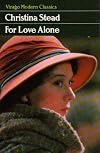
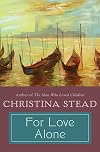
For Love Alone
by Christina Stead
On This Page
Description
One woman's obsession with love and fate leads her to unexpected truths about passion, sexuality, and power in 1930s London Driven by a belief in love above all else, Teresa Hawkins leaves her life in Australia and moves to London in search of her destiny. After years of emotional distance within her family, and despite her naïveté of the vagaries of heartache, Teresa dedicates her life to the commandment "thou shalt love." Affection-starved and painfully vulnerable, she immediately show more focuses her affections on Jonathan Crow, her egotistical and indifferent Latin tutor. But it's only through another man, an entirely unexpected influence on her life, that Teresa will gain a full consciousness of her own sexuality and identity as a woman. For Love Alone is a powerful novel written in an original voice--a feat of literary narrative by one of the twentieth century's finest writers. show lessTags
Recommendations
















Member Reviews
There were times I enjoyed reading this book; I didn't dislike it at any time, but I feel ambivalent about it. Perhaps it is because the characters are of my parents' generation and they are at once too close and too far away; perhaps it is because 500 pages of intellectualising about love is one or two pages too many; perhaps it is because the characters are all unlikeable (apart from Aunt Bea who is delightful). In the end I thought it a book about nothing real
Usually, when a book is as well thought of as this one, I can at least understand the reason even if I don't like it. I don't like it. For 502 pages I didn't like it, and I'm still not sure what, other than its pretensions, makes Christina Stead a respected author.
For Love Alone opens with Andrew Hawkins, father of the protagonist (and Stead's alter ego) Teresa, admiring himself and explaining how women have always loved him. Teresa is rightly disgusted, but she is his true child both in coloring and in her desire to live for love. What love means is the center of the book, but what it means to Teresa is never clear.
Teresa goes from a teaching job for which she is unsuited and poorly trained to a secretarial job which pays better money show more in an effort to get herself into the university in Sydney. Her Latin tutor is a young graduate, Jonathan Crow, who has won a fellowship to study in England and is waiting for his term there to begin. He is as self-centered as her father, but Teresa conceives the plan of following him to England to see what may come of their relationship. Having starved herself for three years to save the money, she arrives in England to find herself "loving" Johnny, but unable to give herself to him. He bemoans his poverty and his inability to find love and holds forth on revolutionary freedom for endless pages. Almost upon her arrival Teresa gets a job in an office run by James Quick, who falls in love with her and spots Jon Crow for the sham that he is. Realizing that she had never loved Jonathan, Teresa also realizes that she loves James and moves in with him. He is willing to give her the freedom that she craves, and she takes it but returns to him.
I didn't like any of the characters. I didn't like the writing. (What is a person to do with a sentence like, "She crouched beside him and looked at his dark hair with the pale lock tossed over his face; at the dark, tenacious, sorry profile."? How can dark hair be pale?) Stead does convey the seediness of lower working class living conditions, but I could not find any redeeming insight in the whole book. I wish somebody would show me what I missed. show less
For Love Alone opens with Andrew Hawkins, father of the protagonist (and Stead's alter ego) Teresa, admiring himself and explaining how women have always loved him. Teresa is rightly disgusted, but she is his true child both in coloring and in her desire to live for love. What love means is the center of the book, but what it means to Teresa is never clear.
Teresa goes from a teaching job for which she is unsuited and poorly trained to a secretarial job which pays better money show more in an effort to get herself into the university in Sydney. Her Latin tutor is a young graduate, Jonathan Crow, who has won a fellowship to study in England and is waiting for his term there to begin. He is as self-centered as her father, but Teresa conceives the plan of following him to England to see what may come of their relationship. Having starved herself for three years to save the money, she arrives in England to find herself "loving" Johnny, but unable to give herself to him. He bemoans his poverty and his inability to find love and holds forth on revolutionary freedom for endless pages. Almost upon her arrival Teresa gets a job in an office run by James Quick, who falls in love with her and spots Jon Crow for the sham that he is. Realizing that she had never loved Jonathan, Teresa also realizes that she loves James and moves in with him. He is willing to give her the freedom that she craves, and she takes it but returns to him.
I didn't like any of the characters. I didn't like the writing. (What is a person to do with a sentence like, "She crouched beside him and looked at his dark hair with the pale lock tossed over his face; at the dark, tenacious, sorry profile."? How can dark hair be pale?) Stead does convey the seediness of lower working class living conditions, but I could not find any redeeming insight in the whole book. I wish somebody would show me what I missed. show less
Ratings
Members
- Recently Added By
Lists

Shaking a Leg
111 works; 3 members
Author Information

24+ Works 3,512 Members
Author Christina Stead was born in Rockdale, New South Wales, Australia on July 17, 1902. She left Australia in 1928 and spent time in Europe, England, and the United States before permanently returning in 1974. She wrote fifteen novels and numerous volumes of short stories. She is best known for her novel, The Man Who Loved Children, which was show more based on her childhood. Her novels were unpublished in Australia until 1965 and she was denied the Britannica-Australia award in 1967 on the grounds that she was no longer considered an Australian. In 1974, she won the Patrick White award. While living in the United States during the 1940s, she worked as a Hollywood scriptwriter and contributed to Madame Curie and They Were Expendable. She died on March 31, 1983. (Bowker Author Biography) show less
Some Editions
Series
Belongs to Publisher Series
Work Relationships
Has as a commentary on the text
Common Knowledge
- Original publication date
- 1945
- People/Characters
- Teresa Hawkins; Jonathan Crow
- Related movies
- For Love Alone (1986 | IMDb)
- First words
- In the part of the world Teresa came from, winter is in July, spring brides marry in September, and Christmas is consummated with roast beef, suckling pig, and brandy-laced plum pudding at 100 degrees in the shade, near the t... (show all)all pine-tree loaded with gifts and tinsel as in the old country, and the old carols have rung out all through the night.
Christina Stead has had trouble finding an audience. (Introduction) - Last words
- (Click to show. Warning: May contain spoilers.)"It's dreadful to think that it will go on being repeated forever, he - and me! What's there to stop it?"
(Click to show. Warning: May contain spoilers.)But to anyone who submits to the power of this remarkable book, it seems as if she has gone as far along the road as any of the great, among whom she must be numbered. (Introduction)
Classifications
Statistics
- Members
- 279
- Popularity
- 115,818
- Reviews
- 2
- Rating
- (3.43)
- Languages
- English
- Media
- Paper, Ebook
- ISBNs
- 15
- ASINs
- 6