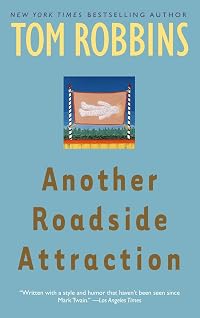
Another Roadside Attraction
by Tom Robbins
On This Page
Description
"Written with a style and humor that haven't been seen since Mark Twain."--Los Angeles Times What if the Second Coming didn't quite come off as advertised? What if "the Corpse" on display in that funky roadside zoo is really who they say it is--what does that portend for the future of western civilization? And what if a young clairvoyant named Amanda reestablishes the flea circus as popular entertainment and fertility worship as the principal religious form of our high-tech age? Another show more Roadside Attraction answers those questions and a lot more. It tell us, for example, what the sixties were truly all about, not by reporting on the psychedelic decade but by recreating it, from the inside out. In the process, this stunningly original seriocomic thriller is fully capable of simultaneously eating a literary hot dog and eroding the borders of the mind. "Hard to put down because of the sheer brilliance and fun of the writing. The sentiments of Brautigan and the joyously compassionate omniscience of Fielding dance through the pages garbed colorfully in the language of Joyce."--Rolling Stone show lessTags
Recommendations





Member Reviews
This is the third book I've read recently that is an experimental search for a philosophy to live by and it is by far the best. Tom Robbins is a master at weaving interesting characters and places into a narrative that is both literary and scatalogical. This, I believe, was his first work and I think it will stand as a monument to him.
The story revolves around the Captain Kendrick's Memorial Hot Dog Wildlife Preserve run by John Paul and Amanda Ziller. Amanda is a vegetarian and butterfly fancier. John Paul is a sculptor, musician and magician. Also living at the preserve is Amanda's son, Thor, Mon Cul, a baboon, and Marx Marvelous, a scientist who has recently dropped out of a prestigious think tank. Their friend, Plucky Purcell, show more stumbled upon a sect of murderous monks and infiltrates them. While in Rome to teach karate to the Pope's Swiss Guard, he is able to enter the catacombs under the Vatican after an earthquake. He helps himself to some gold and then discovers a well-preserved mummy which he believes to be Jesus Christ. If he's right, then Christ never rose from the grave and all of Christianity is a lie. He manages to get "The Corpse" back to the preserve but then they can't agree what to do with it. Vatican officials and FBI agents are closing in. The ending is as offbeat as the rest of the book.
This book should make you think about organized religion and, if you are a Christian, make you question your upbringing but it doesn't deny god. Even if you don't like the message I think the quirky characters, the oddball stories and the description of the Washington flora and fauna are worth the ride. show less
The story revolves around the Captain Kendrick's Memorial Hot Dog Wildlife Preserve run by John Paul and Amanda Ziller. Amanda is a vegetarian and butterfly fancier. John Paul is a sculptor, musician and magician. Also living at the preserve is Amanda's son, Thor, Mon Cul, a baboon, and Marx Marvelous, a scientist who has recently dropped out of a prestigious think tank. Their friend, Plucky Purcell, show more stumbled upon a sect of murderous monks and infiltrates them. While in Rome to teach karate to the Pope's Swiss Guard, he is able to enter the catacombs under the Vatican after an earthquake. He helps himself to some gold and then discovers a well-preserved mummy which he believes to be Jesus Christ. If he's right, then Christ never rose from the grave and all of Christianity is a lie. He manages to get "The Corpse" back to the preserve but then they can't agree what to do with it. Vatican officials and FBI agents are closing in. The ending is as offbeat as the rest of the book.
This book should make you think about organized religion and, if you are a Christian, make you question your upbringing but it doesn't deny god. Even if you don't like the message I think the quirky characters, the oddball stories and the description of the Washington flora and fauna are worth the ride. show less
Robbins' riff on organized religion is still as sharp and funny as it was when it was written half a century ago.
Even though it was his first novel, 'Another Roadside Attraction' already shows the structural elements Robbins continued to use in his other works: a collection of oddball characters and seemingly unrelated and wildly unlikely events all stitched together with wry observations and astonishing metaphors. The reader is entertained, amused, and frequently baffled as to just where this journey is going but it eventually gets there and it always turns out that the trip was worth the effort.
In this debut effort, John Paul Zimmer (loincloth-clad musician, sculptor, and mystic) in company with his companion baboon Mon Cul and his show more lubricious bride Amanda (the ultimate hippy-chick Earth mother) decide to rehabilitate an abandoned diner in Washington’s rain-soaked Skagit Valley. There they open a hot dog stand and zoo containing, among other things, a tsetse fly preserved in amber, a flea circus whose performers are costumed by Amanda in microscopic velvet and spangles, a collection of garter snakes, and a bow-legged rooster. From there, it’s but a hop, skip, and jump (which, in Robbins-land means about 200 pages) to an astonishing discovery in the catacombs of the Vatican and the need to reveal something which could bring down Western civilization. Actually, it’s two decisions – should they tell, and is Western civilization worth keeping, anyway.
If one digs down below the mushroom-glazed surface, there’s a great deal to think about in this novel. Robbins is not reluctant to tackle The Big Questions. Only the reader can decide who comes out on top in the resulting brawl. show less
Even though it was his first novel, 'Another Roadside Attraction' already shows the structural elements Robbins continued to use in his other works: a collection of oddball characters and seemingly unrelated and wildly unlikely events all stitched together with wry observations and astonishing metaphors. The reader is entertained, amused, and frequently baffled as to just where this journey is going but it eventually gets there and it always turns out that the trip was worth the effort.
In this debut effort, John Paul Zimmer (loincloth-clad musician, sculptor, and mystic) in company with his companion baboon Mon Cul and his show more lubricious bride Amanda (the ultimate hippy-chick Earth mother) decide to rehabilitate an abandoned diner in Washington’s rain-soaked Skagit Valley. There they open a hot dog stand and zoo containing, among other things, a tsetse fly preserved in amber, a flea circus whose performers are costumed by Amanda in microscopic velvet and spangles, a collection of garter snakes, and a bow-legged rooster. From there, it’s but a hop, skip, and jump (which, in Robbins-land means about 200 pages) to an astonishing discovery in the catacombs of the Vatican and the need to reveal something which could bring down Western civilization. Actually, it’s two decisions – should they tell, and is Western civilization worth keeping, anyway.
If one digs down below the mushroom-glazed surface, there’s a great deal to think about in this novel. Robbins is not reluctant to tackle The Big Questions. Only the reader can decide who comes out on top in the resulting brawl. show less
This would be well worth reading for the language if nothing else: beautiful prose, with turns of phrase that make you laugh out loud. Reminiscent of Pynchon, but more coherent. The characters are all so extreme that they are almost caricatures, yet still engaging and believable within the zany world of the book.
The story takes a while to get going, but I didn't mind because the characters and the language were so much fun. Once it does get going, it is ultimately about the search for meaning and the nature of religion (and the religion of nature).
The story takes a while to get going, but I didn't mind because the characters and the language were so much fun. Once it does get going, it is ultimately about the search for meaning and the nature of religion (and the religion of nature).
This is the fourth novel I have read in Robbins’s oeuvre, and although I have six more to go, I feel comfortable saying the man can’t go wrong. He’s creative, thought-provoking, funny as hell, and he harbors a love for language and all things word-y that is infectious. Another Roadside Attraction is his first novel, yet unlike the majority of authors who only fine tune their voice in subsequent works, he already has a grasp on his unique style of storytelling.
Some of the reasons I enjoyed this book: hippies, mushrooms, the Paul Newmanesque Plucky Purcell (a.k.a. Brother Dallas), conspiracies within the Roman Catholic church of vast implications, flea circuses, the Infinite Goof, the traditional American staples that are hotdogs, show more Bow Wow Mountain (where I could see myself gladly living out the rest of my days after hitting old age), the Indo-Tibetan Circus and Giant Panda Gypsy Blues Band (where I could see myself gladly living out my youth before my retirement to Bow Wow Mountain), Tarzan movies. The list could go on, as the book is fraught with memorable characters, images, situations, and places.
Another Roadside Attraction is often credited with being a quintessential book of the 1960’s, and although there is no questioning that the novel does in many ways capture the spirit of one of the wildest decades etched in cultural memory, in many ways it goes beyond being a mere time capsule and puts the time period in its ideal mold, rather than definitive. Take this small piece from the book:
“While strolling through her cactus garden one warmish June morning, Amanda came upon an old Navajo man painting pictures in the sand.
‘What is the function of the artist?’ Amanda demanded of the talented trespasser.
‘The function of the artist,’ the Navajo answered, ‘is to provide what life does not.’”
This sums up what I think Robbins excels at, especially in terms of thinking of this book as being iconic of the 1960’s. Yes, in Another Roadside Attraction he picks up on some essential quality that makes up the backbone of the time period, but he also creates it anew, and this vision is uniquely particular to Tom Robbins and infinitely enjoyable for the reader. I recommend this book highly to anyone other than you stiffly stiffersons out there, as there is drug use and numerous sex scenes. Also, there are some ideas put forth that may offend staunch Christians, but, ya know, don’t be so serious. It’s fiction (plus, if you hold on to your beliefs but imagine the implications were the book’s plot hypothetically true, you’ll find a feast where the expression “food for thought” can be applied).
This book is certainly going in my “To Re-Read” pile. A last quote from this book to enjoy (although I can’t remember where it is in the book and I am quoting from memory, I think I’m pretty close):
“Life is a fortune cookie in which someone forgot to put the fortune.”
Think about it. show less
Some of the reasons I enjoyed this book: hippies, mushrooms, the Paul Newmanesque Plucky Purcell (a.k.a. Brother Dallas), conspiracies within the Roman Catholic church of vast implications, flea circuses, the Infinite Goof, the traditional American staples that are hotdogs, show more Bow Wow Mountain (where I could see myself gladly living out the rest of my days after hitting old age), the Indo-Tibetan Circus and Giant Panda Gypsy Blues Band (where I could see myself gladly living out my youth before my retirement to Bow Wow Mountain), Tarzan movies. The list could go on, as the book is fraught with memorable characters, images, situations, and places.
Another Roadside Attraction is often credited with being a quintessential book of the 1960’s, and although there is no questioning that the novel does in many ways capture the spirit of one of the wildest decades etched in cultural memory, in many ways it goes beyond being a mere time capsule and puts the time period in its ideal mold, rather than definitive. Take this small piece from the book:
“While strolling through her cactus garden one warmish June morning, Amanda came upon an old Navajo man painting pictures in the sand.
‘What is the function of the artist?’ Amanda demanded of the talented trespasser.
‘The function of the artist,’ the Navajo answered, ‘is to provide what life does not.’”
This sums up what I think Robbins excels at, especially in terms of thinking of this book as being iconic of the 1960’s. Yes, in Another Roadside Attraction he picks up on some essential quality that makes up the backbone of the time period, but he also creates it anew, and this vision is uniquely particular to Tom Robbins and infinitely enjoyable for the reader. I recommend this book highly to anyone other than you stiffly stiffersons out there, as there is drug use and numerous sex scenes. Also, there are some ideas put forth that may offend staunch Christians, but, ya know, don’t be so serious. It’s fiction (plus, if you hold on to your beliefs but imagine the implications were the book’s plot hypothetically true, you’ll find a feast where the expression “food for thought” can be applied).
This book is certainly going in my “To Re-Read” pile. A last quote from this book to enjoy (although I can’t remember where it is in the book and I am quoting from memory, I think I’m pretty close):
“Life is a fortune cookie in which someone forgot to put the fortune.”
Think about it. show less
Amanda had peed in Seattle, she had peed in Everett. And now as they sped through the Skagit River Valley, she had to pee again. Already, she and John Paul were far behind the caravan that motored to Bellingham (near the Canadian border) where, on the campus of Western Washington State College, the circus was to unfurl its canvases for the last time.
In approximately 1999, I picked this book off the shelves of the main library at the abovementioned college, by then rebranded Western Washington University. I don't think this was my first novel by Robbins, to whom I'd been introduced by Gus Van Sant's screen adaptation of [b:Even Cowgirls Get the Blues|7572|Even Cowgirls Get the Blues|Tom show more Robbins|https://i.gr-assets.com/images/S/compressed.photo.goodreads.com/books/1336172455l/7572._SY75_.jpg|610037]. This was around the same time I took a Post-Modern Literature course where we read [b:The Handmaid's Tale|38447|The Handmaid's Tale (The Handmaid's Tale, #1)|Margaret Atwood|https://i.gr-assets.com/images/S/compressed.photo.goodreads.com/books/1578028274l/38447._SY75_.jpg|1119185] and [b:Blood and Guts in High School|321950|Blood and Guts in High School|Kathy Acker|https://i.gr-assets.com/images/S/compressed.photo.goodreads.com/books/1327880994l/321950._SY75_.jpg|817580] (later I wrote a post-modern essay conversing with Kathy Acker about how much I hated her book).
At any rate, I have fond memories of Robbins' novels as quirky, insightful, and bawdy. A year or so ago, I was in a book rut and a friend (who lives in Everett, site of the second peeing, about 25 miles north of Seattle) suggested Robbins as her favorite author. I thought I'd read through his short oeuvre (only eight novels, an autobiography, and a collection of short stories and essays) in chronological order. That's not working out so well, because I'm finding my tastes have changed.
Written in 1971, this novel was Robbins' attempt at recreating the 1960s on the page, in a non-linear plot, written as a first-person POV report. In the first chapter, we meet a young psychic named Amanda:
"There are three things that I like," Amanda exclaimed upon awakening from her first long trance. "These are: the butterfly, the cactus, and the Infinite Goof."
Later, she amended the list to include mushrooms and motorcycles.
We do and don't know much about Amanda. She's a teen mom, with an "enormously fat" father and apparently no mother, who lives in Arizona. Dad is apparently wealthy enough to have a lawyer, to buy Amanda a performing bear, retired from the Moscow Circus, and to take his daughter to Europe.
"What would you like to see first?" Amanda's father asked his budding twelve-year-old upon their arrival in Paris.
"I'd like to visit the brothels," answered Amanda, scarcely looking up from her onion soup. Amanda's papa refused to take his pubescent daughter into the Parisian fleshpots, but he did point them out to her from the window of a taxi.
Whereupon the child asked, "Father, if you were in a whorehouse and you couldn't finish, would it be permissable [sic] to ask for a bowser bag to take the leftovers home?"
After her exiled Polish prince/rock-and-roll singer boyfriend is caught trying to smuggle exotic butterfly eggs into the country for her, Amanda signs up as a clairvoyant with the Indo-Tibetan Circus and Giant Panda Gypsy Blues Band, which is where she meets and immediately marries John Paul Ziller. There's a whole other cast of characters who, along with the narrator, wax philosophical about drugs and the economy and morality as a social construct. Again, it's the sixties in novel form. While that was apparently charming in 1999, in 2022 I found it boring.
And then there's Robbins' excessive use of figurative language:
On the same page (53 in my library copy), a cucumber sandwich is described thusly:
The bread slices collapsed like movie-set walls beneath her bite; the mayonnaise squished, the cucumber snapped tartly like the spine of an elf.
And then we get this description of the ITC & GPGBB manager at the end of tour:
On Tuesday morning, there was an unseasonal frost. The grass looked as if it had been chewing Tums. Across the antacid residue, Nearly Normal's boots jitterbugged from camp to camp: paychecks to dispense, good-byes to exchange. From camp to camp he trotted through his own breath like a riot cop charging tear gas. His glasses steamed over, his nose was its own gas mask.
I couldn't even make it through the first 100 pages. Considering that what I remember about ECGTB is a discussion of the difference between virginal and nonvirginal vaginal odor, I think I'll skip that one, too. Maybe I'll give Robbins another try in the future, but I think he's no longer a cup of my tea. show less
In approximately 1999, I picked this book off the shelves of the main library at the abovementioned college, by then rebranded Western Washington University. I don't think this was my first novel by Robbins, to whom I'd been introduced by Gus Van Sant's screen adaptation of [b:Even Cowgirls Get the Blues|7572|Even Cowgirls Get the Blues|Tom show more Robbins|https://i.gr-assets.com/images/S/compressed.photo.goodreads.com/books/1336172455l/7572._SY75_.jpg|610037]. This was around the same time I took a Post-Modern Literature course where we read [b:The Handmaid's Tale|38447|The Handmaid's Tale (The Handmaid's Tale, #1)|Margaret Atwood|https://i.gr-assets.com/images/S/compressed.photo.goodreads.com/books/1578028274l/38447._SY75_.jpg|1119185] and [b:Blood and Guts in High School|321950|Blood and Guts in High School|Kathy Acker|https://i.gr-assets.com/images/S/compressed.photo.goodreads.com/books/1327880994l/321950._SY75_.jpg|817580] (later I wrote a post-modern essay conversing with Kathy Acker about how much I hated her book).
At any rate, I have fond memories of Robbins' novels as quirky, insightful, and bawdy. A year or so ago, I was in a book rut and a friend (who lives in Everett, site of the second peeing, about 25 miles north of Seattle) suggested Robbins as her favorite author. I thought I'd read through his short oeuvre (only eight novels, an autobiography, and a collection of short stories and essays) in chronological order. That's not working out so well, because I'm finding my tastes have changed.
Written in 1971, this novel was Robbins' attempt at recreating the 1960s on the page, in a non-linear plot, written as a first-person POV report. In the first chapter, we meet a young psychic named Amanda:
"There are three things that I like," Amanda exclaimed upon awakening from her first long trance. "These are: the butterfly, the cactus, and the Infinite Goof."
Later, she amended the list to include mushrooms and motorcycles.
We do and don't know much about Amanda. She's a teen mom, with an "enormously fat" father and apparently no mother, who lives in Arizona. Dad is apparently wealthy enough to have a lawyer, to buy Amanda a performing bear, retired from the Moscow Circus, and to take his daughter to Europe.
"What would you like to see first?" Amanda's father asked his budding twelve-year-old upon their arrival in Paris.
"I'd like to visit the brothels," answered Amanda, scarcely looking up from her onion soup. Amanda's papa refused to take his pubescent daughter into the Parisian fleshpots, but he did point them out to her from the window of a taxi.
Whereupon the child asked, "Father, if you were in a whorehouse and you couldn't finish, would it be permissable [sic] to ask for a bowser bag to take the leftovers home?"
After her exiled Polish prince/rock-and-roll singer boyfriend is caught trying to smuggle exotic butterfly eggs into the country for her, Amanda signs up as a clairvoyant with the Indo-Tibetan Circus and Giant Panda Gypsy Blues Band, which is where she meets and immediately marries John Paul Ziller. There's a whole other cast of characters who, along with the narrator, wax philosophical about drugs and the economy and morality as a social construct. Again, it's the sixties in novel form. While that was apparently charming in 1999, in 2022 I found it boring.
And then there's Robbins' excessive use of figurative language:
On the same page (53 in my library copy), a cucumber sandwich is described thusly:
The bread slices collapsed like movie-set walls beneath her bite; the mayonnaise squished, the cucumber snapped tartly like the spine of an elf.
And then we get this description of the ITC & GPGBB manager at the end of tour:
On Tuesday morning, there was an unseasonal frost. The grass looked as if it had been chewing Tums. Across the antacid residue, Nearly Normal's boots jitterbugged from camp to camp: paychecks to dispense, good-byes to exchange. From camp to camp he trotted through his own breath like a riot cop charging tear gas. His glasses steamed over, his nose was its own gas mask.
I couldn't even make it through the first 100 pages. Considering that what I remember about ECGTB is a discussion of the difference between virginal and nonvirginal vaginal odor, I think I'll skip that one, too. Maybe I'll give Robbins another try in the future, but I think he's no longer a cup of my tea. show less
oh, tom robbins.
this is his first book, which i think is important to mention for a few reasons. first of all, i find it really interesting that he was able to jump so successfully into such an unusual style of writing. i don't find this book as bizarre as others of his, but to call it unusual is still an understatement. (unusual for anyone but robbins, that is.) second of all, this is the fifth book of his that i've read and each of the other four have been concretely (in my opinion) but discreetly alluded to. it makes me really curious to read the rest of his books to see if he manages to do that with all of them. also, it was published in 1971, but is amazingly pertinent today. (as has been everything else of his that i've read.)
but show more about the book itself. i love tom robbins but am forced to admit that the first third or so of this book was harder for me to read than i'm used to with him. i feel like the last one i recently read (skinny legs and all) took a moment to get going as well, but it held my interest more easily than this one did to start out. i really do love his writing, but it's important in his books to pay attention to everything you read, and i had a little trouble doing that at the outset. but, true to form, it really picked up further on. i'd almost forgotten that the first part of the book wasn't great for me, because he does such a good job once it gets going. and i get distracted because i think what might draw me so strongly to him is that i see him as one of the most honest writers out there. and as usual, he has a lot to say. social and sociological stuff mostly. religion, politics, familiar themes for him. faith and science, if and how they intersect. but mostly this is a book about freedom. and mostly, it is really, really beautiful. both what he says and how he says it. i love that he chooses to write about these human themes and i love what he has to say. and in this book, as much or more than others, i love how he says it.
"When she was a small girl, Amanda hid a ticking clock in an old rotten tree trunk. It drove woodpeckers crazy. Ignoring tasty bugs all around them, they just about beat their brains out trying to get at the clock. Years later, Amanda used the woodpecker experiment as a model for understanding capitalism, Communism, Christianity and all other systems that traffic in future rewards rather than in present realities."
"Among the Haida Indians of the Pacific Northwest, the verb for 'making poetry' is the same as the verb 'to breathe.'
Such tidbits of ethnic lore delighted Amanda, and she vowed that from that time onward she would try to regulate each breath as if she were composing a poem. She was as good as her word, and her new style of breathing added to her warehouse of personal charm.
Once, while breathing an especially strenuous stanza, she sucked in a stinkbug that had been bumbling by. 'What a rotten rhyme,' she gagged. 'I think I'll go back to prose.'"
"'...freedom, real freedom - not the freedom to say 'shit' in public or to criticize their leaders or to worship God in the church of their choice, but the freedom to be free of languages and leaders and gods...'"
"'...Christianity, a religion which is, at best, a distortion of the teachings of Christ, and, at worst, is an authoritarian system that limits man's liberty and represses the human spirit.'"
"'The fact is, what I hated in the Church was what I hated in society. Namely, authoritarians. Power freaks. Rigid dogmatists. Those greedy, underloved, undersexed twits who want to run everything. While the rest of us are busy living - busy tasting and testing and hugging and kissing and goofing and growing - they are busy taking over. Soon their tentacles are around everything: our governments, our economies, our schools, our publications, our arts and our religious institutions. Men who lust for power, who are addicted to laws and other unhealthy abstractions, who long to govern and lead and censor and order and reward and punish; those men are the turds of Moloch, men who don't know how to love, men who are sickly afraid of death and therefore are afraid of life; they fear all that is chaotic and unruly and free-moving and changing - thus, as Amanda has said, they fear nature and fear life itself, they deny life and in so doing deny God. They are presidents and governors and mayors and generals and police officials and chairmen-of-the-boards. They are crafty cardinals and fat bishops and mean old monsignor masturbators. They are the most frightened and most frightening mammals who prowl the planet; loveless, anal-compulsive control-freak authoritarians, and they are destroying everything that is wise and beautiful and free. And the most enormous ironic perversion is how they destroy in the name of Christ who is peace and God who is love.'"
"Marx Marvelous regained consciousness. His chest ached. He felt sick. He couldn't hear the music any more. Nor see the light. What for an instant he thought was the light proved to be the great rosy buttocks of Mon Cul baboon. The baboon was bowing to the crowd that had gathered. Each time he bowed his butt ascended like a flaming sun, and when he straightened, the sun set. So the day dawned and ended, dawned and ended, over and over again with only a soft sound in between like Magritte's bowler hat rolling upon a Belgian carpet. Time passed quickly by Mon Cul's rectal reckoning. It was all okay."
"On the Rand McNally Atlas map of the world, the United States of America is colored pale lime. I assume it was an arbitrary choice of color. Not symbolic and certainly not realistic. As anyone who has flown cross-country well knows, the U.S.A. is greenish brown.
There may be patches of gray, yellow and blue, some solid chartreuses and some solid chocolates; but generally America, from the altitude of an airliner, is a light brown flecked, smeared or mottled with various shades of dull green. That color scheme is maintained from East Coast to West Coast, an admirable if monotonous consistency. One of the few places where the scheme is altered, where it really breaks down and becomes a color experience of a different order, is in the area of northwestern Washington. After hours of flight above lackluster greenish brown, a Seattle-bound plane will eventually cross the Cascade Mountain Range and suddenly find itself gliding over the open throat of an emerald. The scene below is moist and brilliant; a light, bright, pervasive green at once so misty and so vivid that one suffers the illusion that one has come at last to the only region of our nation that is truly green, the place where green turns Zen cartwheels in celebration of the death of brown."
"A sausage is an image of rest, peace and tranquillity in stark contrast to the destruction and chaos of everyday life.
Consider the peaceful repose of the sausage compared with the aggressiveness and violence of bacon." show less
this is his first book, which i think is important to mention for a few reasons. first of all, i find it really interesting that he was able to jump so successfully into such an unusual style of writing. i don't find this book as bizarre as others of his, but to call it unusual is still an understatement. (unusual for anyone but robbins, that is.) second of all, this is the fifth book of his that i've read and each of the other four have been concretely (in my opinion) but discreetly alluded to. it makes me really curious to read the rest of his books to see if he manages to do that with all of them. also, it was published in 1971, but is amazingly pertinent today. (as has been everything else of his that i've read.)
but show more about the book itself. i love tom robbins but am forced to admit that the first third or so of this book was harder for me to read than i'm used to with him. i feel like the last one i recently read (skinny legs and all) took a moment to get going as well, but it held my interest more easily than this one did to start out. i really do love his writing, but it's important in his books to pay attention to everything you read, and i had a little trouble doing that at the outset. but, true to form, it really picked up further on. i'd almost forgotten that the first part of the book wasn't great for me, because he does such a good job once it gets going. and i get distracted because i think what might draw me so strongly to him is that i see him as one of the most honest writers out there. and as usual, he has a lot to say. social and sociological stuff mostly. religion, politics, familiar themes for him. faith and science, if and how they intersect. but mostly this is a book about freedom. and mostly, it is really, really beautiful. both what he says and how he says it. i love that he chooses to write about these human themes and i love what he has to say. and in this book, as much or more than others, i love how he says it.
"When she was a small girl, Amanda hid a ticking clock in an old rotten tree trunk. It drove woodpeckers crazy. Ignoring tasty bugs all around them, they just about beat their brains out trying to get at the clock. Years later, Amanda used the woodpecker experiment as a model for understanding capitalism, Communism, Christianity and all other systems that traffic in future rewards rather than in present realities."
"Among the Haida Indians of the Pacific Northwest, the verb for 'making poetry' is the same as the verb 'to breathe.'
Such tidbits of ethnic lore delighted Amanda, and she vowed that from that time onward she would try to regulate each breath as if she were composing a poem. She was as good as her word, and her new style of breathing added to her warehouse of personal charm.
Once, while breathing an especially strenuous stanza, she sucked in a stinkbug that had been bumbling by. 'What a rotten rhyme,' she gagged. 'I think I'll go back to prose.'"
"'...freedom, real freedom - not the freedom to say 'shit' in public or to criticize their leaders or to worship God in the church of their choice, but the freedom to be free of languages and leaders and gods...'"
"'...Christianity, a religion which is, at best, a distortion of the teachings of Christ, and, at worst, is an authoritarian system that limits man's liberty and represses the human spirit.'"
"'The fact is, what I hated in the Church was what I hated in society. Namely, authoritarians. Power freaks. Rigid dogmatists. Those greedy, underloved, undersexed twits who want to run everything. While the rest of us are busy living - busy tasting and testing and hugging and kissing and goofing and growing - they are busy taking over. Soon their tentacles are around everything: our governments, our economies, our schools, our publications, our arts and our religious institutions. Men who lust for power, who are addicted to laws and other unhealthy abstractions, who long to govern and lead and censor and order and reward and punish; those men are the turds of Moloch, men who don't know how to love, men who are sickly afraid of death and therefore are afraid of life; they fear all that is chaotic and unruly and free-moving and changing - thus, as Amanda has said, they fear nature and fear life itself, they deny life and in so doing deny God. They are presidents and governors and mayors and generals and police officials and chairmen-of-the-boards. They are crafty cardinals and fat bishops and mean old monsignor masturbators. They are the most frightened and most frightening mammals who prowl the planet; loveless, anal-compulsive control-freak authoritarians, and they are destroying everything that is wise and beautiful and free. And the most enormous ironic perversion is how they destroy in the name of Christ who is peace and God who is love.'"
"Marx Marvelous regained consciousness. His chest ached. He felt sick. He couldn't hear the music any more. Nor see the light. What for an instant he thought was the light proved to be the great rosy buttocks of Mon Cul baboon. The baboon was bowing to the crowd that had gathered. Each time he bowed his butt ascended like a flaming sun, and when he straightened, the sun set. So the day dawned and ended, dawned and ended, over and over again with only a soft sound in between like Magritte's bowler hat rolling upon a Belgian carpet. Time passed quickly by Mon Cul's rectal reckoning. It was all okay."
"On the Rand McNally Atlas map of the world, the United States of America is colored pale lime. I assume it was an arbitrary choice of color. Not symbolic and certainly not realistic. As anyone who has flown cross-country well knows, the U.S.A. is greenish brown.
There may be patches of gray, yellow and blue, some solid chartreuses and some solid chocolates; but generally America, from the altitude of an airliner, is a light brown flecked, smeared or mottled with various shades of dull green. That color scheme is maintained from East Coast to West Coast, an admirable if monotonous consistency. One of the few places where the scheme is altered, where it really breaks down and becomes a color experience of a different order, is in the area of northwestern Washington. After hours of flight above lackluster greenish brown, a Seattle-bound plane will eventually cross the Cascade Mountain Range and suddenly find itself gliding over the open throat of an emerald. The scene below is moist and brilliant; a light, bright, pervasive green at once so misty and so vivid that one suffers the illusion that one has come at last to the only region of our nation that is truly green, the place where green turns Zen cartwheels in celebration of the death of brown."
"A sausage is an image of rest, peace and tranquillity in stark contrast to the destruction and chaos of everyday life.
Consider the peaceful repose of the sausage compared with the aggressiveness and violence of bacon." show less
I first read this book at least 45 years ago and didn't remember anything about it. I'm not sure that it has aged well in that the whole hippie culture feels quaint to me rather than edgy as it probably was when first released in 1971. It is still quirky and thought-provoking, though. My biggest beef with the book has nothing to do with its treatment of Christianity, but rather the fact that Robbins goes on and on and on and on and on with his theories ad nauseum. Marx Marvelous will simply not shut up about his theories and the book becomes bogged down and very very tedious to read at times. Even Robbins knew that he went on too long with some of it as shown by his actually including the words blah blah blah into Marx's arguments which show more are falling on Amanda's deaf ears. Blah blah blah indeed. It put me in mind of the gab sessions in the dorm that were more fueled by too much weed than by good ideas. Very self-indulgent stuff. If some of this were edited out, I would give the book a much higher rating because Tom Robbins imagination creates a such a fantastical, fun world. show less
Members
- Recently Added By
Published Reviews
added by jww7575
Lists

Top Five Books of 2019
387 works; 111 members

1970s
657 works; 23 members

Books Read in 2015
3,299 works; 129 members

Literary Travelogue of the United States Challenge
133 works; 6 members

Read
293 works; 4 members

First Novels
373 works; 17 members

Swinging Seventies
255 works; 18 members

Novels that you shouldn't waste your time on
94 works; 52 members

Blue Pyramid 1,276 Best Books of All Time
1,248 works; 32 members

Magic Realism
371 works; 52 members
Author Information

17+ Works 36,725 Members
Tom Robbins is a writer, novelist, editor, and journalist. He was born in Blowing Rock, North Carolina on July 22, 1936. Robbins studied journalism at Washington and Lee for two years and later graduated from the Richmond Professional Institute in 1961. He attended the Graduate School of Far Eastern Studies at the University of Washington. From show more 1957 to 1960, Robbins served in the U.S. Air Force stationed in Korea as a meteorologist. During his years in the service he took courses in Japanese culture and aesthetics in Tokyo. After the military, Robbins took a job as a copy editor at the Richmond Times-Dispatch. Robbins later worked as feature editor and art critic at the Seattle Times and part time at the Seattle Post-Intelligencer. Robbins published the novel, Another Roadside Attraction in 1971. Other books include Even Cowgirls Get the Blues and Still Life With Woodpecker. Even Cowgirls Get the Blues was made into a 1996 film directed by Gus Van Sant. Robbins has also acted in such films as Made in Heaven and Mrs. Parker and the Vicious Circle. A documentary entitled, Tom Robbins: A Writer in the Rain was made in 1997. In 2014, his title Tibetan Peach Pie: A True Account of an Imaginative Life, made The New York Times Best Seller List. (Bowker Author Biography) Tom Robbins is a Southerner by birth, Robbins has lived in & around Seattle since 1962. (Publisher Provided) show less
Awards and Honors
Awards
Notable Lists
Series
Belongs to Publisher Series
No Exit 18 Years (12)
Work Relationships
Common Knowledge
- Canonical title
- Another Roadside Attraction
- Original title
- Another Roadside Attraction
- Original publication date
- 1971
- People/Characters
- Amanda Ziller; John Paul Ziller; Plucky Purcell; Marx Marvellous; Father Gutstadt; Mon Cul (show all 7); The Corpse
- Important places
- Vatican City; San Francisco, California, USA; New York, New York, USA
- Epigraph
- “And there are also many other things which Jesus did, the which, if they should be written every one, I suppose that even the world itself could not contain the books that should be written."
JOHN 21:25
“Incidentally, Reggie Fox, who runs the Dalai Lama's 16-mm. projector, said that 16-mm. Tarzan films or Marx Brothers films would make a big hit with the Dalai Lama and those around him. They most certainly don't want to se... (show all)e any pictures where human or animal life is taken; amusement and adventure are the things that they are interested in.”
Lowell Thomas, Jr., Out of This World
(Appendix, “What to Take When You Go to Tibet") - Dedication
- This book is dedicated to the Kendrick boys—Capt. John (deceased) and Billy (kicking); to Shazam, to tiny Terrie, and to the “fantastic foolybear” wherever she may be.
- First words
- The magician's underwear has just been found in a cardboard suitcase floating in a stagnant pond on the outskirts of Miami.
- Last words
- (Click to show. Warning: May contain spoilers.)Let Amanda be your pine cone.
- Blurbers
- Pynchon, Thomas; Sturgeon, Theodore; Los Angeles Times; Playboy; The New York Times Book Review
- Original language
- English
Classifications
Statistics
- Members
- 3,873
- Popularity
- 4,090
- Reviews
- 40
- Rating
- (3.88)
- Languages
- 10 — Czech, Dutch, English, French, German, Greek, Italian, Portuguese, Russian, Turkish
- Media
- Paper, Ebook
- ISBNs
- 28
- ASINs
- 15