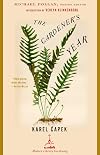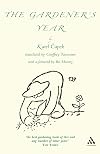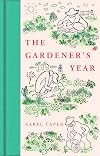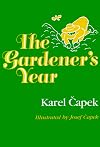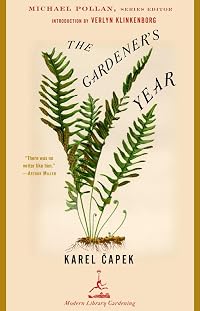
The Gardener's Year
by Karel Čapek
On This Page
Description
It is seldom that a practical guide to gardening attains the level of a literary masterpiece, still more seldom that a book on gardening can amuse and instruct even those who have no garden to plant., nor the faintest interest in acquiring one. The GardenerGC ?O s Year is a charismatic product of Karel CapekGC ?O s genius: amusing, informative, and full of a quizzical interest in people, animals and plants.In this new version, Geoffrey Newsome GC ?o the highly acclaimed translator of CapekGC show more ?O s witty Letters from England GC ?o has captured the grace and irony of the original Czech, to produce a volume that show lessTags
Recommendations


















Member Recommendations

by anonymous user
larshbacker Harrison discusses Karel Capek's book. Deeper reference to gardens and gardening. Highly recommended!
Member Reviews
A joy to read. Even if you don't garden, but if you do, you know that fussy obsession well, the absurdity of the pursuit, the intensity of fetishes, the competitiveness and shared insanity with other gardeners, almost the notes of an anthropologist. It's spring here in southern Australia, my vegetable and seedlings are near ready. The fecund madness of summer is near. I would've loved to have talked to Capek about his garden and shared seedlings with him. But I suspect he and I would be suspiciously eyeing off the size of each other's tomatoes and the voluptuousness of our roses. Still, we'd each know what a garden means to each other.
Worth reading each year around this time.
Worth reading each year around this time.
Famous Czech author Karel Capek entertains readers with a month-by-month rendering of real life gardening. He totally enjoys getting carried away in his subject, making a case for October actually being Spring for gardeners, as well for the "Now!" of buds, and the steaming glory of a newly delivered mound of fresh manure.
His humor combines well with his brother Josef's line drawing interpretations until
"the malice of human souls" deforms their country courtesy of The Munich Pact.
Though Karel Capek often mentions women favorably, all his fellow gardeners
are male. No reason is offered though maybe this was standard in the early 20th century...?
He once raised vegetables to the tune of crunching "...every day one hundred and twenty show more radishes,
because no one else would eat them...."
He further admits that he has become tenderhearted about eating what he has grown:
"If I were obliged to eat my roses or nibble the flowers of lilies-of-the-valley,
I think I should lose the respect which I have towards them."
And they toward him! show less
His humor combines well with his brother Josef's line drawing interpretations until
"the malice of human souls" deforms their country courtesy of The Munich Pact.
Though Karel Capek often mentions women favorably, all his fellow gardeners
are male. No reason is offered though maybe this was standard in the early 20th century...?
He once raised vegetables to the tune of crunching "...every day one hundred and twenty show more radishes,
because no one else would eat them...."
He further admits that he has become tenderhearted about eating what he has grown:
"If I were obliged to eat my roses or nibble the flowers of lilies-of-the-valley,
I think I should lose the respect which I have towards them."
And they toward him! show less
Entertaining and humorous thoughts on what it means to be a gardener with cute illustrations by the author throughout that remind me of Thurber. Lots of great aphorism material in here that gardener's will appreciate: "The life of a gardener is full of change and active will." "A real gardener is not a man who cultivates flowers; he is a man who cultivates the soil." and the opening line "There are several different ways in which to lay out a little garden; the best way is to get a gardener."
Capek's style in this was so fun and accessible that it made me want to read his other prose work, so now I have the collection of his 3 novels waiting on my shelf. I read R.U.R. years ago in a theatre class, and though it is notable for coining the show more word "robot," I had no idea he had more colloquial works without the heavy allegory. show less
Capek's style in this was so fun and accessible that it made me want to read his other prose work, so now I have the collection of his 3 novels waiting on my shelf. I read R.U.R. years ago in a theatre class, and though it is notable for coining the show more word "robot," I had no idea he had more colloquial works without the heavy allegory. show less
Although I am a rather clumsy gardener and I am plagued by rabbits and gophers and deer ( oh my!), I do share Capek's enthusiasm for gardening.
I re-read this book every year. It inspires me and gives me solace in the long dark days of Winter.
This is a light-hearted introduction to the work of Karel Capek, one of the best European writers from the last century.
I re-read this book every year. It inspires me and gives me solace in the long dark days of Winter.
This is a light-hearted introduction to the work of Karel Capek, one of the best European writers from the last century.
Entertaining and humorous thoughts on what it means to be a gardener with cute illustrations by the author throughout that remind me of Thurber. Lots of great aphorism material in here that gardener's will appreciate: "The life of a gardener is full of change and active will." "A real gardener is not a man who cultivates flowers; he is a man who cultivates the soil." and the opening line "There are several different ways in which to lay out a little garden; the best way is to get a gardener."
Capek's style in this was so fun and accessible that it made me want to read his other prose work, so now I have the collection of his 3 novels waiting on my shelf. I read R.U.R. years ago in a theatre class, and though it is notable for coining the show more word "robot," I had no idea he had more colloquial works without the heavy allegory. show less
Capek's style in this was so fun and accessible that it made me want to read his other prose work, so now I have the collection of his 3 novels waiting on my shelf. I read R.U.R. years ago in a theatre class, and though it is notable for coining the show more word "robot," I had no idea he had more colloquial works without the heavy allegory. show less
Karel Capek's little gardening book, The Gardener's Year, is a charming account of the gardener's joys and agonies throughout the year. Because it's a slim volume, a reader might easily dismiss it as a mere trifle. However, any gardener will recognize the age-old truths about which Capek writes.
The Gardener's Year takes the reader through a twelve-month cycle, from January through December. It is obvious from the beginning that Capek is a real "dirt gardener" (as Elizabeth Lawrence would say). He agonizes about the weather regardless of the season. If it's winter, it's either too cold or too warm. If it's summer, it's either too wet or too dry.
If nothing else proves that Capek is a dirt gardener, it's his fascination with the soil. show more Besides devoting an entire chapter to the making of "this noble and humane work which is called the soil," he refers to it continually throughout the book. In the chapter "On the Art of Gardening," Capek writes, ". . . I find that a real gardener is not a man who cultivates flowers; he is a man who cultivates the soil. . . . He lives buried in the ground. He builds his monument in a heap of compost. If he came into the Garden of Eden he would sniff excitedly and say: 'Good Lord, what humus!'" Later in the book, Capek continues on the theme of heaven-sent soil amendments: "Yes, improve the soil. A cartload of manure is most beautiful when it is brought on a frosty day, so that it steams like a sacrificial altar. When its fragrance reaches heaven, He who understands all things sniffs and says: 'Um, that's some nice manure.'" I just wonder if the original Czech word was "manure!"
I think it would be impossible to choose my favorite chapter - my favorite changes with the seasons. However, if I was forced to decide right now, I think I would choose "Buds." Capek perfectly describes that moment when the buds begin to open: "You must stand still; and then you will see open lips and furtive glances, tender fingers, and raised arms, the fragility of a baby, and the rebellious outburst of the will to live, and then you will hear the infinite march of the buds faintly roaring." show less
The Gardener's Year takes the reader through a twelve-month cycle, from January through December. It is obvious from the beginning that Capek is a real "dirt gardener" (as Elizabeth Lawrence would say). He agonizes about the weather regardless of the season. If it's winter, it's either too cold or too warm. If it's summer, it's either too wet or too dry.
If nothing else proves that Capek is a dirt gardener, it's his fascination with the soil. show more Besides devoting an entire chapter to the making of "this noble and humane work which is called the soil," he refers to it continually throughout the book. In the chapter "On the Art of Gardening," Capek writes, ". . . I find that a real gardener is not a man who cultivates flowers; he is a man who cultivates the soil. . . . He lives buried in the ground. He builds his monument in a heap of compost. If he came into the Garden of Eden he would sniff excitedly and say: 'Good Lord, what humus!'" Later in the book, Capek continues on the theme of heaven-sent soil amendments: "Yes, improve the soil. A cartload of manure is most beautiful when it is brought on a frosty day, so that it steams like a sacrificial altar. When its fragrance reaches heaven, He who understands all things sniffs and says: 'Um, that's some nice manure.'" I just wonder if the original Czech word was "manure!"
I think it would be impossible to choose my favorite chapter - my favorite changes with the seasons. However, if I was forced to decide right now, I think I would choose "Buds." Capek perfectly describes that moment when the buds begin to open: "You must stand still; and then you will see open lips and furtive glances, tender fingers, and raised arms, the fragility of a baby, and the rebellious outburst of the will to live, and then you will hear the infinite march of the buds faintly roaring." show less
A very sweet little book about a man and his garden. I chuckled my way through this, and as an avid gardener it was easy to recognize myself in what was described. Who hasn't bought a ton of plants that one just "must have" only to find that there is hardly any space left in the garden to plant them. I'm sure this would make a very popular gift to people who love gardening. I also loved the humorous illustrations.
Members
- Recently Added By
Lists

Garden-essays and books on gardening
53 works; 10 members

Books Read in 2021
5,361 works; 114 members

Best Gardening Books
133 works; 45 members

Slightly Foxed 2
21 works; 1 member
Author Information

257+ Works 7,174 Members
Karel Capek is best known abroad for his plays, but at home he is also revered as an accomplished novelist, short-story writer, essayist, and writer of political articles. His bitingly satirical novel The War with the Newts (1936) reveals his understanding of the possible consequences of scientific advance. The novel Krakatit (1924), about an show more explosive that could destroy the world, foreshadows the feared potential of a nuclear disaster. In his numerous short stories he depicts the problems of modern life and common people in a humorous and whimsically philosophical fashion. The plays of Karel Capek presage the Theater of the Absurd. R.U.R. (Rossum's Universal Robots) (1921) was a satire on the machine age. He created the word robot from the Czech noun robota, meaning "work" for the human-made automatons who in that play took over the world, leaving only one human being alive. The Insect Comedy (1921), whose characters are insects, is an ironic fantasy on human weakness. The Makropoulos Secret (1923), later used as the basis for Leos Janacek's opera, was an experimental piece that questioned whether immortality is really desirable. All the plays have been produced successfully in New York. Most deal satirically with the modern machine age or with war. Underlying all his work, though, is a faith in humanity, truth, justice, and democracy, which has made him one of the most beloved of all Czech writers. (Bowker Author Biography) show less
Some Editions
Series
Belongs to Publisher Series
Work Relationships
Is contained in
Common Knowledge
- Canonical title*
- Het jaar van de tuinier
- Original title
- Zahradníkův rok
- Original publication date
- 1929
- Important places
- Czechoslavakia
- Disambiguation notice*
- Oorspronkelijke titel: Zahadníkºuv rok.
*Some information comes from Common Knowledge in other languages. Click "Edit" for more information.
Classifications
Statistics
- Members
- 520
- Popularity
- 57,394
- Reviews
- 14
- Rating
- (4.15)
- Languages
- 19 — Catalan, Czech, Danish, Dutch, English, Estonian, Finnish, French, German, Galician, Hebrew, Hungarian, Italian, Japanese, Latvian, Norwegian (Bokmål), Spanish, Swedish, Turkish
- Media
- Paper, Audiobook, Ebook
- ISBNs
- 59
- ASINs
- 12