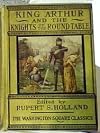
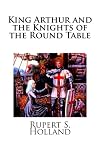
King Arthur and the Knights of the Round Table {Rupert S. Holland, editor}
by Thomas Malory
On This Page
Description
Immerse yourself in the earliest roots of English myth and culture in this captivating twentieth-century retelling of the Arthurian legends. In these thrilling tales, the courageous fifth-century leader and his loyal band of knights wage battle against enemies both foreign and domestic..
Tags
Recommendations


















Member Reviews
Highly recommended for fans of Arthurian lore.
Inspired by the 19th century popularity of Tennyson’s Idylls of the King (the introduction makes much of the author’s friendship with Tennyson), this retelling is based on Malory's Le Morte d'Arthur. I grew up on the Malory edition edited by Pollard (with Arthur Rackham’s wonderful illustrations), so these two books ought to be quite similar. Are they? Hmm. I haven’t read my old book in a while – though it’s now available free from archive.org: https://archive.org/details/ofkingartromance00malorich
From a quick perusal – yes, there’s a similarity, but not so much that it’s not worthwhile to read both books. Both update and abridge the text, making it bit easier for a modern show more audience to read, while maintaining the medieval flavor of the language.
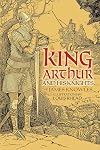
Even if the text were identical, this edition would be worthwhile just for the illustrations. Louis Rhead was an extremely popular illustrator, up until the 1920s, and the images here show why. He does a great job of meshing the romantic style of the day with historical detail and Celtic design elements. Absolutely gorgeous.
Revisiting the content for the first time in many years reminds one how many layers have been laid over the original legends. While the illustrations reflect the romance and chivalry that we expect from these stories, the stories themselves are another thing. These are not stories that reflect the romantic ideals of the 19th century, and certainly not the attitudes of the 21st. The attitudes displayed here are literally right out of the middle ages. His knights pay lip service to honor and courtesy, and not much more. These are petty, jealous, violent men. They quarrel constantly and for no reason. It’s dishonorable to kill your own brother, but pretty much anyone else is fair game. Women are frequently treated as property. Combat is the expected way to resolve any dispute, and a way to prove one’s worth. (Although noble blood is also expected to ‘tell’ – a low-born boy who shows talent at knightly pursuit must, of course, actually be a knight’s bastard.) These attitudes are woven in with a mystical/magical view of Christianity which is also very alien to a modern conception of the religion. It’s fascinating!
Aside from giving an accurate glimpse into the culture and issues of another time, this book would also lend itself quite well to a drinking game. A shot every time someone’s head is either ‘smote’ directly off or cleaved in two, would get you wasted pretty quickly! ;-)
A copy of this Dover e-book edition was provided by NetGalley - which affects my opinion not at all. THANKS! show less
Inspired by the 19th century popularity of Tennyson’s Idylls of the King (the introduction makes much of the author’s friendship with Tennyson), this retelling is based on Malory's Le Morte d'Arthur. I grew up on the Malory edition edited by Pollard (with Arthur Rackham’s wonderful illustrations), so these two books ought to be quite similar. Are they? Hmm. I haven’t read my old book in a while – though it’s now available free from archive.org: https://archive.org/details/ofkingartromance00malorich
From a quick perusal – yes, there’s a similarity, but not so much that it’s not worthwhile to read both books. Both update and abridge the text, making it bit easier for a modern show more audience to read, while maintaining the medieval flavor of the language.
Even if the text were identical, this edition would be worthwhile just for the illustrations. Louis Rhead was an extremely popular illustrator, up until the 1920s, and the images here show why. He does a great job of meshing the romantic style of the day with historical detail and Celtic design elements. Absolutely gorgeous.
Revisiting the content for the first time in many years reminds one how many layers have been laid over the original legends. While the illustrations reflect the romance and chivalry that we expect from these stories, the stories themselves are another thing. These are not stories that reflect the romantic ideals of the 19th century, and certainly not the attitudes of the 21st. The attitudes displayed here are literally right out of the middle ages. His knights pay lip service to honor and courtesy, and not much more. These are petty, jealous, violent men. They quarrel constantly and for no reason. It’s dishonorable to kill your own brother, but pretty much anyone else is fair game. Women are frequently treated as property. Combat is the expected way to resolve any dispute, and a way to prove one’s worth. (Although noble blood is also expected to ‘tell’ – a low-born boy who shows talent at knightly pursuit must, of course, actually be a knight’s bastard.) These attitudes are woven in with a mystical/magical view of Christianity which is also very alien to a modern conception of the religion. It’s fascinating!
Aside from giving an accurate glimpse into the culture and issues of another time, this book would also lend itself quite well to a drinking game. A shot every time someone’s head is either ‘smote’ directly off or cleaved in two, would get you wasted pretty quickly! ;-)
A copy of this Dover e-book edition was provided by NetGalley - which affects my opinion not at all. THANKS! show less
Ratings
Members
- Recently Added By
Author Information

234+ Works 17,829 Members
Sir Thomas Malory, 1405 - 1471 Sir Thomas Malory's works (consisting of the legends of Sir Lancelot, Sir Gareth, Sir Tristram, and the Holy Grail, as well as the stories of King Arthur's coming to the throne, his wars with the Emperor Lucius, and his death) are the most influential expression of Arthurian material in English. The author's sources show more are principally French romances; his own contributions are substantial, however, and the result is a vigorous and resonant prose. "Le Morte d'Arthur," finished between March 1469 and March 1470, was first printed in 1485 by William Caxton, the earliest English printer. Malory is presumed to have been a knight from an old Warwickshire family, who inherited his father's estates about 1433 and spent 20 years of his later life in jail accused of various crimes. The discovery of a manuscript version of "Le Morte d'Arthur" in 1934 in the library of Winchester College, supported the identification of Malory the author with Malory the traitor, burglar, and rapist. It showed that many of the inconsistencies in the printed text were traceable to the printing house rather than to the author. The most reliable modern version, therefore, is one like Eugene Vinaver's that is based on the Winchester manuscript. (Bowker Author Biography) show less
All Editions
Work Relationships
Is contained in
Common Knowledge
- Canonical title
- King Arthur and His Knights; King Arthur and the Knights of the Round Table {Rupert S. Holland, editor}
- Alternate titles
- King Arthur and his knights : selected tales
- Original publication date
- 1860
- People/Characters
- King Arthur
- Important places
- Camelot
- First words
- King Vortigern the usurper sat upon his throne in London, when suddenly, upon a certain day, ran in a breathless messenger.
- Disambiguation notice
- This is a children's adaptation. Please do not combine with Malory's Le Mort d'Arthur
This LT Work is edited by Rupert S. Holland. Please distinguish it from any other editions derived from Sir Thomas Malory's Le morte d'Arthur that have substantively different content. Thank you.
Classifications
- Genres
- Fiction and Literature, Children's Books
- DDC/MDS
- 398.22 — Society, government, & culture Customs, etiquette & folklore Folklore & Folktales Folk literature Legends
- LCC
- PZ8.1 .A788 .M — Language and Literature Fiction and juvenile belles lettres Fiction and juvenile belles lettres Juvenile belles lettres
- BISAC
Statistics
- Members
- 209
- Popularity
- 157,010
- Reviews
- 1
- Rating
- (4.14)
- Languages
- English
- Media
- Paper, Ebook
- ISBNs
- 10
- UPCs
- 1
- ASINs
- 13