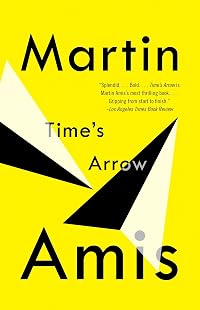
Time's Arrow
by Martin Amis
On This Page
Description
In Time's Arrow the doctor Tod T. Friendly dies and then feels markedly better, breaks up with his lovers as a prelude to seducing them, and mangles his patients before he sends them home. And all the while Tod's life races backward toward the one appalling moment in modern history when such reversals make sense. "The narrative moves with irresistible momentum.... [Amis is] a daring, exacting writer willing to defy the odds in pursuit of his art."--Newsday From the Trade Paperback edition.Tags
Recommendations











Member Reviews
A short, strange, provocative, and deeply disturbing novel. We follow a man, a doctor, called Tod Friendly (not, we will be unsurprised to eventually learn, his real or original name) through the perceptions of a sort of disembodied presence that accompanies him throughout his life. But this presence experiences that life, and everything in it, backwards. Effects precede causes, doctors harm and violence heals, and the dark, horrible secret that lies in Tod Friendly's past moves ever closer to the present.
It's a conceit that seems like it shouldn't really work, not for 165 pages, but it really does. At least, it did for me. It's clever and sometimes dryly funny, and coming at life backwards makes for a fascinating and often insightful show more change of perspective. And a darkly unsettling one, too, as we watch historical atrocities unspooling in reverse.
I feel like this book is doing a lot of things, thematically, not all of which are easy to put my finger on, but which are certainly churning away in the back of my brain right now in some very interesting ways. Above all, perhaps, it raises the question: can there be true redemption from great evil and great guilt? Maybe only if you can turn back time. show less
It's a conceit that seems like it shouldn't really work, not for 165 pages, but it really does. At least, it did for me. It's clever and sometimes dryly funny, and coming at life backwards makes for a fascinating and often insightful show more change of perspective. And a darkly unsettling one, too, as we watch historical atrocities unspooling in reverse.
I feel like this book is doing a lot of things, thematically, not all of which are easy to put my finger on, but which are certainly churning away in the back of my brain right now in some very interesting ways. Above all, perhaps, it raises the question: can there be true redemption from great evil and great guilt? Maybe only if you can turn back time. show less
Well, what can be said about this short but intense novel that hasn’t already been said? It’s an obvious statement that it’s a strange reading experience. Already at page 3 the author describes the confusion that grips the narrator (“Wait a minute. Why am I walking backward into the house? What is the – what is the sequence of this journey I’m on? What are its rules? Why are the birds singing so strangely? Where am I heading?”), and that perfectly illustrates the confusion that the reader experiences. When you start reading the book, you know that it tells the story of a life in reverse order, but to experience it sentence by sentence, page by page as a reader is another matter. I don’t know about you, but I experienced show more quite a few mood swings: I found Amis’s procedure quite nice and ingenious at first, and quite enjoyed the constant game of deciphering (by reversing the order) what Amis described. But after a while it started to bother me a bit and I even found it banal, edging boring. Until I realized that what was described was anything but banal: the main character is a German Nazi doctor – Odilo Unverdorben, the name alone – who was active in the Holocaust industry and was able to escape to America afterwards (I am now telling it in the ‘wrong/right’ order). Indeed, anything but banal, which is why you often only realize after a while how horrible what you have just read is, while just before you were smiling at the irony of what Amis describes (Jews who walk out healthy and well after ‘treatment’ in the gas chamber, for example). If anything meets the definition of the word ‘mindfuck’ (pardon my French), then this is it.
But is this a successful book? I dare not answer that with an unequivocal yes or no. Ingenious and sometimes downright hilarious, certainly. But also excessively intense, and therefore sometimes even long-winded. If you are into meta-layers, then you have to give Amis credit for beautifully showing how constructed storytelling in general is, or how treacherous it is to simply describe actions, separated from their meaning. Or: how the eternal ethical-philosophical theme of free will is very much tied to the direction of time, and therefore loses its meaning when that direction is changed (or simply reversed). Well done, Amis. However, I cannot say that I enjoyed reading this book very much: it was hard work, sometimes got on my nerves, and the existential relevance (which is always very important to me) seemed far-fetched. Finally: this is an experimental novel par excellence. But I do wonder whether Amis, following J.L. Borges a bit, would not have been better off limiting himself to a novella? show less
But is this a successful book? I dare not answer that with an unequivocal yes or no. Ingenious and sometimes downright hilarious, certainly. But also excessively intense, and therefore sometimes even long-winded. If you are into meta-layers, then you have to give Amis credit for beautifully showing how constructed storytelling in general is, or how treacherous it is to simply describe actions, separated from their meaning. Or: how the eternal ethical-philosophical theme of free will is very much tied to the direction of time, and therefore loses its meaning when that direction is changed (or simply reversed). Well done, Amis. However, I cannot say that I enjoyed reading this book very much: it was hard work, sometimes got on my nerves, and the existential relevance (which is always very important to me) seemed far-fetched. Finally: this is an experimental novel par excellence. But I do wonder whether Amis, following J.L. Borges a bit, would not have been better off limiting himself to a novella? show less
A life is a sentence, not a palindrome. It is a thought that seems unnecessary to contemplate given our usual experience of time, in which a life begins, a person accumulates experiences and then dies. Amis alters this structure in Time’s Arrow and invites readers to follow Tod T. Friendly, backwards through his life, through the perceptive lens of a parallel, but disembodied, version of the main character who is objectively experiencing Tod T. Friendly’s life for the first time, as a backwards arc of events, and through a variety of identities, including Tod T. Friendly, John Young, Hamilton de Souza, and finally Odilo Unverdorben (the “unspoiled”), a nazi doctor.
Imagine not just life events happening in reverse order as show more conventionally-ordered moments but instead like a film reel running backwards, complete with people walking backwards, dropped ice cream leaping off the sidewalk back into the cone, smoke rushing into a fire to reform complete logs, etc. Dialogue is backwards as well, but written as recognizable words instead of phonetically-transcribed, indecipherable backmasking.
The novel structure is unsettling. Events don’t make sense, even if you do understand the overall conceit, and this appears to be the point. The novel is a thought experiment asking if a life can be unwound to make sense of it. Are events and perceptions through life the composition of simpler elements, compounded and moved forward? Can lives of virtue, or tragedy, or infamy, or destruction be unpacked to find out what went right or what went wrong? This notion is what gives the book its title, Time’s Arrow.
The concept of time’s arrow references an asymmetrical relationship between the constitutive elements of reality. As abstractions, the natural laws that describe the constitutive forces of reality balance in both directions. They are true working from left to right or right to left. If A + B + C = D then D - C - B = A. However, macroscopically, at the level of events and experiences and perception, this symmetry does not exist. If A leads to B which leads to C, it is not true the C leads to B which leads to A. It is possible, as a state of affairs, but it is not necessarily true. There may even be a necessary order. One of the developmental branches of the time’s arrow theory hypothesizes that the reason for this asymmetry is that at any given moment, the world can be described as a state of affairs with certain actors and relationships. Change is a constant. In the next moment, a new state of affairs is true, but it also contains the previous state of affairs as part of the current one, mixed like dye in a glass of water. In this formulation, the future is indeterminate because it is built on the platform of an ever-changing state of affairs, and the past is closed because of the state of affairs can never be undone. You can’t unring a bell, as they say. Life may be comprised of discrete moments but those moments do not balance the same way, moving forward or backward — life is a sentence, not a palindrome.
The arrow in Time’s Arrow treats time as an intrinsic feature of reality. Tod T. Friendly’s existence plays out in reverse. Moment to moment, the sequence of states of affairs is possible (physically and causally) but only through the application of a strange logic that allows for burnt papers to be reconstructed from ashes, cream to be pulled out of a cup of coffee, food to be regurgitated onto the plate and taken to the kitchen, etc. And the disembodied narrator attempts to make sense of the events in that direction, which never completely adds up. However, these stretches of backwards time do fit together when the narrator adds a horrifying logic that allows discrete moments to fit together. The narrator describes, for example, how Tod T. Friendly’s patients have their injuries returned to them. He removes bandages from one patient’s hand and drives a nail into it and sends him away. In another scene he removes bandages from a battered woman and returns her to her abuser to have the bruises and abrasions “removed by punches.” As this narrative unwinds into the reverse of time’s arrow, a twisted logic of association comes into focus as the narrative follows Tod Friendly through prior identities back to his nazi past, and each backwards event creates a new asymmetrical, cumulative reality, no less horrible than the one we can infer, moving in the other direction, but certainly different. show less
Imagine not just life events happening in reverse order as show more conventionally-ordered moments but instead like a film reel running backwards, complete with people walking backwards, dropped ice cream leaping off the sidewalk back into the cone, smoke rushing into a fire to reform complete logs, etc. Dialogue is backwards as well, but written as recognizable words instead of phonetically-transcribed, indecipherable backmasking.
The novel structure is unsettling. Events don’t make sense, even if you do understand the overall conceit, and this appears to be the point. The novel is a thought experiment asking if a life can be unwound to make sense of it. Are events and perceptions through life the composition of simpler elements, compounded and moved forward? Can lives of virtue, or tragedy, or infamy, or destruction be unpacked to find out what went right or what went wrong? This notion is what gives the book its title, Time’s Arrow.
The concept of time’s arrow references an asymmetrical relationship between the constitutive elements of reality. As abstractions, the natural laws that describe the constitutive forces of reality balance in both directions. They are true working from left to right or right to left. If A + B + C = D then D - C - B = A. However, macroscopically, at the level of events and experiences and perception, this symmetry does not exist. If A leads to B which leads to C, it is not true the C leads to B which leads to A. It is possible, as a state of affairs, but it is not necessarily true. There may even be a necessary order. One of the developmental branches of the time’s arrow theory hypothesizes that the reason for this asymmetry is that at any given moment, the world can be described as a state of affairs with certain actors and relationships. Change is a constant. In the next moment, a new state of affairs is true, but it also contains the previous state of affairs as part of the current one, mixed like dye in a glass of water. In this formulation, the future is indeterminate because it is built on the platform of an ever-changing state of affairs, and the past is closed because of the state of affairs can never be undone. You can’t unring a bell, as they say. Life may be comprised of discrete moments but those moments do not balance the same way, moving forward or backward — life is a sentence, not a palindrome.
The arrow in Time’s Arrow treats time as an intrinsic feature of reality. Tod T. Friendly’s existence plays out in reverse. Moment to moment, the sequence of states of affairs is possible (physically and causally) but only through the application of a strange logic that allows for burnt papers to be reconstructed from ashes, cream to be pulled out of a cup of coffee, food to be regurgitated onto the plate and taken to the kitchen, etc. And the disembodied narrator attempts to make sense of the events in that direction, which never completely adds up. However, these stretches of backwards time do fit together when the narrator adds a horrifying logic that allows discrete moments to fit together. The narrator describes, for example, how Tod T. Friendly’s patients have their injuries returned to them. He removes bandages from one patient’s hand and drives a nail into it and sends him away. In another scene he removes bandages from a battered woman and returns her to her abuser to have the bruises and abrasions “removed by punches.” As this narrative unwinds into the reverse of time’s arrow, a twisted logic of association comes into focus as the narrative follows Tod Friendly through prior identities back to his nazi past, and each backwards event creates a new asymmetrical, cumulative reality, no less horrible than the one we can infer, moving in the other direction, but certainly different. show less
Read: November 2016
Rating: 5/5 stars, best of 2016
The plot: the narrator of this story inhabits the dying body of a man named Tod Friendly, and it soon becomes clear that the narrator is living backwards in time, as Tod becomes younger, loses and gains lovers, and moves from his current country back through Portugal and then to Poland and Auschwitz.
I loved this book. It is so beautifully and cleverly written. It is a wonderful contrast to Counter Clock World by Philip K Dick which deals in a similar reality. Dick however deals with time moving backwards on a social and global scale; how it affects society and culture, whereas Amis never loses his focus on Tod.
What struck me the most about Time's Arrow is that the Narrator (who doesn't show more appear to *be* Tod) observes a world that is so much better than ours in a way. He sees for example, men removing the fur lining of their coats to clothe helpless animals, he sees Auschwitz as a place where the dead and the dying are returned to life and health. Where the soldiers and prison guards bestow small kindnesses on their charges; stopping women here and there in the camp to give them gifts of rings and bracelets, putting body parts back together on an operating table to bring a teenage boy back to life. It is heartbreaking to realise what the narrator is seeing is actually the opposite of reality.
Amis has achieved something incredible for me with this novel. He has shown me a different perspective and a different way of viewing the world we live in. What a thoroughly deserving nominee for the Booker prize. show less
Rating: 5/5 stars, best of 2016
The plot: the narrator of this story inhabits the dying body of a man named Tod Friendly, and it soon becomes clear that the narrator is living backwards in time, as Tod becomes younger, loses and gains lovers, and moves from his current country back through Portugal and then to Poland and Auschwitz.
I loved this book. It is so beautifully and cleverly written. It is a wonderful contrast to Counter Clock World by Philip K Dick which deals in a similar reality. Dick however deals with time moving backwards on a social and global scale; how it affects society and culture, whereas Amis never loses his focus on Tod.
What struck me the most about Time's Arrow is that the Narrator (who doesn't show more appear to *be* Tod) observes a world that is so much better than ours in a way. He sees for example, men removing the fur lining of their coats to clothe helpless animals, he sees Auschwitz as a place where the dead and the dying are returned to life and health. Where the soldiers and prison guards bestow small kindnesses on their charges; stopping women here and there in the camp to give them gifts of rings and bracelets, putting body parts back together on an operating table to bring a teenage boy back to life. It is heartbreaking to realise what the narrator is seeing is actually the opposite of reality.
Amis has achieved something incredible for me with this novel. He has shown me a different perspective and a different way of viewing the world we live in. What a thoroughly deserving nominee for the Booker prize. show less
"Time, the human dimension, which makes us everything we are."
'Time's Arrow' opens with the main character being dragged back from the brink of death by medics after a heart attack– and from then on he grows gradually ever more youthful until his eventual birth. As he grows younger, we learn that he was once a doctor who made his patients worse rather than better and has repeatedly changed his name as he moved West to New York from mainland Europe. It isn't long before we realise where he’s going (or coming from) – that he worked in the various camps across Poland where millions of people (mainly Jews) had been brought back to life and he had been a member of the Hitler Youth.
The narrator exists inside the protagonist’s head and show more experiences everything he does, but is also separate from him. This allows the narrator to comment on events that he has had no power to influence, he doesn't know what is to come any more than the reader does. The use of the narrator allows the reader to consider the protagonists actions intellectually rather than emotionally.
That is not to say that that this isn't an emotional read. The protagonist is a particularly dislikeable individual, before and after the war objectifying women and treating them with utter disdain, and one who reacts quite coldly to the death of his own daughter. But as you would expect, it is his wartime actions which is the real focus of this book and are the most difficult to comprehend. That events happen in reverse – bringing people to life rather than killing them – doesn't make them any less horrifying. We are reminded that these heinous acts weren't one off aberrations but instead played out over a number of years. The reverse timeline compels the reader to reassess events with which we think we are already familiar.
"Probably human cruelty is fixed and eternal, only styles change."
However, whilst part of me admires the creative way that the author has tackled such harrowing events I cannot help but think that he was just too clever and ultimately trivialised them. It soon becomes apparent that in the later life the protagonist feels no guilt about his previous deeds and that he has seemingly escaped censure for them which made uncomfortable reading. I cannot help but think that he had perhaps somehow turned a new leaf, had lived relatively innocently post-war, it might have magnified the horror of his wartime deeds, if that is possible, then I too would have felt differently. Something other than complete contempt.
I suspect that this is yet another of those Marmite books, you will either love or hate it. For me it was an OK read but as with so many by the author that I've read a confusing and underwhelming one. It was at least thankfully brief. show less
'Time's Arrow' opens with the main character being dragged back from the brink of death by medics after a heart attack– and from then on he grows gradually ever more youthful until his eventual birth. As he grows younger, we learn that he was once a doctor who made his patients worse rather than better and has repeatedly changed his name as he moved West to New York from mainland Europe. It isn't long before we realise where he’s going (or coming from) – that he worked in the various camps across Poland where millions of people (mainly Jews) had been brought back to life and he had been a member of the Hitler Youth.
The narrator exists inside the protagonist’s head and show more experiences everything he does, but is also separate from him. This allows the narrator to comment on events that he has had no power to influence, he doesn't know what is to come any more than the reader does. The use of the narrator allows the reader to consider the protagonists actions intellectually rather than emotionally.
That is not to say that that this isn't an emotional read. The protagonist is a particularly dislikeable individual, before and after the war objectifying women and treating them with utter disdain, and one who reacts quite coldly to the death of his own daughter. But as you would expect, it is his wartime actions which is the real focus of this book and are the most difficult to comprehend. That events happen in reverse – bringing people to life rather than killing them – doesn't make them any less horrifying. We are reminded that these heinous acts weren't one off aberrations but instead played out over a number of years. The reverse timeline compels the reader to reassess events with which we think we are already familiar.
"Probably human cruelty is fixed and eternal, only styles change."
However, whilst part of me admires the creative way that the author has tackled such harrowing events I cannot help but think that he was just too clever and ultimately trivialised them. It soon becomes apparent that in the later life the protagonist feels no guilt about his previous deeds and that he has seemingly escaped censure for them which made uncomfortable reading. I cannot help but think that he had perhaps somehow turned a new leaf, had lived relatively innocently post-war, it might have magnified the horror of his wartime deeds, if that is possible, then I too would have felt differently. Something other than complete contempt.
I suspect that this is yet another of those Marmite books, you will either love or hate it. For me it was an OK read but as with so many by the author that I've read a confusing and underwhelming one. It was at least thankfully brief. show less
Although clever, and often funny, this book is something of a one-trick pony. Once the novelty of a life viewed completely backwards wears off, there's not much story in this Holocaust novel. Yes, a Holocaust novel with bathroom humor! That's a problem too because the story is inherently serious; the "main" character is a Nazi concentration camp doctor who has evaded punishment and successfully created a new life for himself in America. Yet the extent of the doctor's lack of morals and complicity is hidden in a gimmicky time in reverse device.
Maybe what Amis is saying that this is the only way the doctor could be forgiven his crimes against humanity. If time were to run in reverse, Nazi doctors would put the gold back into the teeth of show more newly born Jews who then get healthier and healthier until they walk out of camp and are returned to their lives and families.
This book was shortlisted for the Booker Prize in 1991. Sorry, the whole thing just doesn't feel right. show less
Maybe what Amis is saying that this is the only way the doctor could be forgiven his crimes against humanity. If time were to run in reverse, Nazi doctors would put the gold back into the teeth of show more newly born Jews who then get healthier and healthier until they walk out of camp and are returned to their lives and families.
This book was shortlisted for the Booker Prize in 1991. Sorry, the whole thing just doesn't feel right. show less
This is the story of the life of Tod Friendly. What makes it unusual (and probably what landed it on the 1001 List) is that Tod's life is told backwards. And not just in a conventional way. It is narrated as if the narrator is watching a film reel spun in reverse, and telling us what happens in reverse. So: "A child's wailing {is} calmed by the slap of a father's hand, a dead ant revived by the careless press of a passing sole, a wounded finger healed and sealed by a knife's blade." Or, "They're always looking forward to places they've just come back from or regretting things they haven't done yet. They say hello when they mean goodbye."
The narrator of Tod's life is some sort of consciousness within Tod that is Tod, but yet not Tod. The show more narrator is fully aware of Tod, but Tod is not aware of him. And he watches Tod's life unfold backwards, and tells us what is happening in this life in reverse.
The novel opens when Tod has just died. Then he's in a hospital bed, dying. Then he's an elderly man being admitted to the hospital. Then he's an elderly man living a life of leisure in suburbia, suffering a few aches and pains, but doing ok. "Each day, when Tod and I are done with the Gazette, we take it back to the store. I have a good look at the date then. And it goes like this. After October 2, you get October 1. After October 1, you get September 30...." We know that Tod has had another name in the past, and in fact that he may be hiding things from his past, as we follow him back to his busy life as a surgeon in the big city and to his wartime life in Europe.
Without being too spoilerish (I think this fact appears in many descriptions of the book), this is in effect a Holocaust novel. And perhaps the unusual narrative technique is an attempt to highlight the insanity of the Holocaust, or to make some other important point. I, however, found that the narrative technique detracted from the story and from whatever points the author was trying to make. Which is not to say that I did not enjoy this book. I tend to like "puzzle" books where the author is playing games with the reader, and I enjoyed deciphering what was actually going on in the narrative when it is related in this unusual way. For example, longer stretches of dialogue often made no sense when read top to bottom. To understand the conversation, I would have to go to the end of the dialogue in the book, and read from the end to the beginning. As I said, I enjoyed this aspect of the book.
This is the first book by Martin Amis I've read (though I've tried a couple of others). I'm not sure I'll be reading more by him. I developed a perhaps unrational dislike of the Amis name when I read a book by Kingsley Amis in college and absolutely hated it. Still, if the subject appeals, I may in the future try something else by Martin.
3 1/2 stars show less
The narrator of Tod's life is some sort of consciousness within Tod that is Tod, but yet not Tod. The show more narrator is fully aware of Tod, but Tod is not aware of him. And he watches Tod's life unfold backwards, and tells us what is happening in this life in reverse.
The novel opens when Tod has just died. Then he's in a hospital bed, dying. Then he's an elderly man being admitted to the hospital. Then he's an elderly man living a life of leisure in suburbia, suffering a few aches and pains, but doing ok. "Each day, when Tod and I are done with the Gazette, we take it back to the store. I have a good look at the date then. And it goes like this. After October 2, you get October 1. After October 1, you get September 30...." We know that Tod has had another name in the past, and in fact that he may be hiding things from his past, as we follow him back to his busy life as a surgeon in the big city and to his wartime life in Europe.
Without being too spoilerish (I think this fact appears in many descriptions of the book), this is in effect a Holocaust novel. And perhaps the unusual narrative technique is an attempt to highlight the insanity of the Holocaust, or to make some other important point. I, however, found that the narrative technique detracted from the story and from whatever points the author was trying to make. Which is not to say that I did not enjoy this book. I tend to like "puzzle" books where the author is playing games with the reader, and I enjoyed deciphering what was actually going on in the narrative when it is related in this unusual way. For example, longer stretches of dialogue often made no sense when read top to bottom. To understand the conversation, I would have to go to the end of the dialogue in the book, and read from the end to the beginning. As I said, I enjoyed this aspect of the book.
This is the first book by Martin Amis I've read (though I've tried a couple of others). I'm not sure I'll be reading more by him. I developed a perhaps unrational dislike of the Amis name when I read a book by Kingsley Amis in college and absolutely hated it. Still, if the subject appeals, I may in the future try something else by Martin.
3 1/2 stars show less
Members
- Recently Added By
Lists

1001 Books You Must Read Before You Die
1,448 works; 1,134 members

Booker Prize
491 works; 62 members

Unreliable Narrators
170 works; 43 members
Booker Prize Shortlist: Titles Read
103 works; 10 members

Experimental Literature
141 works; 19 members

did I say that I didn't mean that (unreliable narrators)
34 works; 7 members

Speculative Fiction: Slipstream Literature
166 works; 16 members

Man Booker Prize Longlist 1991
6 works; 2 members

Time is out of joint
19 works; 3 members

A Good Read (Radio 4)
287 works; 1 member

Julie Parson’s Old Books
52 works; 4 members

Books Read in 2015
3,299 works; 129 members

KayStJ's to-read list
1,616 works; 11 members

living room bookshelf
150 works; 1 member

Bookshelf from Interstellar
62 works; 1 member
Author Information

58+ Works 29,789 Members
Martin Amis, son of the novelist Kingsley Amis, was born August 25, 1949. His childhood was spent traveling with his famous father. From 1969 to 1971 he attended Exeter College at Oxford University. After graduating, he worked for the Times Literary Supplement and later as special writer for the Observer. Amis published his first novel, The Rachel show more Papers, in 1973, which received the prestigious Somerset Maugham Award in 1974. Other titles include Dead Babies (1976), Other People: A Mystery Story (1981); London Fields (1989), The Information (1995), and Night Train (1997). Martin Amis has been called the voice of his generation. His novels are controversial, often satiric and dark, concentrating on urban low life. His style has been compared to that of Graham Greene, Philip Larkin and Saul Bellow, among others. He is currently Professor of Creative Writing at the Centre for New Writing at the University of Manchester. In 2008, The Times named him one of the 50 greatest British writers since 1945. (Bowker Author Biography) show less
Some Editions
Awards and Honors
Series
Belongs to Publisher Series
Work Relationships
Is abridged in
Common Knowledge
- Canonical title*
- De pijl van de tijd
- Original title
- Time's Arrow, or The Nature of the Offence
- Original publication date
- 1991
- People/Characters
- Tod T. Friendly
- Important places
- Germany
- Important events
- Holocaust; World War II
- Dedication
- To Sally
- First words
- I moved forward, out of the blackest sleep, to find myself surrounded by doctors . . . American doctors:
This book is dedicated to my sister Sally, who, when she was very young, rendered me two profound services. (Afterword) - Quotations
- Still, I'm powerless, and can do nothing about anything. I can't make myself an exception.
And how can we two be right? It would make so many others wrong. - Last words
- (Click to show. Warning: May contain spoilers.)And I within, who came at the wrong time—either too soon, or after it was all too late.
(Click to show. Warning: May contain spoilers.)Built for speed and safety, built to endure for a thousand years, the The Reichsautobahnen, if you remember, were also designed to conform to the landscape, harmoniously, like a garden path. (Afterword) - Original language
- English
- Disambiguation notice*
- original title: Time's Arrow
*Some information comes from Common Knowledge in other languages. Click "Edit" for more information.
Classifications
Statistics
- Members
- 3,345
- Popularity
- 5,074
- Reviews
- 59
- Rating
- (3.71)
- Languages
- 15 — Czech, Danish, Dutch, English, Finnish, French, German, Hebrew, Hungarian, Italian, Polish, Portuguese, Russian, Spanish, Swedish
- Media
- Paper, Audiobook, Ebook
- ISBNs
- 50
- ASINs
- 12