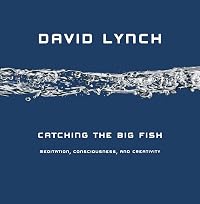
Catching the Big Fish: Meditation, Consciousness, and Creativity
by David Lynch
On This Page
Description
In this "unexpected delight,"* filmmaker David Lynch describes his personal methods of capturing and working with ideas, and the immense creative benefits he has experienced from the practice of meditation. Now in a beautiful paperback edition, David Lynch's Catching the Big Fish provides a rare window into the internationally acclaimed filmmaker's methods as an artist, his personal working style, and the immense creative benefits he has experienced from the practice of meditation. Catching show more the Big Fish comes as a revelation to the legion of fans who have longed to better understand Lynch's personal vision. And it is equally compelling to those who wonder how they can nurture their own creativity. Catching Ideas Ideas are like fish. If you want to catch little fish, you can stay in the shallow water. But if you want to catch the big fish, you've got to go deeper. Down deep, the fish are more powerful and more pure. They're huge and abstract. And they're very beautiful. I look for a certain kind of fish that is important to me, one that can translate to cinema. But there are all kinds of fish swimming down there. There are fish for business, fish for sports. There are fish for everything. Everything, anything that is a thing, comes up from the deepest level. Modern physics calls that level the Unified Field. The more your consciousness-your awareness-is expanded, the deeper you go toward this source, and the bigger the fish you can catch. --from Catching the Big Fish show lessTags
Recommendations








Member Reviews
[3.75] As a movie buff who has been “weirded out” (in good ways) by some of Lynch’s films over the decades, I was pleasantly surprised to learn from his obituary that he penned this short and strange book.
How did Lynch concoct some of the outlandish concepts in flicks like “Blue Velvet,” “Mulholland Drive” and “Eraserhead?” What elements get his creative juices flowing? What can we learn from his successes to help unleash our creativity?
This book provides some fascinating insights, but don’t expect it to be a primer on meditation. It’s definitely not that. What is it? Like many of Lynch’s cinematic creations, the answer is elusive. In some ways, it’s a breezy, stream of consciousness-like almanac that explores show more simple ways to expand our consciousness, enhance our understanding and, in the process, foster creative thought.
“Catching the Big Fish” is comprised of dozens of bite-sized chapters with short identifier headlines (“Identity,” “Dreams,” Fear,” etc.) Most chapters are only 100 to 200 words (I quickly adapted to this succinct format to the extent that when I encountered a chapter that approached 500 words, my inner voice muttered “What gives?” :-)
I cannot honestly write that Lynch’s book changed the way I think about the creative mind, but it certainly provided proverbial “food for thought."
And what would a Lynch creation be without a splash of weirdness? In one of the final chapters titled “Texture,” Lynch writes: “Have you ever seen a little rotted animal? I love looking at those things, just as much as I like to look at a close-up of some tree bark, or a small bug, or a cup of coffee, or a piece of pie. You get in close and the textures are wonderful.”
Yep, that’s the David Lynch that sometimes stupefied me but always intrigued me. show less
How did Lynch concoct some of the outlandish concepts in flicks like “Blue Velvet,” “Mulholland Drive” and “Eraserhead?” What elements get his creative juices flowing? What can we learn from his successes to help unleash our creativity?
This book provides some fascinating insights, but don’t expect it to be a primer on meditation. It’s definitely not that. What is it? Like many of Lynch’s cinematic creations, the answer is elusive. In some ways, it’s a breezy, stream of consciousness-like almanac that explores show more simple ways to expand our consciousness, enhance our understanding and, in the process, foster creative thought.
“Catching the Big Fish” is comprised of dozens of bite-sized chapters with short identifier headlines (“Identity,” “Dreams,” Fear,” etc.) Most chapters are only 100 to 200 words (I quickly adapted to this succinct format to the extent that when I encountered a chapter that approached 500 words, my inner voice muttered “What gives?” :-)
I cannot honestly write that Lynch’s book changed the way I think about the creative mind, but it certainly provided proverbial “food for thought."
And what would a Lynch creation be without a splash of weirdness? In one of the final chapters titled “Texture,” Lynch writes: “Have you ever seen a little rotted animal? I love looking at those things, just as much as I like to look at a close-up of some tree bark, or a small bug, or a cup of coffee, or a piece of pie. You get in close and the textures are wonderful.”
Yep, that’s the David Lynch that sometimes stupefied me but always intrigued me. show less
David Lynch's sheer passion lures the reader irresistibly along brief chapters of Catching the Big Fish: Meditation Consciousness, and Creativity, describing his method of channeling ideas into creative endeavors.
Lynch touts digital video as the future of film and regards director's commentaries as sacrilegious. He also reveals his love for diners, flickering lights, Los Angeles, rotting bodies and other things that drive him “crazy, in a good way.” He writes of the three years he spent making Eraserhead, O.J. Simpson’s influence on Lost Highway, the inception of Twin Peaks’ Red Room, and details of filming his current release INLAND EMPIRE. Epigraphs from the Upanishads introduce many chapters, and Lynch spends most of the book show more crediting Transcendental Mediation with his success in converting inspiration into successful creations. Lynch’s love for both watching and making film is clear; he refers continually to his awe upon entering the “world of a film” and the thrill of “falling in love with ideas.”
At times, Catching the Big Fish conveys a bit of an agenda (all proceeds for the book go towards the David Lynch Foundation for Consciousness-Based Education and World Peace), but the simple, sincere and often poetic tone maintain his believability. Lynch has been practicing Transcendental Mediation for over 30 years, and few could argue with his success as a surrealist, envelope-pushing filmmaker—however he does it.
Lynch’s fans will delight in amusing behind-the-scenes anecdotes of synchronicity with actors, musicians and admired directors. Those seeking advice on creativity, meditation, or simply seeking a good read from a creative, quirky mind will also enjoy this book. show less
Lynch touts digital video as the future of film and regards director's commentaries as sacrilegious. He also reveals his love for diners, flickering lights, Los Angeles, rotting bodies and other things that drive him “crazy, in a good way.” He writes of the three years he spent making Eraserhead, O.J. Simpson’s influence on Lost Highway, the inception of Twin Peaks’ Red Room, and details of filming his current release INLAND EMPIRE. Epigraphs from the Upanishads introduce many chapters, and Lynch spends most of the book show more crediting Transcendental Mediation with his success in converting inspiration into successful creations. Lynch’s love for both watching and making film is clear; he refers continually to his awe upon entering the “world of a film” and the thrill of “falling in love with ideas.”
At times, Catching the Big Fish conveys a bit of an agenda (all proceeds for the book go towards the David Lynch Foundation for Consciousness-Based Education and World Peace), but the simple, sincere and often poetic tone maintain his believability. Lynch has been practicing Transcendental Mediation for over 30 years, and few could argue with his success as a surrealist, envelope-pushing filmmaker—however he does it.
Lynch’s fans will delight in amusing behind-the-scenes anecdotes of synchronicity with actors, musicians and admired directors. Those seeking advice on creativity, meditation, or simply seeking a good read from a creative, quirky mind will also enjoy this book. show less
This was a short, sweet collection of thoughts from late filmmaker and artist David Lynch. He focuses on his longtime practice of Transcendental Meditation and how it has influenced his life and art. I'm a longtime meditator (Insight, Mindfulness, Zen, Tibetan) but have never explored TM, mostly because it appears to have a bit of an exclusivity to it. However, I appreciate how it seemed to work for Lynch.
Lynch also offers brief insights into some of his most famous films and shows (Mulholland Drive, Twin Peaks, Blue Velvet, Eraserhead, the ill-fated Dune, etc). None of these are particularly satisfying passages, as they are all too brief, but he seemed to be a filmmaker who held his cards close to his vest. And that sense of mystery show more came through in his films, which is of benefit to all those who love his work.
Consider this an appetizer, but also an intriguing look into Lynch's mind and inspiration. show less
Lynch also offers brief insights into some of his most famous films and shows (Mulholland Drive, Twin Peaks, Blue Velvet, Eraserhead, the ill-fated Dune, etc). None of these are particularly satisfying passages, as they are all too brief, but he seemed to be a filmmaker who held his cards close to his vest. And that sense of mystery show more came through in his films, which is of benefit to all those who love his work.
Consider this an appetizer, but also an intriguing look into Lynch's mind and inspiration. show less
This was a great little book. David Lynch is way into transcendental meditation (like... Fairfield, Iowa, Maharashi (yeah, the Beatles' Maharashi), possibly a cult into transcendental meditation) but this book is interesting because it reveals how David Lynch, as an artist, relates to his work and makes meaning of creativity and the world around him. This is a book about one creative process. Read that way, particularly if you're a fan, this is a very rich text, but if you approach this book wanting a autobiographical profile or a technical handbook (in the way Mamet's On Directing teaches) you will be disappointed. What you will find here is a book about large, academic subjects written by a visual artist in an non-academic manner.
My show more favorite chapter is titled "The Box and the Key." The whole chapter is a single sentence: "I don't have a clue what those are." If that sort of thing makes you laugh, and ponder, and smile then this book is for you. If a chapter like that makes you angry or annoys you, it's probably safe to say you won't appreciate this book. show less
My show more favorite chapter is titled "The Box and the Key." The whole chapter is a single sentence: "I don't have a clue what those are." If that sort of thing makes you laugh, and ponder, and smile then this book is for you. If a chapter like that makes you angry or annoys you, it's probably safe to say you won't appreciate this book. show less
This was a great little book. David Lynch is way into transcendental meditation (like... Fairfield, Iowa, Maharashi (yeah, the Beatles' Maharashi), possibly a cult into transcendental meditation) but this book is interesting because it reveals how David Lynch, as an artist, relates to his work and makes meaning of creativity and the world around him. This is a book about one creative process. Read that way, particularly if you're a fan, this is a very rich text, but if you approach this book wanting a autobiographical profile or a technical handbook (in the way Mamet's On Directing teaches) you will be disappointed. What you will find here is a book about large, academic subjects written by a visual artist in an non-academic manner.
My show more favorite chapter is titled "The Box and the Key." The whole chapter is a single sentence: "I don't have a clue what those are." If that sort of thing makes you laugh, and ponder, and smile then this book is for you. If a chapter like that makes you angry or annoys you, it's probably safe to say you won't appreciate this book. show less
My show more favorite chapter is titled "The Box and the Key." The whole chapter is a single sentence: "I don't have a clue what those are." If that sort of thing makes you laugh, and ponder, and smile then this book is for you. If a chapter like that makes you angry or annoys you, it's probably safe to say you won't appreciate this book. show less
Is he nuts? Is he a genius? If only the issue were so simple. Somehow I doubt that any other film director has given his fans a more tantalizing, and occasionally infuriating, glimpse into his creative process and idiosyncrasies as Lynch does in this book. As with any other cultural artifact he produces, here Lynch leaves us with many more mysteries than he clears up--but what a read! - Adam
There's an awful lot of quantum nonsense in this book, but if you can get past that, it's my very favorite kind of creativity book: an artist telling specific stories about their own life and experience doing the work, which somehow manages to convey more universal ideas at the same time. I'm intrigued.
I also think that David Lynch doesn't understand people very well.
I also think that David Lynch doesn't understand people very well.
Members
- Recently Added By
Lists

Nonordinary States of Consciousness
184 works; 7 members

Books Read in 2020
4,379 works; 123 members

Reading Glasses Podcast
410 works; 3 members

Creativity Books
4 works; 1 member
Author Information

108+ Works 5,957 Members
David Lynch is an American filmmaker, director, musician, painter, and photographer, born in Montana in 1946. His feature films and television series include Eraserhead (1977), The Elephant Man (1980), Dune (1984), Blue Velvet (1986), Wild at Heart (1990), Twin Peaks: Fire Walk with Me (1992), Lost Highway (1997), The Straight Story (1999), show more Mulholland Drive (2001), and Inland Empire (2006). He was nominated for 13 Academy Awards, 10 BAFTA (winning 3 for The Elephant Man and 1 for Mulholland Drive), and 13 Golden Globes. He is the co-author of Lynch on Lynch (with Chris Rodley), and Room to Dream: A Life in Art (with Kristine McKenna). (Bowker Author Biography) show less
Common Knowledge
Classifications
- Genres
- Nonfiction, Philosophy, General Nonfiction, Art & Design, Biography & Memoir, Religion & Spirituality
- DDC/MDS
- 158.125 — Philosophy & psychology Psychology Applied psychology Personal improvement and analysis Personal improvement and analysis through meditation Transcendental meditation
- LCC
- BF637 .T68 .L96 — Philosophy, Psychology and Religion Psychology Psychology Applied psychology
- BISAC
Statistics
- Members
- 1,197
- Popularity
- 20,844
- Reviews
- 34
- Rating
- (3.57)
- Languages
- 17 — Czech, Dutch, English, Estonian, Finnish, French, German, Hungarian, Italian, Korean, Norwegian (Bokmål), Romanian, Russian, Serbian, Spanish, Turkish, Portuguese (Portugal)
- Media
- Paper, Audiobook, Ebook
- ISBNs
- 36
- UPCs
- 1
- ASINs
- 8