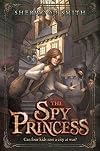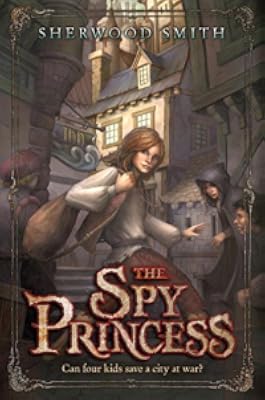
The Spy Princess
by Sherwood Smith
Lilah's Adventures (1), Sartorias-deles {Sherwood Smith} (4734-4735 {summer & fall})
On This Page
Description
When Lady Lilah disguises herself to sneak out of the castle she discovers that the country is on the verge of revolution and her brother is behind it, and Lilah and her friends decide to help by becoming spies.Tags
Recommendations








Member Reviews
Lilah, the young niece of tyrannical King Darian, slips away from her stately home to play with the ragged children she's only ever seen from her carriage, and in short order gets involved in the revolution that's brewing--one in which her principled brother plays a key role. But revolutions are messy affairs, and what started as a lark and adventure turns out to have grave personal consequences.
What's wonderful about this story is how it lets a reader really feel what it would be like to be on the streets, right at the scene, for something as tumultuous-exciting-horrific-scary as a revolution, what it would be like to live through not only the storming of palaces, but the chaos afterward. Sherwood Smith has done a remarkable job in show more making the scene real and yet not so desperately grim that a reader won't enjoy it. There are complicated questions here: how do you win loyalty? How can you hold a nation together? They're gracefully handled in a tale that keeps up a high level of excitement the whole way through.
For me, the peak of excitement was the trial of Lilah's brother Peitar for treason. It's a wonderful instance of the drama of ideas, made all the more so because during the course of the book King Darian has been revealed as actually a quite interesting person, not a cardboard villain by any measure. But there are plenty of high-action episodes for those who like their drama more active--most notably the exploits of the Sharadan Brothers, a Robin Hood-esque set of siblings from past history whose personae Lilah and her friends take on to aid the cause of the rebels.
I think the book can appeal to a wide age range, and I can really imagine siblings reading it together and enjoying it. If my own kids were younger, I can well imagine reading it to them. show less
What's wonderful about this story is how it lets a reader really feel what it would be like to be on the streets, right at the scene, for something as tumultuous-exciting-horrific-scary as a revolution, what it would be like to live through not only the storming of palaces, but the chaos afterward. Sherwood Smith has done a remarkable job in show more making the scene real and yet not so desperately grim that a reader won't enjoy it. There are complicated questions here: how do you win loyalty? How can you hold a nation together? They're gracefully handled in a tale that keeps up a high level of excitement the whole way through.
I think the book can appeal to a wide age range, and I can really imagine siblings reading it together and enjoying it. If my own kids were younger, I can well imagine reading it to them. show less
Lilah, the young niece of tyrannical King Darian, slips away from her stately home to play with the ragged children she's only ever seen from her carriage, and in short order gets involved in the revolution that's brewing--one in which her principled brother plays a key role. But revolutions are messy affairs, and what started as a lark and adventure turns out to have grave personal consequences.
What's wonderful about this story is how it lets a reader really feel what it would be like to be on the streets, right at the scene, for something as tumultuous-exciting-horrific-scary as a revolution, what it would be like to live through not only the storming of palaces, but the chaos afterward. Sherwood Smith has done a remarkable job in show more making the scene real and yet not so desperately grim that a reader won't enjoy it. There are complicated questions here: how do you win loyalty? How can you hold a nation together? They're gracefully handled in a tale that keeps up a high level of excitement the whole way through.
For me, the peak of excitement was the trial of Lilah's brother Peitar for treason. It's a wonderful instance of the drama of ideas, made all the more so because during the course of the book King Darian has been revealed as actually a quite interesting person, not a cardboard villain by any measure. But there are plenty of high-action episodes for those who like their drama more active--most notably the exploits of the Sharadan Brothers, a Robin Hood-esque set of siblings from past history whose personae Lilah and her friends take on to aid the cause of the rebels.
I think the book can appeal to a wide age range, and I can really imagine siblings reading it together and enjoying it. If my own kids were younger, I can well imagine reading it to them. show less
What's wonderful about this story is how it lets a reader really feel what it would be like to be on the streets, right at the scene, for something as tumultuous-exciting-horrific-scary as a revolution, what it would be like to live through not only the storming of palaces, but the chaos afterward. Sherwood Smith has done a remarkable job in show more making the scene real and yet not so desperately grim that a reader won't enjoy it. There are complicated questions here: how do you win loyalty? How can you hold a nation together? They're gracefully handled in a tale that keeps up a high level of excitement the whole way through.
I think the book can appeal to a wide age range, and I can really imagine siblings reading it together and enjoying it. If my own kids were younger, I can well imagine reading it to them. show less
The pacing of this book seemed off, and wasn't what I expected from Sherwood Smith. After learning that she wrote this while 16, it made sense. I am pretty jealous, actually, because I wish I had written something this good when I was 16.
I enjoyed this book, but it definitely started off slow and the plot I was expecting based on the title didn't really take off until part 3 of the book. Instead, there was a slow build up to the revolution, and then an interlude in a magical valley where people could fly. (Which seemed a bit unnecessary since it didn't really add much to the plot - the flying bit, I mean.)
The last part of the book, though, I really enjoyed. It wasn't the best book by Sherwood Smith I've read, but I still liked it. And show more I'm intrigued at this larger world she's created that she drops hints about. show less
I enjoyed this book, but it definitely started off slow and the plot I was expecting based on the title didn't really take off until part 3 of the book. Instead, there was a slow build up to the revolution, and then an interlude in a magical valley where people could fly. (Which seemed a bit unnecessary since it didn't really add much to the plot - the flying bit, I mean.)
The last part of the book, though, I really enjoyed. It wasn't the best book by Sherwood Smith I've read, but I still liked it. And show more I'm intrigued at this larger world she's created that she drops hints about. show less
Lilah is a member of nobility and the king’s niece in the semi-magical, fictional kingdom of Sartorias-deles (which readers may or may not recognize from Sherwood Smith’s other book, including Crown Duel and Sartor – I, for the record, do not because I have not read them). However, her high position doesn't stop her from jumping to join the revolution of the people, who are tired of taxes and over-exploitation. The book is split into three sections that are basically the brewing rebellion, the rebellion itself, and the consequences of the rebellion. It's a pretty long book, so it's hard to summarize much more than that. Lets just say she has an older brother deeply embroiled in the whole mess, and she doesn’t just spend the show more whole time hiding away from the danger.
So first, I have to say that it didn't start out very promisingly. In essence, Lilah sneaks out of her castle dressed as a scruffy boy by the name of Larei for, apparently, the un-elaborated-on pressing desire to "see life outside the castle." Then, oops! She just happens to stumble across a group of kids (her age, of course) who not only are pumped about a revolution, they blab about it to her, this unnamed "boy" who they just met. "Larei," of course, goes, "Cool!" and promises to come back again.
My favorite scene, however, is when her older brother sees her out of his window, and comes to talk to her and explain how he is actually helping to lead the rebellion, he's sorry they've never been able to show their "true selves" to each other before this conversation, and he really thinks they can change (cheesy music here) the lives of everyone for the better. All this, but a bit more jumbled up. Then he asks Lilah, in essence, "wanna help?" And without even thinking about it, she goes, "Ooh, fun! Okay!"
Don’t get me wrong, I know nobles and even children can really care about a rebellion. It’s just that Lilah didn’t face any doubts about this, or about betraying her own uncle. To her it’s basically a game, and while she comes to realize it’s serious later on, she still never regrets or double thinks her allegiance to the sometimes dubious efforts to rid the country of its king.
Still, don’t think I hate the book. I really did have an enjoyable few hours reading it. The plot still interested me enough to keep reading, and I was rooting for a happy ending – but at the same time, I could sense deep down how everything was headed (I didn’t read ahead or anything, it was just the kind of book that has a predictable ending) so it seemed a bit . . . long. And rambling. And a teeny bit (or a lot) contrived. Right around the middle of the book, after the rebellion has started, I seriously had to ask myself what editor hadn’t chopped through the book a bit more. I mean, I kid you not. They go hide out for a while in a magical place where by some unexplained phenomena people can fly. And it’s just part of life there. It truly didn’t add anything to the story at all (basically, some of the houses they visited were up high), and it left me thinking that a ten-year-old had outlined the story.
I later learned that Sherwood Smith wrote The Spy Princess when she was young, and after publishing many other books set in Sartorias-deles, she decided to publish this one. It’s very impressive for such an early endeavor, but it certainly smells like an early attempt. A very, very impressive early attempt that’s actually not that bad. But compared to the big leagues, it has some major drag in enough parts that you’ll be rolling your eyes once or twice. I’d say give it to younger readers for some of the (not really that plentiful) flights of fancy that is really best geared to ten-year-olds, except for the fact that it’s a revolution and – ahem - I’ll just point out the French Revolution and say revolutions aren’t exactly kid-friendly. It’s not gory, and bad things are usually viewed after the fact, but still too heavy for the same age group who delights in main characters getting the ability to fly. Thus the problem with this book.
All in all? It’s a fine book that I read in a few hours (it’s got some heft to it at 400 pages, though, so slow readers might want to steer clear altogether), had some fun with, and as soon as I finish reviewing I’m positive I’ll forget it. I say read it, but go in looking for a scrape-the-surface read, the kind you look for when you really don’t want any more Hemingway-esque books. It’s the kind of book that people who like rebellions or empowered girl protagonists are going to like, but it’s not going to offer anything revolutionary (pun not int – okay, yes, that pun was intended).
This review is also on my blog, Read Till Dawn. show less
So first, I have to say that it didn't start out very promisingly. In essence, Lilah sneaks out of her castle dressed as a scruffy boy by the name of Larei for, apparently, the un-elaborated-on pressing desire to "see life outside the castle." Then, oops! She just happens to stumble across a group of kids (her age, of course) who not only are pumped about a revolution, they blab about it to her, this unnamed "boy" who they just met. "Larei," of course, goes, "Cool!" and promises to come back again.
My favorite scene, however, is when her older brother sees her out of his window, and comes to talk to her and explain how he is actually helping to lead the rebellion, he's sorry they've never been able to show their "true selves" to each other before this conversation, and he really thinks they can change (cheesy music here) the lives of everyone for the better. All this, but a bit more jumbled up. Then he asks Lilah, in essence, "wanna help?" And without even thinking about it, she goes, "Ooh, fun! Okay!"
Don’t get me wrong, I know nobles and even children can really care about a rebellion. It’s just that Lilah didn’t face any doubts about this, or about betraying her own uncle. To her it’s basically a game, and while she comes to realize it’s serious later on, she still never regrets or double thinks her allegiance to the sometimes dubious efforts to rid the country of its king.
Still, don’t think I hate the book. I really did have an enjoyable few hours reading it. The plot still interested me enough to keep reading, and I was rooting for a happy ending – but at the same time, I could sense deep down how everything was headed (I didn’t read ahead or anything, it was just the kind of book that has a predictable ending) so it seemed a bit . . . long. And rambling. And a teeny bit (or a lot) contrived. Right around the middle of the book, after the rebellion has started, I seriously had to ask myself what editor hadn’t chopped through the book a bit more. I mean, I kid you not. They go hide out for a while in a magical place where by some unexplained phenomena people can fly. And it’s just part of life there. It truly didn’t add anything to the story at all (basically, some of the houses they visited were up high), and it left me thinking that a ten-year-old had outlined the story.
I later learned that Sherwood Smith wrote The Spy Princess when she was young, and after publishing many other books set in Sartorias-deles, she decided to publish this one. It’s very impressive for such an early endeavor, but it certainly smells like an early attempt. A very, very impressive early attempt that’s actually not that bad. But compared to the big leagues, it has some major drag in enough parts that you’ll be rolling your eyes once or twice. I’d say give it to younger readers for some of the (not really that plentiful) flights of fancy that is really best geared to ten-year-olds, except for the fact that it’s a revolution and – ahem - I’ll just point out the French Revolution and say revolutions aren’t exactly kid-friendly. It’s not gory, and bad things are usually viewed after the fact, but still too heavy for the same age group who delights in main characters getting the ability to fly. Thus the problem with this book.
All in all? It’s a fine book that I read in a few hours (it’s got some heft to it at 400 pages, though, so slow readers might want to steer clear altogether), had some fun with, and as soon as I finish reviewing I’m positive I’ll forget it. I say read it, but go in looking for a scrape-the-surface read, the kind you look for when you really don’t want any more Hemingway-esque books. It’s the kind of book that people who like rebellions or empowered girl protagonists are going to like, but it’s not going to offer anything revolutionary (pun not int – okay, yes, that pun was intended).
This review is also on my blog, Read Till Dawn. show less
Lady Lilah is only twelve years old, but she is lonely, discontented, and curious: why do the village children shout and throw things when her carriage goes by? Lilah disguises herself as an urchin boy and stumbles into becoming part of the revolution. Various shenanigans ensue.
This book just made me feel tired. I love the world (shared with the Wren, Inda, Court Duel serieses) but everything else felt two degrees removed from reality. I didn't feel anything for any of the characters, and they didn't seem believable, either. Maybe this book was just too simplistic for me to enjoy--certainly it's aimed at a *young* young adult audience.
This book just made me feel tired. I love the world (shared with the Wren, Inda, Court Duel serieses) but everything else felt two degrees removed from reality. I didn't feel anything for any of the characters, and they didn't seem believable, either. Maybe this book was just too simplistic for me to enjoy--certainly it's aimed at a *young* young adult audience.
Great for middle grade readers and a rare find- an action adventure book with a girl as a main character and no romance! I love that there is not a hint of romance anywhere in the whole book.
Lilah is caught up in a revolution against a repressive king--her hated uncle. But things are not as simple as they seem.
This is part of Smith's Sartorias-deles story cycle, and better than most of the YAs in that cycle. Add half a star if you're under 13.
This is part of Smith's Sartorias-deles story cycle, and better than most of the YAs in that cycle. Add half a star if you're under 13.
Members
- Recently Added By
Author Information

113+ Works 10,651 Members
Sherwood Smith writes fantasy and science fiction for young adult and adults. She received a master's degree in history and worked for twenty years as a teacher. Her first book was Wren to the Rescue and she has written more than thirty books since then including the Exordium series with Dave Trowbridge and two of the books in the Solar Queen show more series with Andre Norton. (Bowker Author Biography) show less
Awards and Honors
Awards
Series


Common Knowledge
- Canonical title
- The Spy Princess
- Original publication date
- 2012-08-02
- Dedication
- To the memory of that attic room overlooking Lake Arrowhead,
the summer I turned fifteen - First words
- If you visit my old home, Selenna House, the first thing you see is the wrecked gate.
- Last words
- (Click to show. Warning: May contain spoilers.)And here it is.
- Original language
- English
Classifications
- Genres
- Fiction and Literature, Teen, Fantasy, Young Adult
- DDC/MDS
- 818 — Literature & rhetoric American literature in English American miscellaneous writings in English
- LCC
- PZ7 .S65933 .S — Language and Literature Fiction and juvenile belles lettres Fiction and juvenile belles lettres Juvenile belles lettres
- BISAC
Statistics
- Members
- 167
- Popularity
- 195,629
- Reviews
- 8
- Rating
- (3.66)
- Languages
- English
- Media
- Paper, Ebook
- ISBNs
- 5
- ASINs
- 2