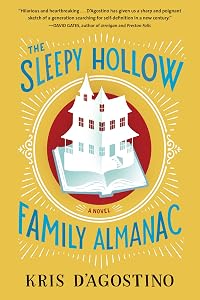
The Sleepy Hollow Family Almanac
by Kris D'Agostino
On This Page
Description
In the spirit of novels by Nick Hornby and Tom Perrotta, a smart, funny debut about a disillusioned young man whose fledgling leap from postadolescence to adulthood lands him back in an already overburdened family nest.Calvin Moretti can't believe how much his life sucks. He's a twenty-four-year-old film school dropout living at home again and working as an assistant teacher at a preschool for autistic kids. His insufferable go-getter older brother is also living at home, as is his kid show more sister, who's still in high school and has just confided to Cal that she's pregnant. What's more, Calvin's father, a career pilot, is temporarily grounded and obsessed with his own mortality. and his ever-stalwart mother is now crumbling under the pressure of mounting bills and the imminent loss of their Sleepy Hollow, New York, home: the only thing keeping the Morettis moored. Can things get worse? Oh, yes, they can.
Which makes it all the more amazing that The Sleepy Hollow Family Almanac is not only buoyantly fun but often very, very funny. In this debut novel, Kris D'Agostino has crafted an engrossing contemporary tale of a loopy but loving family, and in Calvin Moretti, he's created an oddball antihero who really wants to do the right thing—if he can just figure out what it is.
. show less
Tags
Recommendations
















Member Recommendations

Member Reviews
Calvin Moretti is a jerk. Despite being in his twenties, he behaves like a teenager, collecting vintage vinyl and sinking further into debt. While he wants to be a man of the world, he ends up moving back home with his parents. In fact, every decision he makes, or drifts into, leads him backwards.
The timing home is difficult; his overachieving and obnoxious brother is also home for an indefinite time, and his little sister has rejoined the nest. It all seems to be coming together for a Hallmark moment when the reader learns that the father of these children is dying of cancer. All those kids, all that potential help! Caregiving and getting to know each other, creating precious memories.
But no. This is not that family. Because "Dad" is show more not a Hallmark moment patient. He keeps a Colt .45 in his robe. Shooting at life-size family images through a window at night is just something to do. He's bunkered down, stocking the house with everything he can to beat a potential enemy, just not the one that is killing him from within. He makes Calvin promise to be with him in the end, and gives away his fears, it seems, only to Calvin.
An ensemble cast and a family drama like this usually leaves an author plenty of room to make it all work out with lots of hints at impending unity. That despite it all, they'll end up closer and wiser.
But no. This is not that author. Kris D'Agostino doesn't take the shortcuts. He creates characters that are messed up, and that much more real for their flaws. Recognizing that challenges don't always bring out the best in us, he doesn't insult the reader by tidying up their sometimes ugly lives. For example, Calvin works with disadvantaged and disabled children. Perfect setup to make him a sympathetic character, but D'Agostino doesn't go there. Calvin is just as much a jerk at work, impatient with these kids, and we see just how atypical he is. And here's the thing: the more layers of flaws and complications put on each character don't just make them difficult, it actually draws us in.
So how can you work a plot around some extraordinarily complicated characters? D'Agostino does so by making everything a surprise. A push and pull comes from moments when Calvin looks towards the future:
"What's going to happen to us?" I ask.
"In what context?" David asks.
"In the context of life," I say. "A year from now I'll be twenty-five. My father got married when he was twenty-five. He bought a house. I have nothing to show for it."
"We don't want those things," Wally says.
.....
"Maybe we need to grow up," I say. "At least a little. maybe it isn't all about us."
Yet pages later, Calvin is still short-sighted as always, looking for the perfect drug to deaden such questions about life. These moments occur for the rest of the family, as their worry over their Dad and money and a new complication presents itself. Many twists keep the tension ratcheted up, and it's difficult to put it down once you've started. Possibly because, while most families like to imagine they are the Cosby's, the Walton's, or the Cleaver's, the reality is that they are the Simpson's. And the Simpson's are what most of us understand. show less
The timing home is difficult; his overachieving and obnoxious brother is also home for an indefinite time, and his little sister has rejoined the nest. It all seems to be coming together for a Hallmark moment when the reader learns that the father of these children is dying of cancer. All those kids, all that potential help! Caregiving and getting to know each other, creating precious memories.
But no. This is not that family. Because "Dad" is show more not a Hallmark moment patient. He keeps a Colt .45 in his robe. Shooting at life-size family images through a window at night is just something to do. He's bunkered down, stocking the house with everything he can to beat a potential enemy, just not the one that is killing him from within. He makes Calvin promise to be with him in the end, and gives away his fears, it seems, only to Calvin.
An ensemble cast and a family drama like this usually leaves an author plenty of room to make it all work out with lots of hints at impending unity. That despite it all, they'll end up closer and wiser.
But no. This is not that author. Kris D'Agostino doesn't take the shortcuts. He creates characters that are messed up, and that much more real for their flaws. Recognizing that challenges don't always bring out the best in us, he doesn't insult the reader by tidying up their sometimes ugly lives. For example, Calvin works with disadvantaged and disabled children. Perfect setup to make him a sympathetic character, but D'Agostino doesn't go there. Calvin is just as much a jerk at work, impatient with these kids, and we see just how atypical he is. And here's the thing: the more layers of flaws and complications put on each character don't just make them difficult, it actually draws us in.
So how can you work a plot around some extraordinarily complicated characters? D'Agostino does so by making everything a surprise. A push and pull comes from moments when Calvin looks towards the future:
"What's going to happen to us?" I ask.
"In what context?" David asks.
"In the context of life," I say. "A year from now I'll be twenty-five. My father got married when he was twenty-five. He bought a house. I have nothing to show for it."
"We don't want those things," Wally says.
.....
"Maybe we need to grow up," I say. "At least a little. maybe it isn't all about us."
Yet pages later, Calvin is still short-sighted as always, looking for the perfect drug to deaden such questions about life. These moments occur for the rest of the family, as their worry over their Dad and money and a new complication presents itself. Many twists keep the tension ratcheted up, and it's difficult to put it down once you've started. Possibly because, while most families like to imagine they are the Cosby's, the Walton's, or the Cleaver's, the reality is that they are the Simpson's. And the Simpson's are what most of us understand. show less
Moving home after college seems to have become a trend, and it's understandable, given today's high unemployment rate. Who can afford an apartment when you're fresh out of school and working at a minimum wage job, struggling until something better comes along?
That's pretty much where Calvin, the protagonist of D'Agostino's debut novel, The Sleepy Hollow Family Almanac, finds himself in life. At 24, he's a film school dropout (not even a graduate!), living at home again, and working at a preschool for autistic kids (whom he calls "retards" in the first sentence of the book).
Cal's life, he tells the reader, isn't even close to what he wanted or expected for himself. Worse, his dad is seriously ill and his mom is cracking under the stress show more as their home is threatened with foreclosure.
D'Agostino, in an interview provided with the advance review copy I received, says that parts of this story are based on his own experiences. After graduating from college in 2000, he tells us he found himself "completely adrift in the world...," as well as "jobless, broke, and largely without motivation". In writing this novel, the author says he aimed to "put on the page a snippet of someone's life at a crossroads."
The Sleepy Hollow Family Almanac accomplishes this goal. It's packed with the stuff of real life: the maddening preschoolers who demand a potty break when they're just back from the bathroom; the once strong, airline pilot-father who rambles around in a bathrobe when cancer grounds him; the bank account that keeps shrinking even though Cal is desperately trying to save for his own place; the unmarried, pregnant sister; and on and on.
There's a dark humor here, although having experienced some of the stresses D'Agostino writes about, I felt more of the darkness than the humor; too much identification with Cal, I suppose, and perhaps a lack of sufficient sympathy when our trying-to-come-of-age narrator "enter(s) the mind-set of total ambitionless slackerdom."
A novel should be an account of change, whether interior or exterior, and I'm not sure I really saw a lot of change in Cal by the end of the book. He does make some difficult decisions at last, but I was left with the feeling that he's still mostly being pushed around by forces he doesn't fully understand, doesn't like, and can't control. The author does give us a snapshot of a life at the crossroads, but I would have liked to see this character take a more deliberate step at the fork he was facing--no matter which path he chose. show less
That's pretty much where Calvin, the protagonist of D'Agostino's debut novel, The Sleepy Hollow Family Almanac, finds himself in life. At 24, he's a film school dropout (not even a graduate!), living at home again, and working at a preschool for autistic kids (whom he calls "retards" in the first sentence of the book).
Cal's life, he tells the reader, isn't even close to what he wanted or expected for himself. Worse, his dad is seriously ill and his mom is cracking under the stress show more as their home is threatened with foreclosure.
D'Agostino, in an interview provided with the advance review copy I received, says that parts of this story are based on his own experiences. After graduating from college in 2000, he tells us he found himself "completely adrift in the world...," as well as "jobless, broke, and largely without motivation". In writing this novel, the author says he aimed to "put on the page a snippet of someone's life at a crossroads."
The Sleepy Hollow Family Almanac accomplishes this goal. It's packed with the stuff of real life: the maddening preschoolers who demand a potty break when they're just back from the bathroom; the once strong, airline pilot-father who rambles around in a bathrobe when cancer grounds him; the bank account that keeps shrinking even though Cal is desperately trying to save for his own place; the unmarried, pregnant sister; and on and on.
There's a dark humor here, although having experienced some of the stresses D'Agostino writes about, I felt more of the darkness than the humor; too much identification with Cal, I suppose, and perhaps a lack of sufficient sympathy when our trying-to-come-of-age narrator "enter(s) the mind-set of total ambitionless slackerdom."
A novel should be an account of change, whether interior or exterior, and I'm not sure I really saw a lot of change in Cal by the end of the book. He does make some difficult decisions at last, but I was left with the feeling that he's still mostly being pushed around by forces he doesn't fully understand, doesn't like, and can't control. The author does give us a snapshot of a life at the crossroads, but I would have liked to see this character take a more deliberate step at the fork he was facing--no matter which path he chose. show less
The reviews said this was supposed to be funny. I honestly can't say if it is or not because I disliked the book so much I never finished it.
I wanted to like it, but the main character bored me to tears. An over-privileged under-stimulated middle class college graduate with no direction in his life bemoaning his fate. His father has cancer, his sister is pregnant, his mother is struggling to pay the bills, but Calvin's biggest concern is how he's going to save enough to get his own apartment and pay his student loan.
If that's not the definition of a shallow unlikeable character I don't know what is. Every time I picked up this book I lost interest after only a few pages. Enough's enough. I'm done. I hate whiny novels.
I wanted to like it, but the main character bored me to tears. An over-privileged under-stimulated middle class college graduate with no direction in his life bemoaning his fate. His father has cancer, his sister is pregnant, his mother is struggling to pay the bills, but Calvin's biggest concern is how he's going to save enough to get his own apartment and pay his student loan.
If that's not the definition of a shallow unlikeable character I don't know what is. Every time I picked up this book I lost interest after only a few pages. Enough's enough. I'm done. I hate whiny novels.
After graduating from college with an ever-so-useful degree in film studies, Calvin drops out of graduate school and moves back home, where he finds life as he knew it quickly falling apart. His father, an airline pilot, has been diagnosed with cancer and is morosely awaiting his death (although his disease is treatable and the prognosis is good.) His mom is struggling to pay the mortgage on the reduced income Dad's disability brings in. Big brother Chip (the successful son) is at home, too, and helping to pay the bills. Little sister Elissa is still in high school and has just told Calvin she is pregnant. To help earn his own way, Calvin is working with autistic children, for minimum wage, and spending his spare time hanging out with show more his old high school friends.
Although this title has its amusing moments, the reader can't help being overtaken by Calvin's aimless lifestyle and his pessimism. There are some wonderful characters, and the scenes at the school are quite touching. The relationships between Calvin and his family are also well-drawn, if a bit over the top. All in all, though, it's just a rather depressing story about a young man who has no idea who he is or what he wants to do with his life. show less
Although this title has its amusing moments, the reader can't help being overtaken by Calvin's aimless lifestyle and his pessimism. There are some wonderful characters, and the scenes at the school are quite touching. The relationships between Calvin and his family are also well-drawn, if a bit over the top. All in all, though, it's just a rather depressing story about a young man who has no idea who he is or what he wants to do with his life. show less
In his first novel, D'Agostino tells the story of 24-year old Calvin Moretti, who is still living at home with his quirky parents and siblings, employed only because his mother requires it, has no money saved up to move out, and is angry about every bit of it. His father has been diagnosed with cancer, his teenage sister is pregnant, their home is about to be foreclosed, and he just wants to escape it all. Gradually he realizes that his options are to move out and allow his family to struggle alone or to force himself to grow up so he can emotionally and financially help the people he loves. The author successfully shows the struggle the main character goes through in making the hard decisions that will shape his present and future, show more which most readers will be able to relate to. In this sometimes-amusing, sometimes-heartbreaking story, the reader will start out disliking Calvin, but will soon be rooting for him to make the right decisions to keep his family afloat. show less
Twenty four year old Calvin Moretti is not living the dream. Living back home with his parents and employed at a job he doesn’t want, Cal is stuck. His father, a career pilot, has been grounded while undergoing cancer treatments and is convinced that he will not survive. His mother is frantically trying to save their home from foreclosure, his teenage sister is pregnant, and his frustratingly responsible older brother has come home to help. Torn between family responsibility and pursuit of his own happiness, Cal must decide whether to stick around or get out with his sanity intact.
This is a poignant debut that is both funny and moving and full of quirky, memorable characters. If you like dysfunctional but loveable family drama, The show more Sleepy Hollow Family Almanac will not disappoint. show less
This is a poignant debut that is both funny and moving and full of quirky, memorable characters. If you like dysfunctional but loveable family drama, The show more Sleepy Hollow Family Almanac will not disappoint. show less
Drugs, depression, dysfunctional families, death, and a few really funny moments. I would've preferred a few more laughs and something a little less soul-crushing. Good dialogue.
If you liked this book, you might also like The African Safari Papers.
If you liked this book, you might also like The African Safari Papers.
Members
- Recently Added By
Author Information
2+ Works 234 Members
Common Knowledge
- Original publication date
- 2012-03-20
- Blurbers
- Gates, David; Clarke, Brock
Classifications
Statistics
- Members
- 136
- Popularity
- 240,335
- Reviews
- 8
- Rating
- (3.00)
- Languages
- English
- Media
- Paper, Ebook
- ISBNs
- 2
- ASINs
- 2