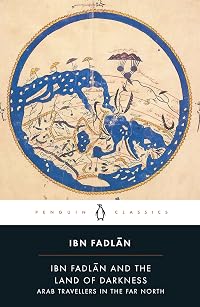
Ibn Fadlan and the land of darkness : Arab travellers in the far north
by Ibn Fadlan
On This Page
Description
"In 922 AD, an Arab envoy from Baghdad named Ibn Fadlan encountered a party of Viking traders on the upper reaches of the Volga River. In his subsequent report on his mission he gave a meticulous and astonishingly objective description of Viking customs, dress, table manners, religion and sexual practices, as well as the only eyewitness account ever written of a Viking ship cremation. Between the ninth and fourteenth centuries, Arab travellers such as Ibn Fadlan journeyed widely and show more frequently into the far north, crossing territories that now include Russia, Uzbekistan and Kazakhstan. Their fascinating accounts describe how the numerous tribes and peoples they encountered traded furs, paid tribute and waged wars. This accessible new translation offers an illuminating insight into the world of the Arab geographers, and the medieval lands of the far north."--Publisher's website. show lessTags
Recommendations

















Member Reviews
So my Beowulf journey continues, from Tacitus* in 2 A.D. to the dig beginning in 1939 at Sutton Hoo, and now this tangent, Fadlan’s 922 A.D. journey to Rūs.
Michael Crichton incorporated much of Fadlan’s account into his own fictionalized Eaters of the Dead; so much so, he should have given Fadlan co-author credit. Plagiarism, really.
But Fadlan does provide a creditable account of a Viking funeral, and Beowulf both opens and closes with the same event. (Xref notes on importance of Viking funeral in Sutton Hoo: Burial Ground of Kings?). He appears to accurately describe - aghast! - the hygiene and eating habits he encounters.
Though unrelated (at the time), Fadlan’s journey happened within a hundred years or so of the writing of show more Beowulf.
And for me and night time photography of the stars, I loved Fadlan’s account of having seen the Northern Lights.
And it’s just fascinating to read what Fadlan (and in this Penguin classic, other early travelers) encountered on their journeys. Very much in keeping with the human desire to know what lies beyond the next hill.
And TIL the Croatian currency the kuna had its roots in the Slavic word for “marten fur” the form for tribute the Rus imposed on a far ranging population.
*who wrote, concerning a different matter, “Where they make a desert they call it peace.” show less
Michael Crichton incorporated much of Fadlan’s account into his own fictionalized Eaters of the Dead; so much so, he should have given Fadlan co-author credit. Plagiarism, really.
But Fadlan does provide a creditable account of a Viking funeral, and Beowulf both opens and closes with the same event. (Xref notes on importance of Viking funeral in Sutton Hoo: Burial Ground of Kings?). He appears to accurately describe - aghast! - the hygiene and eating habits he encounters.
Though unrelated (at the time), Fadlan’s journey happened within a hundred years or so of the writing of show more Beowulf.
And for me and night time photography of the stars, I loved Fadlan’s account of having seen the Northern Lights.
And it’s just fascinating to read what Fadlan (and in this Penguin classic, other early travelers) encountered on their journeys. Very much in keeping with the human desire to know what lies beyond the next hill.
And TIL the Croatian currency the kuna had its roots in the Slavic word for “marten fur” the form for tribute the Rus imposed on a far ranging population.
*who wrote, concerning a different matter, “Where they make a desert they call it peace.” show less
Very interesting and mildly entertaining. A Muslim envoy's account of the first interaction between Viking and Muslim culture. Fadlan graphically describes the RUS's hygiene, size, intelligence and sexual habits. But I can't help but wonder how much of this was made up by some person in a dark basement in Europe a hundred years ago. Many of the accounts seem a little cartoonish, but then again maybe something got lost in translation.
Ibn Fadlan's manuscript gives an unusually vivid account of a journey from Baghdad to present-day Kazan on the Volga River in 922. The other narratives collected in this book are much flatter but still interesting. The mix of facts and speculation are interesting and give a picture of how the world looked to Muslims at this early date. While the Khazars and Rus are accurately described, these travelers still believed that Gog and Magog were locked up behind iron gates built by Alexander.
My Girlfriend gave this book to me as a birthday present, really enjoyed this book especially the description of ancient/medieval practices and places.
The leading item in this collection of "Arab Travellers in the Far North" is Ibn Fadlan's well-known account of his journey in about 922 AD from Baghdad through various west and central Asian states notably the Samanid Iranian-culture empire and the northward to the Bulghar people, vassals of the Jewish Khazars but themselves recent converts to Islam. There he met Rus traders, who according to most West European scholars (though not some Russian ones) were originally Swedish Vikings who settled around Kiev. The most famous part of his report is the description of the rituals surrounding the ship-burial of a Rus leader. This part has been printed as an excerpt many times, but often without the rest of his account. This is followed by the show more less well-known journey of Abu Hamid to much the same region about two hundred years later after the fall of the Khazar empire (and further on to modern Hungary) , and then by other even less known fragments and excerpts from a number of other Arabic writers who visited or described roughly the same regions. The translators have provided useful notes, especially notes identifying many of the obscure place-names and names of ethnic groups. . show less
Ratings
Members
- Recently Added By
Lists

Books recommended in the history category on FiveBooks.com
329 works; 4 members
Author Information
14 Works 652 Members
Series
Belongs to Publisher Series
Work Relationships
Inspired
Common Knowledge
- Canonical title
- Ibn Fadlan and the land of darkness : Arab travellers in the far north
- People/Characters
- Ibn Fadlan
- Important places
- Baghdad; Buchara; Kath; Gurgandsch; Bolgar
- Important events
- Viking ship cremation (922 AD); Arab envoy from Baghdad (922 AD)
- Quotations
- 'We saw a land which made us think a gate to the cold of hell had opened before us.'
Classifications
- Genres
- Travel, Nonfiction, General Nonfiction, History, Religion & Spirituality
- DDC/MDS
- 914.74042 — History & geography Geography & travel Geography of and travel in Europe Russia and neighbouring east European countries Eastern area of European Russia
- LCC
- DK511 .T17 — History of Europe, Asia, Africa and Oceania Russia. Soviet Union. Former Soviet Republics – Poland History of Russia. Soviet Union. Former Soviet Republics Local history and description Russia (Federation). Russian S.F.S.R.
- BISAC
Statistics
- Members
- 443
- Popularity
- 69,348
- Reviews
- 5
- Rating
- (3.83)
- Languages
- English
- Media
- Paper, Ebook
- ISBNs
- 2
- UPCs
- 1
- ASINs
- 2