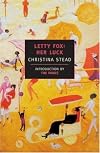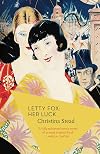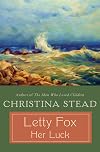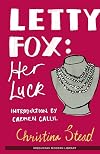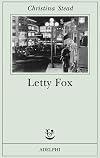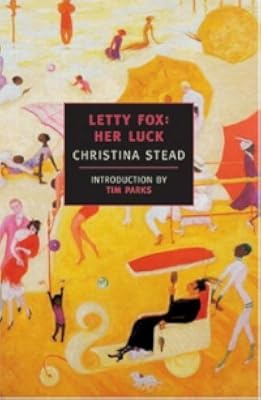
Letty Fox: Her Luck
by Christina Stead
On This Page
Description
From Paris to London to wartime New York, a young woman comes of age--and comes apart--in this witty novel by the author of The Man Who Loved Children. When Letty Fox first arrives in Manhattan, her goal is to escape her chaotic upbringing in London and Paris and the cynicism of her family, and create a fresh new start. This will be the existence she dreamed of--flitting from affair to affair, debating social issues over martinis, and finishing that novel about Robespierre that will make show more her envied by all the right people. Yet, Letty is at odds with both the city and herself: sexually adventurous yet fidgety for lasting romance, radically independent yet conservative, as likely to be betrayed by friends as she is to betray. And when Letty runs through the streets of Greenwich Village, it's as much to unleash her glorious appetite for life as it is to suppress the "black moods" that always threaten to derail it. "No wonder [Christina Stead's] work has reminded many of Tolstoy, Ibsen, Joyce," said the New York Times Book Review. When this poisonously funny satire of the American bourgeoisie was first published in 1947, it was banned in the author's native Australia, and met with alarm by stateside critics for its moral ambiguity. Ahead of its time with its vibrant and furious heroine, it is destined for rediscovery. From an author Saul Bellow called "really marvelous," Letty Fox is a "merciless, cruel, and magnificently unforgiving" comedy of manners (Angela Carter, London Review of Books). show lessTags
Recommendations




















Member Reviews
Like Coonardoo, this is a novel I read because I was trying to get more familiar with my own country's literature. Like that book, Letty Fox was written in the first half of the twentieth century by an Australian, Marxist, female writer, and it was also met with outrage in Australia upon publication – Letty Fox was actually banned here for many years for being too frank in its depictions of sex.
Aside from that, the books couldn't be any less similar. This book is set in the glitzy cities of New York, Paris and London, not a remote cattle station in northern WA. Some of the other reviews of this book have described it as a type of chick-lit from before chick-lit existed, and perhaps to some extent it is, but it's also deeper than that. show more The book is very much situated in time and place – it shows Letty growing up during the Roaring Twenties, then the Depression, then finally being a young adult in World War Two; it's reasonably political too, even openly political, seeing as (maybe not actually) every second character in this book is a socialist.
I'm inclined to see this book as drawing heavily on Christina Stead's own experiences, particularly of the milieu she moved in. As I said, tons of the characters here are socialists – they're also largely filthy rich. Letty moves in circles of aristocrats, writers, publishers; her grandmothers are both rich and one leaves her a large inheritance; she's enormously pretentious and insists on discussing philosophy in French (and by this I am referring to a page describing a conversation she had with one of her boyfriends, all about pretentious philosophy, in French, with no translations provided. This book is profoundly self-indulgent.). Essentially, Letty Fox moves in that Transatlantic intellectual elite which may profess to be Marxist, but only insofar as it doesn't jeopardise their careers and God forbid they should ever associate with poor people.
This may, of course, be one of the times where reading the introduction has influenced my opinion when subsequently reading the book; the introduction is written by a feminist publisher who chose to reprint this in the seventies or eighties because of its compelling depiction of heterosexual relationships, in all their dysfunctional glory. However, they found that Christina Stead herself was not too keen to be associated with a feminist publishing house, proudly declaring her love for men and insisting it's actually women who are the true parasites in society (even more than the bourgeoisie, apparently…) because so many of them "refuse" to do paid work after marriage. This grossly undervalues the huge amount of unpaid work that women, largely, did and still do; it also ignores the huge institutional obstacles unmarried women faced in landing a job. But no, they're all parasites! Okay.
And the novel does, to a large extent, portray many of its female characters as parasites. Letty, as narrator, is constantly describing her female relatives and their acquaintances as "scheming" – how to snag a rich man, how to divorce him so as to claim alimony, how to jail them for not paying alimony. More than one male character goes to jail for falling behind on alimony payments.
But honestly, the novel portrays its male characters as universally flawed too, and I'd prefer to look at this novel as an examination of how women's oppression under capitalism royally fucks up heterosexual relationships. Marriage is primarily depicted as the way women ensured their economic security, and only secondarily about love. Men are depicted as, generally, womanisers, while women (and especially young women!) fall way too hard for men who don't deserve it. While the circle Letty moves in is quite upper-class, she herself is constantly short on money, and I think her constant pursuit of "the right man" reflects this shortage. Her parents' marriage is disastrously bad. If this novel is anything, it's a depiction of some of (lots of) the myriad ways in which heterosexual relationships go bad.
So despite its self-indulgence, the pretentious French, and the fact that for all my "trying to understand my own country's literature" the novel doesn't even mention Australia once, I did enjoy this. I'm even keen to read more Christina Stead, although I hope she wrote some books that are less than 662 pages long, because that got tiresome and I'm sure there are some unnecessary detours she could have skipped. It's an interesting work. show less
Aside from that, the books couldn't be any less similar. This book is set in the glitzy cities of New York, Paris and London, not a remote cattle station in northern WA. Some of the other reviews of this book have described it as a type of chick-lit from before chick-lit existed, and perhaps to some extent it is, but it's also deeper than that. show more The book is very much situated in time and place – it shows Letty growing up during the Roaring Twenties, then the Depression, then finally being a young adult in World War Two; it's reasonably political too, even openly political, seeing as (maybe not actually) every second character in this book is a socialist.
I'm inclined to see this book as drawing heavily on Christina Stead's own experiences, particularly of the milieu she moved in. As I said, tons of the characters here are socialists – they're also largely filthy rich. Letty moves in circles of aristocrats, writers, publishers; her grandmothers are both rich and one leaves her a large inheritance; she's enormously pretentious and insists on discussing philosophy in French (and by this I am referring to a page describing a conversation she had with one of her boyfriends, all about pretentious philosophy, in French, with no translations provided. This book is profoundly self-indulgent.). Essentially, Letty Fox moves in that Transatlantic intellectual elite which may profess to be Marxist, but only insofar as it doesn't jeopardise their careers and God forbid they should ever associate with poor people.
This may, of course, be one of the times where reading the introduction has influenced my opinion when subsequently reading the book; the introduction is written by a feminist publisher who chose to reprint this in the seventies or eighties because of its compelling depiction of heterosexual relationships, in all their dysfunctional glory. However, they found that Christina Stead herself was not too keen to be associated with a feminist publishing house, proudly declaring her love for men and insisting it's actually women who are the true parasites in society (even more than the bourgeoisie, apparently…) because so many of them "refuse" to do paid work after marriage. This grossly undervalues the huge amount of unpaid work that women, largely, did and still do; it also ignores the huge institutional obstacles unmarried women faced in landing a job. But no, they're all parasites! Okay.
And the novel does, to a large extent, portray many of its female characters as parasites. Letty, as narrator, is constantly describing her female relatives and their acquaintances as "scheming" – how to snag a rich man, how to divorce him so as to claim alimony, how to jail them for not paying alimony. More than one male character goes to jail for falling behind on alimony payments.
But honestly, the novel portrays its male characters as universally flawed too, and I'd prefer to look at this novel as an examination of how women's oppression under capitalism royally fucks up heterosexual relationships. Marriage is primarily depicted as the way women ensured their economic security, and only secondarily about love. Men are depicted as, generally, womanisers, while women (and especially young women!) fall way too hard for men who don't deserve it. While the circle Letty moves in is quite upper-class, she herself is constantly short on money, and I think her constant pursuit of "the right man" reflects this shortage. Her parents' marriage is disastrously bad. If this novel is anything, it's a depiction of some of (lots of) the myriad ways in which heterosexual relationships go bad.
So despite its self-indulgence, the pretentious French, and the fact that for all my "trying to understand my own country's literature" the novel doesn't even mention Australia once, I did enjoy this. I'm even keen to read more Christina Stead, although I hope she wrote some books that are less than 662 pages long, because that got tiresome and I'm sure there are some unnecessary detours she could have skipped. It's an interesting work. show less
I almost gave up on this book. I loved the first couple of chapters, I loved the last few chapters. It's the three dozen or so in the middle that just become a slog, but then the effect of the ending would have bee lost without them.
people talk about how christina stead's great weakness is not knowing what to edit/weed out. and it's true, sure, but i dunno...i kinda like that. it makes her lengthy detailed repetitive books of female domestic and familial experience feel more authentic and less literary, in a way i enjoy. like you're at the kitchen table reading the unexpurgated letters from your batty aunt who doesn't know the meaning of discretion, or something. "fun."
“you all kid yourselves your children are too sensitive to go to the public schools, even though every well-heeled man in this generation came from the public schools—and in those days they just had ordinary Irish and Jewish teachers who weren’t respected very highly; there wasn’t the to-do about education there is nowadays. But the products are all right. But your kids are too talented to go there. Private schools are just the means of encouraging the middle class to strip itself, don’t you see..." pg 398
"a system can’t exist without some thought behind it. The thought is just what I say, you’ve got to strip yourself of every cent you have, to immolate yourself before capitalism. It’s a frenzy they’ve got you into. show more You’re really adoring and worshiping capitalism. Because, if you were serious, wouldn’t you all be starting up free progressive schools for the poor, for the slum kids? But it’s only for your little doctors, artists, and teachers in embryo. So you’re not serious. You’re just trying to force the kids so they’ll bring in big money later on.” pg 399 show less
"a system can’t exist without some thought behind it. The thought is just what I say, you’ve got to strip yourself of every cent you have, to immolate yourself before capitalism. It’s a frenzy they’ve got you into. show more You’re really adoring and worshiping capitalism. Because, if you were serious, wouldn’t you all be starting up free progressive schools for the poor, for the slum kids? But it’s only for your little doctors, artists, and teachers in embryo. So you’re not serious. You’re just trying to force the kids so they’ll bring in big money later on.” pg 399 show less
Ratings
Members
- Recently Added By
Lists

Shaking a Leg
111 works; 3 members
Author Information

24+ Works 3,512 Members
Author Christina Stead was born in Rockdale, New South Wales, Australia on July 17, 1902. She left Australia in 1928 and spent time in Europe, England, and the United States before permanently returning in 1974. She wrote fifteen novels and numerous volumes of short stories. She is best known for her novel, The Man Who Loved Children, which was show more based on her childhood. Her novels were unpublished in Australia until 1965 and she was denied the Britannica-Australia award in 1967 on the grounds that she was no longer considered an Australian. In 1974, she won the Patrick White award. While living in the United States during the 1940s, she worked as a Hollywood scriptwriter and contributed to Madame Curie and They Were Expendable. She died on March 31, 1983. (Bowker Author Biography) show less
All Editions
Some Editions
Series
Belongs to Publisher Series
Work Relationships
Has as a commentary on the text
Common Knowledge
- Canonical title
- Letty Fox: Her Luck
- Original publication date
- 1946
- People/Characters
- Letty Fox
- Important places
- New York, New York, USA; Paris, France; London, England, UK
- Epigraph
- L'expérience te manque, et malheureusement c'est une chose qui ne s'acquiert qu'à force de sottises et de bévues!
-Le Paysan et la Paysanne Pervertis
RÉTIF DE LA BRETONNE - First words
- One hot night last spring, after waiting fruitlessly for a call from my then lover, with whom I had quarreled the same afternoon, and finding one of my black moods on me, I flung out of my lonely room on the ninth floor (unlu... (show all)cky number) in a hotel in lower Fifth Avenue and rushed into the streets of the Village, feeling bad.
- Last words
- (Click to show. Warning: May contain spoilers.)I have a freight, I cast off, the journey has begun.
- Blurbers
- Carter, Angela; Bellow, Saul
Classifications
Statistics
- Members
- 307
- Popularity
- 104,503
- Reviews
- 4
- Rating
- (3.15)
- Languages
- English, Italian
- Media
- Paper, Ebook
- ISBNs
- 15
- ASINs
- 3