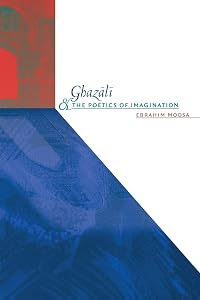
Ghazālī and the Poetics of Imagination
by Ebrahim Moosa
On This Page
Description
Focusing on Abu Hamid al-Ghazali, the preeminent Muslim thinker, this book argues that his work has lasting relevance as a model for a critical encounter with Muslim intellectual tradition in a modern and postmodern context. It proposes that Muslims who place their own traditions in conversation with modern traditions share the same vantage point.Tags
Recommendations




Member Reviews
I started to read this book because I had a decidedly distasteful attitude towards Abu Hamid Al-Ghazali and I decided that perhaps I was not giving the man a fair shake. I had recently read that in Al-Ghazalis’ “Council to Kings” he characterized the ‘race of women’ as consisting of females whose behavior could be pigeonholed into the following categories: dog, pig, fox, scorpion, pigeon, donkey, mouse, snake, monkey or sheep. A good woman would be most similar to a sheep. I don’t like to be called a sheep. Anyhow, this “Council to Kings” book is out of print, so I couldn’t get a feel for the context in which Al-Ghazali wrote this stuff, plus one needs to keep in mind that gender justice is very historical time and show more context dependent. Therefore, I decided to read Ebrahim Moosa’s book to get a better idea of who this Al-Ghazali person was and what he had to say about women.
First off, he doesn’t have anything to say about women in this book. Al-Ghazali’s ideas of individuality and what constitutes human consciousness are gender neutral.
Second, there isn’t much verbatim quoting of Al-Ghazali, this is Moosa’s commentary on Al-Ghazali’s ideas, many of which were spread out across volumes of Al-Ghazali’s copious literary output.
Third, Moosa does have a post-modernism bias (based on my observation that only post-modernists use the word ‘bricolage’) however, he is respectful of Muslim tradition. His basic tenant is Muslims need to deconstruct the past so that it can then be reconstructed with a foundation of tradition but with an active dialog in respect to dealing with modern problems.
Moosa’s book is very good in that it paints a very complex portrait of a highly complicated and interesting historical figure. No Al-Ghazali wasn’t perfect, yes he backtracked on some of his ideas or wasn’t consistent, and perhaps even he was a dreaded ‘flip-flopper’, but nevertheless, who exactly is right all of the time? Who doesn’t change their mind? And besides, Al-Ghazali did write some stunningly beautiful things. I particularly liked his analysis of the “light” ayahs in Surat al-Noor. Furthermore, since so many Muslim traditions have picked over and borrowed from Al-Ghazali’s work, I felt like I had a better understanding of so many other Muslim thinkers, particularly Rumi and Muhammad Iqbal. In reading Al-Ghazali, you get a better understanding of the source of many Muslim ‘talking points”.
There is a lot of heavy vocabulary, most of which Moosa defines so you don’t have to go running to a dictionary (ex. Anathema, catachresis, epistemicide, teleiopoiesis, liminality, palingenesis). The style is academic, but not so obtuse that a college sophomore couldn’t handle it. The chapters on self and identity were lovely, but I got a bit lost on the metaphysics chapters.
After reading this book I had much greater respect for Abu Hamid Al-Ghazali, and while he wasn’t perfect and got some stuff wrong, overall he was an amazing thinker. show less
First off, he doesn’t have anything to say about women in this book. Al-Ghazali’s ideas of individuality and what constitutes human consciousness are gender neutral.
Second, there isn’t much verbatim quoting of Al-Ghazali, this is Moosa’s commentary on Al-Ghazali’s ideas, many of which were spread out across volumes of Al-Ghazali’s copious literary output.
Third, Moosa does have a post-modernism bias (based on my observation that only post-modernists use the word ‘bricolage’) however, he is respectful of Muslim tradition. His basic tenant is Muslims need to deconstruct the past so that it can then be reconstructed with a foundation of tradition but with an active dialog in respect to dealing with modern problems.
Moosa’s book is very good in that it paints a very complex portrait of a highly complicated and interesting historical figure. No Al-Ghazali wasn’t perfect, yes he backtracked on some of his ideas or wasn’t consistent, and perhaps even he was a dreaded ‘flip-flopper’, but nevertheless, who exactly is right all of the time? Who doesn’t change their mind? And besides, Al-Ghazali did write some stunningly beautiful things. I particularly liked his analysis of the “light” ayahs in Surat al-Noor. Furthermore, since so many Muslim traditions have picked over and borrowed from Al-Ghazali’s work, I felt like I had a better understanding of so many other Muslim thinkers, particularly Rumi and Muhammad Iqbal. In reading Al-Ghazali, you get a better understanding of the source of many Muslim ‘talking points”.
There is a lot of heavy vocabulary, most of which Moosa defines so you don’t have to go running to a dictionary (ex. Anathema, catachresis, epistemicide, teleiopoiesis, liminality, palingenesis). The style is academic, but not so obtuse that a college sophomore couldn’t handle it. The chapters on self and identity were lovely, but I got a bit lost on the metaphysics chapters.
After reading this book I had much greater respect for Abu Hamid Al-Ghazali, and while he wasn’t perfect and got some stuff wrong, overall he was an amazing thinker. show less
Ratings
Members
- Recently Added By
Author Information
5+ Works 74 Members
Ebrahim Moosa is associate university research professor of religious studies and director of the Center for the Study of Muslim Networks at Duke University
Awards and Honors
Series
Belongs to Publisher Series
Common Knowledge
- Canonical title
- Ghazālī and the Poetics of Imagination
- Original publication date
- 2005
- People/Characters
- Ghazzālī (1058-1111)
- Important places
- Abbasid Caliphate; Persia
- Disambiguation notice
- 2005 edition: Ghazālī and the poetics of imagination / Ebrahim Moosa
Classifications
Statistics
- Members
- 43
- Popularity
- 689,317
- Reviews
- 1
- Rating
- (4.38)
- Languages
- English
- Media
- Paper, Ebook
- ISBNs
- 4