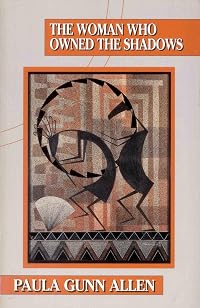
The Woman Who Owned the Shadows
by Paula Gunn Allen
On This Page
Description
The Woman Who Owned the Shadows starts where the rest of the world leaves Indians off: at the brink of death. Ephanie Atencio is in the midst of a breakdown from which she can barely move. She has been left by her husband and is unable to take care of her children. To heal, Ephanie must seek, however gropingly, her own future. She leaves New Mexico for San Francisco, where she begins again the process of remembering and finding a way to herself, relying no longer on men, but on her primary show more connections to the spirit women of her people and to the women of her own world. show lessTags
Recommendations





















Member Reviews
Review: The Woman Who Owned The Shadows by Paula Gunn Allen. This is a book about a contemporary American Indian woman named Ephanie Atencio. The poetic writing style captivated me from page one. Yet, the content was fascinating and interesting it was sometimes hard to follow. The story was written in various combinations revolving around different aspects of Ephanie’s life. In order for me to understand and visualize clearly I had to read at a slow pace. The story of Ephanie life was occupied by many issues and it took a strong woman to live among minorities, especially being female, lesbian, and Native American. Ephanie Atencio story begins when she is under a lot of stress and is on the edge of having a breakdown. Her husband has show more left her and she becomes unable to care for her children. Her mother winds up taking the children so Ephanie could have time to pull herself together. She leaves New Mexico for San Francisco, where she can sort out parts of her emotions and life. For a while she went through a process of remembering her childhood and ultimately finding a way to know herself, no longer relying on men. She learns her journey weaves effectively through many faces of reality. She searches for her strength and her power that she knows is within her in order to face her future. Ephanie does marry again to a Nisei man, Thomas Yoshuri, feeling at this time in her life he needs her and she needs structure. She soon realizes she can’t know herself through him. She starts to spend a lot of time with the white women of the community and is befriended by Teresa who she can easily talk with. Ephanie goes through many confusing emotions throughout her story but when she finally accepts reality within herself she knows her future was among the women of her own people and the women in her world. show less
Part of book project. I found this slow going, I didn't develop concern for the characters. The politics are still relevant.
Ratings
Members
- Recently Added By
Lists

Indigenous America Reader
145 works; 12 members
Author Information

28+ Works 2,053 Members
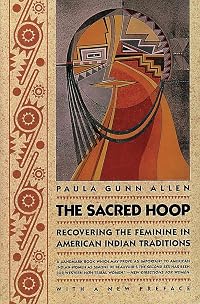
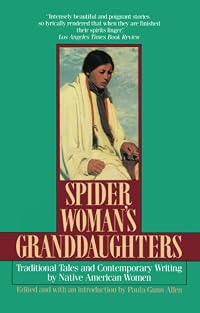
Of Laguna Pueblo and Sioux descent, Allen was one of the best-known Native American writers and critics and cousin to another, Leslie Marmon Silko. She was born in Grants, New Mexico, on October 24, 1939. She received a bachelor's degree in English in 1966 and a master's degree of fine arts in creative writing in 1968 from the University of Oregon show more and a doctorate in American studies in 1975 from the University of New Mexico. She taught at numerous schools during her lifetime including San Francisco State, University of California at Berkeley and University of California at Los Angeles. She wrote 17 books including volumes of her own poetry, fiction, and nonfiction. She also edited important collections of Native American writing. She received grants from the National Endowment for the Arts, the Ford Foundation, and the University of California at Los Angeles, where she was a postdoctoral fellow in American Indian Studies. She received numerous awards including an American Book Award for editing Spider Woman's Granddaughters: Short Stories by American Indian Writers in 1990 and the Hubbell Medal in 1999. She devoted much of her work to combating oppression by critiquing the ideas that have sanctioned it. The Woman Who Owned the Shadows (1983), is about a woman who comes to realize that she is a lesbian. Allen explores and affirms for women and lesbians the ideas of Spider Grandmother who, in many Native American traditions, is the creator of the heavens, the earth, and all the spirit beings, and therefore an icon of female power. The Sacred Hoop (1986), is a collection of essays written over a number of years that explicitly argue that Native American literature, traditions, mythology, and spirituality can be powerful antidotes to white racism, sexism, and homophobia. She died of lung cancer on May 29, 2008. (Bowker Author Biography) show less
Common Knowledge
- Original publication date
- 1983
Classifications
Statistics
- Members
- 198
- Popularity
- 165,992
- Reviews
- 2
- Rating
- (3.45)
- Languages
- Dutch, English
- Media
- Paper, Ebook
- ISBNs
- 6
- ASINs
- 1