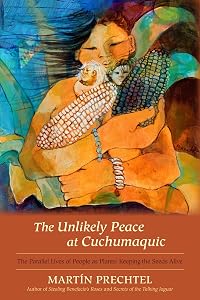
The Unlikely Peace at Cuchumaquic: The Parallel Lives of People as Plants: Keeping the Seeds Alive
by Martín Prechtel
On This Page
Description
"A memoir, spiritual adventure story, and ecological fable, this book shares the message that plants and humanity are interconnected, and that the survival of one depends upon the other"--Provided by publisher.Tags
Recommendations





























Member Reviews
"Like victims of an ancient spiritual and cultural shipwreck, we have been adrift for four thousand years, floating on people-centered rafts of provisional civilizations that have convinced themselves they are the real thing and the cutting edge of human evolution, while designating our true magical origins of deep small cultures as some dirty, half-evolved, grunting, primitive past.
But no matter how far we’ve drifted away from those real indigenous shores, the spirits of our last happy, intact, indigenous ancestors from before we began to drift are effortlessly coursing right along with us. Having merged with the vastness of the natural wild tossing sea we so fear to drown in, they follow each of us like a pod of giant sea turtles, show more their big sweet scaly heads thumping up under us, trying their best to get our attention and tow us home to our real selves, knocking on the hull of the lifeboat of today’s assumed culture, while we drift along figuring that the anxiety of civilization’s never-ending feeling of emergency is normal."
This passage is from page 310 of the book. It sums up Prechtel's almost-desperate thesis; help is available to those who ask. Indigeneousity is a fundamental capacity of humans; what is forgotten is not lost. There's a fierce hopefulness to this book, overtaking the beauty and grief found in Prechtel's previous texts.
This is Prechtel's longest and most literal and prescriptive book. Whereas his past book have been written for a general audience, this book is very clearly aimed at his students in his school—Bolad's Kitchen. For these reasons, it also took me longer to read than any of his other books.
As the title suggests, the central theme of the book is the interconnected co-existance of plants and people. To take a plant discussed heavily in the book—what we are maize and maize is us? What if these two species are part of a kind of reciprocal maintenance, where each is sustained and evolves with the other? The Maya lived in such a world, and there’s a lot we’ve left behind by stepping out of such a story, to a place where food could be a commodity rather than a peer.
A subtext surrounds the importance of authenticity. There is merit to the hipster inclination towards provenance. We like to turn away from stories which displease us. “I can’t afford those handmade pants,” is the sort of statement you might hear, speaking of some artisanal denim from California or New York. But the speaker is unlikely to disavow pants altogether. They will purchase handmade pants—made by the hands of an eleven-year-old in Malaysia getting paid a dollar an hour. There’s a reason you don’t see the label “Handmade in China;” we don’t like to think about those hands, the hands that we are unwilling to pay enough to afford basic human dignity. Prechtel explores this thread by discussing a “House of Origins,” a place where we can tell the complete story of everything inside. How many objects in your life hold this significance? One facet of the sacred is a familiarity so deep that something becomes a part of ourselves.
If you sometimes find yourself picking at the chinks in the wall of Western culture, you will find this book a fortifying tonic. show less
But no matter how far we’ve drifted away from those real indigenous shores, the spirits of our last happy, intact, indigenous ancestors from before we began to drift are effortlessly coursing right along with us. Having merged with the vastness of the natural wild tossing sea we so fear to drown in, they follow each of us like a pod of giant sea turtles, show more their big sweet scaly heads thumping up under us, trying their best to get our attention and tow us home to our real selves, knocking on the hull of the lifeboat of today’s assumed culture, while we drift along figuring that the anxiety of civilization’s never-ending feeling of emergency is normal."
This passage is from page 310 of the book. It sums up Prechtel's almost-desperate thesis; help is available to those who ask. Indigeneousity is a fundamental capacity of humans; what is forgotten is not lost. There's a fierce hopefulness to this book, overtaking the beauty and grief found in Prechtel's previous texts.
This is Prechtel's longest and most literal and prescriptive book. Whereas his past book have been written for a general audience, this book is very clearly aimed at his students in his school—Bolad's Kitchen. For these reasons, it also took me longer to read than any of his other books.
As the title suggests, the central theme of the book is the interconnected co-existance of plants and people. To take a plant discussed heavily in the book—what we are maize and maize is us? What if these two species are part of a kind of reciprocal maintenance, where each is sustained and evolves with the other? The Maya lived in such a world, and there’s a lot we’ve left behind by stepping out of such a story, to a place where food could be a commodity rather than a peer.
A subtext surrounds the importance of authenticity. There is merit to the hipster inclination towards provenance. We like to turn away from stories which displease us. “I can’t afford those handmade pants,” is the sort of statement you might hear, speaking of some artisanal denim from California or New York. But the speaker is unlikely to disavow pants altogether. They will purchase handmade pants—made by the hands of an eleven-year-old in Malaysia getting paid a dollar an hour. There’s a reason you don’t see the label “Handmade in China;” we don’t like to think about those hands, the hands that we are unwilling to pay enough to afford basic human dignity. Prechtel explores this thread by discussing a “House of Origins,” a place where we can tell the complete story of everything inside. How many objects in your life hold this significance? One facet of the sacred is a familiarity so deep that something becomes a part of ourselves.
If you sometimes find yourself picking at the chinks in the wall of Western culture, you will find this book a fortifying tonic. show less
Ratings
Members
- Recently Added By
Lists

Best Environmental Books
32 works; 2 members
Author Information
16 Works 495 Members
Martin Prechtel's life took him from his native New Mexico upbringing as a half-blood Native American from a Peublo Indian reservation to the village of Santiago Atitlan, Guatemala. There, he was trained as a shaman and eventually served the Tzutujil Mayan population as a full village member, becoming a principal in the body of village leaders. show more Martin once again resides in his native New Mexico where he is a writer, teacher, speaker, musician, and healer show less
Classifications
Statistics
- Members
- 31
- Popularity
- 905,238
- Reviews
- 1
- Rating
- (4.50)
- Languages
- English
- Media
- Paper, Ebook
- ISBNs
- 3