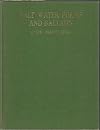
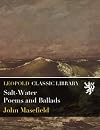
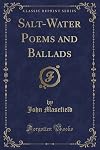
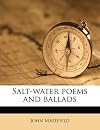
Salt-Water Poems and Ballads
by John Masefield
On This Page
Description
The Salt-Water Poems and Ballads were published in the new days of the twentieth century by a young man, newly home in Britain but freshly off a ship which arguably had been his truest home since before his eighteenth birthday. The love for the sea that John Masefield lays out in front of us is more than a simple saccharine wistfulness for the aquamarine beauty. He cares for its darkness, its perilous changeability and mercilessness. Whilst many poets who deal with a life at sea focus show more exclusively on the swashbuckling adventure available on tropical isles in ports of anarchy, The Salt-Water Poems and Ballads take in this element along with the accidents, the fears and the comfort of the routine in the midst of danger. Masefield cherishes even the darker moments beneath the 'cold skies'. 'When the rising moon was a copper disc and the sea was a strip of steel, We dumped him down to the swaying weeds ten fathoms beneath the keel' The poems work with the full spectrum of a sailor's life, the movement, the longing and the even the superstition and folklore of a life at sea. Picture the author in a little cabin, far out on deep water. Shimmering waves and flickering lamplight as John Masefield began to reach out and call us all to go to sea, more surely than any siren or mermaid. In the author's own words 'I must go down to the seas again, to the vagrant gypsy life, To the gull's way and the whale's way, where the wind's like a whetted knife;And all I ask is a merry yarn from a laughing fellow-rover, And quiet sleep and a sweet dream when the long trick's over.' About the Publisher Forgotten Books publishes hundreds of thousands of rare and classic books. Find more at www.forgottenbooks.com This book is a reproduction of an important historical work. Forgotten Books uses state-of-the-art technology to digitally reconstruct the work, preserving the original format whilst repairing imperfections present in the aged copy. In rare cases, an imperfection in the original, such as a blemish or missing page, may be replicated in our edition. We do, however, repair the vast majority of imperfections successfully; any imperfections that remain are intentionally left to preserve the state of such historical works. show lessTags
Recommendations









































Member Reviews
Found this in a used bookstore in Milwaukee, WI and only knew one of them, Sea Fever. "I must go down to the seas again, to the lonely sea and the sky,/And all I ask is a tall ship and a star to steer her by" It's a nice book, some nice illustrations and one lovely color plate. A few of the verses in here sound like Popeye, but most are first rate.
1913 edition
Ratings
Members
- Recently Added By
Lists

First published in 1916
68 works; 4 members
Author Information

181+ Works 4,031 Members
Once one of the most popular English poets of the century, Masefield has fallen into undeserved neglect since his death. He was born in a Victorian house with rural vistas, which he later recalled as "living in Paradise." In childhood, he had a series of intense, visionary experiences inspired by both nature and literature, which gave him a show more habitual sense of participation in a greater life. These had weakened by 1891, when he entered training for the merchant naval service. An officer on the White Star Line's Adriatic, he jumped ship in New York in 1895 and roamed across America. He returned to England two years later when a recovery of his intense childhood visions convinced him he could succeed as a writer. Masefield excelled more at narrative than at symbolism. His first book, "Salt Water Poems and Ballads" (1902), displayed the allegiance to outcasts and wanderers that marks his subject matter. The musicality of that volume derives partly from the strong early influence of W. B. Yeats. Increasingly, Masefield experimented with colloquial diction, particularly from the lower classes. His "The Everlasting Mercy" (1911) recounted the conversion of a rural scoundrel in language that astonished many readers. Highly prolific, he produced more than 20 volumes of fiction, 17 plays, and other prose work besides his major volumes of poetry. Masefield still appeals particularly to the common reader. He was appointed poet laureate in 1930. (Bowker Author Biography) show less
Classifications
Statistics
- Members
- 96
- Popularity
- 336,249
- Reviews
- 2
- Rating
- (3.67)
- Languages
- English
- Media
- Paper, Ebook
- ISBNs
- 5
- ASINs
- 10