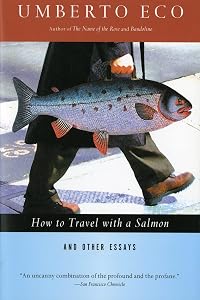
How to Travel with a Salmon and Other Essays
by Umberto Eco
On This Page
Description
How to Travel with a Salmon is a highly engaging collection of what Umberto Eco calls his diario minimo - minimal diaries - after the magazine column in which he began "pursuing the pathways of parody." These essays, written in the late eighties and early nineties, are his playful but unfailingly accurate takes on militarism, computer jargon, Westerns, art criticism, librarians, bureaucrats, meals on airplanes, Amtrak trains, bad coffee, maniacal taxi drivers, express mail, 33-function show more watches, fax machines and cellular phones, pornography, soccer fans, academia, and - last but definitely not least - the author's own self. How to Travel with a Salmon gives us Umberto Eco's acute vision of the absurdities of modern life. show lessTags
Recommendations


Member Reviews
It reads like a collection of essays by a hybrid of Jorge Luis Borges and Dave Barry. (I mean that as a compliment because I admire both of those writers.)
In “How to Speak of Animals,” reflecting on a news item about two kids who break into the Central Park Zoo after-hours, go swimming in the polar bear enclosure and end up getting chewed to bits, he gives his theory on the root cause:
These children were probably victims of our guilty conscience, as reflected in the schools and the mass media.
"Human beings have always been merciless with animals, but when humans became aware of their own cruelty, they began, if not to love animals (because, with only sporadic hesitation, they continue eating them), at least to speak well of them. As show more the media, the schools, public institutions in general, have to explain away so many acts performed against humans by humans, it seems finally a good idea, psychologically and ethically, to insist on the goodness of animals. We allow children of the Third World to die, but we urge children of the First to respect not only butterflies and bunny rabbits but also whales, crocodiles, snakes.
Mind you, this educational approach is per se correct. What is excessive is the persuasive technique chosen: to render animals worthy of rescue they are humanized, toyified. No one says they are entitled to survival even if, as a rule, they are savage and carnivorous. No, they are made respectable by becoming cuddly, comic, good-natured, benevolent, wise, and prudent.
…
Advertising, cartoons, illustrated books are full of bears with hearts of gold, law-abiding, cozy, and protective—although in fact it’s insulting for a bear to be told he has a right to live because he’s only a dumb and inoffensive brute. So I suspect that the poor children in Central Park died not through lack of education but through too much of it. They are victims of our unhappy conscience.
To make them forget how bad human beings are, we were taught too insistently that bears are good. Instead of being told honestly what humans are and what bears are."
And some unassailable logic in “How to Avoid Contagious Diseases”:
"I read recently that according to the revelations of Professor Matré, heterosexual contact is carcinogenic. High time somebody came out and said it. I would go even farther: heterosexual contact causes death, period. Even a fool knows that it ends in procreation, and the more people are born, the more die." show less
In “How to Speak of Animals,” reflecting on a news item about two kids who break into the Central Park Zoo after-hours, go swimming in the polar bear enclosure and end up getting chewed to bits, he gives his theory on the root cause:
These children were probably victims of our guilty conscience, as reflected in the schools and the mass media.
"Human beings have always been merciless with animals, but when humans became aware of their own cruelty, they began, if not to love animals (because, with only sporadic hesitation, they continue eating them), at least to speak well of them. As show more the media, the schools, public institutions in general, have to explain away so many acts performed against humans by humans, it seems finally a good idea, psychologically and ethically, to insist on the goodness of animals. We allow children of the Third World to die, but we urge children of the First to respect not only butterflies and bunny rabbits but also whales, crocodiles, snakes.
Mind you, this educational approach is per se correct. What is excessive is the persuasive technique chosen: to render animals worthy of rescue they are humanized, toyified. No one says they are entitled to survival even if, as a rule, they are savage and carnivorous. No, they are made respectable by becoming cuddly, comic, good-natured, benevolent, wise, and prudent.
…
Advertising, cartoons, illustrated books are full of bears with hearts of gold, law-abiding, cozy, and protective—although in fact it’s insulting for a bear to be told he has a right to live because he’s only a dumb and inoffensive brute. So I suspect that the poor children in Central Park died not through lack of education but through too much of it. They are victims of our unhappy conscience.
To make them forget how bad human beings are, we were taught too insistently that bears are good. Instead of being told honestly what humans are and what bears are."
And some unassailable logic in “How to Avoid Contagious Diseases”:
"I read recently that according to the revelations of Professor Matré, heterosexual contact is carcinogenic. High time somebody came out and said it. I would go even farther: heterosexual contact causes death, period. Even a fool knows that it ends in procreation, and the more people are born, the more die." show less
A good casual reflection of Eco's genius and sense of humor, How to Travel is an oddball mix of short essays and fiction. Most pieces follow the "how-to" title format, with satiric content. Of note are the title essay, "How to Justify a Private Library," "How to Write an Introduction," "How to Watch out for Widows," and "How to Organize a Public Library." These have a rather matte sheen of cultural commentary on travel, life as an intellectual (I know, but Eco breaks the shiny celebrity life into rather hilarious pieces) and even issues like cultural representation and pacing in movies. Their reassuring rhythm stays fresh in this way: they always begin on-topic, precisely, but then take a very specific turn, and follow whatever conceit show more has been chosen to an appropriate closing point. Though most columnists induce involuntary urges in me to hit my head against the nearest wall, I'd gladly subscribe to a magazine that featured this kind of thing, if I could read Italian and Eco were in any state to be writing.
The pieces which don't fit into this pattern provide nice change of pace and are completely unexpected. "Stars and Stripes" gets a little distracted by its own details, but is a brilliant little sci-fi sidetrack. "On the Impossibility of Drawing a map of the Empire on a Scale of 1 to 1" shows the extent of imagination which makes Eco successful in so many other ventures. "Editorial Revision" is clever and delightful, but I won't pretend to follow all of it; along with "Sequels" and a few of the other literary pieces it was a demonstration of the depth of Eco's reading but not all accessible for those who haven't a complete knowledge of the classics.
The closing essay is tender, kind, and loyal, all without giving up the honesty of telling about one's hometown or the historic rigor characteristic to Eco's writing, and gives the perfect bittersweet closing to a book unified only by the author's perspective. show less
The pieces which don't fit into this pattern provide nice change of pace and are completely unexpected. "Stars and Stripes" gets a little distracted by its own details, but is a brilliant little sci-fi sidetrack. "On the Impossibility of Drawing a map of the Empire on a Scale of 1 to 1" shows the extent of imagination which makes Eco successful in so many other ventures. "Editorial Revision" is clever and delightful, but I won't pretend to follow all of it; along with "Sequels" and a few of the other literary pieces it was a demonstration of the depth of Eco's reading but not all accessible for those who haven't a complete knowledge of the classics.
The closing essay is tender, kind, and loyal, all without giving up the honesty of telling about one's hometown or the historic rigor characteristic to Eco's writing, and gives the perfect bittersweet closing to a book unified only by the author's perspective. show less
"How to Travel with a Salmon & Other Essays" is a 'How-To' book by Umberto Eco, with which he aims to help readers get through our modern lives. You may be one of those who needs to know "How to Recognize a Porn Movie" or "How to Eat Ice Cream" or "How to Use the Coffeepot from Hell." Or not. But if you izz or if you izzent, you'll probably have a good laugh at the modern CORRECT way of doing any one of the 41 things that other people don't know how to do correctly. Bring lots of clean underpants and a few rolls of toilet paper, and keep them handy while you enjoy Umberto Eco's latest laugh at the modern world.
Four-and-a-half stars because neither author Eco nor his translator, William Weaver, thought to tell me how much paper I would show more need.
Solomon sed show less
Four-and-a-half stars because neither author Eco nor his translator, William Weaver, thought to tell me how much paper I would show more need.
Solomon sed show less
Absolutely hilarious, but you do have to be on Eco's frequency
Essays, particularly when very well-written, surpass short-stories for one very specific reason: they are generally based in fact, which is always funnier than truth and frequently more difficult to pin down.
I bought my copy of this book at the Oxford Bookstore in Kolkata. Friends and I had gone there to see an exhibit of paintings of ordinary daily use things. I saw the spine and the stack of books by Mr. Eco and had to stop and pick one up.
It was a lovely gift to myself, and one that brought my travel companions and I great joy. We particularly enjoyed the advice on dealing with the coffeepot from hell and also the discussion of how to function in the blissfully self-indulgent bureaucracy of the Italian university system.
I am a great show more admirer of Mr. Eco's writings and revel in these wonderful moments of discovery. The ordinary daily use object of a book that holds the potential for such things as ordinary daily laughter. show less
I bought my copy of this book at the Oxford Bookstore in Kolkata. Friends and I had gone there to see an exhibit of paintings of ordinary daily use things. I saw the spine and the stack of books by Mr. Eco and had to stop and pick one up.
It was a lovely gift to myself, and one that brought my travel companions and I great joy. We particularly enjoyed the advice on dealing with the coffeepot from hell and also the discussion of how to function in the blissfully self-indulgent bureaucracy of the Italian university system.
I am a great show more admirer of Mr. Eco's writings and revel in these wonderful moments of discovery. The ordinary daily use object of a book that holds the potential for such things as ordinary daily laughter. show less
This one had me laughing, quite a few time and rather out loud. It's a collection of anecdote from 80's and 90's: how to travel with a salmon 'or how to be taken by his children and his publisher for an alcoholic'
Some I found really funny, other less so but I think that anyone can find something to his liking ...
Some I found really funny, other less so but I think that anyone can find something to his liking ...
This is a book I can only take in small pieces. Individually, almost every essay is delightful; as a whole, they get a bit tedious. Good book to have by your bedside, and read one or two an evening. Or in the bathroom. Favorite essays; Rejection letters.
Members
- Recently Added By
Lists

Italian Literature
558 works; 43 members

Animals in the Title
498 works; 11 members

Books whose title names an object usually found in the kitchen
171 works; 14 members
Author Information

514+ Works 115,736 Members
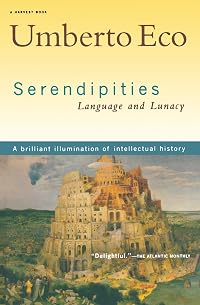
Umberto Eco was born in Alessandria, Italy on January 5, 1932. He received a doctorate of philosophy from the University of Turin in 1954. His first book, Il Problema Estetico in San Tommaso, was an extension of his doctoral thesis on St. Thomas Aquinas and was published in 1956. His first novel, The Name of the Rose, was published in 1980 and won show more the Premio Strega and the Premio Anghiar awards in 1981. In 1986, it was adapted into a movie starring Sean Connery. His other works include Foucault's Pendulum, The Island of the Day Before, Baudolino, The Prague Cemetery, and Numero Zero. He also wrote children's books and more than 20 nonfiction books including Serendipities: Language and Lunacy. He taught philosophy and then semiotics at the University of Bologna. He also wrote weekly columns on popular culture and politics for L'Espresso. He died from cancer on February 19, 2016 at the age of 84. (Bowker Author Biography) show less
Some Editions
Series
Belongs to Publisher Series
Work Relationships
Is contained in
Common Knowledge
- Canonical title
- How to Travel with a Salmon and Other Essays
- Original title
- Il secondo diario minimo
- Alternate titles*
- Omgekeerde wereld : kleine kroniek
- Original publication date
- 1992
- First words
- Between 1959 and 1961 I was responsible for a regular column entitled "Diario minimo" in the literary magazine Il Verri, edited by Luciano Anceschi.
According to the newspapers, there are two main problems besetting the modern world: the invasion of the computer, and the alarming expansion of the Third World. - Quotations*
- (...) De bezoeker komt binnen en zegt: 'Wat een hoop boeken! Heeft u die allemaal gelezen?' Aanvankelijk dacht ik dat je aan deze woorden uitsluitend mensen kon herkennen die niet zo vertrouwd zijn met het boek en slechts gew... (show all)end zijn aan een paar plankjes met vijf detectives en een meerdelige jeugdencyclopedie. Maar de ervaring heeft me geleerd dat ook mensen van wie je dat helemaal niet vermoedt dergelijke dingen zeggen. Wel kan gezegd worden dat het altijd gaat om mensen die een boekenplank beschouwen als een opbergplek voor gelezen boeken en die een bibliotheek niet beschouwen als een onontbeerlijk hulpmiddel bij het werk, maar daarmee zijn we er nog niet. Volgens mij raakt iedereen bij het zien van veel boeken vervuld van een angstig ontzag voor kennis en glijdt onherroepelijk af naar bovengenoemde vraag, waarin zijn gekweldheid en zijn schuldbewustzijn tot uitdrukking komen. ('Hoe rechtvaardig je je eigen bibliotheek', p.106-107)
- Last words
- (Click to show. Warning: May contain spoilers.)Baudolino performs another miracle: convincing a credulous Lanobard that miracles are rare merchandise. 1965-90
- Original language
- Italian
*Some information comes from Common Knowledge in other languages. Click "Edit" for more information.
Classifications
Statistics
- Members
- 2,568
- Popularity
- 7,446
- Reviews
- 20
- Rating
- (3.66)
- Languages
- 22 — Bulgarian, Catalan, Czech, Danish, Dutch, English, Finnish, French, German, Greek, Hebrew, Italian, Korean, Norwegian (Bokmål), Norwegian, Polish, Portuguese, Russian, Serbian, Spanish, Swedish, Turkish
- Media
- Paper, Audiobook, Ebook
- ISBNs
- 59
- ASINs
- 26